
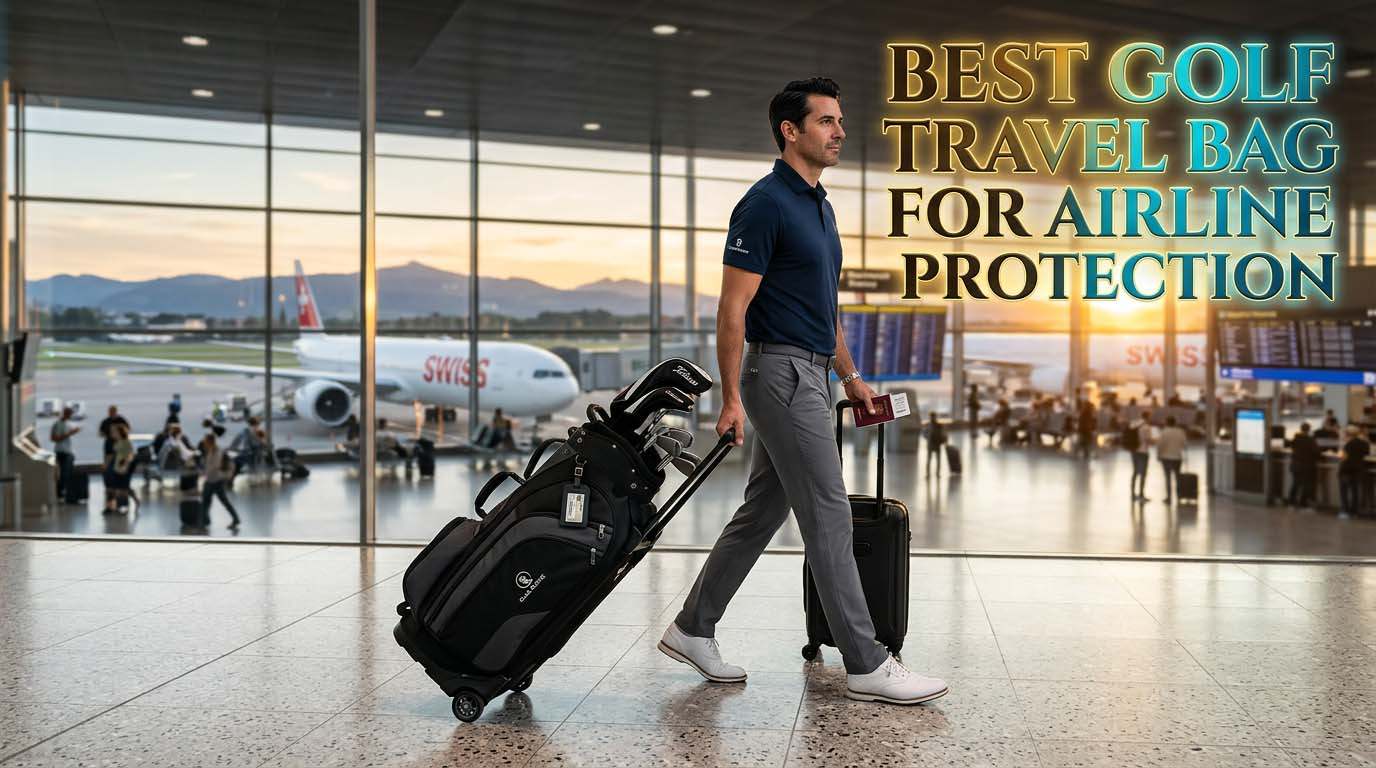
Let’s not sugarcoat it. Your golf clubs are going to get thrown. The airline baggage handlers aren’t malicious, they’re just moving three hundred bags an hour through a steel maze of conveyor belts and cargo holds. Your $600 driver doesn’t stand a chance inside a flimsy nylon sack.
I’ve watched a brand-new set of Titleist irons get unloaded with the club head of a 4-iron bent at a forty-five-degree angle. The owner was holding the broken shaft and staring at the tarmac as he’d just watched his dog get hit by a truck. That moment is avoidable. Completely avoidable.
The core question is simple: do you need a tank-like hard case, or will a premium soft bag with a rigid top get the job done? The answer depends on how much you care about your equipment and how often you fly.
But if you want the short version, the best golf travel bag for airline protection in 2026 is the SKB Staff ATA Hard Shell Case. It’s overkill for the casual golfer and exactly right for everyone else.
Below, I’ve broken down every option into three clear tiers of protection. No fluff. No fifteen-item lists where you can’t tell the difference between a $40 bag and a $400 bag. Just the honest breakdown of what works, what doesn’t, and why.
Your Quick-Reference Top Picks for Airline Protection
If you’re in a rush, here’s the cheat sheet. I’ll go deep on each one in the sections below.


Are Soft Golf Travel Bags Safe for Airline Travel? The Honest Truth
I get this question all the time from buddies who think they can save a few bucks. The short answer is: it depends on what you’re protecting and how much risk you’re willing to accept.
Soft bags fail in two specific ways. First is crush damage. When a suitcase full of dirty laundry or a heavy duffel bag gets stacked on top of your travel bag, the soft sides compress. If that weight lands on the club heads, something bends or snaps.
The second failure point is abrasion. Those conveyor belts and luggage carousels are basically industrial sandpaper wrapped in rubber. I’ve seen soft cases with holes worn clean through the fabric after a single trip.
You’ll hear a lot of people recommend the “Stiff Arm,” that plastic or aluminum pole that extends above the club heads inside the bag. It helps with vertical compression, no question. But it does almost nothing for side-impact. If a bag gets dropped on its side or another bag slams into it, that pole isn’t saving your shafts.
So who should buy a soft bag? The casual golfer who flies once a year. The person who drives to local courses and only needs protection from the occasional rain. And the golfer who wraps every iron head in three towels and packs their bag like they’re shipping Fabergé eggs.
If that sounds like you, a premium soft bag can work. But if you own clubs worth several thousand dollars and you fly more than twice a year, a hard case is the only honest recommendation I can give you.
The 3 Best Hard Cases for Airline Protection
1. SKB Staff ATA Hard Shell Case
Spec Check: Material: Impact-resistant polyethylene. Interior: 48.75″L x 11.13″W x 14.25″D (bottom), 11.75″D (top). Weight: 15.71 lbs. Latching: TSA locking latches. Wheels: 2 wheels. Exterior: 50.5″ x 13″ x 15.5″.
This is the gold standard. The SKB Staff ATA is built to a specification called “ATA” — Air Transport Association rating.
That’s not a marketing term. It means this case has passed vibration tests, drop tests, and edge-impact tests that simulate the worst of air travel. It’s the same standard used for military shipping containers and sensitive medical equipment.
I’ve owned one of these for about four years now. On my first trip with it, I flew from Chicago to Palm Springs with a connection in Denver. I had the case packed decently — not perfectly, but good enough.
When I picked it up at baggage claim, I saw a set of black scuff marks on one corner, as if someone had dragged it across a concrete floor. But the case itself? No dents. No cracks. No signs of structural stress. Inside, my clubs were exactly where I left them.
The polyethylene shell is the star here. It’s not brittle like ABS plastic. It flexes under impact and bounces back. I’ve seen videos online of people jumping on these cases to show how tough they are, and honestly, I don’t doubt them.
The TSA latch system is also a huge plus; you set your own combination, and the latches are metal-reinforced. They won’t pop open if the case gets tossed around.
That said, there are compromises. The wheels are functional, but they’re not the smooth-gliding spinner wheels you’d find on a premium suitcase. In a busy airport terminal, you feel the weight. It’s not terrible, but if you’re weaving through crowds, it’s not graceful either.
The interior is also one big empty box. You’ll need to use towels or bubble wrap to keep everything from sliding around inside. Some people see that as a downside. I see it as a blank canvas; you pack it however you want.
Who it’s for: The protection-first golfer. The guy who flies twice a year with a bag worth more than his car. The person who wants to never think about whether their clubs survived the flight.
Who it’s not for: The infrequent flyer who wants something lightweight and easy to store. If you’re only going to fly once with your clubs, this might be more than you need.
2. Samsonite Tour Deluxe Golf Hard Case
Spec Check: Material: ABS Plastic. Interior: Holds clubs up to 48″ and bags up to 10.5″ wide. Weight: 14 lbs. Wheels: 4 multi-directional spinner wheels. Interior padding: Built-in quilted padding with foam top cushion.
If the SKB is a military-grade tank, the Samsonite Tour Deluxe is a nice commuter car. It’s lighter, it’s more maneuverable, and it comes with a padded interior that the SKB lacks. But it’s not built to the same standard.
The first thing you notice with this case is the wheels. Four 360-degree spinner wheels make a massive difference in an airport. You can push it alongside you like a piece of luggage, and it glides over tile and carpet without resistance.
After wrestling the SKB through a terminal, switching to the Samsonite feels like going from a shopping cart with a stuck wheel to one that rolls perfectly.
The quilted interior is another win. You open the case, and there’s soft padding lining the inside. It’s not thick enough to stop a heavy impact from crushing the shell, but it does a solid job of absorbing minor bumps and preventing your clubs from rattling around. The internal compression straps also help keep the golf bag from shifting during transit.
Now for the honest weakness. The shell is made from ABS plastic. It’s a hard plastic, sure, but it’s more brittle than the SKB’s polyethylene. If this case takes a direct drop from a four-foot conveyor belt onto a hard floor, I’d be nervous.
I’ve seen ABS crack under stress. It’s not a matter of if it can happen; it’s a matter of when. The latches also feel less substantial than the SKB’s. They’re functional, but I wouldn’t trust them after five or six years of heavy use.
Who it’s for: The golfer who wants a hard case but doesn’t want to spend too much. The infrequent flyer who goes on one golf trip a year and wants reliable, easy-to-use protection.
Who it’s not for: The frequent traveler. If you’re flying four or more times a year with this case, I think you’ll be replacing it within two seasons.
3. Sturdum Hard Case with TSA Lock
Spec Check: Material: ABS Plastic. Interior: Fits clubs up to 48″. Weight: Not specified but feels comparable to the Samsonite. Wheels: 4 wheels, removable. Security: Built-in TSA combination lock.
Sturdum is a newer name in the golf travel game, and that makes me a little cautious by nature. The specs look great on paper, and the fact that it comes with a built-in TSA combination lock is a nice convenience; you don’t have to buy a separate padlock like you would with the SKB. The lock is integrated into the case, so you can’t lose it.
The removable wheels are another thoughtful touch. After a couple of years, travel bag wheels tend to wear out. Being able to swap them without replacing the whole case is a practical feature that most manufacturers ignore.
But here’s where I’m on the fence. This is still an ABS shell, which means it has the same vulnerability as the Samsonite when it comes to hard impacts.
And because Sturdum is a newer brand with a limited track record, I can’t point to years of user feedback to tell you whether the handle mechanism holds up or the latches start slipping after a year. That’s not a deal-breaker; every brand has to start somewhere. But it does mean you’re taking a calculated risk.
Who it’s for: The bargain hunter who wants a hard case with modern features like spinner wheels and a built-in lock. The golfer who’s willing to gamble on a newer brand in exchange for better value.
Who it’s not for: The protection-obsessed traveler. If you absolutely cannot afford to have a case fail, stick with the established brands.
The Premium Hybrid and Soft Case Solutions
Not everyone wants a hard case. Some people prioritize easy airport navigation, lightweight packing, or compact storage. These next three options represent the best of the soft case world and the hybrid designs that try to bridge the gap.
4. Sun Mountain ClubGlider Meridian
Spec Check: Material: Ballistic-style nylon. Weight: 11.3 lbs. Dimensions: 52″ x 14″ x 14″. Wheels: 4-wheel retractable-leg system. Pockets: 2.
If I had to fly every week for work and take my clubs, this is probably the bag I’d choose. The ClubGlider Meridian solved a problem nobody else in the industry had addressed: airport navigation.
The four-wheel rolling system keeps the bag upright and balanced, and the retractable-leg design means the bag glides like a premium carry-on suitcase, not like a drunk person dragging a broken suitcase.
I tested this bag on a trip from New York to Orlando. From the curb to the check-in counter to the gate, it was shockingly easy to manage.
You don’t lean it at an angle. You just push it alongside you. The wheels are large enough to handle carpet, tile, and even those rubber transition mats between different terminal floors.
The protection is good but not great. The ballistic nylon fabric is thick and puncture-resistant. The foam padding provides a decent level of impact absorption. But it’s still a soft bag at the end of the day.
If a heavy suitcase falls on it from a few feet up, the clubs are going to feel that impact. The top section is reinforced, but the sides are still vulnerable.
Who it’s for: The frequent business traveler who values maneuverability over brute-force protection. The golfer who connects through multiple airports and wants to move quickly.
Who it’s not for: The golfer checking their clubs onto a regional airline that throws bags around. If you’re flying on a smaller carrier with a reputation for rough handling, take a hard case.
5. Golfimate Travel Bag with Carbon Fiber Hard Top
Spec Check: Material: 1680D Oxford fabric with carbon fiber hard top. Weight: 9.6 lbs. Dimensions: 53″ x 15″ x 11″. Wheels: All-terrain oversized wheels. Interior: Fits full-size bags up to 12.5″ diameter.
The Golfimate takes a smart approach. It protects the most vulnerable part of your golf bag, the club heads, with a carbon fiber hard top.
That’s where most broken shafts happen, right at the junction of the head and the shaft. By keeping that area rigid, this bag eliminates the most common failure point of soft cases.
The rest of the bag is 1680D Oxford fabric, which is the same heavy-duty material used in high-end duffel bags and tactical gear. It’s water-resistant, so you don’t have to worry about rain on the tarmac.
The oversized all-terrain wheels roll smoothly over rough surfaces, another thoughtful touch for travelers who park in long-term lots or walk across uneven pavement.
The honest weakness is that the soft sides are still soft. The hard top protects the heads, but the iron shafts and the bag body are still exposed. If something heavy lands sideways on this bag, the side panels will compress. It’s better than a fully soft case, but it’s not a hard case.
Who it’s for: The golfer who wants to upgrade from a pure soft bag without jumping to a full hard shell. The occasional traveler who wants peace of mind for the one part of the bag that matters most.
Who it’s not for: The high-volume flyer. If you’re on a plane every month with clubs, the side panels will wear out faster than you’d like.
6. Club Glove College Traveler
Spec Check: Material: 1000 Denier nylon. Weight: Not specified but very light. Wheels: Rugged wheels. Zippers: Premium YKK. Buckles: ITW Nexus.
The College Traveler is the absolute minimum viable product for airline travel. It’s not a bad bag, Club Glove makes excellent products, and the hardware here (YKK zippers, ITW Nexus buckles) is genuinely high-end. But this is the stripped-down, budget version of their legendary Pro Traveler.
The most obvious difference is the padding. There’s very little of it. You need to pack this bag carefully, wrapping each club head in a towel and using a Stiff Arm to keep the driver from taking the full force of any compression. The water-resistant 1000 Denier nylon is durable enough to hold up to handling, but it’s not puncture-proof.
I’d recommend this bag to a specific type of traveler: the “I only fly once a year, and I’m willing to wrap my clubs in towels” golfer.
Or a junior golfer whose clubs aren’t worth thousands yet. For that use case, it’s a great deal. But if you hand this to an airline baggage handler with an unprotected set of expensive clubs, you’re gambling.
Who it’s for: The budget-conscious traveler who already owns a Stiff Arm and doesn’t mind spending time packing carefully. The parent buying a travel bag for a teenager or a high school golfer.
Who it’s not for: Anyone carrying clubs worth more than a few hundred dollars. If you can afford to lose a club, you can afford this bag. If you can’t, buy a hard case.
Comparison Table: Hard Case vs. Premium Soft Case
Here’s how the top contenders line up head-to-head.
| Feature | SKB Staff ATA (Hard) | Sun Mountain ClubGlider (Soft) |
|---|---|---|
| Crush Protection | Excellent (ATA-Rated) | Moderate (Good for top/sides) |
| Weight | 15.71 lbs | 11.3 lbs |
| Maneuverability | Good (2 wheels) | Excellent (4-wheel glider) |
| Security | Very High (TSA Latch) | High (Zippers) |
| Storage (when not used) | Bulky / Hard to store | Folds down / Packs flat |
| Best For | Maximum safety | Frequent, comfortable travel |
How to Pack a Golf Travel Bag for Maximum Protection
Even the best case in the world won’t save your clubs if you pack them wrong. Here’s what I’ve learned from years of making mistakes.
The “Umbrella Trick” I swear by: Never check a bag without first opening a large umbrella and placing it inside the bag on top of the club heads. That umbrella acts as a sacrificial barrier. If something heavy lands on the bag, the umbrella frame absorbs the impact before it transfers to your driver. It’s saved me at least twice.
Remove the heads. If your driver and fairway woods have removable heads, take them off. Wrap each one separately in a towel and put them in one of the bag’s accessory pockets. This removes the stress from the shaft-hosel connection entirely. It’s the single best thing you can do to prevent broken shafts.
The towel wrap method. Don’t use bubble wrap. Airport security hates it, and they might open your bag to inspect it, leaving a mess. Use bath towels. Wrap each iron head individually. Wrap a towel around the center of the shaft bundle.
Fill space in the bag with more towels or soft clothing. The goal is to prevent any movement inside the case.
Reverse the bag orientation. Put the golf bag into the travel case with the club heads facing down, toward the wheels. This puts the strongest part of the golf club, the shaft tip, in the direction of impact. It reduces stress on the shafts and makes it harder for a heavy blow to snap them at the hosel.
The Final Verdict: What Should You Buy?
Here’s the decision engine, stripped of all the fluff.
- If you fly 4+ times a year: SKB Staff ATA. No debate. It’s the only case I fully trust for high-volume travel.
- If you fly 1-3 times a year and want easy travel: Sun Mountain ClubGlider Meridian. You’ll love the airport experience, and the protection is good enough for occasional trips.
- If you fly once every 3 years and are on a strict budget: Samsonite Tour Deluxe or Sturdum. Either one will work for the occasional trip as long as you pack carefully.
- If you absolutely loathe the idea of picking up a heavy case: Golfimate. It’s the lightest option that still offers meaningful protection for the club heads.
- If you need a bare-bones starter bag for a junior or a one-off trip: Club Glove College Traveler. Just don’t expect it to survive heavy abuse.
Your clubs are an investment. The right travel bag isn’t an expense — it’s insurance. Buy the one that matches your risk tolerance and your travel frequency. Your driver will thank you.
Frequently Asked Questions
Can I check a hard golf case on any airline?
Most major airlines accept hard-sided golf travel cases as standard checked luggage. However, it’s always smart to confirm size and weight limits with your specific airline before booking.
Some low-cost carriers have stricter size restrictions or charge oversized baggage fees. The SKB Staff ATA, for example, falls within the standard dimensions for most airlines, but a few regional carriers may flag it as oversized.
Is a hard case or soft case better for protecting golf clubs on a plane?
A hard case provides significantly better protection against crush damage and side impacts. Soft cases are more convenient to store and transport through airports but offer less structural protection.
If you’re flying with expensive clubs, a hard case is the safer choice. If you fly rarely and pack carefully, a high-quality soft case can work.
How do I prevent my driver shaft from breaking during air travel?
Two things: remove the driver head if it’s adjustable, and use a Stiff Arm or similar support rod that extends above the club heads. Also, pack your bag with the club heads pointing toward the wheels of the travel case.
This places the shaft tip, the strongest point, toward the direction of potential impact. Wrapping each head individually in a towel also helps absorb shock.
Do TSA-approved locks interfere with golf travel bag inspection?
No. TSA-approved locks allow security screeners to open the case without damaging the lock. If your hard case has an integrated TSA lock system, it’s even easier for them to inspect without breaking anything. The SKB Staff ATA and Sturdum both feature TSA-compatible locking systems that make the process smooth.