

If you own a stand bag and you’ve ever strapped it onto a trolley, you already know the drill. You get to the first tee, take a practice swing, and hear it, that horrible scraping sound of the bag rotating on the frame.
By the third hole, the legs have deployed twice, your clubs are rattling sideways, and you’re seriously considering just carrying the thing. I’ve been there more times than I care to count.
The problem isn’t you. It’s the trolley. Most push carts are built for cart bags, flat bottoms, rigid bases, zero protruding parts. Stand bags have curved bottoms, retractable legs that stick out at awkward angles, and a center of gravity that shifts the moment you start walking.
The best golf trolley for stand bag owners isn’t just any trolley. It’s one that actually accounts for that weird geometry and locks the bag in place instead of fighting it. After testing five different models with a couple of stand bags, here’s what I found works, actually, and what doesn’t.



The Stand Bag Problem: Why Your Current Trolley Drives You Crazy
Before we get into the specific trolleys, it’s worth understanding why stand bags and trolleys don’t get along. It’s not bad luck. It’s physics.
A stand bag has two pieces of hardware that most cart bags don’t: a hinged leg mechanism and a curved base designed to sit comfortably on your back. When you strap that onto a standard trolley cradle, the legs create a fulcrum. The bag wants to pivot around that point.
Every bump, every turn, every slight incline encourages the bag to rotate. And if the lower strap isn’t positioned perfectly, or if the trolley’s cradle has any give, the legs will eventually catch on something and deploy mid-round. I’ve had it happen while walking down a fairway.
Suddenly, your bag is standing up on its own while you’re holding the handle of a now-empty trolley.
So when I tested these five trolleys, I wasn’t looking for general “is this a good cart?” qualities. I was specifically evaluating three things:
- Stand Bag Security: Does the bag stay put without twisting or rotating, even over uneven ground?
- Ease of Setup: How quickly can you get the bag on and off without wrestling with straps?
- Leg Control: Does the trolley help keep the stand bag’s legs retracted, or does it fight against them?
Everything else- storage, foldability, weight- matters, but it’s secondary. If the bag doesn’t stay secure, nothing else matters.
5 Best Golf Trolleys for Stand Bag That Actually Work with Stand Bags
Here are the five trolleys I tested, ranked from the one that handles stand bags best to the one that just kinda gets by. I’ve been honest about the limitations on each, because there’s no perfect solution, just the one that fits your priorities.
1. Bag Boy Nitron – The Premium “Set & Forget” Solution
Key Specs: Weight: ~16 lbs (7.25 kg) | Material: Aluminum | Folded Dimensions: 23.2 x 16.1 x 12.6 inches | Auto-open mechanism | Bungee strap system | Scorecard console with drink/phone holders
The Nitron is the only trolley I tested that feels like it was designed by someone who actually tried strapping a stand bag to a regular cart and got frustrated.
The auto-open feature is the headline grabber; you press a button and the frame springs open on its own, but that’s not why it wins here. The key is the bungee strap system on the lower cradle.
Most trolleys use rigid plastic brackets or simple nylon straps that sit below the bag. The Nitron uses adjustable bungee hooks that you can position to wrap around the stand bag’s legs.
This does two things: it prevents the legs from deploying, and it stops the bag from rotating because the bungees hold tension from multiple directions. I tested it with a TaylorMade FlexTech stand bag, which has a notoriously awkward base, and the Nitron held it rock solid over 18 holes with hills and rough cart paths. Not a single twist.
The extra-large accessory bag under the scorecard console is a nice bonus for stand bag users, because let’s be honest, stand bags don’t have much storage. You can keep extra balls, gloves, and a rain suit down there without cluttering your bag.
The trade-off: It’s heavy. The shipping weight is over 21 lbs, and even the trolley itself feels substantial. If you’re lifting it in and out of a trunk multiple times a week, you’ll notice it.
It’s also expensive, easily the priciest option here. And the auto-open mechanism, while cool, adds complexity. If something breaks, you’re not fixing it with a wrench.
Who it’s for: The golfer who wants the most secure stand bag experience available and doesn’t mind paying for it or carrying a bit of extra weight. If you’re done fiddling and just want it to work, this is the one.
2. Motocaddy Cube – The Best Value for Stand Bag Users
Key Specs: Weight: ~15 lbs | Material: Aluminum | Folded Dimensions: 22 x 14.3 x 11.8 inches | 2-step fold | Adjustable ergonomic handle | Quick-release wheels | Parking brake
The Cube surprised me. On paper, it looks simple, almost too simple. But sometimes simple is exactly what you need with a stand bag.
The frame is rigid aluminum with a flat base and adjustable lower bag support hooks. There’s no curved cradle trying to accommodate the bag’s shape, just a flat platform and hooks that you position yourself.
That’s actually an advantage. With the curved cradles on many trolleys, the stand bag’s legs sit at an awkward angle and create pressure points. The Cube lets you cinch the bag down tight at the exact spot that works for your bag’s geometry.
I set it up with a Ping Hoofer, which has a pretty pronounced leg mechanism, and it took me about 90 seconds to find the right hook position.
Once I did, the bag didn’t budge. The 2-step fold is genuinely fast; you’re done in about 10 seconds, and the folded size is compact enough for a small trunk.
The trade-off: Storage is minimal. You get a scorecard holder, a drink holder, and one small compartment. If you carry a lot of accessories, a rangefinder, extra gloves, snacks, and rain gear, you’ll run out of room fast.
The handle is comfortable but not padded as generously as the Nitron’s. And on very bumpy terrain, I noticed the bag would shift slightly if I didn’t have the lower hooks tight enough. It never fully rotated, but I had to re-tighten once during a round.
Who it’s for: The budget-conscious golfer who wants a lightweight, reliable trolley that handles a stand bag without fuss. You trade some storage and a bit of luxury for a great price and solid performance.
3. Big Max Blade IP 2 – The Ultra-Compact Specialist
Key Specs: Weight: 13.6 lbs | Material: Aluminum and PU | Folded Dimensions: 34.6 x 24.4 x 4.9 inches (ultra-flat) | FlatFold mechanism | Dual foot brake | XL organizer panel
The Blade IP 2 is a marvel of engineering for storage. It folds down to just under 5 inches thick, flat enough to slide behind a car seat or stack against a wall with barely any footprint.
For stand bag users who also carry their bag sometimes, that’s a huge deal. You can keep this thing in your trunk full-time and barely notice it’s there.
It’s also lightweight at 13.6 lbs, which makes it the lightest option here. The XL organizer panel is genuinely useful; there are dedicated pockets for balls, gloves, phone, and valuables, which helps compensate for the limited storage on a stand bag itself.
But here’s where it gets tricky for stand bag owners: The cradle design on the Blade IP 2 is more specific than on the Nitron or Cube. The bag sits higher on the frame, which changes the balance point. With a stand bag, the curved base and protruding legs make it harder to find a stable position.
I spent a good five minutes on my first setup trying to get the bag to sit level without the legs catching on the lower bracket.
Once I found the sweet spot, it held fine for a front-nine walk. But I had to re-adjust at the turn because the bag had shifted slightly. It’s not a dealbreaker; it’s more fiddly than the top two. The dual foot brake is also a bit awkward to use compared to a single pedal system.
Who it’s for: The golfer with a small car trunk or who prioritizes ultra-slim storage above all else. If you’re willing to spend a few extra minutes dialing in the bag position, the payoff is a trolley that disappears when folded.
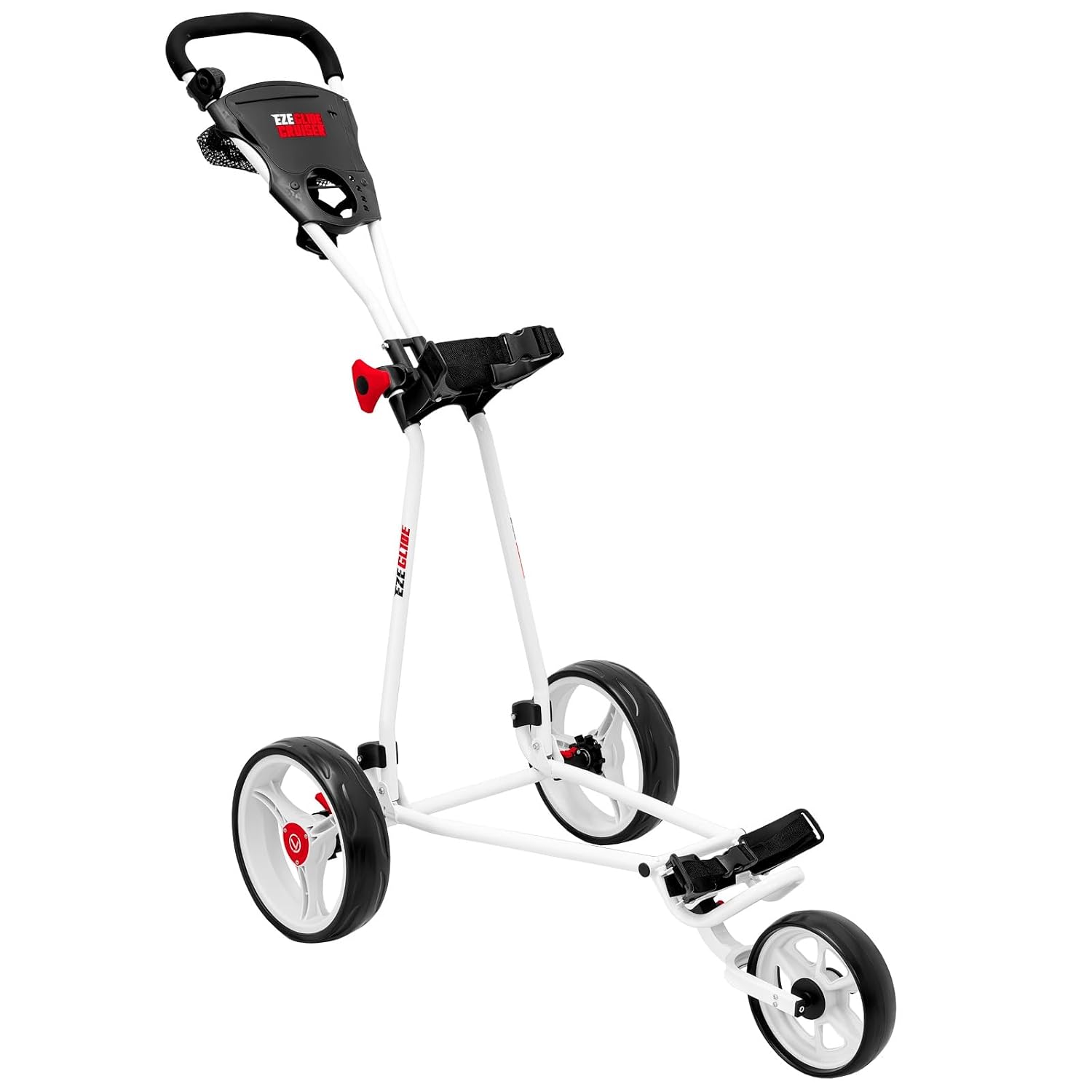
4. EZE Glide Cruiser – The Simple, Reliable Budget Pick
Key Specs: Weight: ~15 lbs (6.8 kg) | Material: Nylon frame | Folded Dimensions: 27.95 x 18.9 x 9.25 inches | Two-stage fold | Adjustable handle height | Nylon bag brackets | Foot brake
The Cruiser is the trolley you buy when you need something that works, and you don’t want to spend a lot. It’s not fancy. The frame is nylon instead of aluminum, the wheels look basic, and the fold mechanism feels a little clunky compared to the smooth actions on the Cube or Nitron.
But for stand bag security, it’s better than I expected. The nylon bag brackets are wide and flexible, which means they can accommodate the curved bottom of a stand bag better than rigid plastic cradles.
The brackets grip the bag without creating pressure points, and the wide stance helps distribute the weight evenly.
I used it with an older Sun Mountain stand bag that has fairly aggressive leg deployment, and the Cruiser kept it from twisting through most of a round. Not perfectly; I did have one moment on a steep downhill where the bag shifted sideways, but for the price, it’s respectable.
The trade-off: It feels cheap. The handle isn’t as ergonomic as the others, the foot brake is basic, and the two-stage fold is functional but not elegant. The nylon frame flexes a bit under heavier loads, which doesn’t inspire confidence.
It’s a functional trolley, not a joy to use. And the “25 pockets” listed in the specs is misleading; it includes things like mesh slots and small sleeves that aren’t actually useful pockets.
Who it’s for: The golfer on a strict budget who just needs to get the bag around the course without breaking the bank. It works, but don’t expect refinement. If you can stretch your budget, the Motocaddy Cube is a much better investment.
5. PowaKaddy Micra Cube – The “It’s Okay” Option
Key Specs: Weight: ~16.5 lbs (7.5 kg) | Material: Metal | Adjustable handle (left/right) | Quick-release wheels | Key lock system | Strong adjustable straps | Water-resistant phone storage
The Micra Cube is a fine trolley. It’s just not a stand bag trolley in the way the top three are. It feels like it was designed as a general-purpose push cart, and stand bag compatibility was an afterthought.
The lower support is a simple adjustable strap system, but the cradle itself has a bit of flex. When I strapped a stand bag onto it, I noticed the bag would tilt slightly to one side because the lower strap didn’t have a secure anchor point; it just looped around the bag and hooked back onto itself. On flat ground, it was fine.
On hills, especially side slopes, the bag would gradually shift. By the end of nine holes, I had to readjust twice.
To be fair, the adjustable handle is genuinely useful. I’m left-handed, and being able to flip the handle orientation was a nice touch. The key lock system is also unique; you can lock the trolley to a post or rack if you’re worried about theft. And the compact fold is decent, though not as flat as the Big Max.
The trade-off: Inconsistent stand bag security. Some rounds it held fine, others it didn’t. The storage is minimal, and the build quality doesn’t feel as solid as the Motocaddy Cube (which is in a similar price range). The 30 reviews with a middling score reflect that inconsistency.
Who it’s for: A golfer who already owns a PowaKaddy bag and wants brand consistency, or someone who finds a great deal and is willing to fuss with strap positioning. If stand bag security is your top priority, skip this one.
How to Secure Your Stand Bag on Any Trolley? (Pro Tips)
Even with the right trolley, a stand bag needs a bit of extra attention. Here are three tricks I’ve learned that make a noticeable difference, regardless of which trolley you choose.
Tip 1: Lock the legs together. Most stand bags have two legs that deploy independently. If you use a bungee cord or even a spare shoelace to tie the legs together near the hinge point, they can’t deploy.
It takes five seconds and makes a huge difference. Some trolleys (like the Nitron) have bungee hooks that do this naturally. If yours doesn’t, add your own.
Tip 2: Strap strategy matters. The upper strap should go around the bag’s carry handle; that’s the strongest attachment point.
The lower strap should go around the bag’s base, just above the leg mechanism, not around the legs themselves. If you strap the legs directly, you create a pivot point. Strap the body of the bag, and let the legs sit naturally against the trolley frame.
Tip 3: The honest reality check. I’m going to say something you might not want to hear. If you’re constantly frustrated with your stand bag on a trolley, if nothing seems to work, the simplest solution is to buy a cheap cart bag for the trolley and keep your stand bag for the driving range or occasional carry rounds.
A basic cart bag costs much less than a premium trolley, and it will sit perfectly on any push cart. It’s not glamorous, but it’s practical. I know a few golfers who do this, and they’ve never looked back.
Final Verdict: Which One Should You Buy?
After testing all five, here’s where I land.
If you want the absolute best experience with a stand bag- zero fuss, zero rotation, just strap it on and walk- get the Bag Boy Nitron. It’s the only trolley I tested that feels purpose-built for this specific problem. Yes, it’s heavy and expensive. But it works, and it works consistently.
If you want the best value and you’re not trying to spend premium money, the Motocaddy Cube is your pick.
It’s lightweight, folds quickly, and the adjustable lower hooks do a surprisingly good job of securing a stand bag. You lose some storage and a bit of refinement, but you save a significant amount.
If your trunk is tiny and storage space is your #1 priority, the Big Max Blade IP 2 is worth the extra setup time. It folds impossibly flat, and the organizer panel helps make up for your stand bag’s lack of pockets. Just be prepared to spend a few minutes dialing in the bag position.
If you’re on a tight budget, the EZE Glide Cruiser will get you through a round. It’s not refined, it doesn’t feel premium, and the bag security is just okay. But it’s cheap, and it works well enough for flat courses.
And if you’re considering the PowaKaddy Micra Cube, test it first if you can. It’s a decent general trolley, but for stand bag owners, there are better options at the same price point.
Frequently Asked Questions
Can I use any stand bag with a trolley?
Technically, yes, but not all combinations work well. Stand bags with aggressive leg deployment, where the legs spring out forcefully when the bag is set down, are harder to secure.
Bags with a flatter base and less pronounced leg mechanism are easier. If your bag has a wide leg spread, look for a trolley with adjustable lower supports like the Bag Boy Nitron or Motocaddy Cube.
Will a stand bag damage a trolley over time?
Not typically, but the protruding legs can scratch or wear down the cradle material on some trolleys. The nylon brackets on the EZE Glide Cruiser are more resistant to this than the painted aluminum on some models. Using a small piece of adhesive felt on the contact points can prevent any wear.
Should I buy a separate cart bag instead of using my stand bag?
If you walk most rounds and use a trolley regularly, a dedicated cart bag is the simpler solution. Cart bags have flat bottoms, no leg mechanism, and more storage. They sit on any trolley without fuss.
But if you also carry your bag sometimes, for range sessions, quick nine-hole rounds, or travel, keeping the stand bag makes sense, as long as you pair it with a trolley that handles it well.
How important is the lower strap position for a stand bag?
It’s the single most important factor. The lower strap needs to sit above the leg mechanism, cinching the bag body to the trolley frame. If the strap sits below or directly on the legs, the bag will pivot, and the legs may deploy.
Most trolleys have fixed lower strap positions, which is why adjustable ones, like on the Motocaddy Cube or Bag Boy Nitron, perform better with stand bags.
Do electric trolleys work better with stand bags than push trolleys?
It depends on the cradle design. Some electric trolleys have deeper, more secure cradles that can accommodate stand bags better than basic push trolleys.
But the same principles apply: adjustable lower supports and bungee-style straps make the biggest difference. If you’re considering an electric trolley for a stand bag, look for those features specifically.