
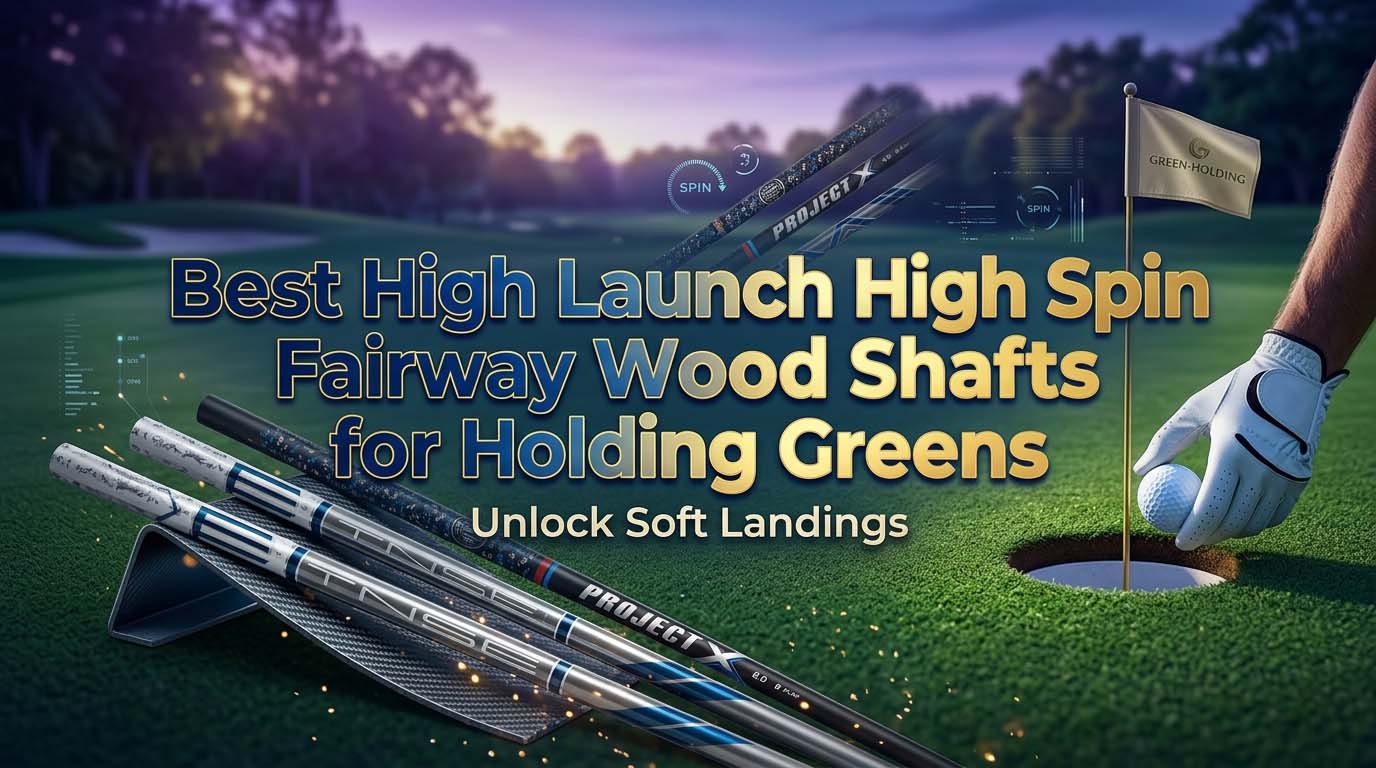
Holding greens with a fairway wood is one of the hardest shots in golf. You need a specific trajectory: high apex, steep descent angle. A standard low-spin shaft will make that shot nearly impossible. You swing well, you make solid contact, and yet the ball still bounds through the putting surface and off the back fringe. It’s maddening, and I’ve been there more times than I care to count.
If you’ve been hunting for the best high launch high spin fairway wood shafts for holding greens, you’ve probably noticed most reviews focus on pure distance and smash factor. We aren’t doing that here. The goal isn’t to overpower the hole; it’s to drop the ball on it and watch it stop. I tested the three most promising models from TRUE TEMPER to find the shaft that actually delivers on that promise without feeling like a wet noodle.
Stop looking for the stiffest, lowest torque shaft you can find. For this job, you need a shaft that helps you launch the ball high and spin it soft. Here are the shafts that actually do that.


Why You Need a High Launch, High Spin Fairway Shaft
Before I explain which shaft wins, it helps to understand why this specific profile matters for the guy trying to hold greens. If you just want the list, the top picks above have you covered. But if you want to understand what your swing is doing and why the right shaft matters, stick with me.
The Physics of Holding a Green
Fairway woods naturally spin less than irons. The longer shaft and lower static loft create a flatter delivery into the ball, which produces lower spin rates. Low spin is fantastic for roll-out distance on a driver, but it’s a nightmare for stopping on a green. You need that ball to climb high, stall, and descend steeply. A high-spin shaft works with the clubhead to generate that quick lift. Without it, you are relying entirely on a bump-and-run or a perfect bounce to stop the ball. That’s a losing bet.
The Trade-Off You Must Accept
Let’s be completely honest here. You will likely lose 5 to 10 yards of roll-out by switching to a high-spin fairway shaft. That is the whole point. You are trading pure distance for control and stopping power. If you never fly greens and you only care about maxing out your numbers on a launch monitor, this style of shaft isn’t for you. But if you are tired of standing on a par 5 green wondering why your best strike just scooted six feet past the pin, this is the trade you have to make. The peace of mind is worth more than those extra yards.
The Best High Launch High Spin Fairway Wood Shafts
Every shaft on this list earned its spot by doing one thing well: helping the ball climb and drop quickly. I tested all three in actual fairway woods on real courses, paying attention to feel, launch angle, and stopping power. Here’s how they stack up.
TRUE TEMPER Project X Denali Charcoal CB
The specs:
- Weight: 60g
- Flex: 5.5 (Regular), 6.0 (Stiff), 6.5 (X-Stiff)
- Length: 46 inches
- Adapter and grip included
The Denali Charcoal CB is the standout for the holding greens crowd. Unlike typical low-spin shafts that feel like rebar, the Denali uses a Counter-Balanced (CB) design that promotes a smoother transition through the hitting zone. The first time I hit a 5-wood with this shaft, I knew immediately it was different. The ball climbed. I mean really climbed. For a 60g shaft, it produces a surprising amount of spin without feeling loose or whippy.
You get this lively feel that just wants to work with you, not against you. Paired with a 5-wood or 7-wood, the Denali creates a desirable spinning feel that gives you the confidence to attack pins. You can actually aim for the front edge of the green and watch the ball settle instead of scoot. It is the best balance of feel and stopping power without breaking the bank.
Honest weakness: If you have a very aggressive transition, the snap loader swing type, it might feel a little soft for your taste. This is built for rhythm, not violence. It works best when you let the shaft do the work.
Project X LZ Graphite
The specs:
- Weight: 65g
- Flex: Stiff (6.0)
- Length: 46 inches
- No adapter included
The LZ, which stands for Load Zone, has a cult following for a reason. It is designed to load and unload smoothly, creating a high, majestic ball flight that is a dream for holding greens. I built a 7-wood with it, and the flight was pure high draw. It makes a golf fairway wood feel like a high-lofted hybrid. The ball doesn’t just fly; it soars. And then it drops. The spin rate is listed as mid, not high, but the launch angle is so steep that the ball still stops very quickly. It darts into the green.
This is the best option for players who want a pure high-draw flight. If you are a smooth swinger with a good tempo, the LZ will make you look like a hero. The transition is so fluid that you almost forget you are swinging a wood.
Honest weakness: The mid spin means it is slightly less forgiving for stopping power compared to the Denali, especially on hard, fast greens. You need a perfect strike to get the full stopping benefit. Also, it does not include an adapter, which adds cost and a trip to the clubfitter. Factor that in.
TRUE TEMPER Project X HZRDUS Smoke Black
The specs:
- Weight: 70g
- Flex: 5.5 (Regular), 6.0 (Stiff), 6.5 (X-Stiff)
- Length: 46 inches
- Adapter and grip included
Don’t let the Smoke name fool you. Most people play this shaft in a driver for low spin distance, but the Smoke Black model behaves very differently in a fairway wood. I played the HZRDUS Smoke Black in a 3-wood for a few rounds and it really opened my eyes. It’s a heavy shaft, no way around it. The 70g weight helps the steeper-faced fairway wood get the ball up, and the mid-high spin profile ensures the ball climbs and drops predictably.
It feels very stable. Less lively than the Denali, but more predictable under pressure. If you want to feel like you are swinging a well-balanced tool that provides authority, this is it. The weight also gives it a smooth tempo, which can help if you tend to get quick from the top.
Honest weakness: The weight can be tiring on the back nine. If your swing speed drops, launching the ball becomes harder and you lose the stopping power you are chasing. Also, be very careful when you order. The Smoke Black model is the high spin option. The Smoke Green and Smoke Yellow models are designed for distance and lower spin. Buy the wrong one and you will be disappointed.
How to Choose the Right Flex & Weight for Holding Greens
I have watched too many golfers buy a stiff shaft because they think it makes them play better. For holding greens, you want to launch the ball high, not drive it into the ground with a boring trajectory. A few simple guidelines will save you money and frustration.
Flex (Don’t Overflex)
A shaft that is too stiff will lower your launch angle. You will fight to get the ball in the air, and the spin rate will suffer. If you swing your fairway wood at 80 to 85 miles per hour, seriously consider a Regular (5.5) flex. It helps the head stay square longer and produces the spin you need. If you swing closer to 90, a Stiff (6.0) is the right call. Going harder than you need is the fastest way to kill your stopping power.
Weight (Light vs. Heavy)
Lighter shafts, specifically the 60g to 65g range, are the sweet spot for this use case. They help you generate clubhead speed, which directly translates to higher launch and more spin. The 60g Denali is the gold standard here. Heavier shafts like the 70g Smoke can offer stability and predictability, but they require more effort to generate the kinetic energy needed for a high spinning shot. If you are physically strong or play a shorter course, the weight can be an asset. For the typical mid-handicap golfer trying to hold greens, go lighter.
Final Verdict – Which One Stops the Ball?
You do not need the shaft that feels the stiffest in the store. You need the shaft that works with your club to produce a steep descent angle and soft landing. Every shaft here can help you hold greens, but one does it better than the others for the largest group of golfers.
The #1 Pick is the TRUE TEMPER Project X Denali Charcoal CB. It offers the best combination of accessible launch, thanks to that Counter-Balanced design, and genuine stopping spin at a fair price. It is the most playable high-spin shaft for the golfer who actually needs one. It doesn’t feel like a compromise. It feels like the right tool for the job.
The Splurge Pick is the Project X LZ for the smooth, rhythmic swinger who wants a pure, high-draw flight. It is a joy to swing, just be ready to deal with the adapter situation and accept that its stopping power is slightly behind the Denali.
The Stable Pick is the HZRDUS Smoke Black for the player who wants predictable authority and doesn’t mind the weight. Just make absolutely sure you buy the Black model and not the Green or Yellow.
Frequently Asked Questions
What makes a shaft high launch and high spin?
It refers to the shaft’s bending profile. A high launch shaft is designed to store energy and release it in a way that keeps the clubhead moving upward through impact, creating a steeper angle. High spin means the shaft helps the clubface stay square to the ball’s equator longer, generating more revolutions per minute. This combination creates a climbing ball that drops steeply on the green.
Will I lose distance with a high spin fairway shaft?
You will likely lose some roll-out distance, typically 5 to 10 yards. This is a trade-off, not a bug. You are exchanging raw distance for stopping control. If you play on tight fairways or struggle to hold greens, the control is worth far more than the extra yards of bounce.
What flex do I need if my swing speed is around 85 miles per hour?
For a swing speed of 80 to 85 mph in a fairway wood, a Regular flex (5.5) is usually the best choice. It allows the shaft to load properly and generate the launch angle and spin you need. Going to a Stiff flex (6.0) can lower the trajectory and defeat the purpose of this exercise. Only move to Stiff if you are swinging closer to 90 mph.
Do I need a special adapter for these shafts?
It depends on which shaft you choose. The Project X Denali Charcoal CB and the HZRDUS Smoke Black both come with a compatible adapter and grip included. The Project X LZ does not include an adapter, so you will need to purchase one separately or have a clubfitter install it. Always verify compatibility with your club head brand before ordering.
Can I use a driver shaft in my fairway wood instead?
You can, but it is rarely the best idea for holding greens. Driver shafts are typically designed for low spin and flat trajectories to maximize distance. A fairway wood needs a different profile to help the ball climb and stop. Using a driver shaft will likely make your rollout problem worse instead of fixing it. Spend the money on a dedicated fairway wood shaft.