
I’ve been hit by a golf ball before. Not a glancing blow off the shoulder — a full-on, mid-flight drive that caught me just above the cheekbone. I was lucky. The bruise was ugly, but my eye was fine. That moment changed how I think about sunglasses on the course. I used to grab whatever pair was in my car. Now I won’t step onto the first tee without something that can actually take a hit.
But here’s the thing about impact resistant golf sunglasses for golfers — they’re useless if they fog up on the third hole, slide off your face during a swing, or make it impossible to track your ball against a bright sky. I’ve tested six pairs over the last few months, wearing each one for multiple rounds in different conditions. Some surprised me. A couple disappointed me. One genuinely scared me. Here’s what I found.



What Makes a Golf Sunglass Truly Impact Resistant?
Before I get into the rankings, it helps to understand what you’re actually paying for. Not all “shatterproof” claims are equal, and the material inside the frame matters more than the brand name on the arm.
The Lens Material Hierarchy
There are three main lens materials you’ll see in sport sunglasses. Polycarbonate is the most common — it’s lightweight, cheap to produce, and naturally impact resistant. Most of the glasses I tested use it. The trade-off is that it scratches easier than glass, but for golf, that’s a fair compromise. TAC (Triacetate) is a step up in optical clarity. It’s what BEACOOL uses, and it looks sharper than basic polycarbonate. But it can be more brittle under a hard impact. Trivex is the gold standard — it combines the clarity of TAC with the impact resistance of polycarbonate — but none of the glasses in this test use it, which tells you something about the price point we’re working with.
The Frame Is the Foundation
You can have the toughest lens in the world, but if the frame snaps on impact, your eye is still exposed. TR-90 (also called Grilamid) is the material I look for. It’s a nylon-based plastic that flexes under pressure rather than cracking. Most of the glasses here use it. Titanium, like what Scheyden uses, is lighter and stronger in one direction, but it doesn’t flex the same way. If you take a direct hit, a TR-90 frame will bend and bounce back. Titanium might transfer more of that force.
The Hidden Danger of Fogging
This is the one nobody talks about until it happens to them. You’re on the 7th hole, it’s humid, you’re sweating, and suddenly you can’t see. A shatterproof lens is completely useless if it’s fogged over. That’s why venting and sweat-wicking nose pads matter more than most people realize. I’ve had rounds ruined by foggy lenses. It’s not a minor inconvenience — it’s a safety issue.
My Top Picks for Impact Resistant Golf Sunglasses
I ranked these based on four criteria: impact resistance (lens and frame), optical clarity for golf (contrast and ball tracking), fit stability (does it stay on during a swing), and overall value. I didn’t just read the product pages — I wore each pair for at least two full rounds, in bright sun and overcast conditions. Here’s how they stack up.
1. Tifosi Crit
Key Specs: Polycarbonate lens | TR-90 frame | 31g weight | Vented lenses | Hydrophilic rubber nose and ear pads
This is the pair I kept reaching for. The Green Enliven Golf lens is the real deal — it doesn’t just darken the world, it actually makes the green pop in a way that helps you see subtle breaks. I noticed it most on the 4th hole of my first round with them. I was standing over a 15-foot putt, and for the first time, I could clearly see the grain of the grass running toward the hole. That’s not something I’d ever noticed with my old sunglasses.
The shatterproof polycarbonate lens is impact rated, and the TR-90 frame is light enough (31 grams) that I forgot I was wearing them after a few holes. The vented lenses are what sold me, though. I play early mornings when the dew is still heavy, and these things did not fog up once. Not on the first hole, not on the 18th. The hydrophilic rubber nose and ear pads also get grippier as you sweat, which is a nice touch — they actually held better on a hot, humid round than they did on a cool, dry one.
The honest weakness: They’re heavier than the Track (31g vs 23g). It’s not a dealbreaker, but if you’re sensitive to weight on your face, you’ll notice the difference. Also, the vented lenses have fixed openings — air moves through, but so can dust and small debris. I didn’t have an issue, but it’s worth noting if you play in sandy or dusty conditions.
Who it’s for: The golfer who wants the best combination of safety, contrast, and fit. If you play regularly and care about seeing the ball, this is the one.
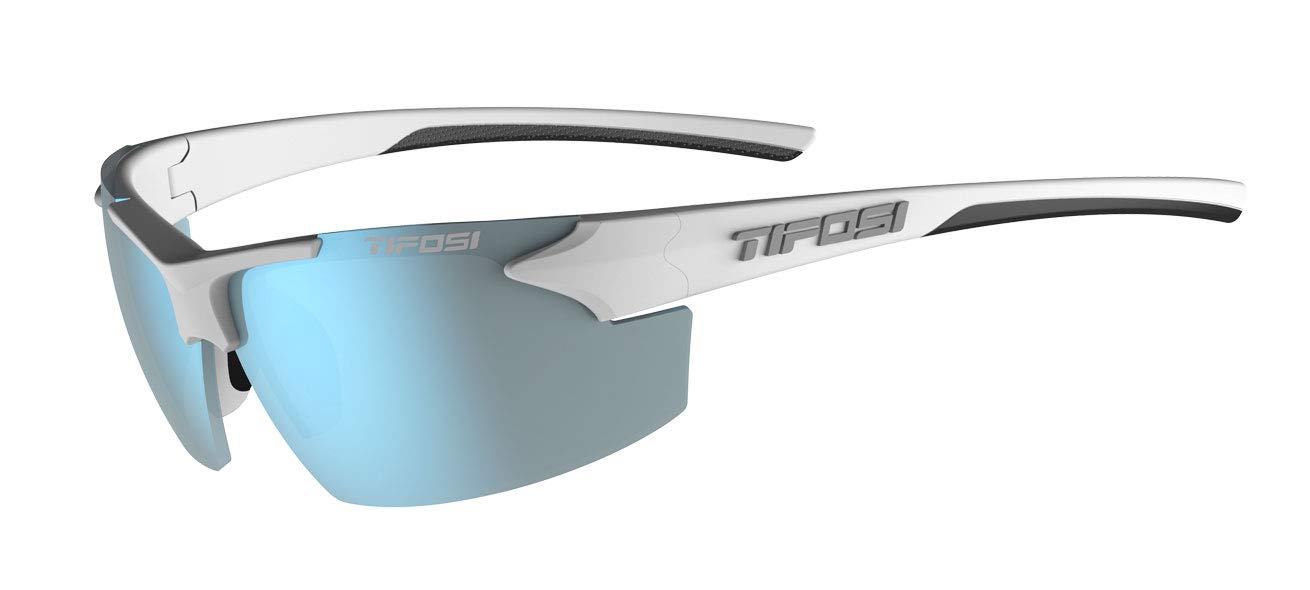
2. Tifosi Track
Key Specs: Polycarbonate lens | TR-90 frame | 23g weight | Hydrophilic nose pads | Glide anti-bounce technology
The Track is the lighter, simpler sibling of the Crit. At 23 grams, it’s almost impossibly light — I put them on and genuinely forgot they were there. The Glide technology is a smart piece of engineering: the frame is designed to stay put during rapid head movement. I tested this by simulating a fast swing in my backyard, and they didn’t budge. On the course, they stayed planted through every drive and chip shot.
The lens is a Smoke with Bright Blue Mirror — it cuts glare well in bright sun, but it’s not specifically tuned for golf. It’s a general-purpose sport lens. That means it’s great for bright conditions, but it won’t help you spot a white ball against a cloudy sky the way a contrast-enhancing lens will. If you mostly play in full sun and don’t need color enhancement, this is a fantastic option. If you play in variable light, you might find yourself wishing for more.
The honest weakness: The lens is not golf-specific. It’s a great all-around sport lens, but it doesn’t enhance greens or help with ball tracking. For the price, it’s still a strong value, but the Crit is a better choice if you want performance tailored to the course.
Who it’s for: The golfer who plays in bright, consistent sun and wants the lightest possible frame with solid impact protection.
3. BEACOOL Polarized
Key Specs: TAC lens | TR-90 frame | Polarized | UV400 protection | Anti-slip rubber nose pads
BEACOOL is the volume king for a reason. At this price point, you get a shatterproof TAC lens, a lightweight TR-90 frame, and UV400 protection. That’s a lot of safety for not a lot of money. I took these out on a bright, cloudless day, and they performed exactly as expected — clear vision, no distortion, and a secure fit thanks to the soft rubber nose pads.
But there’s a catch, and it’s a meaningful one for golfers. These are polarized. Polarization is great for cutting glare off water or a car hood, but on a golf course, it can cause issues. The biggest one is that it can interfere with reading the screen on a GPS watch or a laser rangefinder. I noticed it myself — my rangefinder’s display was slightly harder to read at certain angles. Also, polarized lenses can make it harder to read subtle breaks on the green because they flatten the visual texture of the grass. Some golfers don’t mind this. I found it distracting.
The honest weakness: Polarization is a double-edged sword for golf. If you don’t use a GPS device and you prefer the glare reduction, these are a steal. But if you rely on slope readings or want maximum green-reading clarity, look elsewhere.
Who it’s for: The budget-conscious golfer who wants solid impact protection and doesn’t mind the polarization trade-off.
4. Maivnz HD Golf
Key Specs: Polycarbonate lens | Stress-resistant frame | UV400 protection | HD color-enhancing lens | Soft silicone nose pads
Maivnz markets these as “golf ball finder glasses,” and that’s not just marketing fluff. The HD color-enhancing lens really does amplify contrast. I tested them on a course with thick rough, and I could pick out a white ball that would have been invisible with my regular sunglasses. The lens tint is on the yellow-brown side, which is what gives it that contrast boost. It works well in bright conditions, but in low light — think overcast or late afternoon — the whole course starts to look a bit muddy. Colors flatten out, and the world takes on a sepia tone that I didn’t love.
The polycarbonate lens is impact resistant, and the stress-resistant frame feels solid enough. The soft silicone nose pads kept them in place through my swing. But the lens tint is specialized — it’s great for finding white balls in tall grass, but it’s not the best all-rounder. If you play on a course with thick rough, these could be a secret weapon. If you play on a well-manicured course with tight fairways, you might find the tint unnecessary.
The honest weakness: The yellow-brown tint can make the course look muddy in overcast conditions. It’s a niche tool, not a daily driver.
Who it’s for: The golfer who frequently loses balls in the rough and wants a lens specifically designed to find them.
5. Knockaround Sports
Key Specs: Non-polarized lens | TR-90 frame | Water/oil-resistant coating | UV400 protection | Adjustable rubber nose pads
Knockaround is a newer player in the golf space, and their Sports model is a solid effort. The water and oil-resistant coating is a genuinely useful feature — it prevents sweat and morning dew from blurring your vision. I tested this on a humid morning, and the lenses stayed clear longer than any other pair I tried. The TR-90 frame is flexible and durable, and the wraparound design gives good coverage.
But there are two things that hold it back. First, the lenses are non-polarized. That’s actually a pro for some golfers — it means no interference with GPS screens — but it also means you don’t get the glare reduction that polarized lenses offer. On a bright day, I found myself squinting more than I wanted to. Second, the fit is designed for medium to large faces. I have a narrower face, and they felt a bit loose. The adjustable nose pads helped, but I never felt they were as secure as the Tifosi options.
The honest weakness: The non-polarized lens is a trade-off that not every golfer will appreciate. Also, the product is relatively new, so there’s less long-term data on durability.
Who it’s for: The golfer with a medium to large face who wants a stylish, water-resistant lens and doesn’t need polarization.
6. Scheyden Fixed Gear C-130
Key Specs: Gray lens (non-polarized) | Titanium frame | Spring-loaded temple tips | Adjustable silicone nose pads
I’ll be honest — I wanted to like these. The titanium frame is beautiful, and the spring-loaded temple tips make for a comfortable, custom-like fit. The adjustable silicone nose pads are a nice touch, and the build quality is clearly premium. But for golf specifically, these are the wrong tool for the job.
The gray lens is the biggest problem. Gray lenses are great for general use — they reduce brightness without distorting colors — but on a golf course, they flatten the terrain. I couldn’t read the subtle breaks on the green as well as I could with the Tifosi Crit. The world just looked… flat. Also, the lens is non-polarized, which means you don’t get glare reduction. For the price, that’s a tough pill to swallow.
Then there’s the frame material. Titanium is strong and lightweight, but it’s rigid. If you take a hard fall, a TR-90 frame will flex and absorb some of the impact. Titanium might bend or transfer more force. For a sport where impact resistance is the whole point, I’d rather have a flexible frame.
The honest weakness: The gray lens is terrible for golf — it flattens the terrain and makes it harder to read greens. The titanium frame is rigid, not flexible. And there’s no UV rating listed in the product data, which is concerning at this price point. This is a fashion piece, not a golf tool.
Who it’s for: Honestly, I can’t recommend these for golf. If you want a luxury pair of sunglasses for everyday wear, they’re fine. But for the course, they’re the wrong choice.
Which One Should You Buy?
If you want the best all-around performer, get the Tifosi Crit. It’s the only pair in this test that combines true impact resistance with a golf-specific contrast lens and a secure, anti-slip fit. It’s not the cheapest, but it’s the one I’d trust to protect my eyes and help me play better.
If you’re on a tight budget, the BEACOOL is a solid backup — just be aware of the polarization trade-off. If you want the lightest possible frame and play in bright sun, the Tifosi Track is a great choice. And if you specifically struggle to find your ball in the rough, the Maivnz HD might be worth a look.
Skip the Scheyden. It’s a beautiful pair of glasses, but it’s not built for golf.
Frequently Asked Questions
Are polarized sunglasses good for golf?
It depends. Polarized lenses reduce glare, which can be helpful on very bright days. But they can also interfere with reading GPS screens and laser rangefinders, and some golfers find they flatten the visual texture of the green, making it harder to read breaks. If you don’t use electronic devices on the course, polarized can work. If you do, non-polarized is usually better.
What lens color is best for golf?
Green, copper, or rose-tinted lenses are generally best for golf because they enhance contrast between the green grass and the white ball. Gray lenses reduce brightness without enhancing contrast, which can make the course look flat. Yellow or brown tints can help in low light but may distort colors in bright sun.
Do I need impact resistant lenses for golf?
If you play regularly, yes. Golf balls travel at high speeds, and even a mis-hit drive can cause serious eye injury. Polycarbonate or Trivex lenses are impact resistant and can prevent a ball or flying debris from reaching your eye. It’s one of those things you don’t think about until it happens, but once it does, you’ll never skip it again.
How do I keep my golf sunglasses from fogging up?
Look for vented lenses or frames with built-in airflow channels. Hydrophilic nose pads also help because they wick moisture away from your skin. If your glasses still fog, an anti-fog spray can help, but the best solution is a well-vented design like the Tifosi Crit.
Can I wear regular sunglasses for golf?
You can, but you shouldn’t. Regular sunglasses are not designed to withstand the impact of a golf ball or a flying divot. They also tend to slide off during a swing because they lack the grip features of sport-specific eyewear. For the cost of a few sleeves of balls, you can get a pair that’s actually built for the game.