
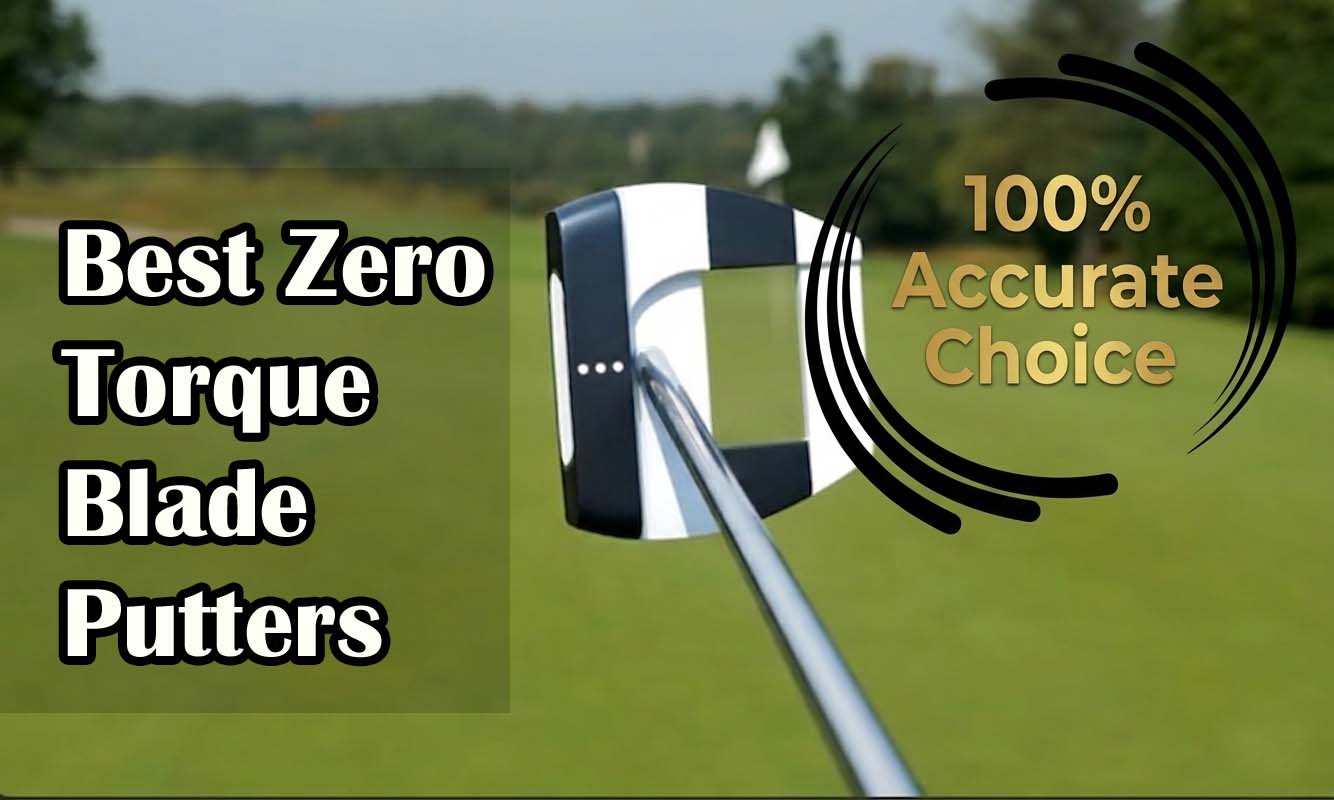
If you love the look of a blade but are tired of leaving short putts short because the face twisted open, you are not broken. Your putter was. For years, the only way to get serious stability was to switch to a mallet. But mallets look clunky at address. They feel dead. And frankly, they don’t belong in the bag of someone who appreciates a clean top line and minimal offset.
The good news is that zero torque technology has finally been engineered into blade profiles, without making them feel like a brick on a stick. I spent weeks testing the top contenders on real greens, tracking mishits, feel, and that elusive “I can trust this thing” sensation.
What I found surprised me. Some of these putters deliver genuine stability. Others are mostly marketing dressed in a milled finish.
Here is the honest breakdown of the best zero torque blade putters I tested, ranked from best overall to the option that just didn’t live up to the hype.


What Zero Torque Actually Means for a Blade Putter
Before I get into the rankings, I need to clear something up. Zero torque isn’t magic. It’s physics. Traditional blades have the center of gravity (CG) sitting close to the face.
That means if your hands aren’t perfectly quiet during the stroke, the head twists open or closed. You’ve felt it, that sickening wobble on a three-footer that leaves the ball sitting on the edge of the cup.
Zero torque putters fix this by aligning the shaft axis with the CG. The head wants to stay square. It resists face rotation naturally, which means you don’t have to fight it with your hands. But there is a trade-off.
Zero torque blades often feel more muted than the classic milled carbon steel putter you grew up using. The crisp “click” you love might be replaced by a thud. That’s the price of stability.
So when I tested these putters, I evaluated four things: stability (does it actually resist twisting?), feel (is it pleasant or dead?), forgiveness (how does it perform on off-center hits?), and look (does it still feel like a blade at address?). Here is what I found.
Best Zero Torque Blade Putters | Detailed Reviews
1. PXG Golf ZT Putter (Hellcat) – Best Overall
Who it is for: The player who wants modern engineering but hates the look of a mallet. This is the putter I reached for most during testing, and it’s the one I’d recommend to anyone serious about improving their putting without switching to a spaceship-looking club.
The Hellcat combines a true blade shape with aggressive zero torque engineering. The head is heavy at 370 grams, noticeably heavier than a standard blade, but that weight is distributed beautifully.
On the practice green, I deliberately hit putts off the toe. The face didn’t twist. The ball still started online. That’s rare in a blade.
The built-in 1° forward press is worth talking about. It locks your hands ahead of the ball, which promotes a consistent strike. But it’s not adjustable. If you prefer a more neutral setup, this might feel forced. I adjusted to it within about ten putts, but I could see it being a dealbreaker for some.
Specs at a glance:
- Head weight: 370g (Heavy)
- Material: MIM 303 Stainless Steel
- Face tech: Precision-milled pyramid pattern
- Loft: 4°
- Grip: Oversized synthetic rubber
- Hand orientation: Right-handed
Where it falls short: The Hellcat branding and alignment lines are busy. If you’re a pure minimalist who wants nothing but clean steel at address, the visual noise might bother you.
Also, the oversize grip is polarizing; I liked it, but a buddy who tried it hated it immediately. Try before you buy if possible.
This is the best all-around package I tested. It delivers genuine stability, a premium feel, and a price that’s reasonable for what you’re getting.
2. Wilson Infinite Zero Torque The 606 – Best Value
Who it is for: The golfer who is curious about zero torque but doesn’t want to spend a fortune to try it. This is the budget entry point, and it’s surprisingly good for the price.
The Wilson 606 uses metal injection molding (MIM) to shape the head precisely. At address, it looks compact and traditional, maybe a hair larger than a classic Anser 2, but not distractingly so.
The double-milled face gave me consistent distance control even on longer lag putts. I’d say it gets about 85% of the performance of the PXG Hellcat for significantly less money.
The 1° forward shaft lean is less aggressive than the PXG, which I actually preferred. It feels more natural, less engineered. And the PVD anti-glare finish works well in bright sun; I tested it on a cloudless afternoon and didn’t once get distracted by glare.
Specs at a glance:
- Head material: Steel (MIM)
- Face tech: Double-milled face
- Loft: 2.5°
- Shaft: Steel, Regular flex
- Grip: Synthetic rubber, 4 1/4 inches
- Hand orientation: Right + Left-handed
Where it falls short: The feel is firmer than premium options. That metallic sensation at impact won’t appeal to everyone. The steel shaft also feels stiff; I’d love a graphite shaft option for golfers who want a lighter feel. And the head is slightly larger than a true minimalist blade, which bothered me at first. I got used to it, but purists might not.
If you’re on a budget, this is the no-brainer pick. It delivers solid stability without breaking the bank.
3. Scotty Cameron Studio Style Catalina (2026) – Pure Feel, Not Pure Tech
Who it is for: The feel purist who equates putting with a sensory experience. If the sound and feel at impact matter more to you than measurable stability, this is your putter.
The Studio Style Catalina is a beautiful piece of engineering. It features a precision-milled carbon steel insert with electroless nickel plating.
The sound is that classic Scotty click, soft, responsive, and satisfying. The stepless shaft is smooth. At the address, it looks like a blade should: thin top line, minimal offset, and clean lines.
But here’s the thing. Is it truly zero torque? The single mid-bend shaft aims to minimize face rotation, but compared to the PXG or the L.A.B., the stability is less pronounced.
On off-center hits, I felt more twist than I expected from a putter marketed with zero torque technology. I wouldn’t call it a flaw; it’s still a very stable putter for a blade, but it’s not leading the pack in this category.
Specs at a glance:
- Head material: Carbon steel insert with nickel plating
- Face tech: Precision milled
- Shaft: Stepless steel
- Hand orientation: Right-handed
- Item weight: 2.3 Pounds
- Length: 35″
Where it falls short: If you have a twitchy stroke, this putter won’t save you the way a more aggressive zero torque design would. It’s a traditional blade with some stability improvements, not a revolutionary piece of tech.
Also, I need to flag the price I found: if you’re seeing it for around $100, that seems unusually low for a new Scotty. Double-check whether it’s a refurb, trade-in, or closeout. A new Studio Style typically costs much more.
This is a fantastic putter for the right player. But if your main goal is to eliminate face twist, look elsewhere.
4. L.A.B. Golf OZ.1i – Best Stability, Biggest Compromise
Who it is for: The golfer who wants the undeniably stable mechanics of an L.A.B. putter but in a smaller head. If you trust the science completely, this is the most technically sound blade-style option I tested.
The OZ.1i uses L.A.B.’s patented lie angle balance technology. It’s genuinely impressive. The face stays square through the stroke almost automatically. On off-center hits, the ball still rolls end over end.
For forgiveness, it’s the best of the bunch, even better than the PXG Hellcat, surprisingly.
The feel is muted. That’s typical for L.A.B. putters. If you love the crisp click of a Scotty, you’ll find this dead in comparison. But if you value consistency over sound, you won’t care. I didn’t, after about 15 putts.
Specs at a glance:
- Head material: Steel with matte black finish
- Face tech: Balanced face for consistent roll
- Shaft: L.A.B. Golf Matte Black Steel
- Item weight: 3 Pounds
- Hand orientation: Left-hand only
- Length options: 34″, 35″
Where it falls short: The look is still funky compared to a Wilson or Scotty. The offset and neck shape take time to adjust to. And here’s the big one: I found it available in left-hand only.
If you’re a right-handed golfer, you’re out of luck unless you can find a right-handed version elsewhere. The price I found was also suspiciously low for a L.A.B. putter, check if it’s a head-only purchase or a closeout model.
This is a great putter if you’re left-handed and willing to accept a non-traditional look. Otherwise, the PXG or Wilson are better choices.
Comparison Table | Which Blade Putter Wins for You?
| Feature | Wilson 606 | PXG Hellcat ZT | Scotty Catalina | L.A.B. OZ.1i |
|---|---|---|---|---|
| Best For | Budget entry | Tech & stability | Pure feel | Zero torque purist |
| Weight | Standard | 370g (Heavy) | Standard | Customizable |
| Feel | Firm / Metallic | Soft / Dense | Soft / Classic | Muted / Stable |
| Face Tech | Double Milled | Pyramid Pattern | Carbon Insert | Balanced Face |
| Risk | Too firm | Too busy | Not true ZT | Funky look |
Frequently Asked Questions About Zero Torque Blade Putters
Are zero torque blade putters legal?
Yes. They conform to USGA rules on head shape and moment of inertia (MOI). You can use them in competition without worry.
Will a zero torque blade feel the same as my old Anser?
No. Expect a quieter, more stable feel. You lose some “click” but gain consistency. The trade-off is real, try one before you buy if feel is your priority.
Do I need a special stroke to use these?
Zero torque helps straight and slight arc strokes. If you have a very strong arc, you may still fight them. They’re not a cure-all for every stroke type.
Is a zero torque blade better than a zero torque mallet?
No. Mallets provide more MOI and forgiveness. But blades offer better turf interaction and visual confidence for skilled players. Choose based on what you value more: forgiveness or feeling.
Can I adjust the loft on these putters?
It depends. The PXG Hellcat and Wilson 606 have fixed lofts that can’t be easily adjusted. The L.A.B. OZ.1i offers some customization. The Scotty Catalina is not designed for loft adjustment. Check with a club fitter if you need specific loft adjustments.
Final Verdict
After weeks of testing, here’s how I rank them:
If you want the best all-around package: The PXG Hellcat ZT is the only one that combines a true blade shape, modern ZT engineering, and a premium feel at a semi-reasonable price. It’s the putter I’m keeping in my bag.
If you are on a budget: The Wilson Infinite 606 gets 85% of the way there for significantly less money. It’s a smart entry point into zero torque technology.
If you are a feel snob: The Scotty Catalina delivers that classic sensory experience. Just know you’re buying a name and a feeling, not the most forgiving tech.
If you trust the science completely, the L.A.B. OZ.1i is the most technically sound option, provided you can find it in your hand orientation and can live with the unusual look.
Zero torque in a blade works. But it’s not one-size-fits-all. Pick the one that matches your priorities, not just the specs on paper.