
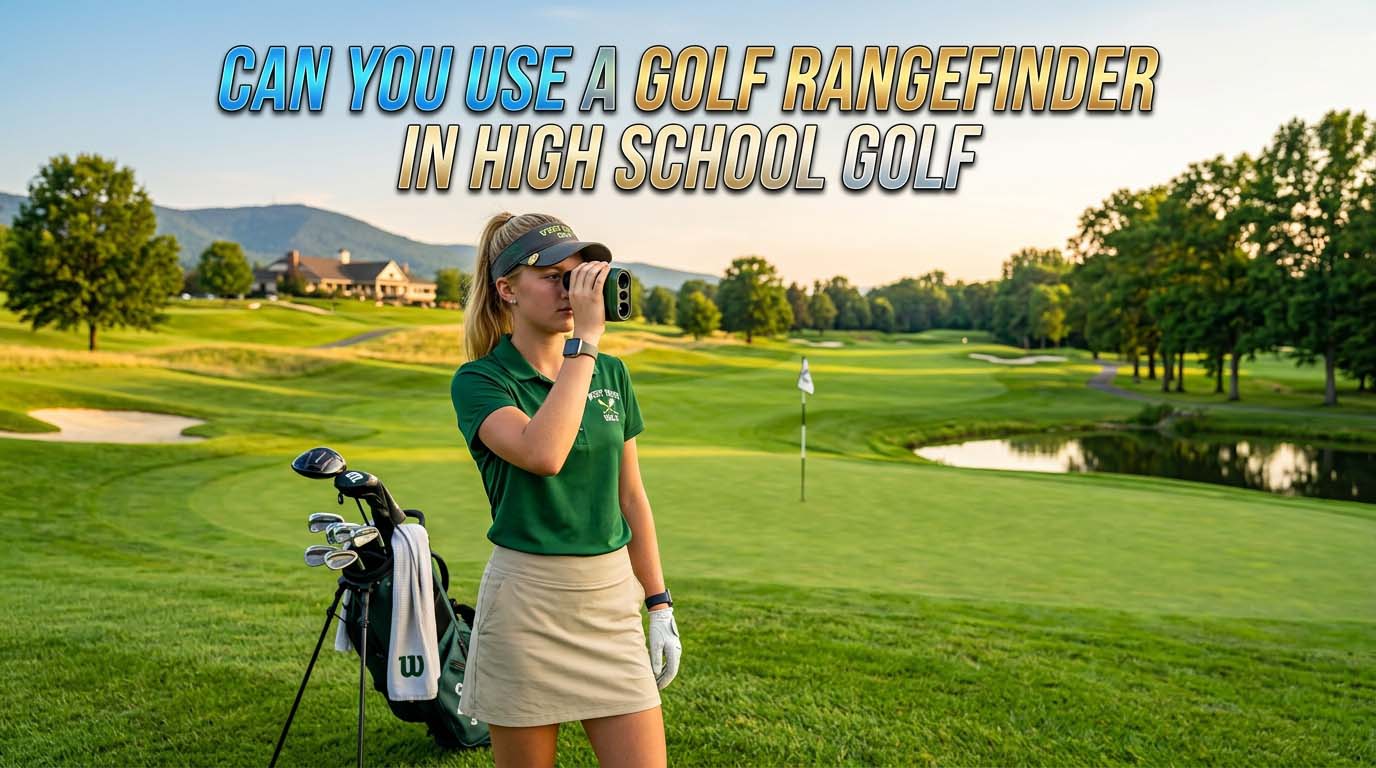
Yes, you can use a golf rangefinder in high school golf, but only if it measures distance and nothing else. The national rule for high school golf says the device must not measure slope, wind, or any other extra information.
That said, your state association can change this rule. Some states have stricter rules, and a few have said no to rangefinders completely. Before you buy one or bring one to a match, you need to know what your state allows.
This guide walks you through the national rule, the state exceptions, what happens if you break the rule, and how to pick a device that will not get you in trouble.
The NFHS Distance-Only Rule
The National Federation of State High School Associations (NFHS) writes the rules for high school golf in the United States. Under NFHS rules, players may use a rangefinder that only measures distance.
The device cannot measure slope, wind speed, elevation changes, or any other condition. It also cannot give advice, like telling you which club to hit.
The NFHS made this change a few years ago to keep up with how common rangefinders had become in practice.
The rule is simple: if your rangefinder only tells you how many yards to the pin, it is legal. If it tells you the yardage plus the uphill angle, it is not legal, even if you never use the slope feature.
This is the single most important thing to understand. The rule is about what the device can do, not what you choose to use. A rangefinder with a slope button is illegal in high school play even if you keep that button turned off.
How State Associations Can Override the National Rule
Here is where it gets tricky. The NFHS writes model rules, but each state’s high school athletic association decides whether to adopt them. Most states follow the NFHS distance-only rule. Some states add their own twists.
A few states have said no to rangefinders altogether. If you live in one of those states, you cannot use any rangefinder during a high school match, even if it only measures distance.
Other states allow distance-only devices during the regular season but ban them in the postseason or state championship. There is no single answer that applies to everyone.
This is why the first thing you should do is check with your coach or athletic director. They will know the exact rule for your state.
Do not assume the rules you read online are true for your area. A quick conversation with your coach will save you from a penalty that could cost you a match.
Penalties for Using a Non-Compliant Rangefinder
What happens if you get caught with a rangefinder that has slope? The penalty depends on whether the tournament committee thinks you did it on purpose.
If you accidentally bring a non-compliant device to the course and do not use it, the committee might give you a warning. If you use it, even once, you are looking at a two-stroke penalty for each hole you used it on. If you use it a lot, you could be disqualified.
Here is what most people do not know: the committee does not need to catch you in the act. If a rules official asks to see your rangefinder and sees a slope button, that is enough.
You do not need to have pressed it. The device just needs to be capable of measuring slope for you to be in violation.
Some tournaments do a device check before the round. A rules official or starter will look at your rangefinder to see if it has a slope button or any extra features.
If it does, you cannot use it for that round. You can either put it away or go without. You cannot keep it in your bag and just not use it.
How to Choose a Tournament-Legal Rangefinder
If you are in the market for a rangefinder for high school golf, you need to be careful. Many of the most popular models have slope features built in. You want a device that does one job: tells you the distance.
Here is a simple checklist to help you find a legal device:
- Look for the words “distance only” or “tournament legal” on the box. Many manufacturers specifically market a version of their rangefinder for tournament play.
- Make sure the device does not have a slope button. Some models have a slope mode you can turn on and off. That does not matter. The button exists, so the device is not legal for high school play.
- Avoid rangefinders with wind or altitude readings. These are considered extra information under the rules.
- Be careful with GPS watches. A GPS watch that gives you distances is fine. A GPS watch that also gives you an elevation change or suggests a club is not legal.
- Ask your coach before you buy. Show them the device you are thinking about. They can tell you if it will pass an inspection.
One more thing: do not buy a cheap knockoff from an unknown brand just because it says “tournament legal.” Stick with established brands that have a reputation to protect. A $50 rangefinder from an unknown website might measure distance, but it also might have hidden features that get you in trouble.
State-by-State Variations
This is not an exhaustive list, and rules change. But these are the known situations as of recent seasons. You must confirm with your state association.
| State | What Is Allowed | Notes |
|---|---|---|
| California | Distance-only rangefinders | Follows the NFHS rule. Slope is not allowed. |
| Texas | Distance-only rangefinders | Follows the NFHS rule. No state-specific changes. |
| Florida | Distance-only rangefinders | Allowed in regular season. Check postseason rules. |
| Massachusetts | No rangefinders | Has historically banned all electronic measuring devices. Confirm with the MIAA. |
| New York | No rangefinders | Has historically followed a stricter local rule. Check with the NYSPHSAA. |
| Ohio | Distance-only rangefinders | Allowed. No known restrictions beyond the NFHS rule. |
| Illinois | Distance-only rangefinders | Allowed. Local conferences may add restrictions. |
Do not rely on this table alone. State associations update their rules, and local conferences can add their own restrictions. The only way to be sure is to ask your coach or your state’s athletic association directly.
Common Misconceptions About Rangefinders in High School Golf
There is a lot of bad information out there about rangefinders in high school golf. Here are the myths you should ignore.
Myth: “If I do not use the slope feature, it is okay.”
This is false. The rule is about what the device can do, not what you do with it. If your rangefinder can measure slope, it is illegal, even if you never press that button.
Myth: “Laser is always legal, GPS is not.”
This is misleading. What matters is the features, not the technology. A laser rangefinder with slope is illegal. A GPS watch that only gives distances is legal. The technology is not the problem.
Myth: “Coaches can use rangefinders to give advice.”
This is true, but with a limit. A coach can use a rangefinder to figure out distances and then tell you a club. But the player is the one who cannot use a rangefinder that gives extra information. The coach is not bound by the same rule.
Myth: “I can just claim I did not know the rule.”
Ignorance is not an excuse. The committee will still penalize you if you use a non-compliant device, even if you genuinely did not know. That is why it is your job to know the rules.
Beyond the Rule: Does a Rangefinder Actually Help?
Here is a question that does not get asked enough. If your state allows a distance-only rangefinder, should you use one?
For most players, yes. A rangefinder saves time because you do not have to look for sprinkler heads or walk off distances. It also gives you confidence. When you know exactly how far you are, you can commit to your club and your swing.
But a rangefinder will not fix a bad swing. If you are a high school player who averages 90, the problem is probably not that you do not know the distance. It is that you hit the ball sideways. A rangefinder will not help with that.
There is also a risk factor. The more features your rangefinder has, the more likely you are to accidentally break a rule. A simple distance-only model eliminates that risk. It is not as flashy, but it is safe.
If you already have a rangefinder with slope, check your state rule before you consider using it in a match. If your state allows distance-only devices, you have two options. You can buy a new rangefinder, or you can ask if your current model has a way to permanently disable the slope.
Many models let you turn off slope, but as we covered, that does not make it legal under NFHS rules.
Frequently Asked Questions
Can I use my smartphone GPS app during a high school match?
No, not in most states. A smartphone app that gives distances is treated the same as a rangefinder. If the app measures slope or wind, it is illegal. Even if it only gives distances, your state has to allow electronic measuring devices in the first place.
Many states do not allow phones on the course during a match. Check with your coach before you rely on your phone.
Do I need to have my rangefinder inspected before every round?
No, not every round. Some tournaments do spot checks at the first tee. Others do not check at all. But you should be ready for an inspection at any time. If you are not sure whether your rangefinder is legal, do not bring it to the course.
Is it legal to use a rangefinder during practice rounds or non-tournament play?
Yes. The NFHS rule only applies during the competitive round or tournament. In practice, you can use any rangefinder you want. That is a great time to use a rangefinder with slope to learn your carry distances and how the course plays. Just remember that the rules are different on match day.
What is the penalty if I accidentally leave slope on and do not use it?
This depends on the tournament committee. If you show up with a slope rangefinder and the committee sees it before you tee off, they will likely ask you to put it away.
You will not get a penalty because you did not use it. But if you use it, even by accident, you get a two-stroke penalty. If it happens repeatedly, you could be disqualified.
Are there any rangefinder brands specifically approved by the NFHS?
No. The NFHS does not approve specific brands or models. The rule is about what the device can do, not who made it. A no-name rangefinder that only measures distance is legal. A top-of-the-line rangefinder with all the features is not. Focus on the features, not the brand.
Final Word | Know Your Rule, Play by It
The short version is simple. Golf rangefinders are allowed in high school golf under the NFHS distance-only rule. But you need to confirm that your state has not changed that rule.
Then you need to make sure your rangefinder only measures distance. No slope, no wind, no altitude, no club suggestions.
If you follow those three steps, you are good to go. If you skip them, you are gambling with your eligibility. A two-stroke penalty is bad. Disqualification from a tournament is worse. And having to explain to your coach that you did not read the rules is the worst of all.
Check with your coach. Check your state association website. Check your rangefinder before you put it in your bag. It takes five minutes, and it could save you from a very bad day.