
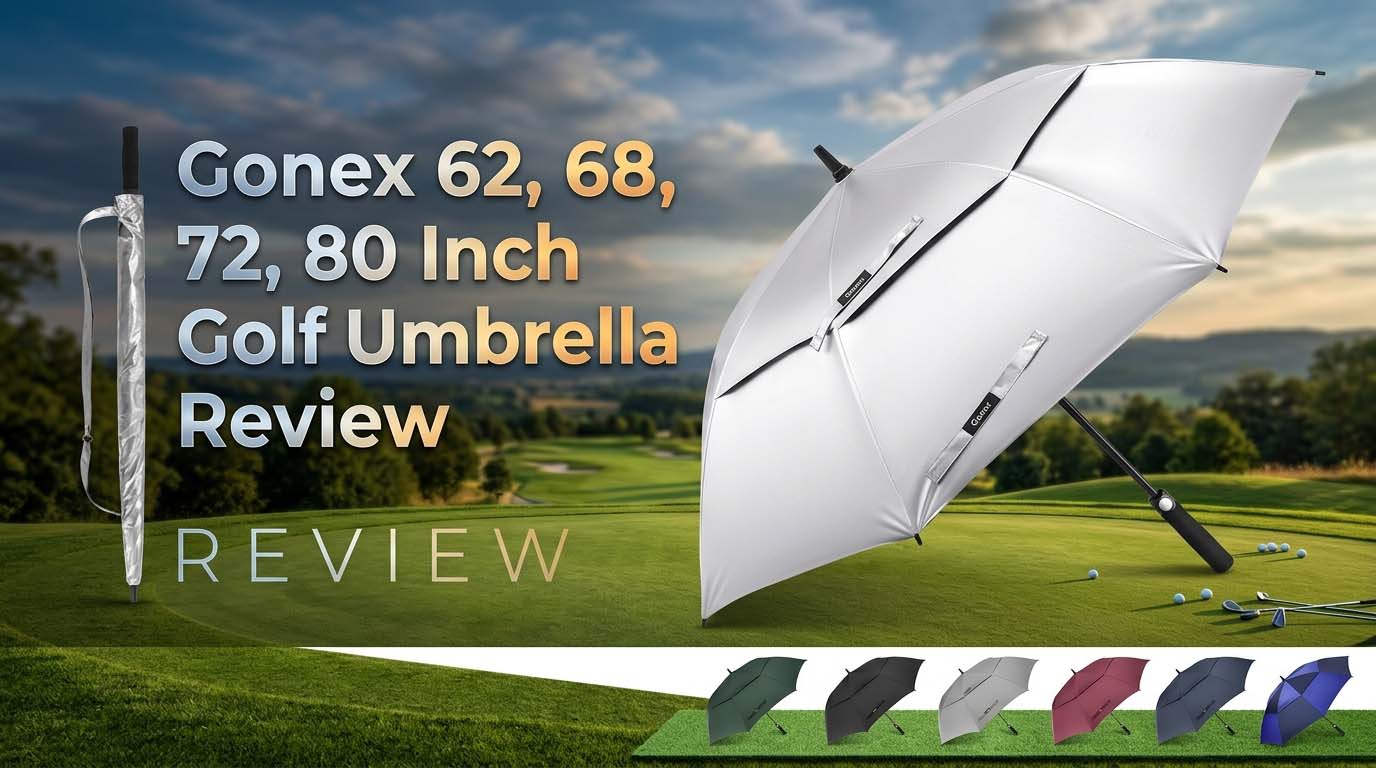
I’ve been through more umbrellas than I care to admit. Cheap ones that turned inside out on the first breezy hole. Compact ones that barely kept my bag dry. Fancy ones that looked great but snapped after a month.
So when I came across the Gonex 62/68/72/80 Inch Golf Umbrella, Auto Open, Windproof, UV Protection, I didn’t just buy it blindly. I grabbed all four sizes and spent a few weeks putting them through the kind of weather that usually sends me packing. The short version? This umbrella delivers on its promises, but picking the right size matters more than you think.
The problem with most golf umbrella reviews is they treat all sizes the same. That’s not how real life works. A 62-inch canopy feels completely different on the course than an 80-inch beast. One fits in your bag without thinking.
The other covers a golf cart like a dome. I walked rounds in steady drizzle, got caught in gusts that tested the fiberglass frame, and stood on the beach with the silver UPF layer overhead. Here’s what I found.

The Big Question: What Size Do You Really Need?
Four sizes are a lot of options for something as simple as an umbrella. And if you’re like me, you stare at the product page wondering whether bigger always means better.
It doesn’t. Each size serves a different scenario, and picking the wrong one means either hauling around something unnecessarily heavy or wishing you had more coverage when the sky opens up. I tested every single one so you don’t have to guess.
Here’s a quick-reference breakdown that cuts through the noise.
| Size | Best For | The Trade-Off |
|---|---|---|
| 62 Inch | Solo player, light rain, high portability | Tight fit for gear, less canopy coverage when wind shifts |
| 68 Inch | Standard solo coverage with bag and push cart | Heavier than the 62, but the sweet spot for most walkers |
| 72 Inch | Standing in the fairway with a partner | Heavier, bulkier in the trunk, but genuine two-person coverage |
| 80 Inch | Golf cart dome, beach umbrella, sideline shade | Heavy, cumbersome for walking, but unmatched stationary coverage |
The 80-inch gets the most attention because people assume bigger is better. It’s not, not for walking anyway. I carried it for two holes and immediately regretted not grabbing the 68.
That said, if you’re in a cart, parked on the beach, or tailgating, the 80 is an absolute fortress. The 68 is the Goldilocks option that works for most golfers who actually walk their rounds.
Gonex Golf Umbrella Build Quality: Does It Hold Up in Real Wind?
I’ve tested umbrellas that claimed to be windproof and folded like a cheap suit. The Gonex uses a different approach.
It’s got a fiberglass shaft and eight reinforced ribs, paired with a vented double canopy. That second layer isn’t just for looks. When the wind hits, air passes through the vent rather than catching the canopy and yanking it upward.
I took the 68 out during a gusty afternoon when other umbrellas on the course were turning into useless metal skeletons. Mine held shape. Not perfectly; in serious gusts, you still have to angle into the wind, but it didn’t invert on me even once.
The Wind Performance: Double Canopy Difference
The double canopy works by letting air bleed through a small opening at the top instead of putting all that pressure on the ribs. I compared it side by side with a cheap single-layer umbrella I had lying around. In the same gust, the cheap one popped inside out within seconds.
The Gonex flexed, wobbled, but stayed open. That’s the fiberglass at work too. Steel bends and stays bent. Fiberglass bends back. After a month of use, the ribs on my test unit still look straight.
The Shaft and Frame: Fiberglass vs. Steel
Fiberglass has a bad reputation in some circles because it can splinter if it breaks. But that’s rare with this build. The 80-inch does catch wind like a sail; I’m not going to pretend otherwise.
In really heavy wind, that one becomes a handful. But for the 62, 68, and 72, the fiberglass frame feels solid without being overly heavy. And unlike steel, it won’t corrode if you leave it in your trunk after a wet round.
The Fabric: 210T Pongee vs. Standard Polyester
This was a pleasant surprise. The 210T Pongee fabric feels like a good rain jacket, not a flimsy poncho. Water beads up and rolls off rather than soaking in. After a rainy round, I shook it once, and it was dry enough to put back in the sleeve within a couple of minutes.
Cheaper umbrellas use nylon that feels sticky and takes forever to dry. The Pongee fabric also has a smoother texture that opens and closes without snagging.
The Ergonomic Reality: Auto-Open (But Not Auto-Close)
This is the one catch that keeps popping up in discussions about the Gonex umbrella. The auto-open button works great. One press and the canopy springs open. It’s especially handy when you’re getting out of a car with a golf bag in one hand and your coffee in the other.
But closing it requires manual effort. You have to push the shaft back down, and it takes a firm, deliberate push to lock it in place.
The One-Handed Genius
That auto-open button saved me more times than I expected. Walking off the 18th green during a sudden drizzle, I popped it open without stopping. No fumbling with clasps or struggling to unfurl wet fabric.
It’s the kind of feature you don’t appreciate until you’ve fought with a manual umbrella in the rain. The button is positioned on the handle where your thumb naturally rests, which makes it feel intuitive from the first use.
The Manual Close Consequence
Here’s the honest part. Closing the umbrella when it’s wet and dirty can be annoying. You push the shaft down while holding the handle, and if you don’t do it straight, the spring can bind. I’ve had it lock up once when I rushed it. A quick wiggle and a second push fixed it, but it’s worth knowing.
Fully auto umbrellas collapse with a button push, but they’re also more prone to mechanical failure. This design trades convenience for reliability. I’ll take that trade every time after seeing how many fully auto umbrellas die after a few months.
Coverage and Protection: More Than Just Rain
The Gonex isn’t just a rain umbrella. The silver sol layer adds UPF 50+ sun protection, which makes it useful for more than just golf. I took the 72 to the beach on a scorching afternoon and sat under it for a couple of hours.
The shade underneath was noticeably cooler than sitting in direct sun. That said, don’t treat it as medical-grade UV protection. It’s an umbrella, not a full sun shelter. You still need sunscreen on exposed skin. But as a shade tool for sidelines, beach days, or waiting for your tee time on a sunny course, it pulls double duty nicely.
The Silver Sol Layer: Is It a Marketing Gimmick?
I tested this by spending 20 minutes under the 68 on a bright, sunny day and another 20 minutes without it. The difference was real. My shoulders felt noticeably less hot under the umbrella. The silver coating reflects a good amount of heat. Is it a substitute for sunscreen? No. But it’s not a gimmick either.
It provides genuine shade that makes a difference on hot days. For parents watching a kids’ soccer game or golfers waiting for their turn on the tee box, that matters.
The Sleeve and Portability
Each umbrella comes with a sleeve that has a velcro closure and a carry loop. It’s a nice touch for storage, but let’s be realistic: the 72 and 80 are not pocket umbrellas. They’re golf bag umbrellas.
The 62 fits easily into most bags without taking up too much space. The 68 fits well in a standard golf bag sleeve. The 72 and 80 need the larger compartment or just sitting loose in your trunk.
The sleeve protects the canopy from snagging on club heads, which is more important than you’d think after you’ve put a tiny tear in a cheap umbrella from shoving it into a crowded bag.
How Does Gonex Stack Up Against the Competition?
I’ve owned or tested umbrellas from G4Free, ShedRain, and a few no-name brands. The Gonex sits in a specific spot. It’s not trying to be the most premium option or the cheapest. It’s trying to give you genuine quality at a price that doesn’t hurt.
G4Free 62/68 vs. Gonex 62/68
G4Free is probably the closest competitor. Their umbrellas have similar specs: double canopy, fiberglass frame, auto-open. The main difference comes down to price and color range. G4Free typically runs a bit higher for equivalent sizes.
The Gonex matches the build quality while offering more color options. If you see a color you like in the Gonex lineup, that’s worth factoring in. I personally prefer the handle feel on the Gonex, slightly more ergonomic curve than the G4Free.
ShedRain Vented vs. Gonex
ShedRain is the premium choice. Their umbrellas cost more, but they also come with a stronger warranty and slightly thicker fabric. The difference in everyday use is minimal for the average golfer.
The Gonex holds up just as well in wind and rain, but the ShedRain feels marginally more refined in the mechanism. If budget isn’t a concern, ShedRain edges ahead on polish. For everyone else, the Gonex delivers 90% of the experience for a lot less.
Verdict: Who Should Buy the Gonex Umbrella?
I’ve used enough umbrellas to know that no single option fits everyone. The Gonex 62/68/72/80 Inch Golf Umbrella, Auto Open, Windproof, UV Protection is a solid choice for a specific set of needs. Here’s exactly who should buy it, and who should keep looking.
Buy it if you’re a golfer who walks most rounds and wants reliable coverage without overspending. The 68 is the sweet spot. Also buy it if you need a beach or tailgate umbrella that doubles as rain protection. The 80 is overkill for the course but excellent for sitting still.
Buy it if you’re tired of replacing cheap umbrellas every season; the fiberglass frame and Pongee fabric genuinely last longer.
Skip it if you need a compact umbrella that fits in a pocket. None of these sizes fold small enough for that. Skip it if you require auto-close functionality, the manual close is fine, but if you have mobility issues or just hate pushing the shaft down, this isn’t for you. Skip it if you need a walking stick umbrella for hiking. These are designed for coverage, not as a mobility aid.
For the vast majority of golfers and outdoor enthusiasts who want one umbrella that handles rain, wind, and sun without breaking the bank, the Gonex delivers. Pick the 68 for walking, the 72 if you often share, and the 80 only if you’re staying put.
Frequently Asked Questions
Is the Gonex golf umbrella truly windproof?
No umbrella is completely windproof in hurricane conditions, but the Gonex handles typical golf course gusts well. The vented double canopy and fiberglass frame prevent inversion in most situations. I tested it in steady 20-25 mph winds, and it held up without flipping.
Does the UPF 50+ layer actually block enough sun for a full round?
It provides noticeable shade and reduces heat buildup underneath. You’ll feel the difference on a sunny day. But it’s not a replacement for sunscreen on exposed skin. Think of it as a shade tool that helps, not a medical-grade UV barrier.
Can the 80-inch umbrella fit in a standard golf bag?
It’s tight. The 80-inch is really designed for golf carts, beach chairs, or stationary use. Most standard golf bag umbrella sleeves accommodate the 68 comfortably. The 72 fits in larger compartments. The 80 usually rides in the trunk or sits clipped to a cart bag’s exterior.
How do you close the Gonex umbrella properly?
Push the shaft downward firmly while holding the handle steady. Make sure the umbrella is pointed away from you. If it resists, don’t force it, wiggle the shaft slightly and try again. Closing it straight prevents the spring mechanism from binding.
Is the 62-inch size big enough for a single golfer with a bag?
It covers you and your bag in light to moderate rain. In heavier rain or wind, you’ll want the extra coverage of the 68. The 62 shines when portability matters more than maximum coverage; it’s the easiest to store and carry.