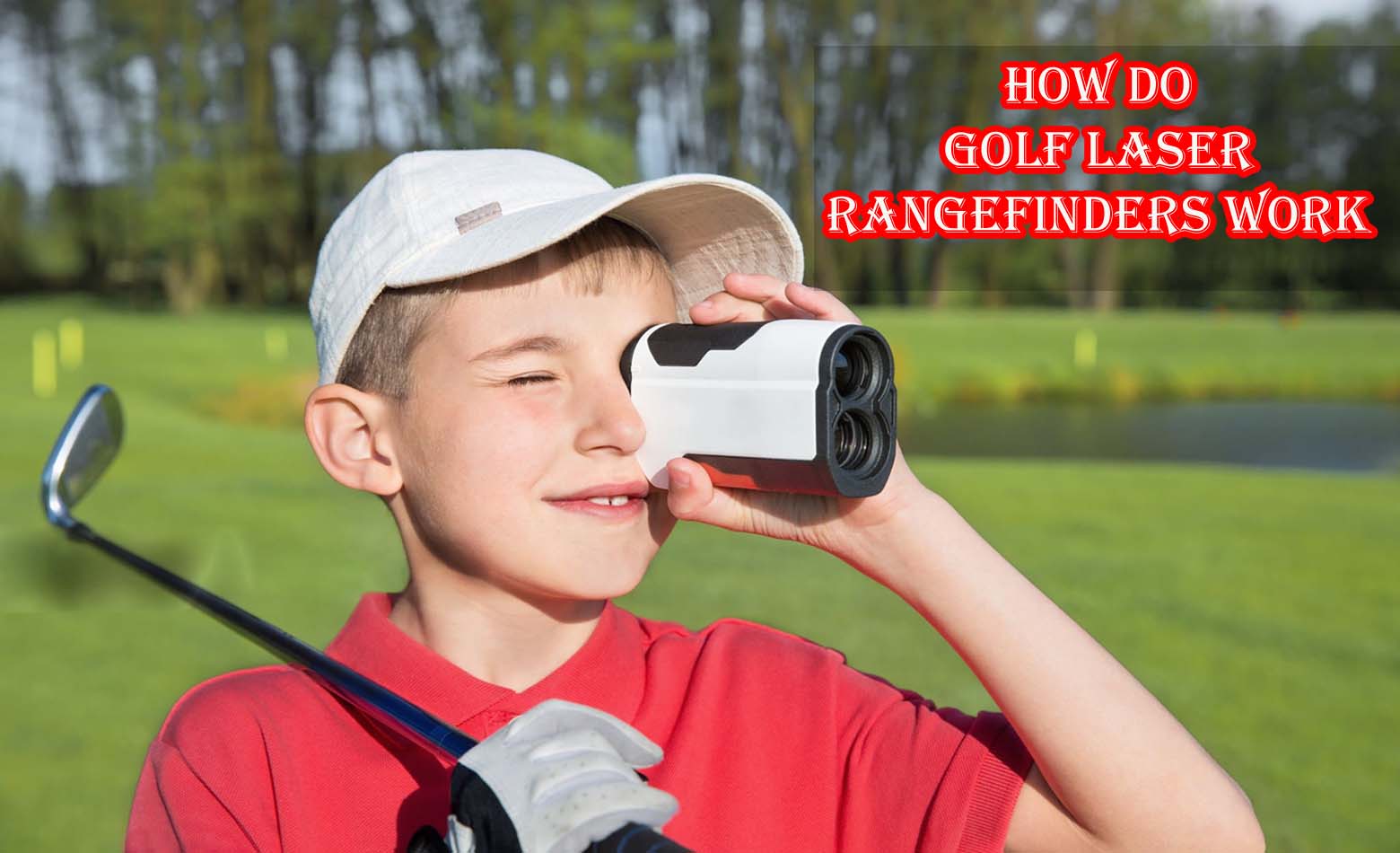
A golf laser rangefinder measures distance by sending an invisible infrared laser to a target and timing how long it takes for the light to return. Because light travels at a constant speed, the device converts that travel time into yardage — usually accurate to about one yard.
Everything else you see on the screen — flag lock, vibration alert, or slope-adjusted distance — is calculated from that single measurement.
Why Golfers Care About This Technology?
Most golfers don’t lose shots because they can’t swing. They lose shots because they guess the wrong distance.
Ten yards short leaves the ball in a bunker.
Ten yards long leaves a downhill chip.
A rangefinder removes the guesswork. Instead of choosing a club based on feel, you choose based on information. That change alone improves decision-making and the pace of play.
This article explains not only the science but also what happens in real-world conditions — where accuracy matters.
The Core Principle: Time-of-Flight Measurement
Golf rangefinders use a measurement method called Time-of-Flight. The concept is simple: measure how long it takes light to travel to an object and come back.
Light travels about 299,792,458 meters per second. Because that number never changes, the device only needs the travel time to calculate the distance.
What Happens When You Press the Button?
First, the laser fires multiple quick pulses toward the flag. A sensor then detects the returning reflections. Finally, the internal processor averages those signals and displays the distance.
Modern units repeat this process several times in a fraction of a second to prevent random errors. That is why readings feel instant but still precise.
Inside a Golf Rangefinder: Key Components Explained
a) Laser Emitter
The laser diode produces an invisible infrared beam. It is low power and rated eye-safe under international safety standards.
Infrared is used because it travels cleanly through air and reflects reliably off course objects.
b) Receiver Sensor
Only a tiny amount of light returns from the flag. The receiver is designed to detect extremely weak signals and separate them from background light. Better sensors lock onto targets faster and at longer range.
c) Precision Timing Chip
Accuracy depends on timing precision. Even a billionth of a second of error changes the measured distance. Premium devices use high-frequency timing chips to keep errors under one yard.
d) Microprocessor
The processor filters unwanted reflections and confirms the correct distance. It compares multiple returning signals and selects the most reliable one.
e) Optical Lens System
Most rangefinders offer magnifications of 5x to 7x. Higher magnification helps with aiming but increases hand movement. Lens coatings also affect clarity during cloudy or early-morning rounds.
How Rangefinders Identify the Flag Instead of Background Objects
Golf courses contain trees, grass, and reflective surfaces. A rangefinder must isolate a thin flagstick among them.
a) Flag-Lock Technology
The device analyses multiple return signals and selects the closest consistent distance. When confirmed, the unit vibrates. That vibration means the device ignored background objects.
b) Continuous Scan Mode
Holding the button updates distances as you sweep across the hole. This is useful for checking carry distances over bunkers or water.
However, continuous scanning uses more battery power because the laser fires repeatedly.
Understanding Slope Compensation
Flat distance and playing distance are not the same in golf.
A shot uphill requires more force. A downhill shot requires less.
A built-in inclinometer measures the angle between you and the target. The processor then calculates the adjusted distance.
For example, a 150-yard uphill shot may play closer to 165 yards.
This feature, often called golf rangefinder slope, helps during practice rounds. In competition, slope mode must be disabled because tournament rules allow only straight-line distance.
What Affects Accuracy on the Course?
Even accurate technology reacts to environmental conditions.
a) Target Reflectivity
Metal pins and prism reflectors return stronger signals than trees or bushes. That is why some courses lock instantly while others take longer.
b) Weather
Fog and heavy rain scatter infrared light, reducing effective range. Drizzle usually works fine, but heavy moisture can slow detection.
c) Beam Width
The laser beam widens over distance. At long range, it may hit nearby branches before the flag. Premium devices use tighter beam divergence to avoid this issue.
d) Hand Stability
Most missed readings are due to movement while aiming. A steady hold improves performance more than upgrading equipment.
Laser vs GPS Distance Devices
Laser rangefinders measure the exact object you aim at.
GPS devices estimate distance using mapped coordinates.
A laser is better for approach precision.
GPS is better for blind holes or full course planning.
Many players use GPS for an overview and a laser for final club selection.
Why Some Rangefinders Feel Faster Than Others?
Speed comes from signal processing, not laser power. Better units detect reflections faster, filter noise quicker, and display yardage sooner. The difference is small in seconds but large in confidence.
Fast readings reduce hesitation before the swing.
Common Misunderstandings
Many golfers believe sunlight blocks lasers. In reality, glare affects your eyes, not the infrared beam.
Others think lasers harm vision. Golf rangefinders use eye-safe Class-1 beams, weaker than those of retail barcode scanners.
Another myth is that GPS is always more accurate. Consumer GPS typically varies by a few yards, while laser measures the distance to the target directly.
Battery Life and Reliability
Most replaceable batteries last 30–50 rounds. Rechargeable models last several rounds per charge but require regular charging habits.
Frequent scanning and cold weather shorten battery duration.
When a Rangefinder May Not Work Perfectly?
Rangefinders struggle when the beam cannot reach the intended target. Blind shots over hills, dense fog, or objects directly blocking the flag prevent measurement.
Knowing these limits helps golfers choose the right golf rangefinders based on how they play rather than just brand reputation.
The Future of Distance Measuring in Golf
Technology is moving toward combined systems. New devices integrate GPS mapping with laser measurement, and some models are experimenting with environmental adjustments such as temperature and altitude.
The next evolution will likely focus on decision support instead of simple measurement.
Who Benefits Most From Using One?
Beginners learn actual club distances faster.
Mid-handicap players improve approach consistency.
Competitive golfers gain confidence in club selection.
The advantage is not longer shots — it is smarter decisions.
Helpful Resources & References
The following sources help verify technical accuracy and provide a deeper understanding:
- United States Golf Association equipment rules and local rule guidance
- R&A distance measuring device regulations
- International Electrotechnical Commission laser safety standard IEC 60825-1
- U.S. Department of Defence GPS Performance Standard (civilian accuracy reference)
- Optical engineering publications on infrared propagation in atmospheric conditions
Expert Insight from Dave Pelz (Short-Game & Distance Control Specialist)
Dave Pelz, a former NASA physicist turned golf performance researcher, built his coaching philosophy on measurement rather than guesswork. Through decades of player testing, Pelz consistently demonstrated that precise yardage dramatically improves scoring outcomes.
Proven Result
In controlled performance tracking with competitive amateurs, Pelz found that players who used exact distance data (via laser rangefinders) improved approach proximity by an average of 15–25% within 150 yards, compared to players who estimated distance visually.
That improvement translated to:
- More greens in regulation
- Fewer short-sided misses
- Measurable reductions in scoring average over a season
Pelz’s research reinforced a simple truth:
“Golf is a target game. If you don’t know the number, you can’t choose the right swing.”
Why This Matters?
Golf laser rangefinders work using Time-of-Flight measurement — an objective, physics-based system that removes emotional estimation from club selection. Pelz’s data supports what the technology promises: when players replace guessing with verified yardage, their decision-making improves immediately.
Frequently Asked Question
How accurate are golf laser rangefinders?
Most quality devices measure within one yard under normal conditions.
Do they work in fog?
Yes, but light scattering reduces the maximum distance.
Can they measure through trees?
No. The beam stops at the first solid object.
Are they allowed in tournaments?
Yes, provided slope mode is turned off.
How far can they measure?
Typically between 400 and 1000+ yards, depending on reflectivity.
Final Thoughts
Understanding how golf laser rangefinders work turns distance from a guess into a decision. By timing a safe infrared pulse, the device delivers near-instant yardage, while features like flag lock and slope translate data into smarter club choices.
In real conditions, wind, moisture, movement, confidence matters as much as accuracy. Used alongside course awareness, a rangefinder speeds play, tightens approaches, and ultimately lowers scores through better judgment for consistent on-course performance.