
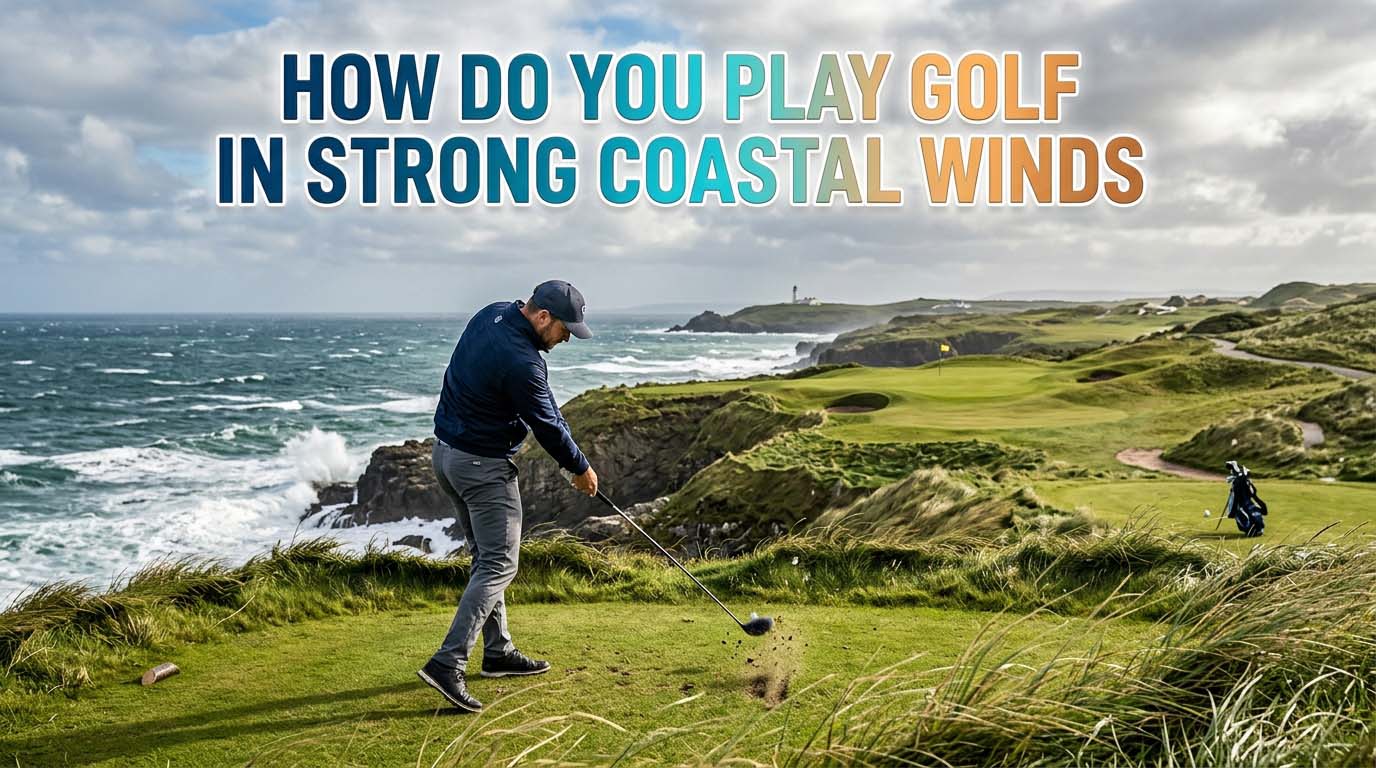
If you have ever teed off on a seaside course, you know the feeling. The wind comes off the ocean, and it does not behave like inland wind. It is heavier. It shifts without warning. The ball does things you did not expect.
The advice you read online often says “swing easy” or “take one more club.” That works at your local park course on a breezy day. It does not work when you stand on a cliffside hole with a 25 mph crosswind that changes direction every 30 seconds.
I have played hundreds of rounds on coastal courses. The ocean air is different. Salt and moisture make it denser.
A 10 mph coastal headwind has about 15 to 20 percent more drag on the ball than the same wind inland. That means your standard yardage calculations are wrong before you even start.
This article gives you a complete system for coastal wind. It covers the physics, the equipment changes, the shot adjustments, and the mental approach. After this, you will not need to search for another guide.
Why Coastal Wind Feels Different from Inland Wind
You have to understand the air itself. Near the coast, the air is thicker because of humidity and salt content. This density creates more resistance on the ball. A shot that normally carries 150 yards in calm inland air will travel shorter in coastal air even without wind. Add a headwind and the effect multiplies.
Wind shear also plays a role. Near the ocean, wind speed changes sharply at different heights. At 30 feet above ground, the wind might be 20 mph.
At 3 feet, it might be only 8 mph. That means your ball starts in one wind zone and moves into another as it climbs. This is why coastal shots often balloon or fall short even when you think you picked the right club.
Coastal terrain adds turbulence. Dunes, cliffs, and trees that are bent by constant wind create eddies. The wind is not smooth. It swirls. A shot that looks like a straight headwind from the tee can become a crosswind 50 yards down the fairway because the wind channels around a dune.
The Salt Air Factor
Salt air increases air density by roughly 3 to 5 percent. That does not sound like much, but it changes how the ball compresses and spins. High-compression tour balls (90+) react poorly in this dense air.
They do not compress enough, which reduces launch and increases spin. Lower compression balls (70 to 80) work better. They compress more easily and launch with less spin, which helps the ball cut through the heavier air.
I switched to a 75-compression ball on coastal rounds and saw my carry distance stabilize. The ball did not jump off the face the same way, but it also did not get knocked sideways as easily.
What to Do Before the Round
Preparation is half the battle. You cannot fix coastal wind problems during the round if you did not set up correctly beforehand.
Equipment Audit for Coastal Conditions
Stiffer shafts help. They reduce head deflection at impact, which lowers spin. In dense coastal air, less spin means a lower, more penetrating ball flight. I use shafts one flex stiffer than normal when I play at the coast.
Clubs with lower lofts perform better. On exposed holes, I often leave the driver in the bag and use a 3-wood or even a 2-iron. The lower launch angle keeps the ball out of the worst wind. Hybrids tend to launch too high for coastal wind. I prefer long irons with reduced loft.
Warm-Up Routine Specific to Coastal Play
Do not waste the range time hitting full shots with your favorite club. Focus on punch shots. Hit balls with the ball back in your stance, a three-quarter swing, and a smooth tempo. This simulates what you will need on the course.
Also test your ball flight in the actual wind. Hit a few wedges and watch how much they spin. Hit a 5-iron and see how far it carries. The numbers will be different from your inland practice. Write them down on your glove or scorecard so you have real data for the round.
Shot Execution System for Coastal Wind
This is the core of the article. Each wind condition requires a different approach.
Into a Coastal Headwind
The standard advice says take one more club. In coastal wind, take two or three more clubs. If you normally hit a 7-iron 150 yards, grab a 5-iron and hit a punch shot with a 60 to 70 percent swing.
Use the stinger technique. Place the ball slightly back in your stance, lean the shaft forward, and keep your hands ahead through impact.
This delofts the club and reduces spin. The ball will start low and stay low. In dense coastal air, a low shot with less spin holds its line better than a high shot that balloons.
Swing speed reduction is critical. For every 10 mph of coastal headwind, reduce your swing speed by about 15 percent. Inland formulas use 10 percent. The denser air demands more compensation.
I learned this the hard way. I tried to muscle a 6-iron into a 15 mph ocean breeze and watched the ball climb, stall, and drop 20 yards short.
When I switched to a 4-iron with a smooth 70 percent swing, the ball flew under the wind and carried exactly where I aimed.
Downwind with Ocean Breeze
Tailwinds at the coast create more rollout than inland tailwinds because the dense air pushes the ball forward and keeps it spinning longer. That sounds beneficial, but it also means the ball can balloon if it catches too much spin.
For a tailwind, subtract about 15 percent of the total distance for every 10 mph of wind. Inland, your formula would subtract 10 percent. So from 150 yards with a 10 mph tailwind, play it as 127 yards.
Be careful with wedges. A full swing with a wedge creates high spin. The tailwind catches that spin and lifts the ball. It can still come up short. I prefer a lower club with a three-quarter swing to keep the ball flight down.
The Coastal Crosswind
Crosswinds are the real challenge on coastal courses. The ocean often sits on one side, so holes run perpendicular to the wind. You have to aim far off the green and trust your shot.
Here is a system I use based on wind angle and strength:
- 30-degree crosswind: aim off by half a club
- 45-degree crosswind: aim off by one full club
- 60-degree crosswind: aim off by one and a half clubs
- 90-degree crosswind (direct side wind): aim off by two clubs
So from 150 yards with a 15 mph 90-degree crosswind, aim as if the hole is 130 yards away from the wind side. You are not trying to hit a curveball. You are aiming where the wind will push the ball.
Ball flight shaping helps. If the wind is left-to-right, hit a draw. The draw spin fights the wind and keeps the ball straighter. If the wind is right-to-left, hit a fade. This takes practice, but it cuts the effect of the crosswind in half.
Shifting Winds
At the coast, wind rarely stays steady. It can gust 10 mph stronger for 10 seconds, then drop to calm for 20 seconds. You have to time your shots.
Watch the water. Wind direction shows as streaks on the surface. Look at the flag base, not the tip. The base shows ground-level wind, which is what affects your ball after it lands. The tip shows upper wind, which affects the ball in the air.
Wait for a lull. On exposed coastal holes, I stand on the tee and wait until the flag relaxes or the water streaks calm. That is my window. If the wind is gusting 25 mph, I wait for a 10-second lull and then swing. Do not rush. A bogey after waiting is better than a double bogey after hitting into a gust.
Coastal Course Management Principles
You now have the mechanics. The last piece is strategy.
Exposed vs. Sheltered Holes
Some holes on a coastal course are open to the ocean. Others are tucked behind dunes or trees. Treat them differently. On exposed holes, aim for the fat part of the green. Accept that you might make bogey. Do not chase flags. On sheltered holes, you can be more aggressive.
Playing from Coastal Rough
Dormant grass, fescue, and seaside rough grab the clubface differently. The grass is often wiry and dry. It can twist the clubhead closed or open. In wind, this is worse because you have less control over spin. I use a more upright swing and take the club back slower to avoid the grass grabbing the hosel.
The Bump-and-Run as a Weapon
In coastal wind, putting from 30 yards off the green is often smarter than using a wedge. The ball stays on the ground where the wind cannot affect it. I use a hybrid or a 5-iron and roll the ball toward the hole. This works especially well on firm coastal greens where the ball runs out.
Putting in Coastal Wind
Wind affects putts more than most realize. On exposed greens, crosswinds can push the ball off line. Add about 10 percent more pace on downhill putts into the wind. The wind will slow the ball down.
On uphill putts with a tailwind, the ball will roll faster than you expect. Practice a few long putts before the round to feel the difference.
Common Coastal Wind Myths
Let me clear up a few things.
Myth: Swing harder into a headwind to muscle through it.
The truth: Harder swings produce more spin. In dense coastal air, that extra spin catches the wind and balloons the ball. You lose distance.
Myth: Use the same club you would use on a calm day.
The truth: In coastal wind, you need two or three clubs more into the wind, not just one. The denser air and higher drag demand at least two extra clubs.
Myth: The wind is the same from tee to green.
The truth: Coastal wind channels around dunes, cliffs, and buildings. The wind at the tee might be a 15 mph headwind. Forty yards down the fairway, it becomes a 10 mph crosswind because a dune blocks the direct flow. Watch the flag at the green, not just the tee flag.
Frequently Asked Questions
How does coastal fog affect ball flight differently than clear wind?
Fog adds even more moisture to the air. The ball experiences additional drag. On top of that, fog limits visibility. You cannot see the flag or the landing area as clearly. The best approach is to shorten your target.
Play for the center of the green even more aggressively. Also, fog often reduces wind speed because it stabilizes the air layer near the surface, but the humidity still makes the ball fly shorter.
Should I use a different grip in coastal wind?
Yes. Use a slightly firmer grip. In normal conditions, a relaxed grip reduces tension. In coastal wind, the club can twist more easily if you hold it too softly.
I switch to a ten-finger grip (instead of overlap or interlock) on very windy days because it gives me more control over the clubface through impact. But do not squeeze the life out of the handle. Just firm enough to keep the face square.
How do I handle wind on elevated coastal tees (cliffside holes)?
Wind speed increases with height. A 15 mph wind at ground level becomes 20 mph or more at 100 feet above the ocean. Elevated tees also have more turbulence because cliffs create eddies.
The ball will start in stronger wind and then descend into lower wind. This means the wind has more time to push the ball off line. Aim even more offset than your normal crosswind calculation. Use a club with less loft to keep the ball flight down while it is in the upper wind.
What is the best approach for playing from pot bunkers in coastal wind?
Pot bunkers near the coast often have coarser sand mixed with salt and shell fragments. The sand is heavier and does not compress as evenly. Take a more open clubface and swing harder to get the ball out, but expect less spin.
The wind will also affect the sand particles as you swing, so keep your head still. Once out, accept that you may have a longer second shot from the bunker than usual.
How do I adjust my pre-shot routine when wind is gusting 20-30 mph?
Shorten your routine. In gusty wind, you cannot overthink. Pick a club, decide your aim point based on the current gust, and commit.
Do not wait for a perfect lull if it means you lose focus. Breathe. A calm mind leads to a calmer swing. I take one extra deep breath before each shot to lower my heart rate.
Does ocean tide affect wind patterns during a round?
Yes. Incoming tide brings cooler water toward the shore. Cooler water stabilizes the air and can reduce wind strength slightly. Outgoing tide leaves warmer water further out, which creates more temperature differential with the land and can strengthen sea breezes.
If you are playing a full round, check the tide chart. The wind often changes direction and intensity when the tide turns. Midday ebb tides tend to produce the strongest winds in many coastal areas.