
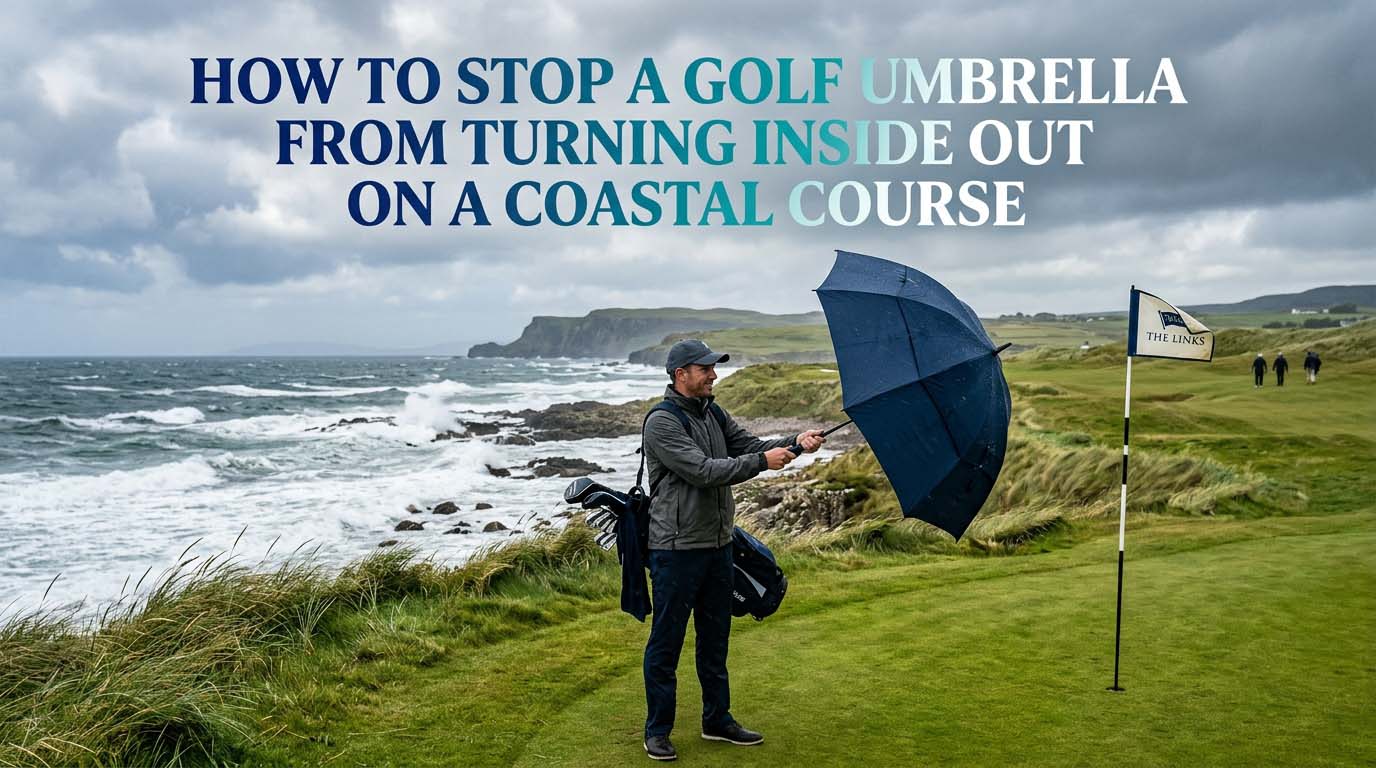
You are standing on the 8th hole at a coastal links course. The breeze off the ocean was light when you teed off, but now a gust slams into your umbrella and flips the canopy inside out. The ribs bend. The fabric tears. You are left holding a useless stick in the rain. I have been there more times than I want to admit.
After years of playing on exposed courses from Bandon to the British coast, I learned that stopping an inversion is not about luck. It is about technique, understanding the wind, and choosing the right gear. Here is what actually works.
The Right Angle and Grip That Keep the Canopy Aloft
Most golfers hold the umbrella straight over their head. That is a mistake. When the wind hits the underside of a flat canopy, it creates lift like a parachute. The moment you feel a gust, do not freeze.
Stop walking, lower your hand to the very bottom of the handle, and angle the canopy 20 to 30 degrees into the wind. Never point it straight up. You want the wind to spill over the top, not catch underneath.
Your grip matters too. Hold the handle at its base, right where it meets the shaft. If you grip it halfway up, the leverage works against you. A gust will rip the umbrella out of your hand or torque the frame.
With a low grip, your arm acts as a shock absorber. I also keep the umbrella tilted slightly forward when walking; imagine you are holding a shield against the wind. This deflects gusts upward before they can get under the canopy.
When the wind is steady and strong, you may need to lower the umbrella altogether for a few seconds. Do not fight it. Close it quickly, wait for a lull, then open it again after judging the next burst. That takes practice, but it saves your equipment.
Why a Golf Umbrella Turns Inside Out
To fix the problem, you need to understand what causes it. A standard golf umbrella has a concave shape. When wind hits that curved underside, it fills the space like a bucket being lowered into moving water.
The air pressure inside the canopy builds faster than the fabric and ribs can release it. The result: the canopy pops over the top of the frame. That is an inversion.
Coastal gusts are not steady. They hit suddenly and hard. The peak force of a gust can be double the sustained wind speed. That shock load is what overwhelms the umbrella’s structure.
A cheap umbrella with thin metal ribs will bend first, then flip. Even a good umbrella can flip if the angle is wrong. The key is to prevent that pressure build-up by giving the wind an escape path. That is where vented canopies come in, but we will get to that later.
The salt air on coastal courses also makes the problem worse. Salt spray corrodes the metal joints and stiffens the slider mechanism over time. A sticky slider means you cannot close the umbrella fast enough when a gust hits.
Rust builds up inside the hub where the ribs connect, creating weak spots that snap under load. That is why an umbrella that worked fine inland fails after a few rounds by the ocean.
The Unique Wind Behavior of a Coastal Course
Inland courses have trees, hills, and buildings that break up the wind. A coastal course has none of that. The wind comes straight off the ocean with full force.
But it is not constant. It comes in pulses: a gust, then a lull, then a bigger gust. You have to treat your umbrella like a sailboat mainsheet: constantly adjusting the angle.
There are two specific wind patterns that cause most inversions on coastal courses. The first is the gust front. A gust front is a line of strong wind that moves across the course like a wave.
You see the grass flatten, then three seconds later the wind hits you. If your umbrella is straight up when that gust arrives, it will flip. Watch the grass and the water. When you see the telltale ripple, tilt the umbrella immediately.
The second pattern is the dune tunnel effect. Wind accelerates through gaps between dunes, clubhouses, or cart paths. It comes at you sideways, often at waist height. That horizontal hit catches the underside of a standard umbrella from the side and flips it before you can react.
When you walk near a dune gap, close the umbrella or hold it very low and angled toward the gap. That one habit has saved me more umbrellas than any fancy vent.
Salt also creates a subtle issue. After a few rounds, the umbrella’s canopy fabric becomes slightly stiffer from salt crystallization. That stiffness reduces the fabric’s ability to flex with the wind.
A stiff canopy catches more wind than a supple one. Rinse your umbrella with fresh water after a coastal round. It takes two minutes and extends the life of the canopy.
Choosing a Windproof Golf Umbrella for Coastal Play
Technique will only take you so far. If you play coastal courses regularly, you need the right tool. The most important feature is a vented canopy. A vented umbrella has a panel of open mesh or a slit near the top that lets air escape. This equalizes the pressure between the underside and the top of the canopy.
Without that pressure difference, the umbrella cannot invert. You can test an umbrella’s venting by looking at the top from the inside; a proper vent is a separate section of fabric or a gap, not just a tiny hole.
Fiberglass ribs are essential. Fiberglass flexes in a gust and returns to its original shape. Aluminum or steel ribs bend permanently.
Once bent, the umbrella’s tension is uneven, and it will flip again in a lighter wind. I have snapped aluminum ribs on a solid canopy in a 20 mph breeze. Fiberglass will bow but survive.
Canopy size matters too. Big 68-inch umbrellas give you more coverage, but they also catch more wind. On a blustery coastal day, a 60-inch vented umbrella is easier to control.
The smaller surface area means less lift. Do not buy the biggest umbrella you can find. Buy the one that works with the wind.
Double-layer canopies are another good option. These have a top layer and a bottom layer with a gap between them. Wind hits the top layer, flows through the gap, and passes over the bottom layer without catching underneath.
It works like a spoiler on a car. I own one double-layer umbrella that has never flipped, even in a strong coastal blow. That is my recommendation for anyone who plays near the ocean more than twice a year.
Avoid umbrellas labeled “windproof” that do not specify venting. Some marketing uses the word loosely. Look for actual vents, visible mesh panels, or a secondary layer. If the description says “wind-resistant,” that usually means it handles a light breeze, not a coastal gust.
Comparison of Common Umbrella Materials
| Material | Flexibility | Durability in Salt Air | Best Use |
|---|---|---|---|
| Fiberglass ribs | High — bends and returns | Good — resists corrosion | Coastal, gusty conditions |
| Aluminum ribs | Low — bends permanently | Poor — corrodes quickly | Inland, calm days |
| Steel ribs | Very low — heavy and rigid | Poor — rusts fast | Not recommended for wind |
| Double-layer canopy | N/A (fabric design) | Excellent — prevents lift | Coastal, strong sustained wind |
The Field Repair Protocol When the Umbrella Flips
Even with the best technique and gear, it can still happen. A sudden gust catches you off guard, and the canopy flips. Do not panic. Do not yank the runner down. That is the biggest mistake.
When the canopy is inside out, the ribs are locked in an inverted position. Forcing the slider will snap the fiberglass or tear the fabric at the hubs.
Here is the step-by-step fix I use on the course:
- Hold the umbrella by the ferrule — that is the tip at the top. Gently shake the umbrella toward the ground. This lets the ribs swing back into their normal position.
- Use your free hand to separate the primary ribs. Guide each rib back over the runner, one at a time. Do not force anything. The ribs should move back smoothly if the fabric is not torn.
- Once the canopy is close to its normal shape, slowly close the umbrella. Slide the runner down gently. If you feel resistance, stop and check for a caught rib.
- Inspect for damage. Look for bent ribs, torn seams, or a cracked hub. If a rib is bent but not broken, you can gently flex it back. But do not trust it fully — a bent rib will fail again sooner.
If you are in the middle of a round and the fabric tore, use packing tape on the underside of the tear.
That will hold for the remaining holes without making the tear worse. Do not use duct tape; it leaves sticky residue that attracts dirt. Packing tape peels off cleanly.
One more thing: if the umbrella has inverted multiple times, replace it. The fabric stretches with each inversion, creating loose spots that catch more wind. The hubs also develop micro-cracks. You cannot fix that on the course.
Common Habits That Sabotage Wind Resistance
Many golfers do things that make the problem worse without realizing it. Here are the habits I see most often, and the ones I stopped doing myself.
- Holding the umbrella straight overhead. This blocks your view and gives wind a flat target. Always angle it.
- Leaning the umbrella back on your shoulder. That tilts the canopy backward, catching wind on the underside. Keep it tilted forward.
- Leaving the umbrella open on the ground during a putt. I have seen an open umbrella roll across a green like a tumbleweed. The frame gets twisted and the canopy rips. Lay it flat on the ground, pointed downwind, or stick it behind your bag.
- Using a golf cart umbrella for handheld play. Those are designed to clamp to a cart. They often have straight handles that are hard to grip low, and they lack venting. Buy a handheld umbrella for handheld use.
- Continuing to use an old umbrella with creaking joints. Creaking means the metal has fatigued. It will snap in the next decent gust. Retire it.
Another subtle mistake is opening the umbrella too fast. When you pop it open aggressively, you stress the joints and the slider. Over time, that loosens the tension. Open it smoothly and let the canopy find its shape before you tilt it into the wind.
Frequently Asked Questions
How much wind can a standard golf umbrella handle?
A standard golf umbrella with a solid canopy and metal ribs can handle sustained winds up to about 15 to 25 miles per hour. Above that, the risk of inversion rises quickly.
In coastal gusts that exceed 30 mph, even a good umbrella needs careful angle management. Vented fiberglass models can withstand stronger gusts, but no umbrella is safe in a full gale.
Are double-canopy umbrellas better than single-canopy for wind?
Yes. The gap between the two layers creates a pressure relief valve. Wind passes through the top layer and exits between the layers, so it never builds up underneath. Double-canopy umbrellas are significantly better at resisting inversion in coastal conditions.
What is the best way to anchor an umbrella when using my hands to hit a shot?
Lay it flat on the ground, pointed downwind. Do not stand it up unsupported — a gust will either tip it over and drag it or flip it. Another option is to place it behind your golf bag so the bag blocks some wind. Never leave it open and unattended on a cart path or near a green.
Can I straighten a bent umbrella rib on-site?
Yes, gently. Use your hands to bend the rib back into alignment. But understand that the metal or fiberglass has been stressed. The rib will not hold its shape as well, and it will likely bend again in a lighter wind. Treat it as a temporary fix to finish your round, then replace the umbrella or have the rib professionally swapped.
Do I repair or replace an umbrella that has inverted multiple times?
Replace it. Repeated inversions stretch the canopy fabric unevenly and weaken the plastic hub at the top. Even if you straighten the ribs, the fabric will catch more wind the next time because it has lost its original tension. A new vented umbrella will cost less than a repair and will save you the frustration of another flip.