
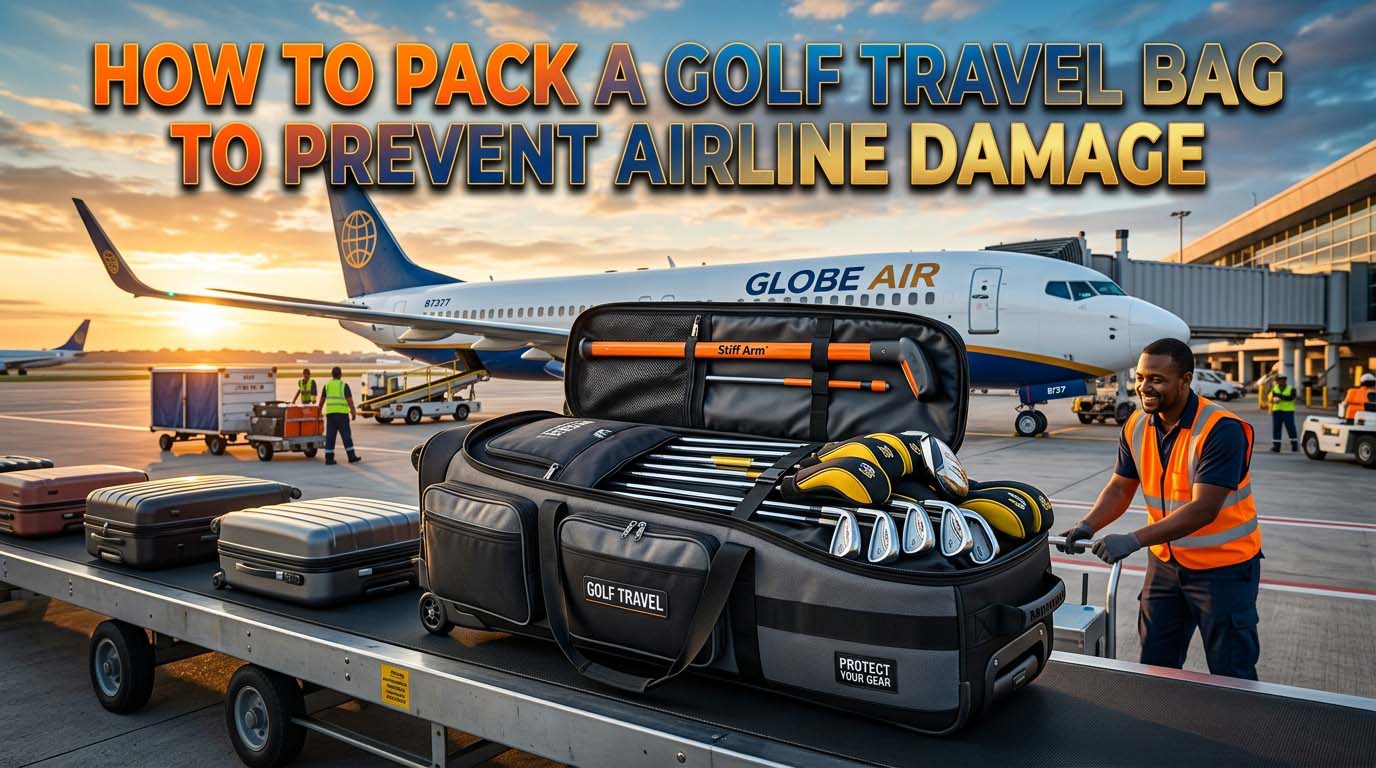
You spent good money on your set. The last thing you want is to open your travel bag at the destination and find a snapped shaft or a driver head rattling loose. Most airline damage is not a single hard smash. It is the slow wear of clubs shifting against each other for hours during loading, unloading, and flight vibration. This guide covers exactly how to eliminate that movement.
Why Golf Clubs Break During Travel
Before you pack, it helps to know what you are protecting against. The most common failure points are not what most people expect.
The number one cause of damage is not a bag falling off a cart. It is compression and vibration over time. When clubs shift inside a soft case, graphite shafts rub against each other and the side of the bag. That constant friction creates micro-fractures. The shaft may look fine when you pack it, but it snaps on the first swing at your destination.
The top of the bag is the danger zone. In a soft case, the overhead bins and cargo handlers place heavy bags on top of your golf bag. The top of your bag compresses down onto the club heads. This is where drivers and fairway woods most often break.
The second cause is torsion. When a baggage handler grabs your bag by the handle at one end, the clubs inside twist. If they are not locked in place, that twist travels down the shafts. Graphite shafts handle bending well. They do not handle twisting.
Equipment Audit: Choosing the Right Travel Bag
A good travel bag is the foundation. You have three choices.
Hard case. A hard shell offers the most protection. The rigid exterior transfers impact forces away from the clubs. The downside is storage. You need to keep the hard case somewhere during your trip. Rental cars and hotel rooms get tight fast.
Soft case with padding. Most golfers use this. It is easier to store and lighter to carry. The padding level varies significantly between brands. The cheapest soft cases have a single layer of foam. Premium soft cases use multi-density foam in the impact zones. A soft case requires more internal packing strategy than a hard case.
Hybrid. Some bags combine a soft case with rigid panels in the top and bottom. These are a good middle ground. They store smaller than a hard case but offer better protection than a standard soft case.
The “no-rot” test is a quick way to evaluate any bag. Grab the top of the fully packed bag with one hand and the bottom with the other. Try to twist it. If you can twist it easily, your clubs will twist too. That is a soft case that needs more internal structure.
The Layered Protection System
This is the method that prevents damage. It works on five layers. Each layer handles one type of movement.
Layer 1: The Spine
A stiff arm is a metal or carbon fiber rod with a rubber top that sits inside the bag. It extends above the longest club. When the top of the bag gets compressed, the stiff arm takes the weight. It keeps the bag from collapsing onto your driver.
If you do not have a stiff arm, you can build one. A five-gallon bucket from a home improvement store works. Cut the bottom out, slide it over the top of your clubs, and let the bucket walls act as a rigid barrier. Some experienced travelers use a pool noodle cut to length. Slide it over the shafts before placing them in the bag. It adds compression resistance and prevents shafts from rubbing each other.
The spine must be taller than your tallest club. If the soft top of the bag can still touch the club head, the spine is too short.
Layer 2: The Head Lock
Driver and fairway wood heads are the most vulnerable pieces. If your clubs have interchangeable heads, remove them. Put each head in its headcover. Then place each head-and-headcover inside a sock. Pack those socks inside your carry-on or in a separate pocket of the travel bag where they cannot press against anything hard.
If you cannot remove the heads, you need to prevent lateral movement. Wrap a towel around the heads of the woods. Secure it with a rubber band or tape. This creates a padded block that cannot slide around.
For putters, the same logic applies. The putter head is often the most expensive single club in the bag. Remove it if possible. If not, protect it with a headcover and extra layers of towel.
Layer 3: The Middle Section
Irons and wedges need a different strategy. Place them so the heads are at the bottom of the bag. Alternate the orientation. Point one iron head up, the next iron head down. This “inverted wedge” trick interlaces the club heads. They lock each other in place. There is less room for shifting.
Wrap a towel around the entire bundle of iron heads. This dampens any remaining vibration and protects the ferrules. Ferrules crack easily when clubs bang together.
Layer 4: The Base
The bottom of the bag takes the most abuse during loading and unloading. Use your golf shoes as shock absorbers. Place them at the bottom of the bag, soles facing down toward the travel bag floor. Wrap a towel around them to keep dirt contained. The shoes add a layer of cushion between your clubs and whatever the airline drops the bag on.
Layer 5: The Crown
The top of the bag is where most compression damage occurs. After you have packed everything, there will be empty space at the top. That space allows the bag to compress when something sits on it. Fill it.
Soft items work best. Pack your rain gear, a pair of pants, and a few extra towels at the top. Stuff them around the stiff arm. Do not leave any empty space. The goal is to make the top of the bag as solid as the rest of it.
What Not to Put in Your Travel Case
Some items should never go inside a golf travel bag.
Do not pack heavy liquid bottles near the clubs. A full water bottle or sunscreen will shift and hit the shafts. If it breaks, the liquid damages grips and ferrules.
Do not pack loose batteries. TSA inspectors will open the bag to check, and they rarely repack it correctly. Keep batteries in their original packaging or taped to a flat surface.
Do not pack your rangefinder, GPS, or watch in the travel bag. These always go in your carry-on. If the airline loses your checked bag, you lose your expensive electronics. If they damage the bag, those items are also damaged. Keep valuables on your person or in your cabin luggage.
The Pre-Flight Shake Test
Before you zip the bag, lift it off the ground by the handle. Shake it. Then drop it from about six inches onto a hard surface. Listen. Any rattling or clanking means the clubs are not locked in place.
Go back and add more padding until the bag is silent. This test takes ten seconds and catches most packing failures.
Final System Check: Weight Distribution and Balance
A lopsided travel bag is a red flag for airline scanners. If one side is significantly heavier than the other, the bag will not sit flat on the conveyor. That increases the chance it gets flagged for manual handling.
Balance the weight. Put heavy items like shoes on the bottom. Use clothes and towels to fill gaps. The bag should be heavy enough that it does not wobble when you set it on the floor, but light enough to stay under the airline weight limit. Most airlines cap golf bags at 50 pounds. Some go to 70 pounds. Check your specific carrier before you pack.
The Pressure Check: What Happens at Altitude
Cargo holds are not fully pressurized. During flight, the pressure drops. A sealed bag will have air trapped inside. That air expands. If your bag is packed tight with no ventilation, the expansion can push stress onto the sides and zippers.
The fix is simple. Leave a small gap in the main zipper. Do not seal it completely. Alternatively, pack so that there is some give in the top of the bag. Soft items like towels and clothes compress easily and absorb the pressure change.
Everyday Items That Work as Packing Tools
You do not need specialized golf gear for every layer. Here is a short list of household items that work.
Pool noodles. Cut to length. Slide them over shafts to prevent rubbing.
Five-gallon bucket. Cut the bottom out. Use it as a rigid top cover for soft cases.
Cardboard. A sheet of corrugated cardboard placed at the bottom of the bag adds a layer of impact resistance. Replace it each trip.
Plastic grocery bags. Use them as filler for small gaps. They weigh nothing and pack flat.
Rubber bands. Keep bundles of clubs tight. Rubber bands are better than tape because they do not leave residue.
The Backup Plan: If Something Breaks Anyway
No matter how careful you are, there is always a chance. Carry a small emergency kit in your golf bag.
Include a tube of ferrule glue. If a ferrule cracks or separates, a drop of glue holds it in place for the round. Carry one extra grip and a roll of grip tape. A damaged grip can be replaced at the hotel in ten minutes. Carry a hex key that fits your driver head. If a head loosens during shipping, you can tighten it before you play.
Before you fly, take photos of your entire set. Shoot the serial numbers of each club. Take a photo of the bag packed and ready. If something is missing or damaged, you have visual evidence for the insurance claim. Keep your purchase receipts in your email so you can access them anywhere.
Frequently Asked Questions
How heavy can a golf travel bag be before airlines charge fees?
Most airlines set the limit at 50 pounds for a checked golf bag. Some allow up to 70 pounds, like Delta and United on certain fare classes. Exceeding the limit results in an overweight fee that can be more than the base bag fee. Weigh your bag at home before you leave.
Can I pack golf balls in my travel bag?
Yes, but pack them strategically. Place them in the bottom of the bag near the shoes. They add weight quickly, so count them. A dozen standard golf balls weighs about one pound. If you are near the weight limit, pack fewer balls and buy more at your destination.
Do I need to remove my putter head?
Yes, if you can. Putter heads are often attached with a single screw. Removing the head eliminates the risk of the shaft bending at the neck. Put the head in its cover and pack it in your carry-on.
Should I remove the grips or sensors from my clubs?
If your clubs have sensors in the grips, remove them before packing. The sensors add a tiny amount of height. If the clubs are packed tight, that extra height forces the top of the bag to bulge. Remove the sensor and pack it in a separate pocket.
How do I handle connecting flights?
Short layovers are risky. If your bag is transferred between planes manually, it faces the most handling during that transfer. Use an AirTag or similar tracker so you know where your bag is. If the connection is under one hour, your bag may not make it onto the second plane. Book longer layovers for peace of mind.
What about TSA inspections and locks?
Use TSA-approved locks on your travel bag. Non-approved locks will be cut off by TSA if they need to inspect the bag. That leaves your bag unsecured for the rest of the trip. If you are flying internationally, some countries require a physical inspection of golf clubs for dirt and seeds. Use a lock that allows easy access so they can repack your bag properly after inspection.