
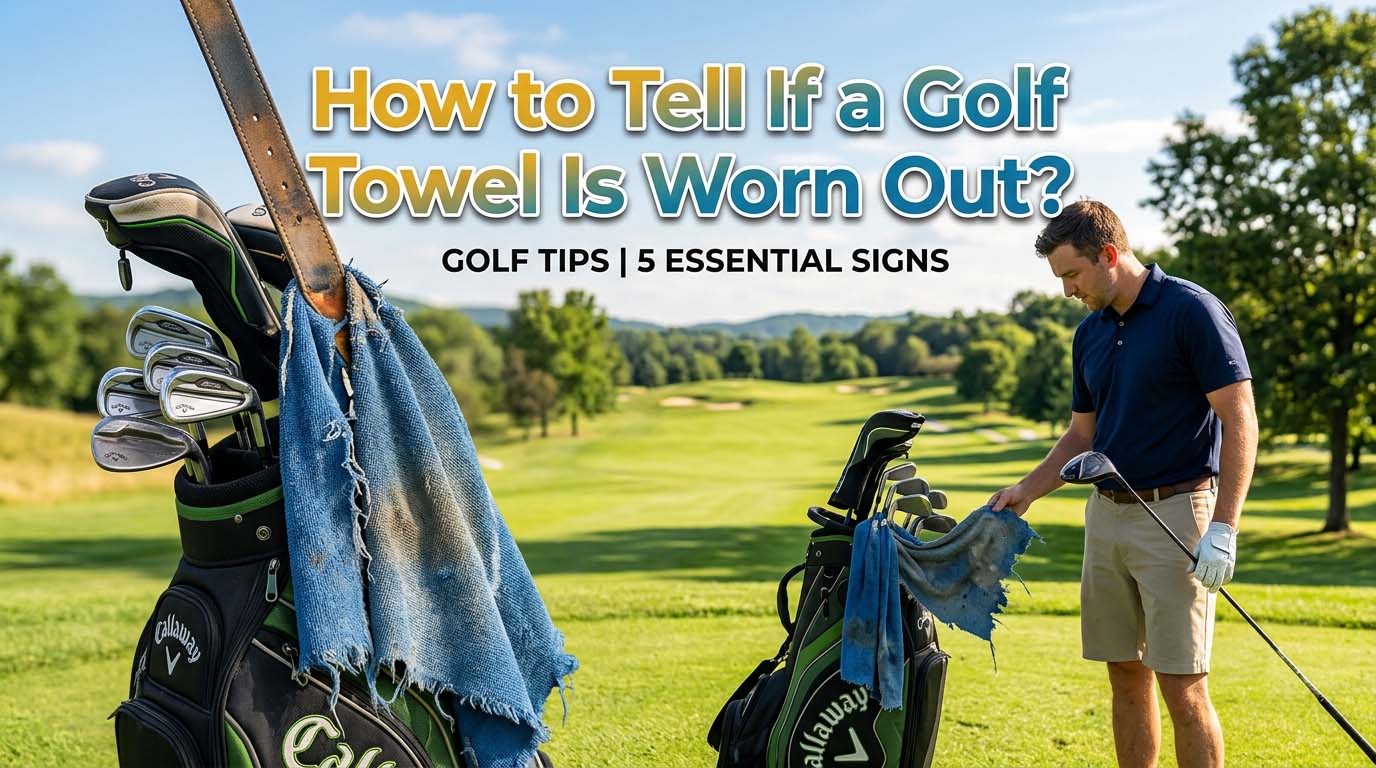
I have been through many kinds of golf towels over the years. Some lasted a full season. Others died in three months. The difference was not always the brand or the price. Most of the time, it was me not knowing when to let go.
A worn-out towel does not just stop working. It can hurt your clubface, leave lint on your grips, and make you think your golf clubs are dirty when they are not.
The single most reliable way to tell if your golf towel is done is the thumbnail test. You do not need to look at stains or rips first. You just need water and ten seconds.
The Primary Test: The Thumbnail Check
This is the only test that measures performance directly. It works on any towel material.
What you do:
- Wet the towel with clean water. Soak it completely.
- Wring it out with moderate force. You want it damp, not dripping.
- Press the center of the towel with your thumb. Hold for three seconds.
- Remove your thumb and look at the spot.
What it tells you:
If the spot stays wet and dark, the towel fails the test. A healthy towel, even when damp, will wick that moisture away from your thumb instantly. The wet spot should disappear within a second or two.
If it does not, the internal fibers are matted or clogged. The towel is functionally dead. It looks fine, but it will not clean effectively anymore.
This happens because of the physics of capillary action. Microfiber and cotton both rely on tiny channels between fibers to pull water in. Over time, dirt, oil, detergent residue, and hard water minerals fill those channels. The towel becomes a smear tool instead of a cleaning tool.
Secondary Visual and Tactile Signs of Wear
Pass the thumbnail test? Good. Now look for these other signs. They tell you when the towel is still working but starting to fail.
The Fraying Threshold
A single loose thread is not a reason to replace. I have seen people throw away towels because one edge had a stray loop. That is wasteful. Use the three-stitch rule.
If you can pull a thread and it unravels past three stitches, the weave is compromised. The towel will soon develop holes or lose its shape. At that point, replace it.
The Lint Shedding Index
A clean towel should not leave lint on a clean clubface. If you wipe a dry club and see fuzz or tiny fibers, the towel is shedding broken fibers. This happens when the material has been abraded by sand, velcro, zippers, or rough washing.
That lint will stick to your clubface and affect spin. It makes the towel worse than a dirty towel.
The Stiffness Indicator
A towel that feels stiff or crunchy after washing, even without fabric softener, has mineral buildup or detergent residue.
The fibers cannot separate to trap dirt. You can sometimes fix this with a vinegar soak (one cup white vinegar in hot water, no detergent). If the stiffness returns after one more wash, the fibers are permanently damaged.
The Hidden Performance Decline
This is the part most articles miss. A towel can pass all the visual checks and still perform poorly.
The Sponge Test
A new golf towel should hold six to eight times its dry weight in water. A worn-out towel might hold only two or three times. Here is a simple home test.
- Weigh your towel dry. Use a kitchen scale.
- Soak it, then wring it out lightly (same as the thumbnail test).
- Weigh it wet.
- Divide the wet weight by the dry weight.
If the ratio is below 4, the towel is losing absorbency. It will not pick up water from your clubface or ball effectively. You will have to wipe multiple times.
The Drying Speed Failure
A worn-out towel dries faster because it has less fiber surface area to hold water. That sounds like a good thing. It is not. A fast-drying towel cannot hold enough water to clean wet clubs or wet grass.
You end up with a towel that is dry before you finish the next hole. That means you are wiping a dry towel across a dirty surface. That grinds dirt into the clubface.
The Serviceable vs. Worn Out Decision
Sometimes you can fix a towel. Sometimes you should not.
The Grommet or Badge Check
If the carabiner loop or the silicone badge is cracked or detached, you can sew a new loop on. That is a five-minute fix. But if the fabric around the badge is frayed or torn, the towel is done. The whole area is the weakest point. It will tear open the first time you pull the towel off the bag.
The Edge Case Assessment
Not every towel needs to go in the trash. Create a hierarchy.
| Use | Condition | Action |
|---|---|---|
| Clubface and ball | Passes thumbnail test, no fraying, no lint | Keep |
| Grips and hands | Fails thumbnail test but looks clean | Move to bag towel |
| Bag exterior and shoes | Stains, minor fraying but still holds water | Move to shoe towel |
| Disposal | Lint shedding, stiffness, holes, or fails sponge test | Throw away |
A towel that is too clean to throw away but too worn for clubface is still useful. Just label it. I keep a dedicated shoe towel in my bag. It saves my good towels from mud and sand.
Avoiding Premature Towel Failure
Most types of golf towels do not die from normal use. They die from the washing machine.
Never use fabric softener or dryer sheets. They coat the fibers with a waxy layer. That layer blocks water absorption. You will see the thumbnail test fail after just two washes with softener.
Wash with a mild detergent only. No bleach. Bleach breaks down microfiber. For cotton towels, bleach is fine, but it will fade colors quickly.
Air dry or tumble dry on low heat. High heat melts microfiber. The fibers fuse together and lose their ability to wick. Cotton can handle high heat but shrinks.
Avoid washing with items that have zippers, Velcro, or hooks. They snag the weave. Wash golf towels alone or with other soft items like undershirts.
Lifespan expectation:
| Material | Washer cycles before noticeable decline |
|---|---|
| Generic cotton | 50 to 100 |
| Standard microfiber | 100 to 150 |
| Premium waffle-weave microfiber | 150 to 200 |
These numbers assume proper care. If you use fabric softener, cut all numbers by 75 percent.
Myth: A Stained Towel Is a Dirty Towel
This is the biggest mistake I see. People throw away a towel because it has a grass stain or a rust spot.
They keep a towel that looks clean but has lost all absorbency. The truth is that a stained towel that still wicks moisture is far more useful than a clean towel that smears water. Stain does not affect performance. Matted fibers do.
If you care about looks, buy a black towel. If you care about performance, use the thumbnail test.
Frequently Asked Questions
What is the slit in a golf towel for?
The slit is for hanging from a D-ring or a bag strap without a carabiner. You slide the strap through the slit. It lets you pull the towel off quickly. It is not a sign of wear. Some towels come with a slit brand new.
Should you wet your golf towel before use?
Yes, for clubface cleaning. A dry towel is abrasive. For grip cleaning, use a slightly damp towel. A bone-dry towel is only useful for drying your hands or your gloves.
How many golf towels should you carry in your bag?
At least two. One wet for clubface and ball cleaning. One dry for hands and grips. That is the standard setup on tour. It is not a luxury. It saves time and keeps your equipment clean.
Can a worn-out golf towel damage my clubs?
Yes, indirectly. A matted or stiff towel acts like sandpaper. It micro-scratches the clubface over hundreds of wipes. A towel that sheds lint leaves a residue that can affect spin on the ball. The damage is slow but real.
Is a cotton or microfiber towel better for longevity?
Microfiber lasts longer in terms of structural integrity. It has fewer loose threads. But cotton is more forgiving of improper washing.
Cotton will not melt in high heat. The best longevity comes from a high-quality microfiber with proper care. Follow the care checklist above and your towel will last twice as long.