
Most golfers grab a towel, hook it on the bag, and assume they’re set. But after a few rounds, you realize that one dry towel doesn’t cut it. A dirty club face costs you spin. A wet grip makes you squeeze too hard. And that muddy towel you keep using to wipe your ball? It’s scratching your chrome finish without you noticing.
Here is the truth: proper golf towel use is a two-towel system. One side stays wet for cleaning, the other side stays dry for finishing. If you walk nine holes with only one dry towel, you are leaving strokes on the course.
In this guide, I’ll walk you through everything I’ve learned from cleaning clubs in every condition: dry dust, sticky mud, wet rain, and sweaty summer rounds. No fluff. Just what works.
Setting Up Your Towel System Before the Round
The minutes before you tee off determine how well your towel performs. Don’t just toss it on the bag and hope for the best.
Wetting Strategy
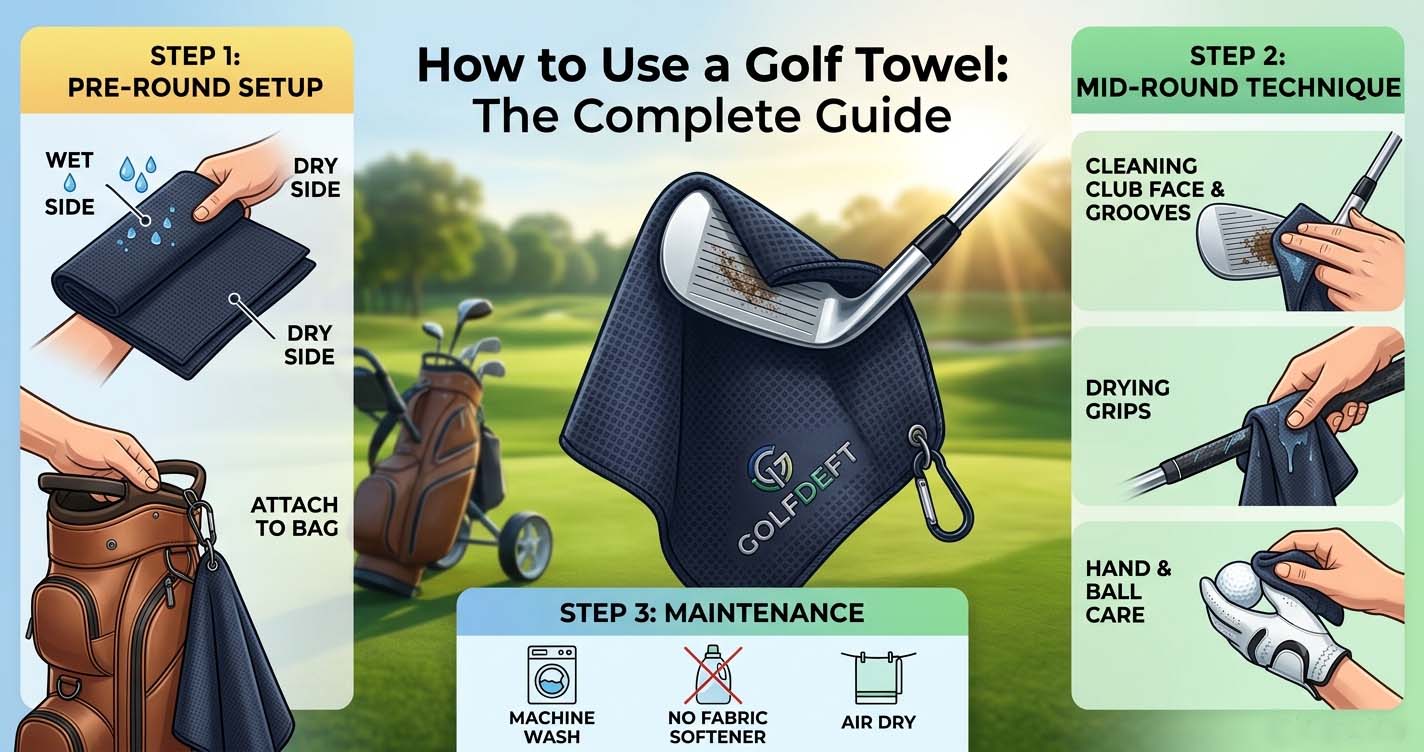
Take your primary towel and get one half completely saturated under a faucet. Wring it out until it stops dripping, but keep it damp, not soaking. The other half stays bone dry. This is the only setup you need for 90% of rounds.
If the course is dry and dusty, a wetter side works better because dirt lifts faster. If the fairways are dewy, skip the wetting – the moisture on the grass already makes the ball and club face damp.
Folding and Positioning
Fold the towel lengthwise so the wet and dry halves are clearly separated. Hang it so the wet half hangs lowest, gravity will keep moisture away from the dry section.
Place the towel on the side of your bag that matches your dominant hand. Right-handed player? Hang it on the right side of the bag so you can grab it without reaching across your body. This small adjustment saves time on every shot.
Attachment Method and Access Speed
Not all towel attachments are equal. The way you hang your towel controls how fast you can pull it mid-round.
- Slit towels: The slit lets you hook the towel over any club shaft. You can grab it with one hand, and it pulls free instantly. Best for walkers who need fast access.
- Magnetic towels: Stick to the bag frame, a cart bar, or even the back of a training aid. Quick to remove, but the magnet can lose grip if the towel gets heavy with water. Good for riders who move between cart and green.
- Clip or hook towels: Secure but require two hands to detach. Best for riders who don’t need to grab the towel while walking. The clip can scratch painted bag surfaces over time.
- Tri-fold towels: These have multiple fabric textures – a scrub section, a polish section, and a drying section. They are bulkier and harder to access quickly. Good for the range, less practical for mid-round use.
If you carry two towels (which I recommend), use a slit towel for your primary cleaning towel and a smaller magnetic or clip towel for drying hands and grips. That way you never mix functions.
The Three Use Cases and Their Correct Techniques
A golf towel has three distinct jobs, and each requires a different motion and care level.
1. Cleaning the Club Face and Grooves
This is the most important use. Dirt in the grooves kills spin and control. Here is the exact sequence I use after every iron shot:
- Wet pass: Take the damp half of your towel, lay it over the club face, and pull it from the hosel toward the toe in one direction. Never scrub back and forth – that drives debris deeper into the grooves.
- Dry finish: Flip to the dry half and wipe the face again in the same direction. This removes moisture and picks up any remaining fine dust.
- Groove check: If you see packed dirt in the grooves after wiping, use a tee or a groove tool to pick it out. A quick poke is better than rubbing with the towel again.
A common mistake: using a muddy towel to clean a dry club. You are essentially rubbing sandpaper against the chrome. If your towel is caked with mud, rinse it out at a water station before wiping your clubs. This alone will extend the life of your irons.
2. Drying and Restoring Grip Tack
Wet or sweaty grips make you hold the club tighter, which kills swing speed and feel. The dry half of your towel (or a separate dry towel) is for grips only, never use the wet side on a grip.
Hold the club upright and run the dry towel along the grip from top to bottom. One pass is usually enough. If your hands are sweaty, wipe them first, then the grip. This keeps oil from transferring back onto the rubber.
3. Wiping Your Face, Hands, and Body
Never use the same side of the towel that you used for club cleaning. The dirt and sand particles that come off the club will scratch your face and irritate your skin. I keep a small dry towel specifically for sweat and face wiping. If you only have one towel, designate the top few inches of the dry half for body use and keep it folded away from the rest.
Mid-Round Management: Keeping Your Towel Useful
By the third hole, your towel might be soaked, muddy, or both. Here is how to keep it working.
Refreshing a Saturated Towel
If the towel is only wet but not dirty, wring it out over the grass and give it a snap. This restores the damp-dry split. If it is muddy, you need to rinse it. Walk to the nearest water cooler or restroom, wet the entire towel under a stream, wring it out, and re-fold it with a clean damp side and a dry side.
Rotating Two Towels
This is the secret to never struggling with a wet towel. Carry one cleaning towel and one dry towel. The dry towel hangs on the opposite side of the bag or stays in a pocket. Use the cleaning towel for clubs and balls. Use the dry towel only for grips, hands, and face. The dry towel stays dry all around.
Playing in Rain
Rain forces you to change your system. The cleaning towel will get soaked no matter what. Keep a second dry towel inside a zippered pocket or wrapped in a plastic bag.
Pull it out only between shots to dry your grips and hands. After the round, hang both towels to air dry as soon as possible – leaving a wet towel balled up in a bag leads to mildew.
Post-Round Towel Care That Extends Life
A good golf towel lasts years if you clean it right. Most people ruin their towels by using fabric softener.
Washing
Machine wash with warm water and a mild detergent. No fabric softener – it coats microfiber fibers and kills absorption. Also avoid bleach, which breaks down the material.
Drying
Air dry if you can. If you use a dryer, tumble dry on low or no heat. High heat shrinks and stiffens the fabric. Remove the towel while it is still slightly damp and let it finish drying on a rack. This keeps the fibers flexible.
When to Replace
When the towel stops absorbing water or starts leaving lint on your club face, it is time for a new one. A worn microfiber towel will actually push dirt around rather than pick it up.
The Dirty Towel Paradox | Why Your Cleaning Method Could Be Damaging Clubs
This is the gap that most guides skip. If you use a dirty towel to wipe a clean club, you are grinding abrasive particles into the face and finish. The chrome on irons is tough, but repeated micro-scratches from sand and mud will dull the shine and make the face rougher, which can affect spin consistency.
The fix is simple: after every heavy mud cleaning, flick the towel to dislodge loose dirt. If the towel is visibly covered in brown, rinse it before the next wipe. Also, always wipe from the hosel toward the toe; never drag debris across the face from side to side.
Frequently Asked Questions
Can I use a regular bath towel instead of a golf-specific one?
You can in a pinch, but bath towels are thicker, heavier, and produce more lint. Microfiber towels pick up dirt better and dry faster. Cotton terry works for drying grips but smears debris on club faces. For regular play, a microfiber golf towel is worth the small cost.
How do I attach a towel without a slit to a golf bag?
Use a carabiner or a towel clip. Loop the towel through the carabiner and clip it to the bag’s towel ring or a D-ring. You can also thread the carabiner through a corner of the towel if it does not have a grommet. Avoid using a metal hook directly on the bag paint – it can scratch.
Should I wet my golf towel before every round?
Only if the course is dry or dusty. If the grass is wet from morning dew, skip the wetting, the moisture on the ball and club is enough to lift dirt. For summer afternoons with hardpan conditions, a pre-wetted towel saves you time and water.
Can I use a golf towel to clean my golf gloves?
Yes, but only with the dry side. Wet leather gloves shrink and lose their fit. If your glove is sweaty, let it air dry between shots. Use the dry towel to pat off excess moisture without rubbing.
What is the difference between a caddie towel and a player towel?
Caddie towels are usually larger, 16 by 24 inches or bigger, because caddies clean multiple clubs at once. Player towels are smaller, around 12 by 18 inches, for one-handed use. Caddie towels often have a slit for hanging on the bag, while player towels may use clips or magnets for faster access during play.
Final Take
The best use of a golf towel comes down to three rules: keep one side wet and one dry, never mix cleaning and body use, and rinse the towel when it gets muddy. With these habits, your clubs stay clean, your grips stay tacky, and you avoid the frustration of a soaked, useless towel on the back nine.
Set up your system before the round, manage it during play, and care for it after. That is all it takes to turn a simple towel into a stroke-saving tool.