
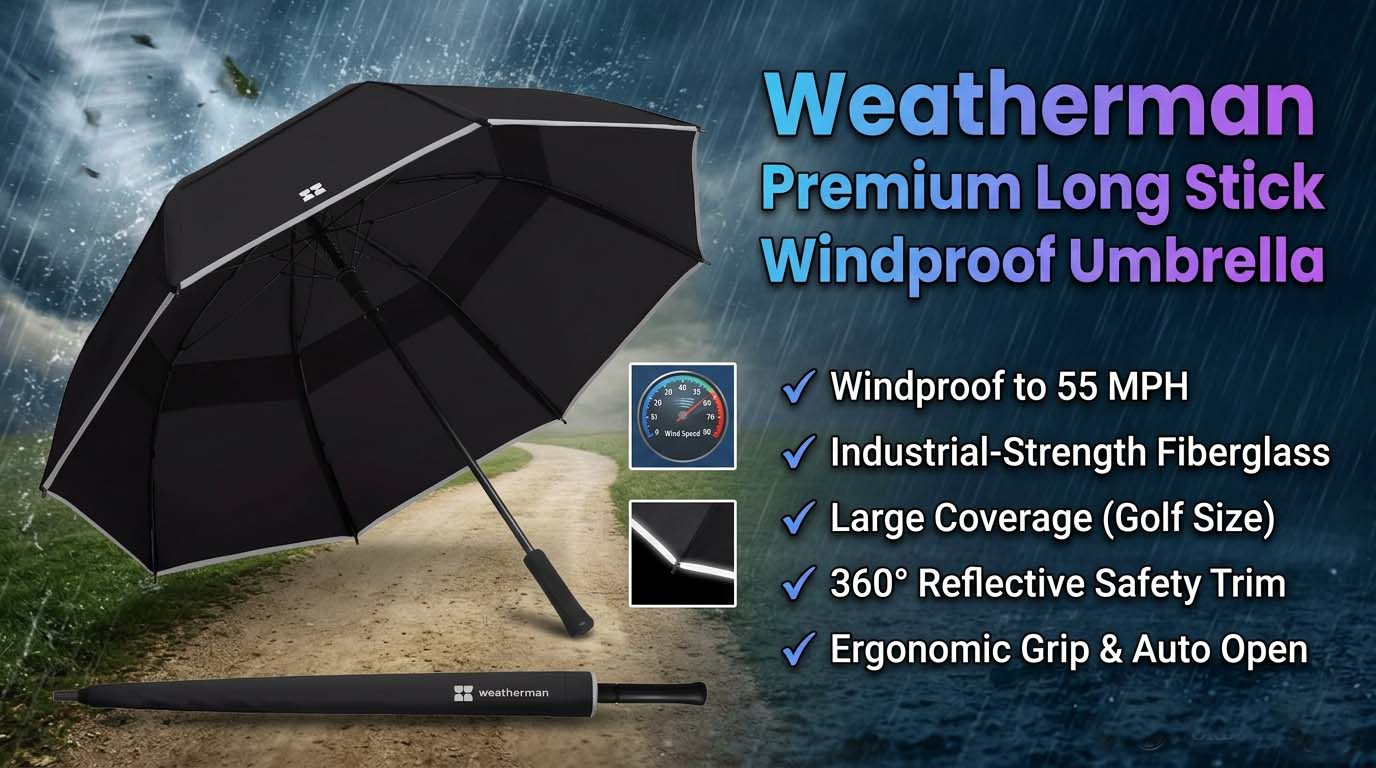
When I first came across the Weatherman Premium Long Stick Windproof Large Umbrellas for Rain (Sage), I’ll admit I was skeptical. Another pricey umbrella claiming to solve the age-old problem of flipping inside out on a windy sidewalk? I’d been burned before. But after carrying this thing through weeks of commutes, storms, and everyday wear, I get it now.
This isn’t marketing hype. It’s a genuinely well-engineered tool built by someone who actually understands weather.
At a Glance
Before I get into the weeds, here’s a quick snapshot of the product I’m reviewing. This single umbrella does one thing exceptionally well: it keeps you dry in conditions that would destroy most competitors.

The Verdict Upfront
Here’s the short version: the Weatherman Premium Long Stick is not the lightest, most compact, or cheapest umbrella you can buy.
But it is the most thoughtfully engineered stick umbrella I’ve tested for extreme weather. It earns a spot as a top-tier heavy-duty option for anyone who walks to work, waits at bus stops, or just hates buying a new cheap umbrella every season.
The umbrella was developed by meteorologist Rick Reichmuth, and that pedigree isn’t just marketing fluff. It shows in the choices made , the frame, the fabric, even the way the handle feels in your hand.
I evaluated this thing across four main criteria: wind performance in real storms, build quality and materials, everyday usability, and long-term value. Here’s what I found.
Why the Weatherman Premium Long Stick Windproof Umbrella Gets Design Right
You can tell within the first thirty seconds of holding this umbrella that it wasn’t designed by a marketing team. It was designed by someone who’s been caught in bad weather more times than they can count and decided to fix the problem for good.
The Fiberglass Frame
Most umbrellas in this price range use steel ribs. Steel is strong but heavy, and when it bends in a gust, it often stays bent. The Weatherman uses a fiberglass frame instead, and this matters more than you’d think.
Fiberglass flexes under pressure and springs back into shape. I took this out on a day when the wind was whipping hard enough to make street signs rattle, the kind of day where a fifteen-dollar umbrella would’ve turned into a twisted metal skeleton within minutes.
The Weatherman flexed, held, and didn’t invert. The 55 mph windproof claim feels earned, not exaggerated.
The Canopy and Fabric
The canopy fabric is dense, water-repellent, and quick-drying. After a solid downpour, I gave it a few shakes, and it was dry enough to put away without soaking everything in my bag. The Sage color I tested is a muted, sophisticated green, not too army, not too pastel.
It’s the kind of shade that looks intentional with a coat or a suit. One nice touch: there’s 360-degree reflective trim stitched around the edge. I noticed it catching car headlights on a dark evening walk, which gave me more peace of mind than I expected.
The Handle | the Elephant in the Room
I need to be direct about this, because it’s the biggest point of hesitation for a lot of people. The handle is plastic. On an umbrella at this price point, that feels like a compromise. I get the concern.
I felt it too when I first unboxed it. But after using it daily, I think it’s the right call for what this umbrella is trying to be. The plastic is a dense, hard, ergonomic shape that fits the hand well.
It won’t rot, crack, or splinter like wood can after repeated soaking. And it’s lighter, which matters when you’re holding it up against strong wind for twenty minutes.
Does it have the warm feel of polished walnut? No. But for a commuter’s daily driver that lives in the rain, the plastic handle is more functional. It’s the biggest compromise you’ll have to accept, and for me, it was worth it.
How It Performs in the Real World
Specs are one thing. How an umbrella handles a real Tuesday evening with gusty rain is another. I put this through a few weeks of varied conditions, and here’s where it shined and where it didn’t.
The Wind Tunnel Test
I don’t have a wind tunnel, but I do live in a city where wind channels between buildings like a maze. I walked through a few notorious gusts that have broken other umbrellas I’ve owned. The Weatherman flexed and held.
The trick is the fiberglass frame and the way the canopy is tensioned; it doesn’t fight the wind so much as absorb it. It didn’t invert once. That’s not something I can say about any other stick umbrella I’ve used at this size.
Water Resistance and Drying
The fabric sheds water seriously well. After rain, a few firm shakes, and it’s mostly dry. I left it leaning against a wall indoors, and it didn’t leave a puddle. One thing I found interesting: Amazon lists this umbrella as having “Sun” and “Patio” use cases in the product specs, which seems odd for a rain umbrella.
But after using it, I get it. The canopy is dense enough to provide solid UV protection, making it a legit option for a patio table or a day at the beach. It’s a dual-use thing that most rain umbrellas don’t offer.
Coverage for Two People
This is a long stick, and it’s large, wide enough that my partner and I could walk side by side under it without shoulder-to-shoulder dripping. For a couple commuting together or a parent walking with a kid, the coverage is excellent. It’s not quite golf-umbrella huge, but it’s close.
What It’s Like to Use Every Day
The little things matter when you use something daily. Here’s where the Weatherman gets out of its own way and where it trips.
Auto-Open and Manual Close
It opens automatically with one press of the button, which is great when a downpour starts without warning. The close is manual; you push it back down by hand. This is actually a design choice that makes the frame more durable, since automatic closing mechanisms are a common failure point.
The trade-off is that you’ll get a little water on your hand when you close it. That’s unavoidable with a manual-close umbrella. I’ve learned to do a quick shake before closing, and it’s fine, but if wet hands bother you, it’s worth knowing upfront.
Weight and Portability
This is a long stick umbrella. It’s not compact, and it won’t fit in a backpack’s laptop pocket. You carry it in your hand or tuck it under your arm. It’s not overly heavy for a stormproof umbrella of this size, but it has presence.
For a car commuter or someone walking a few blocks, it’s fine. For someone who needs to stash it in a bag for emergencies, the collapsible version makes more sense. This one is for the hand or the golf bag.
How It Stacks Up Against the Competition
I haven’t tested every umbrella on the market, but I’ve owned enough to know where the Weatherman sits. Against a cheap gas-station special, it’s night and day; the fiberglass frame alone makes it worth the leap.
Against a premium brand like Blunt, the Weatherman is less avant-garde in design but more practical in price and backed by a stronger guarantee. Against a standard type golf umbrella, the Weatherman is lighter, better in wind, and won’t rust at the joints the way steel frames eventually do.
The lifetime warranty is the kicker. You’re not paying for an umbrella; you’re paying to never buy another one.
Final Verdict
I’ve been using this umbrella long enough to trust it. Here’s who I think it’s for and who should pass.
The Lifetime Guarantee Factor
The lifetime guarantee changes the value equation completely. If something breaks, they replace it. That means the upfront cost isn’t a one-time expense for a single umbrella; it’s a one-time expense for the next decade or more of umbrellas.
When you look at it that way, buying a twenty-dollar umbrella every year starts to look more expensive. The guarantee is real, and it takes the risk out of the purchase.
Who Should Buy It
- City dwellers who walk to the train or bus every day
- Golfers who want a classic stick style that can handle wind
- Parents who need one umbrella that can cover two people
- Anyone tired of buying cheap umbrellas that break in the first storm
Who Should Skip It
- People who prioritize portability above all else, get the collapsible version instead
- Anyone who wants a luxury leather or wood handle at this price point
- People on a tight budget who just need something that works for a season or two
Frequently Asked Questions
Is the Weatherman Premium Long Stick really windproof up to 55 mph?
In my experience, it handles strong gusts that would destroy a standard umbrella. The fiberglass frame flexes instead of snapping, and the canopy is tensioned to resist inversion. I can’t guarantee it’ll survive a hurricane, but for everyday windstorms, it held up flawlessly for me.
Does the plastic handle feel cheap in hand?
It’s a dense, hard plastic with an ergonomic shape that actually fits the hand well. It won’t crack or rot like wood in wet conditions. It doesn’t have a premium luxury feel, but it’s functional, comfortable for extended carry, and lighter than a wood handle would be.
Is the Sage color more blue or green?
It’s a muted, earthy green with gray undertones. Think dried sage leaves, not mint or teal. It looks sophisticated with neutral coats and dark suits without screaming for attention.
How does the lifetime warranty work?
If the umbrella breaks due to a manufacturing defect or normal use, the company replaces it. It’s a straightforward promise that removes the risk of an expensive umbrella failing after a season or two. Keep your purchase confirmation handy.
Can I take this umbrella on a plane?
Yes, but it’s a long stick umbrella, so it won’t fit in most carry-on bags. I’d recommend checking it or carrying it through the gate and stowing it in the overhead bin if the flight attendants allow it. For frequent flyers who need something packable, the collapsible version is a better fit.
After spending real time with the Weatherman Premium Long Stick Windproof Large Umbrellas for Rain (Sage), I can say it earned a permanent spot by my front door.
It’s not perfect; the plastic handle and manual close are genuine trade-offs, but for what it sets out to do, it’s the best stick umbrella I’ve used. If you live somewhere with real weather and want something that’ll last, this is it.