

A golf bag is not a single product. It is a system of compromises. The best bags don’t excel at any one spec; they make every system work together so you forget you are carrying it. Weight, storage, straps, dividers, materials, and hardware all interact. Change one, and you affect the others.
Most articles answer this question by listing bags. That misses the point. You need the criteria, not the verdict. Once you understand the features that matter and the trade-offs between them, you can walk into any store and judge any bag on its own merits.
Here is what separates the best golf bags from the rest, broken down by the systems that define them.
The Ten Features Shared by Every Elite Golf Bag
Every high-performance golf bag includes these ten features. Not all are equally important to every player, but if a bag lacks more than two of them, it is not in the top tier.
| Feature | Why It Matters | Who Prioritizes It |
|---|---|---|
| Full-length dividers | Prevents club tangling and protects grips | Anyone who values organized clubs |
| Integrated stand mechanism | Keeps bag upright and off wet ground | Walkers and push-cart users |
| Multi-density strap system | Distributes weight across both shoulders | Anyone who carries more than 9 holes |
| Strategic pocket topology | Places essentials where you can reach them without taking the bag off | All players |
| Insulated cooler pocket | Keeps drinks cold for a full round | Hydration-focused golfers |
| Rangefinder/valuables access | Quick access to electronics and wallet | Tech-heavy players |
| Waterproof or resistant materials | Protects gear from rain and morning dew | Players in wet climates |
| Reinforced base plate | Prevents bag from collapsing when set down | Cart riders and push-cart users |
| Lightweight core construction | Reduces fatigue over 18 holes | Walkers |
| Premium hardware | YKK zippers, metal clips, rubber feet that last years | Long-term owners |
These ten features are the baseline. Some are non-negotiable (full-length dividers, reinforced base), some depend on how you play (stand vs. no stand), and some are pure luxury (premium leather accents). The best bag for you will nail all the non-negotiables and then optimize the rest for your specific routine.
How Cart Bag Features Differ From Carry Bag Features
Most feature confusion comes from mixing bag types. A cart bag is built to sit on a golf cart or push cart. It is heavy, large, and organized for stationary use. A carry bag is built for walking. It is light, tapered, and balanced for the human body.
Cart bag features: 14-way dividers (often with a dedicated putter well), huge apparel pockets that open wide, a stable flat base that won’t tip on a cart seat, a rain hood that covers clubs while riding, and handles placed for lifting onto a cart. Weight is not a primary concern; most cart bags weigh 6 to 8 pounds.
Carry bag features: Dual-strap harness with padded shoulder straps, a lightweight stand mechanism (aluminum or carbon-fiber legs), a tapered silhouette that hugs your back, pocket placement that keeps weight centered, and a lower overall weight — typically 3.5 to 5.5 pounds. The stand system must deploy quickly and retract without snagging.
The most common feature error in golf is buying a cart bag and trying to carry it, or buying a lightweight carry bag and expecting cart-level storage. They are designed for different physics. If you do both, you need a hybrid bag that splits the difference, usually around 5.5 to 6.5 pounds with a dual strap and decent divider count.
Strap Features That Create True Carrying Comfort
A strap system can make a 6-pound bag feel like 4 pounds, or a 4-pound bag feel like 8 pounds. It is the single most underrated feature on any carry bag.
Single-strap vs. dual-strap: Single straps look classic but concentrate all weight on one shoulder. You will shift the bag constantly. Dual straps (also called a backpack harness) distribute weight evenly across both shoulders, with a sternum strap to stabilize the load. Any bag meant for regular carrying should have a dual-strap system.
What premium straps have: Memory foam padding that conforms to your shoulder shape, airflow channels to reduce sweat, moisture-wicking fabric on the contact surface, and grab handles integrated into the strap webbing for lifting. The best straps also include quick-release buckles so you can detach the bag without threading the strap through.
Articulation systems: Some high-end bags (like Vessel’s Equilibrium Strap) use a pivoting connection that lets the bag rotate independently of the strap. When you lean forward, the bag stays upright.
This reduces strain on your lower back and prevents the bag from sliding off your shoulder. The yardstick: a great strap system makes the bag feel half its actual weight. A bad strap makes even a lightweight bag feel like a burden.
Storage Features That Define an Effective Golf Bag
Pocket count is meaningless without smart layout. The best bags place pockets where your hands naturally reach while the bag is on your back or on a cart.
Essential storage zones:
- A quick-access rangefinder pocket high on the side — reachable without taking the bag off.
- A magnetic valuables pocket (lined with soft material) for phone, wallet, keys. Magnets avoid zipper noise and are faster to access.
- A plush-lined glove slot that airs out the glove between shots.
- An insulated cooler pocket deep enough for six cans plus ice. Should be easy to access while the bag is on a cart.
- A large apparel pocket for rain gear, extra layers, and a ball retriever. Must have a key hook or clip inside.
Divider count and depth: Full-length dividers run the entire depth of the bag. They prevent grips from catching on each other when you pull or replace a club. Partial dividers (only at the top) save weight but cause tangling.
A 14-way divider is best for organization but adds weight and makes club removal slightly slower. A 6-way or 8-way divider is a good compromise for walkers. The critical detail: check the bottom of the bag. If the dividers don’t go all the way down, you will get club chatter and grip damage.
Balance matters: Storage pockets should be arranged so the loaded bag’s center of gravity stays near your spine. A bag with a huge cooler pocket on one side and nothing on the other will cause your back to twist. The best bags place heavier items (drinks, balls) low and centered.
Materials Features That Decide How Long a Bag Survives
The difference between a bag that lasts two seasons and one that lasts a decade is in the raw construction.
Fabric density: Golf bags use nylon in various deniers (D). 420D is common on budget bags; it’s light but tears easily. 600D is the standard for mid-range. 840D and 1680D ballistic nylon are found on high-end bags.
They resist abrasion from bag drop areas, cart edges, and rough handling. Duck canvas (like on MacKenzie bags) is durable but heavy and not waterproof.
CORDURA: This is a branded nylon with a special weave that resists tearing, scuffing, and moisture. It’s not completely waterproof, but it sheds light rain much better than standard nylon. If a bag says CORDURA, you are getting a fabric that military gear uses. That’s a good sign.
Zippers: YKK is the gold standard. High-end bags use YKK Vislon or waterproof zippers. Cheap zippers will snag, jam, or break within a few months. Open every pocket zipper before buying. It should glide smoothly with no resistance.
Base plate and stand feet: The base plate should be rigid. press on it in the store. If it flexes, the bag will collapse when set down on wet ground. Stand feet should be rubber or TPR (thermoplastic rubber), not bare plastic. Rubber feet grip grass and won’t slide on wet turf.
Waterproofing: Fully waterproof bags use seam-sealed construction and waterproof zippers. They will keep your gear dry in steady rain. Splash-resistant bags use DWR (durable water repellent) coatings that wear off over time. If you play in rain, pay for full waterproofing. If not, splash resistance is fine.
Lightweight Features and Their Hidden Sacrifices
This is the part most articles avoid. Every lightweight bag makes a trade-off. You can choose between light, durable, or spacious; pick two. If a bag says it weighs under 3.5 pounds and has a full stand and 14 dividers, something else had to give.
Here is what gets sacrificed to hit low weight:
- Strap foam gets thinner. Less padding means more pressure points on your shoulder. The bag may feel light on a scale but heavy after 12 holes.
- Divider count drops. Many ultra-light bags use a 4-way or 5-way divider. Clubs will tangle more often.
- Pockets shrink. A 3-pound bag won’t hold a full change of rain gear, six drinks, and a dozen balls. Something has to stay home.
- Stand legs get smaller. Thinner legs and smaller feet reduce stability on uneven ground. The bag may wobble or tip.
- Base plate flexes. To save ounces, manufacturers use thinner plastic. The base will deform over time.
- Single-strap design. Some ultra-light bags use a single strap to save weight, but then the weight isn’t distributed at all.
The honest balance point for most golfers is 4.5 to 6.0 pounds. In that range, you can have a decent stand, good padding, full-length dividers, and enough pocket space for a full round.
If you insist on under 4 pounds, accept that you will lose either comfort or capacity. The trade-off is yours to make, but know that it exists.
New Features That Separate This Generation of Golf Bags
Bag technology has moved beyond simple storage and straps. Here are the features that actually improve your round, not just the price tag.
Anti-twist stand mechanisms: Older stands use a single pivot point that lets the bag twist when you swing. Newer designs use a four-bar linkage or stabilizer bar that keeps the bag from rotating. You can see the difference: the bag stays square to your body.
Magnetic accessory rungs: Some cart bags have magnetic strips on the front for holding a rangefinder, glove, or hat. They are convenient but lose strength over time — check the magnet strength in the store.
Passive cooling back panels: Foam pads with air channels that keep your back from sweating. They don’t work miracles but are noticeably better than flat foam.
TPR overmolded handles: Soft rubber over hard plastic at every grab point. They don’t get slippery when wet and are more comfortable to carry than raw nylon.
Self-equalizing straps: Dual straps that automatically adjust to your shoulder width. No need to fiddle with buckles each time you put the bag on.
Carbon-fiber stand components: Expensive but shaves half a pound without losing strength. Found only on premium Vessel and Sun Mountain bags.
Wheeled hybrid travel integration: Some stand bags now include a hidden handle and wheels for airport travel. They are heavier but eliminate the need for a separate travel bag.
Not every new feature is worth the premium. Ask yourself: will it help me on every round, or just look cool at the first tee? If it’s the latter, skip it and spend the money on a better strap or more durable fabric.
Choosing Features Based on How You Actually Golf
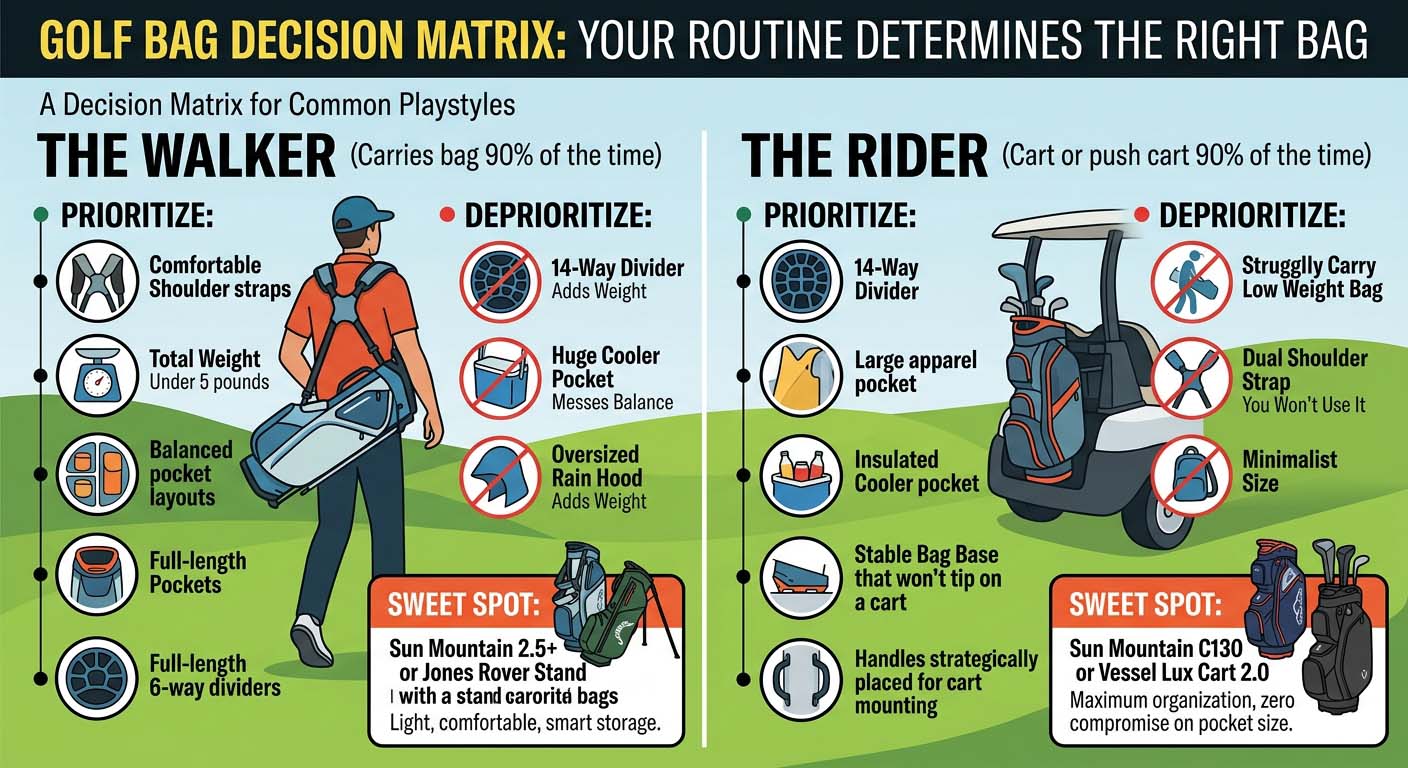
Your routine determines which features matter. Here is a decision matrix for the three common playstyles.
The Walker (carries bag 90% of the time)
- Prioritize: Strap comfort, total weight under 5 pounds, balanced pocket layout, full-length dividers (at least 6-way).
- Deprioritize: 14-way dividers (adds weight), huge cooler pocket (messes with balance), oversized rain hood (adds weight).
- Sweet spot: Sun Mountain 2.5+ or Jones Rover Stand. Light, comfortable, smart storage.
The Rider (cart or push cart 90% of the time)
- Prioritize: 14-way divider, large apparel pocket, insulated cooler, stable base that won’t tip on cart, handles placed for cart mounting.
- Deprioritize: Low weight (you aren’t carrying it), dual strap (you won’t use it), minimalist size.
- Sweet spot: Sun Mountain C130 or Vessel Lux Cart 2.0. Maximum organization, zero compromise on pocket size.
The Hybrid Player (carries sometimes, rides sometimes)
- Prioritize: Convertible features — dual strap that tucks away, stand mechanism that works on a cart without wobbling, weight between 5.5 and 6.5 pounds, at least 8-way divider.
- Deprioritize: Extremes — don’t get the lightest bag or the heaviest cart bag.
- Sweet spot: Ping Hoofer or Vessel Player V Pro. They do both reasonably well.
If you play with a half-set or just a few clubs, a Sunday bag (like the Sunday Loma) is fine. But for a full set, never go below 3.5 pounds — the sacrifices are too severe.
A Storefront Checklist for Judging Golf Bag Features
You can read reviews all day, but nothing replaces your own hands. Take this checklist to a golf shop and evaluate any bag in person.
- Pick it up and put it on your shoulder. Does the strap cross your collarbone or dig in? Adjust the strap length. The bag should sit centered on your back, not sliding toward one side.
- Walk 20 steps with it. Feel the center of gravity. Does it pull you backward or lean to one side? That’s an unbalanced pocket layout.
- Unzip every pocket. Each zipper should glide smoothly. Feel the interior lining. Cheap nylon feels scratchy; premium feels soft. Check the depth — can you fit a full rain jacket?
- Deploy the stand. Push the legs out. They should lock firmly without wobbling. Set the bag down on a level surface. Does it rock? Test it on a slight incline if possible.
- Test divider depth. Insert a club into each slot. Push it all the way down. Does it hit the bottom without snagging? Look under the bag; the dividers should extend to the base.
- Check strap webbing thickness. Squeeze the adjuster buckles. Cheap webbing is thin and slippery. Good webbing is thick and has a textured feel.
- Squeeze the base. Press down on the bottom. It should be rigid. If it flexes, the bag will collapse within a season.
- Load it up. If the store allows, put a few clubs, a water bottle, and a jacket inside. Then pick it up again. The bag should feel balanced. If it tips heavily to one side, the pocket placement is off.
This check takes five minutes. It will tell you more than any five-star review.
Frequently Asked Questions
Is a 14-way divider feature actually better than a 4-way divider?
It depends on your priority. A 14-way divider gives each club its own slot, zero tangling, and easy grip access. But it adds weight (about half a pound) and makes club removal slower because you have to aim for a narrow slot.
A 4-way or 6-way divider is lighter, faster for club changes, and forces you to organize by group (irons, woods, wedges). For riders, 14-way is better. For walkers, 6-way is usually enough.
Do professional golfers prioritize the same features amateurs do?
Not really. Pros who use staff bags never carry them; caddies do. So they prioritize branding, full-length dividers, and a large rain hood. They don’t care about strap comfort or weight.
Pros who carry (rare on tour) use lightweight stand bags, but even then, they focus on access and durability over storage. Amateurs need walkability and practical storage, which pros often ignore.
What does a fully waterproof golf bag feature set include, and is it worth the price premium?
A fully waterproof bag uses seam-sealed construction (all stitch holes are taped or welded), waterproof zippers (YKK AquaGuard or similar), and fabric with a waterproof membrane (not just a water-repellent coating). It will keep your gear dry in sustained rain.
The price premium is usually $50 to $100 over a splash-resistant bag. If you play in rainy climates or early morning dew, it is worth it. If you only play in dry weather, spend the money elsewhere.
How do magnetic pocket features compare to zippered pockets in terms of real utility?
Magnetic pockets are faster to open and close, one hand, no zipper. They are excellent for rangefinders and gloves. But magnets lose strength over time if exposed to heat or shock, and they won’t hold heavy items securely.
Zippers are more secure and last longer. The best bags use magnets for quick-access items and zippers for valuables and large compartments.
Are the features of luxury golf bags materially better or just cosmetic?
Some luxury bags (like Vessel and Jones) use better materials: 1680D ballistic nylon, YKK zippers, memory foam straps, and reinforced bases. These bags genuinely last longer and carry more comfortably.
Others use premium finishes (leather accents, custom colors) but the same base construction as mid-range bags. The rule: look at the material specs before the brand name. If a bag uses CORDURA and YKK zippers, it is probably worth the price. If it just has a fancy logo, you are paying for looks alone.