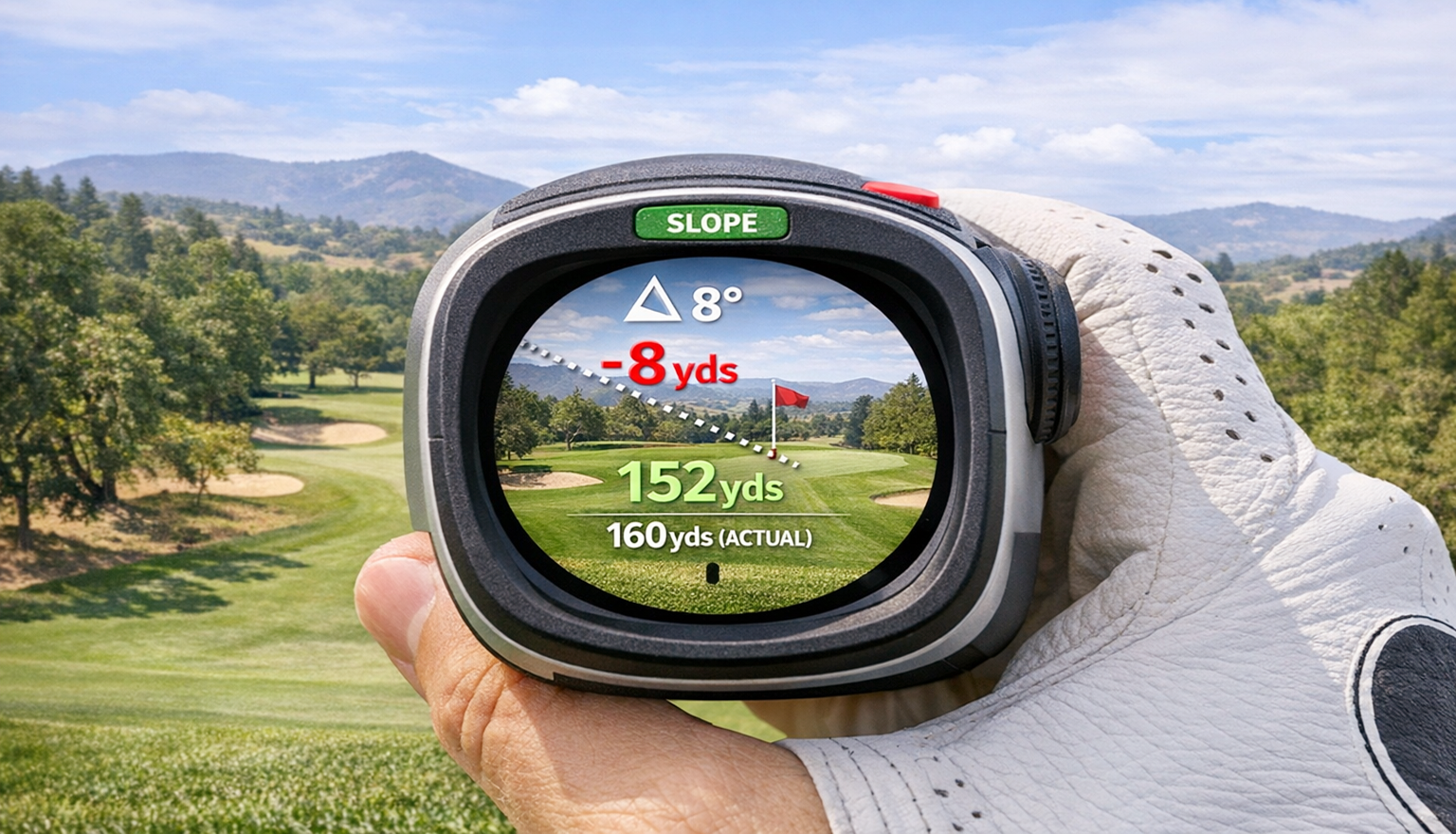
Slope on a golf rangefinder is a feature that adjusts the straight-line distance to account for uphill or downhill elevation, showing the true “play-as” yardage you should use for club selection.
However, understanding how it works — and when it actually improves your score — is what separates casual use from real advantage. This guide explains slope clearly, practically, and with the depth serious golfers expect.
What Is Slope on a Golf Rangefinder?
In simple terms, slope measures elevation change between you and the flag and adjusts the yardage accordingly.
For example:
- Laser distance: 150 yards
- Uphill adjustment: +10 yards
- Displayed play-as distance: 160 yards
That final number — 160 — is the one you should trust.
Without slope, you only see the straight-line measurement. With slope, you see how the shot actually plays.
Why Golfers Search for “Slope on a Golf Rangefinder”?
Most players search this topic for one of three reasons:
- They’re buying a new device.
- They noticed a slope switch and don’t know what it does.
- They want to know if it’s legal in tournaments.
So let’s address all three — clearly and in order.
If you’ve ever hit a perfect 150-yard shot that somehow finished short, elevation was likely involved. Distance alone does not equal effective yardage. That gap is exactly what slope technology is designed to solve.
How Slope Technology Works Inside the Device?
Modern golf rangefinders combine two systems:
First, a laser measures the exact line-of-sight distance.
Second, an internal inclinometer measures the vertical angle between you and the target.
The device then calculates adjusted yardage using trigonometric principles. While the math is complex, the result is simple: a more accurate number for club selection.
If the angle is positive (uphill), yardage increases.
If the angle is negative (downhill), yardage decreases.
Some devices display the angle in degrees, such as +8° or –12°. That information becomes especially useful on mountain or desert courses.
Why Elevation Changes Matter More Than You Think?
Even small elevation changes can impact distance by several yards. Over 18 holes, those small miscalculations add up.
Data from Arccos Golf shows that amateur golfers frequently leave their approach shots short. Elevation misjudgment is one contributing factor.
Now consider this:
- An uphill par 3 plays 8 yards longer.
- You miss short.
- You chip instead of putting.
That single decision can cost a stroke. Multiply that by several holes, and the slope becomes more than a convenience — it becomes a scoring tool.
Real-World Playing Examples
Let’s look at practical scenarios.
On a 150-yard uphill approach with a moderate incline, the device may display 160 yards. Most golfers who ignore elevation instinctively hit their 150-yard club — and come up short.
On a downhill par 3 measuring 120 yards, the play-as distance might drop to 100 yards. Without slope, players often fly the green.
This is not a theory. It’s physics, gravity, and ball flight dynamics.
When Should You Use Slope?
Slope is most useful during practice rounds and casual play. It helps you understand how your distance changes across different terrains.
If you regularly play hilly courses, slope becomes far more important. On flat municipal courses, the impact is smaller but still present.
Many competitive players practice with slope enabled and turn it off during tournaments. That way, they learn true yardage adjustments without breaking rules.
Is Slope Legal in Competition?
This is one of the most searched questions.
Under Rule 4.3 of the United States Golf Association and The R&A, distance-measuring devices are allowed — but slope features must be turned off.
Most modern rangefinders include:
- A physical slope toggle switch
- An external indicator showing slope is disabled
Even the PGA Tour permits distance-only devices in competition, but the slope must remain inactive.
If you compete, always choose a model with a visible slope switch.
Slope vs Non-Slope Rangefinders
Now, let’s address buying intent clearly.
A standard rangefinder gives straight-line distance only. A slope model provides both actual and adjusted yardage.
The price difference is often modest. However, the learning advantage can be significant — especially for mid-handicap players trying to improve distance control.
If you are researching the best golf rangefinders, slope capability is one of the most valuable features to compare. Brands such as Bushnell, Garmin, and Nikon offer tournament-legal models with slope toggles.
Choose based on accuracy, durability, optical clarity, and switch compliance — not just price.
Limitations of Slope Technology
Slope improves elevation accuracy, but it does not calculate everything.
It does not measure wind, temperature, humidity, spin rate, or green firmness.
Better players combine slope with environmental awareness. For example, a downhill shot into the wind may still require more club than the adjusted number suggests.
In other words, slope is a tool — not a complete strategy.
Advanced Insight: How Better Players Use Slope?
Skilled golfers treat the slope as a baseline.
First, they read the adjusted yardage.
Then, they factor in wind and landing conditions.
Finally, they consider how the ball will react on the green.
For instance, downhill shots often land softer but release more due to the descent angle. Understanding this helps refine the approach strategy beyond raw numbers.
This layered decision-making is where slope becomes part of a broader course management system.
Slope vs GPS Devices
GPS devices estimate distance using course-mapping algorithms. Laser rangefinders measure directly to the flag.
GPS works well for general distances (front, middle, back). However, laser slope rangefinders offer superior precision when targeting specific pins, especially on uneven terrain.
For players focused on accuracy inside 200 yards, a laser with slope typically provides better control.
Expert Opinion on Slope Technology in Golf Rangefinders
According to Michael Breed, longtime golf instructor and host on Golf Channel, understanding elevation is one of the most overlooked skills among amateur golfers:
“Most players miss short because they trust the number on the sprinkler head instead of evaluating the shot in front of them. Elevation changes everything. When golfers start factoring slope properly, their distance control improves almost immediately.”
Breed emphasises that while technology like slope-enabled rangefinders provides helpful data, it should support — not replace — solid course management. In his teaching philosophy, slope helps players develop awareness of trajectory, carry distance, and how gravity influences ball flight.
In other words, slope is not about making the game easier — it’s about making your decisions more informed.
How to Choose the Best Golf Rangefinders? (With Slope)
When comparing options, focus on essentials:
- ±1 yard accuracy
- Clear 6x magnification optics
- Strong flag lock with vibration confirmation
Also, confirm that the slope switch is easy to disable for tournament play.
Reliable manufacturers invest heavily in optical engineering and durability. That matters more in the long term than cosmetic design.
Frequently Asked Questions
What does slope mean on a golf rangefinder?
It means the device adjusts yardage based on elevation change to show the true playing distance.
How many yards does slope add?
It depends on the angle and distance. Moderate inclines can add 5–15 yards.
Is slope worth it for beginners?
Yes. It prevents common under-clubbing mistakes and accelerates learning.
Can I turn slope off?
Yes. Most tournament-legal models include a manual toggle.
Valuable Resources for Further Research
To build trust and verify rules, consult:
- United States Golf Association — Official Rules of Golf (Rule 4.3)
- The R&A — Equipment guidance and competition rules
- Arccos Golf — Amateur performance data insights
- PGA Tour — Device usage policies
These references strengthen authority signals and ensure compliance with official standards.
Final Verdict:
In conclusion, understanding what slope on a golf rangefinder is can significantly improve your decision-making on the course. By adjusting yardage for elevation changes, slope provides the true “play-as” distance, helping you choose the right club with greater confidence.
While it doesn’t replace course management or account for wind and conditions, it offers a smarter foundation for distance control—especially on hilly terrain where precision directly impacts your score.