
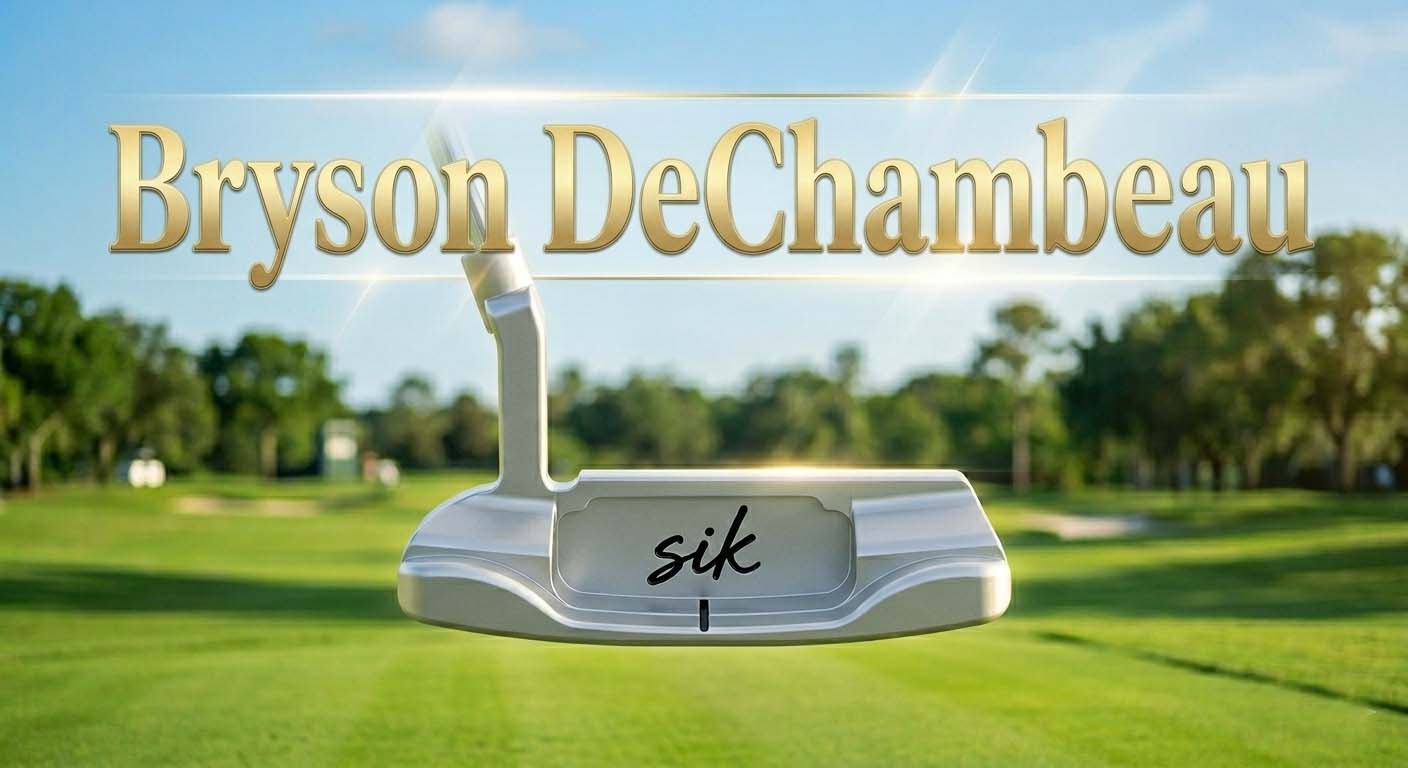
Bryson DeChambeau currently plays a SIK Pro C-Series Armlock putter with a JumboMax Ultralite JumboFlat 17 grip. He pairs it with a Titleist Pro V1x Double Dot golf ball. This putter is one of the most talked-about clubs in golf because it looks nothing like what most pros carry. It’s an armlock design, which means it locks against his forearm to create a pendulum motion without wrist movement. Here’s everything you need to know about his setup, the specs, and why it works for him.
Bryson’s Putter: The SIK Pro C-Series Armlock
The SIK Pro C-Series is a blade-style putter, but it is not a traditional blade. The head has a compact shape with a single alignment line. What makes it different is the armlock shaft. The shaft is longer than a normal putter shaft and is designed to rest against the inside of the lead forearm.
Bryson uses a grip that wraps around the top of the shaft and extends past the butt end. This combination allows him to lock the putter into his arm, eliminating any wrist hinge during the stroke.
The putter uses SIK’s descending loft technology. That means the face has two levels of loft: a higher loft on the lower part and a lower loft on the upper part. This design keeps the ball launch consistent, even if you hit high or low on the face. Bryson’s model is customized to his exact specs, but the head is the same Pro C-Series available in stores.
Full Spec Sheet – Length, Loft, Lie, Weight, and Grip
Here are the exact specs of Bryson DeChambeau’s putter as he uses it in competition. These numbers matter because they explain why the putter behaves the way it does.
| Spec | Value | Why It Matters |
|---|---|---|
| Length | 43 inches | Long enough to anchor against the forearm, creating a stable pivot point. |
| Loft | 2 degrees effective (descending loft face) | Promotes topspin and consistent launch regardless of strike location. |
| Lie angle | 71 degrees | Steeper lie works with armlock posture to keep the face square. |
| Head weight | 360 grams | Heavier head increases stability and reduces backswing length. |
| Shaft | Steel, no taper (straight shaft) | Allows the grip to slide on without bending; keeps the armlock position solid. |
| Grip | JumboMax Ultralite JumboFlat 17 | Wide, flat grip prevents twisting and fills the palm. One of the largest grips available. |
| Grip style | Armlock with extended butt | The grip extends past the shaft end so Bryson can place it under his forearm pad. |
A standard putter is usually 33 to 35 inches long. Bryson’s is 43 inches. That extra length is what makes the armlock possible. The lie angle is also flatter than a typical putter because he stands taller and more upright with the putter locked in his arm.
Why an Armlock Putter? The Mechanics Behind His Choice
Bryson has always been a player who wants to eliminate variables. Early in his career, he used a standard-length putter, but he struggled with wrist breakdown under pressure. The armlock putter solves that problem by turning the stroke into a pure shoulder rotation.
When he sets up, he presses the grip against his lead forearm. During the stroke, his wrist stays locked in a neutral position. The putter and his arm move as one unit. This reduces face rotation and keeps the putter on line through impact. The SIK face’s descending loft helps too.
Because the low part of the face has more loft and the high part has less, the ball launches with the same amount of spin no matter where the strike hits. That is critical for a player like Bryson who hits the ball with high speed and wants a consistent roll.
The JumboMax grip is also key. It is thick (about the size of a bicycle handle grip) and has a flat top. Bryson says it stops the putter from twisting in his hands. Without that grip, he would have to actively hold the face square. With it, the putter stays square naturally.
The Evolution of Bryson’s Putter (What He Used Before)
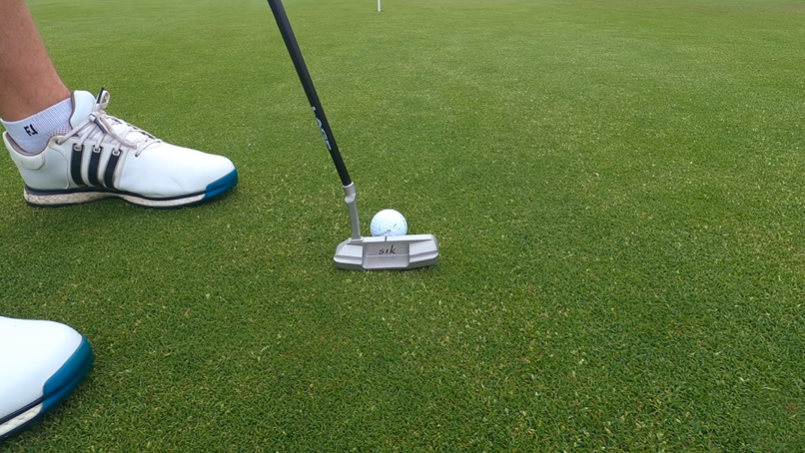
Bryson did not start his pro career with an armlock putter. He used a standard-length putter, usually a TaylorMade Spider Tour mallet, during his early PGA Tour years and even during his 2020 U.S. Open win. In 2021, he experimented with an armlock putter but did not commit to it full-time. By 2022, he fully switched to armlock and has not looked back.
He first tried the SIK Pro C-Series in early 2022 after working with SIK founder Dr. Geoff Kromholz. The switch was not immediate; he tested several heads and lengths before settling on the current 43-inch setup. He also changed grip brands over the years, moving from a SuperStroke to JumboMax. The current JumboMax Ultralite JumboFlat 17 was chosen because it reduced the overall weight of the putter, which helped him feel.
What is interesting is that he has never tried a mallet-style armlock putter. He prefers the blade shape because he says it gives him better feedback on center hits. The Pro C-Series is technically a blade, but the head is slightly larger than a traditional blade to accommodate the extra weight.
Should You Use an Armlock Putter Like Bryson?
Armlock putters are not for everyone. They work best for golfers who struggle with wristy strokes or who want more stability. But there are trade-offs.
- Who benefits: Golfers who tend to flip the putter head or have a lot of hand movement. The armlock forces you to roll your shoulders. If you already have a stable stroke, the armlock might feel too stiff.
- Who struggles: Golfers who like to “feel” the putter head through the stroke. An armlock can feel heavy and disconnected because the putter moves with your arm, not your wrists. Also, if you have a shorter backswing, the long shaft can feel awkward.
- Setup changes: You will need to stand taller and farther from the ball. The putter grip must sit against your forearm, which changes your eye line. Some players find it hard to adjust to the different visual perspective.
- Alternatives: If you want stability but do not want the full armlock, consider a counter-balanced putter. Counter-balanced putters have extra weight in the grip to lighten the head feel, which also reduces wrist action, but without the long shaft.
If you are thinking about buying the same putter, the SIK Pro C-Series Armlock is available at retail. However, Bryson’s exact setup (43 inches, 71-degree lie, JumboMax grip) may not be stock. You can order custom from SIK or a fitter who carries armlock options. Just know that the learning curve is real. Expect to spend several rounds getting used to the feel.
Frequently Asked Questions
What length putter does Bryson DeChambeau use?
He uses a 43-inch putter. This is about 8 to 10 inches longer than a standard type putter. The extra length allows the shaft to lock into his forearm for the armlock stroke.
What size putter grip does he use?
He uses a JumboMax Ultralite JumboFlat 17 grip. It is one of the largest putter grips available. The diameter is about 2 inches at the top, and it has a flat rectangular shape to fit the palm.
Can you buy the same putter as Bryson DeChambeau?
Yes, the SIK Pro C-Series Armlock putter head is sold in golf shops and online. But his exact custom specs (length, lie, grip) are not available as a stock option. You can order a custom-built putter from SIK with those specifications.
Is an armlock putter legal?
Yes. Armlock putters conform to USGA rules as long as the shaft does not exceed 46 inches. Bryson’s 43-inch putter is under that limit. The grip does not have to be anchored to the body, only touching the forearm, which is allowed.
Does Bryson DeChambeau use a blade or mallet putter?
He uses a blade-style putter (SIK Pro C-Series). Despite its compact head shape, it functions like a mallet in terms of stability because of the armlock mechanism. Do not confuse the head shape with the putting style.
What exact putter does Scottie Scheffler use?
Scottie Scheffler uses a different putter entirely. He uses a traditional-length mallet (often a TaylorMade Spider Tour or a custom prototype). His setup is standard length with a face-balanced alignment. It is not an armlock.
What putter grip does Bryson DeChambeau use?
He uses a JumboMax Ultralite JumboFlat 17 armlock grip. It is specifically designed for armlock putters and has an extended flat section that runs up the shaft.