
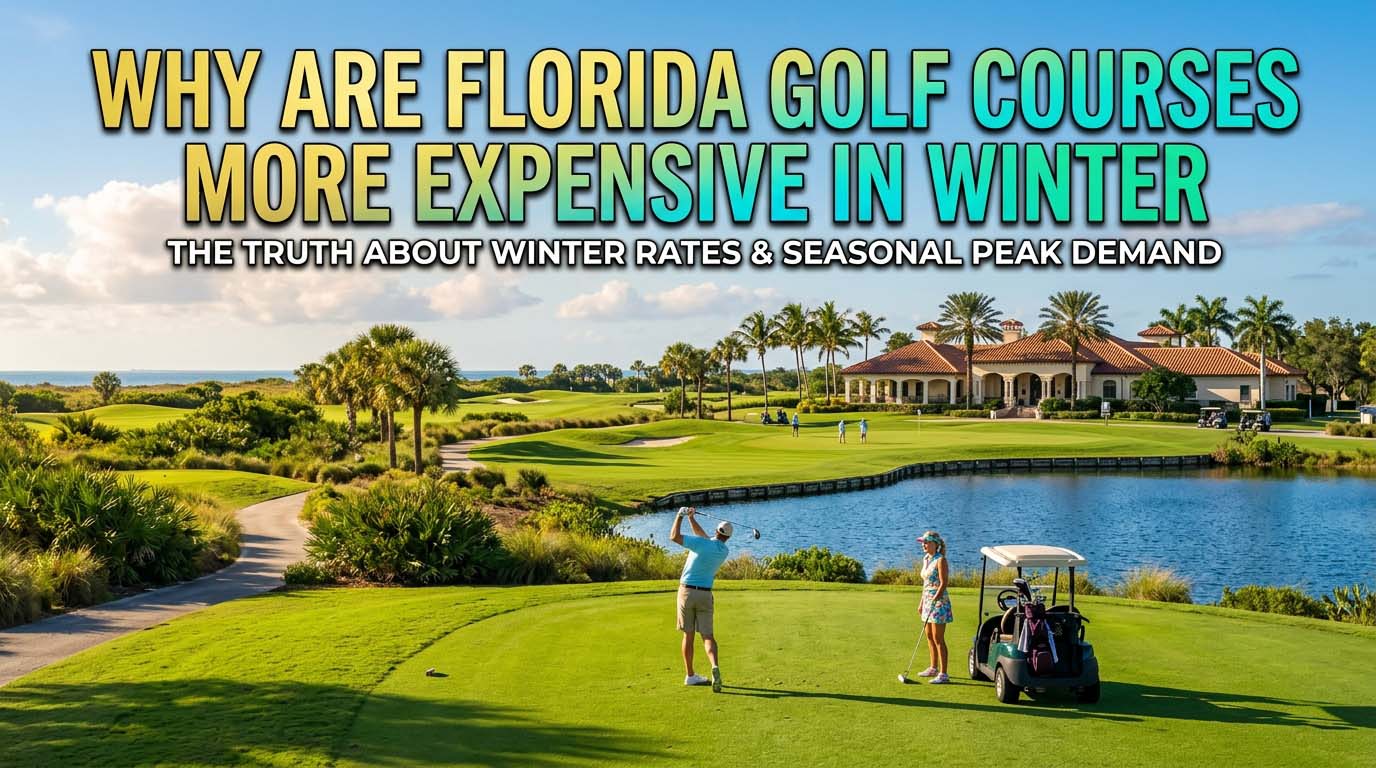
If you have ever booked a tee time in Florida during January, you already know the sting. A round that costs $25 in July suddenly jumps to $85 or more. It feels like a cash grab.
But there is more going on than simple greed. Florida golf courses are more expensive in winter because of two things happening at the same time. Demand hits its highest point of the year, and operating costs hit their highest point of the year too. Understanding this teaches you not just where your money goes, but how to keep more of it in your pocket.
The Snowbird Effect and the Demand Wave
The first reason is obvious once you see the numbers. Every winter, roughly one million seasonal residents and tourists flood into Florida. Many of them are retirees who play golf three to four times a week.
They are not tourists taking one round. They are regulars who fill the tee sheet every Tuesday and Thursday.
This does not just increase demand. It transforms the market. A course that averages 100 rounds per day in September suddenly sees 250 rounds per day in February. The course has a limited number of tee times. When demand doubles, the price naturally follows.
But this is only half the story. If demand were the only factor, courses in crowded cities like Orlando would stay cheap in winter. They do not. The other half is much less visible.
The Hidden Cost of Perfect Winter Grass
Florida grass is Bermudagrass. It grows fast in the summer heat, turns brown and dormant when temperatures drop below 60 degrees, and needs almost no water during cool months. In summer, the course simply lets the grass grow and mows it. Cheap and easy.
Winter is a different world. To keep fairways and greens green and healthy for the paying winter crowd, courses overseed every playing surface with a cool-season grass like Ryegrass. This process costs a small fortune.
The course has to kill off the existing Bermudagrass in patches, till the soil, spread the Ryegrass seed, water it heavily for two to three weeks, and mow it at a lower height to get a tight, playable surface.
All of this happens before a single golfer steps on the course. The bill for a single 18-hole course runs between $100,000 and $200,000 every fall.
Then the maintenance continues. Ryegrass drinks water. A course in winter uses twice the water it uses in summer. It also needs fertilizer every two weeks and more frequent mowing to keep the surface clean. Labor costs jump because grounds crews work overtime.
So when you pay $85 for a January round, part of that covers the seed, water, and labor that went into making the course look like a postcard. The course had to spend that money before you ever showed up.
The Two-Tiered Price Economy
Once you understand the costs, the pricing model makes more sense. Florida courses run two separate markets at the same time.
Residents pay one price. They get a significant discount because they are year-round customers who fill tee sheets during the slow months. They are also the members who buy food and drinks and support the pro shop. Courses keep them happy with low rates and loyalty programs.
Winter visitors pay a different price. They have no loyalty to the course. They will not return in August. They are buying a single experience, often booked through a third-party app. The course charges them the full market rate because they will pay it.
This is not deception. It is price discrimination in the classic economic sense. The course maximizes revenue by charging each group what the market will bear. The winter visitor is not paying more because the course is greedy. They are paying more because the course knows they are a one-time buyer with no leverage.
Myth vs. Reality Breakdown
| Myth | Reality |
|---|---|
| The course owners gouge us because we are desperate. | The course spends over $100,000 to overseed every fairway, rough, and green so winter players get a pristine surface. That cost shows up on the green fee. |
| Winter golf is better, and that is why it costs more. | Winter golf is different. The course looks great, but the real cost driver is the intense maintenance needed to keep a cool-season grass alive in a warm climate. |
| They could lower the price and still profit. | A full 18-hole regulation course needs at least 180 to 200 rounds per day just to break even in winter. With shorter daylight hours and expensive turf management, the margin is thin. |
The Regional Price Map
Not all of Florida charges the same winter premium. Where you choose to play changes what you pay by a huge margin.
South Florida, including Palm Beach, Naples, and Miami, has the highest premiums. International tourists, luxury resorts, and deep-sea fishing crowds push rates to $150 to $300 per round. You pay for the name and the zip code.
Central Florida, including Orlando, Tampa, and Winter Haven, has moderate premiums. The tourism engine is big, but the supply of courses is also big. Expect rates from $60 to $120 per round. This is where communities like Four Lakes Golf Club offer a strong value. You get the full winter experience without the coastal markup.
North Florida, including Jacksonville, Pensacola, and the Panhandle, has the mildest premiums. Snowbird traffic is lower. Prices peak only during Spring Break and PGA events. Expect $40 to $80 per round. If you want the cheapest winter golf in Florida, drive north.
The Regional Ecosystem Factor
The golf course does not set its prices in a vacuum. Winter is peak season for the entire Florida travel industry. Hotels, rental cars, restaurants, and attractions all charge more. The golf course is a small piece of this bigger wave.
When a course buys fertilizer, it buys from a supplier that charges a winter premium because its own costs are higher. When the course pays its maintenance crew, it competes with every other resort and hotel in the area for the same workers.
The entire local economy runs on a higher cost base in winter. The course cannot charge less than its suppliers charge.
The Value Hunter Playbook
Once you know why prices spike, you can plan around it. These strategies actually work. Target municipal courses. Municipal courses are subsidized by local taxpayers. They have a legal or cultural mandate to keep rates low for residents.
Even in peak winter, a municipal course in Central Florida might charge $40 for a morning round.
Play in Central Florida instead of the coasts. The coasts draw the highest-paying tourists. Inland cities like Winter Haven have plenty of good courses without the coastal markup.
Book twilight rates. Most courses drastically drop their rates after 2 PM. In winter, daylight runs until 5:30 PM. You get three hours of golf for half the price of a morning tee time.
Avoid peak weeks. Christmas week and President’s Day week are the most expensive. Book in early December or late January instead.
Look for bundled memberships. Some 55+ communities offer a single fee for unlimited golf, pool access, and social events. For a retiree who plays three times a week, this often works out cheaper than paying per round at a public course. Four Lakes Golf Club is one example of this model.
Frequently Asked Questions
What is the most expensive week to play golf in Florida?
President’s Day week in February and the week between Christmas and New Year’s Day. Hotel occupancy is at its annual high, and every tee time is premium.
Why don’t municipal courses raise their prices as much as private courses?
Municipal courses get taxpayer support and have a public service mission. They aim for affordable access, not profit maximization.
Is it cheaper to play on a Tuesday morning in January than a Saturday morning?
Drastically so. Tuesday through Thursday tee sheets are soft. A weekday morning can cost 30 to 40 percent less than the identical weekend time.
Does buying a Florida golf membership in fall to avoid winter premiums work?
Only if you play more than three times a week. Read the fine print. Many seasonal memberships are set up to capture the same revenue you would pay per round anyway.
Are there hidden fees on top of the winter green fee?
Yes. Some upscale courses add a mandatory resort fee or amenity fee. This covers practice facility access, range balls, or a towel. Ask before you book to avoid surprises.