
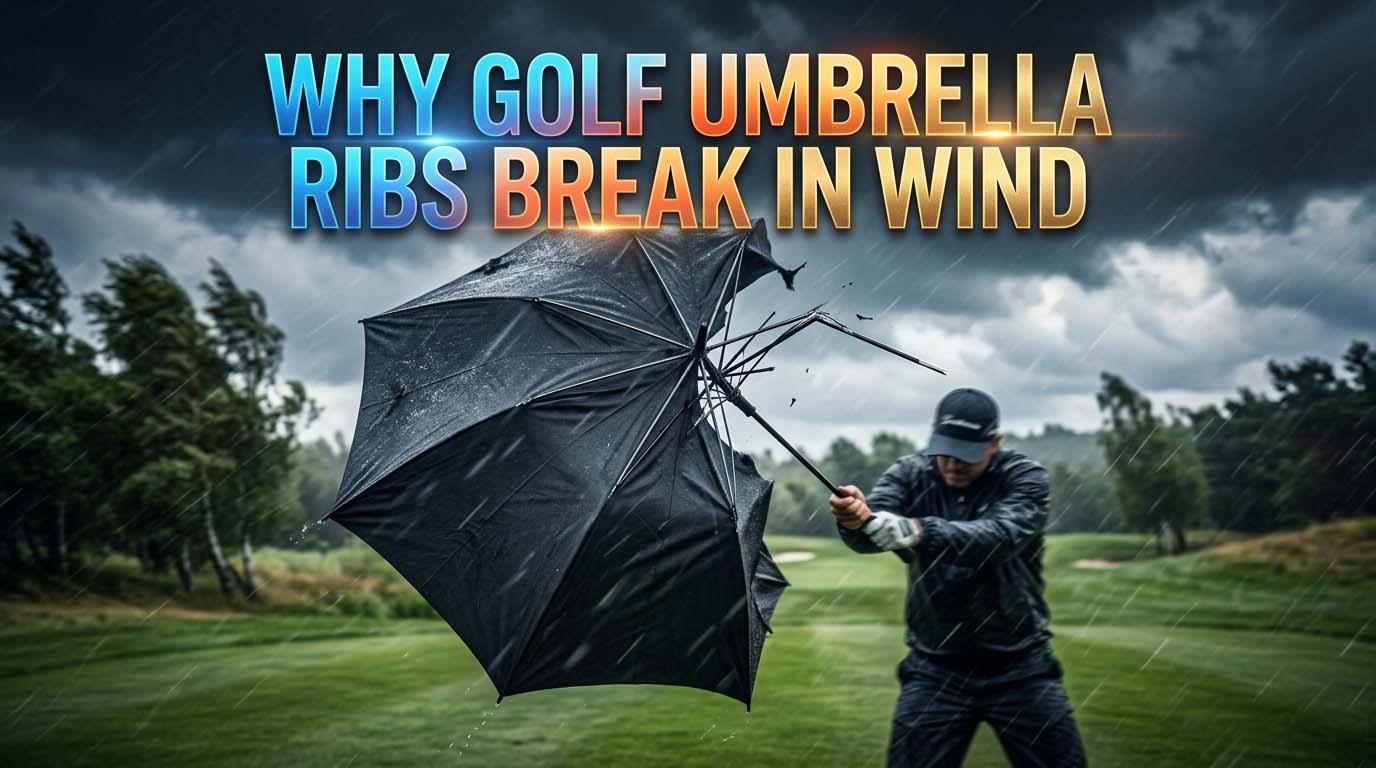
Golf umbrella ribs break in wind because the pressure from the wind on the canopy is stronger than what the ribs or their joints can handle. It is not random. The break happens when three things come together: strong gusts, a design that creates lift inside the umbrella, and a material that has already weakened from repeated use.
Most people think it is just bad luck. But once you understand what is really going on, you can stop it from happening.
Why Wind Turns an Umbrella into a Sail
When you hold a big golf umbrella open, it catches the wind like a small sail. The canopy’s curved shape is the problem. Wind hits the outside and pushes, but it also gets trapped underneath the fabric. That trapped air has nowhere to go.
Pressure builds inside the canopy, and the ribs get pulled upward hard. This upward force is what snaps them, not just the sideways push.
The bigger the umbrella, the more force it catches. A 60-inch golf umbrella has almost twice the surface area of a standard rain umbrella.
How Wind Pressure Creates Lift and Snap
Think of the canopy as a shallow bowl facing down. Wind coming from the side pushes the whole umbrella sideways, but wind traveling across the top creates a low‑pressure zone above the fabric. At the same time, wind entering from the bottom fills the bowl and creates high pressure inside.
The difference between the low pressure above and the high pressure below lifts the canopy violently. The ribs bend upward well beyond their normal range. If they are made of a material that doesn’t bend much, they crack or snap at the weakest point, usually near the hinge where the rib meets the hub.
The Missing Factor: Aerodynamic Lift
Most explanations stop at “wind is strong.” But the real killer is aerodynamic lift, similar to how an airplane wing works. The canopy shape acts like a wing turned upside down. Air moving over the curved top has to travel farther than air moving under the flat bottom. That makes the air above move faster, which lowers its pressure.
The higher pressure underneath forces the canopy upward. This lift multiplies the force on the ribs by a factor of two or three compared to simple side pressure. That is why a moderate gust can snap ribs that would handle a strong sideways shove.
Why Fibreglass Isn’t Always Bulletproof
Golf umbrellas often advertise fibreglass ribs as “unbreakable.” Fibreglass is flexible and does not rust, but it does not last forever. Every time the umbrella flexes in the wind, tiny cracks form inside the fibreglass strands.
Over many uses, those cracks grow larger. Eventually the rib fails without warning. The same thing happens with metal ribs, but metal bends and stays bent. Fibreglass stays straight until it suddenly snaps.
This makes people think fibreglass is weaker, but the real issue is fatigue – cumulative damage from repeated bending.
Myths About Material Strength
Many golfers believe steel ribs are stronger because they do not snap. But steel has its own problem: it bends permanently. A bent rib ruins the umbrella shape and makes it worse in the next wind. Another myth is “more ribs equals stronger.” The number of ribs does not matter much if the joints are weak or the spacing is poor.
What matters is the quality of the plastic hub where all ribs connect, and the epoxy that holds the rib to the ferrule. Cheap umbrellas use thin fibreglass rods and weak glue. They break far earlier than a well‑made umbrella with the same materials.
| Material | What happens in high wind | Long‑term weakness |
|---|---|---|
| Fibreglass | Flexes a lot, then snaps suddenly | Fatigue cracks after many uses |
| Steel | Bends and stays bent | Permanent deformation, rust |
| Carbon fiber | Very stiff, can snap without warning | Expensive, brittle under impact |
Four Simple Ways to Keep Your Ribs Intact
- Let the wind go through. Never hold the umbrella straight into a strong gust. Tilt it slightly so the wind spills around the sides. For extreme gusts, close the umbrella completely.
- Point it away from the gust. If the wind is coming from your left, tilt the umbrella so the top points left. This lets the wind flow over the top instead of catching underneath.
- Use a double‑canopy umbrella. Umbrellas with a vented top or a second canopy layer let air escape upward. This relieves the pressure difference that causes lift.
- Replace after heavy use. A fibreglass rib that has been flexed many times is weaker. If your umbrella has survived several storms, inspect the ribs for hairline cracks or loose joints. Replace it before it breaks mid‑round.
What to Look for in a Golf Umbrella That Fights Wind
When shopping, focus on three things that actually prevent breakage. First, look for vented canopies: a small opening at the top or a double‑layer design. Second, reinforced joints: the hub should be metal or thick plastic, and the rib connection should have a solid ferrule.
Third, rib thickness – thicker fibreglass rods (7 mm or more at the base) resist fatigue longer. Avoid umbrellas that brag only about “wind resistance” without mentioning how they handle lift. A good wind‑resistant umbrella will have a canopy that spills air, not traps it.
Frequently Asked Questions
Can wind direction affect which rib breaks first?
Yes. Wind hitting the front of the umbrella puts more stress on the two or three ribs opposite the direction of the gust. If the wind hits from the left, the right‑side ribs take the most upward force. That is why ribs often break on the side farthest from where you hold the handle.
Do cheap umbrellas break more often in the same wind?
Yes. Cheap umbrellas use thinner fibreglass rods, weaker epoxy at the joints, and hubs made of brittle plastic that crack under load. In the same gust, a well‑made umbrella may survive while a cheap one breaks because the joints fail first.
How can I tell if a rib is about to fail before it snaps?
Look for small white lines or rough spots on the fibreglass near the hub. These are micro‑cracks. Also check if the rib feels loose when you wiggle it. If the joint moves more than normal, the glue is failing. A rib that makes a creaking sound in moderate wind is close to snapping.
Is it better to collapse the umbrella or keep it open in a sudden gust?
Collapse it. Keeping it open in a sudden strong gust almost guarantees a broken rib or a torn canopy. Pushing the button to close it takes less than a second. It is safer for you and for everyone around you.