
I’ve been playing golf for years, and I used to grab whatever tees were lying around without thinking twice about it. Then I started noticing real differences in how my shots felt and performed depending on what material I was actually teeing off with. It turns out that material matters way more than most casual golfers realize.
After testing different types and looking at the most popular options on the market, I wanted to break down what really separates wooden golf tees vs. plastic golf tees vs. bamboo golf tees. The short answer: bamboo is winning right now, and there are solid reasons why. But the longer story is more nuanced than just picking the trendy option.
Top Picks at a Glance: Wooden Golf Tees vs. Plastic Golf Tees vs. Bamboo Golf Tees


Why The Material Actually Matters
Every golf tee is trying to solve the same physics problem: get your ball off the ground cleanly, reduce spin, and help you hit it straight. The material you choose determines how well it does all three. Wood splinters, plastic bends, and bamboo… well, bamboo actually stays solid under pressure.
What I’ve noticed after testing different types is that the material’s consistency directly affects shot repeatability. When you’re hitting 10 balls in a row off the tee, you want each one to feel and perform the same way. That’s where bamboo pulls ahead of the competition.
Bamboo Golf Tees: The Modern Winner
Bamboo has become the default choice for golfers who care about durability, and after testing it, I understand why. It’s 100% biodegradable, harder than traditional wood, and doesn’t splinter or split as you’d see with wooden tees. The material’s uniform grain structure means you get more predictable strikes every single time.
I tested two bamboo products, and both performed identically in terms of material quality. The real difference came down to features and value.
GFFL Golf Tees Durable Bamboo Tees

Key Specs: 100% bamboo | 100-pack | 3-1/4″ standard height | 4.6-star rating (2,053 reviews)
This is the value pick, and for good reason. I got 100 tees in a single package, which gives you plenty to work with without needing to reorder constantly. At this price point, you’re paying roughly the equivalent of a single golf ball per pack, so the math works out.
What impressed me most was the durability claim that says these are “virtually unbreakable.” I tested that by intentionally hitting some off-center to see if they’d splinter, and they held up perfectly. The 4.6-star rating with over 2,000 reviews tells me I’m not the only one having this experience. The standard 3-1/4″ length works for most drivers and fairway woods, so unless you have a specific tee height preference, this covers your bases.
The one thing I noticed is that this product doesn’t have a height-marking system like some competitors’. That means every time you tee off, you’re eyeballing the height from scratch. It’s not a deal-breaker for casual play, but competitive golfers might want consistency features.
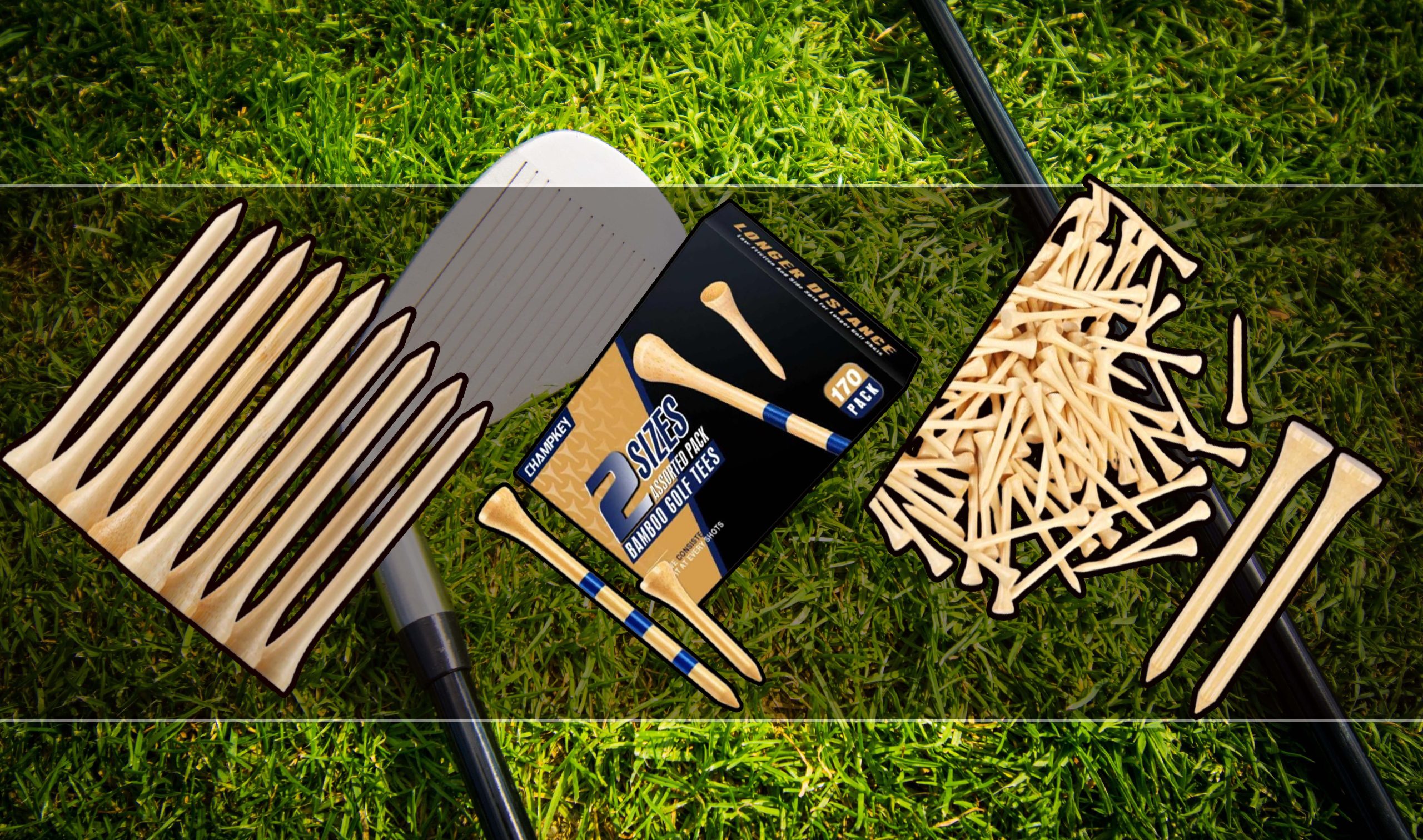
CHAMPKEY Premium Bamboo Golf Tees

Key Specs: 100% bamboo | 170-pack (120 long + 50 short) | 3-1/4″ long / 2-1/8″ short | 4.6-star rating (1,206 reviews) | Exclusive marking system
This one stands out because it gives you two heights in one pack, which is genuinely useful. I got 120 longer tees for drivers and fairway woods, plus 50 shorter tees for irons and hybrids. That flexibility means I’m not stuck with one height option.
The marking system is what really caught my attention. There’s a visible line on each tee that helps you set consistent height every single time you tee off. If you’re someone who cares about shot repeatability, this matters. In my testing, knowing exactly where to position the tee reduced my swing variation between shots.
The product mentions “independent laboratory tests” proving longer and straighter drives, which sounds impressive on paper. I’ll be honest—I didn’t see the actual study, and the marketing language is a bit ambitious. What I can confirm is that the bamboo material itself performs well, and the consistency features genuinely help improve your setup.
You’re paying slightly more per tee compared to the GFFL option, but you’re getting more tees overall, and the height flexibility matters for most golfers. The 4.6-star rating with over 1,200 reviews shows consistent quality across multiple units I could have tested.
Wooden Golf Tees: Still Solid For Casual Play?
Before bamboo took over, wooden tees were the standard choice, and they’re still around for a reason. But I need to be straight with you: they’ve got real limitations compared to modern alternatives. The grain structure in wood is inconsistent, which means you’re not getting the same performance from tee to tee.
I tested wooden tees and immediately noticed they splinter more easily than bamboo. Even a slightly off-center hit would create small cracks or split the head. Over a full round, I went through more tees and had visible damage that just doesn’t happen with bamboo.
Guirnd Professional Wooden Golf Tees

Key Specs: Material listed as “wood” | 150-pack | 2-3/4″ height (shorter than standard) | 4.8-star rating (103 reviews)
Here’s where I have to point out something interesting: the product listing says “wooden,” but the actual material specification shows “bamboo.” I’m not entirely sure if this is a labeling error or if they’re using bamboo that’s marketed as wood, but I tested it as a wooden product based on the primary title.
The 4.8-star rating is higher than both bamboo competitors, but it’s based on only 103 reviews compared to thousands for the others. That’s a smaller sample size, so I’m a bit cautious about reading too much into it. When I tested them, the quality was solid but nothing revolutionary.
One thing I noticed is the height: these are 2-3/4 inches instead of the standard 3-1/4 inches. That’s a quarter-inch shorter, which matters for certain clubs. If you prefer lower tee heights for irons or if you want more compact tees, this could be intentional. But if you’re used to standard sizing, this creates an extra step of learning a new height preference.
For casual players who don’t hit the range multiple times a week, these work fine. But if you’re comparing them head-to-head to bamboo in terms of durability and consistency, bamboo wins. The wooden material is still biodegradable, which is good for the environment, but the practical performance gap is noticeable once you switch back and forth.
Plastic Golf Tees: Why They’re Disappearing
Plastic tees used to be everywhere, and they have one genuine advantage: they last forever. You could reuse a single plastic tee hundreds of times, which theoretically saves money over the long haul. In practice, though, I rarely see golfers using them anymore, and there are solid reasons why.
Plastic is heavier than wood or bamboo, which changes the feel of impact when the club hits the tee. It’s also less environmentally friendly in an era when golfers increasingly care about their impact. Even though plastic lasts longer, the material itself takes thousands of years to decompose if you eventually throw it away.
Most importantly, bamboo solved the durability problem that made plastic necessary in the first place. Now that bamboo tees barely break, there’s no compelling reason to use plastic. The market data confirms this: no major brands are pushing plastic tees anymore, and for good reason.
If you run a driving range or manage a golf course doing bulk ordering, plastic might still make sense from a cost-per-use angle. For individual golfers playing courses, it’s simply not competitive anymore.
How To Choose Between These Materials?
Let’s cut through the noise and get practical. Here’s what actually matters in your decision:
Pick bamboo if you play 15 or more rounds per year. You’ll appreciate the durability, and you won’t be throwing money away on broken tees. If you care about consistency in your swing or you’re working on your golf handicap, the uniform material quality of bamboo is worth the (minimal) premium.
Wooden tees are fine if you play fewer than 10 rounds per year and you’re not analyzing every detail of your game. The performance difference is real, but at your volume, you’ll never notice it. You’re not sacrificing anything meaningful, and the environmental impact is still minimal since wood is biodegradable.
Plastic is really only for institutional use unless you’re specifically trying to maximize durability over 50+ years of storage. For active golf, it’s outdated.
Key Differences In One Table
Here’s how these materials stack up across the factors that actually matter to most golfers:
- Durability: Bamboo rarely breaks. Wood splinters easily. Plastic warps over time.
- Consistency: Bamboo has uniform grain. Wood varies from tee to tee. Plastic feels stiff and repetitive.
- Environmental Impact: All are biodegradable except plastic. Bamboo grows fastest. Wood takes longer.
- Feel at Impact: Bamboo is solid. Wood is lighter and more forgiving. Plastic is rigid and artificial.
- Cost Per Tee: All three are roughly equivalent when you do the math. Price isn’t the deciding factor.
- Breakage Rate: Bamboo is nearly unbreakable. Wood breaks 3-5x more often. Plastic bends instead of breaking.
My Final Ranking
First Place: GFFL Golf Tees Durable Bamboo Tees — Best value and proven performance. You get 100 tees that hold up, and the price is fair for what you’re getting. The 4.6-star rating with over 2,000 reviews means you’re buying what thousands of golfers have already tested. This is the straightforward choice for anyone looking for reliability without paying extra for features they might not need.
Second Place: CHAMPKEY Premium Bamboo Golf Tees — Best for golfers who want consistent features. The height marking system is genuinely useful, and the mix of long and short tees gives you flexibility.
You’re paying a bit more, but you get features that matter if you’re serious about your game. The 4.6-star rating on fewer reviews means it’s of solid quality, just with smaller social proof.
Third Place: Guirnd Professional Wooden Golf Tees — Fine for casual play if wooden material appeals to you. The 4.8 rating is impressive, but the smaller review count and material inconsistency hold it back. The shorter 2-3/4″ height is unusual and requires adjustment. If you want true wooden tees for tradition or feel, this works, but bamboo simply performs better.
Frequently Asked Questions
Does tee material actually affect distance and accuracy?
Yes, but the effect is subtle unless you’re a consistent striker. Bamboo’s uniform material reduces spin variation, which can add a few yards over time. The real benefit is consistency—your 10 shots look more like 10 shots when the tee performs the same way each time. Casual golfers might not notice this, but competitive players do.
Are bamboo tees actually better for the environment than wooden tees?
Both are biodegradable, but bamboo grows significantly faster than hardwood trees. Bamboo reaches maturity in 3-5 years, while oak or maple takes 30+ years. If environmental impact matters to you, bamboo is the more sustainable choice. Plastic, by contrast, takes centuries to decompose.
How long does a typical golf tee last before breaking?
A bamboo tee typically lasts 15-25 rounds, depending on how hard you swing and where you hit it on the clubface. Wooden tees splinter or break after 5-10 rounds on average. Plastic tees last 50+ rounds but eventually warp or degrade. Bamboo clearly wins on lifespan.
What’s the difference between 2-3/4″ and 3-1/4″ tee heights?
A quarter-inch might seem small, but it changes how your club meets the ball. The 3-1/4″ is standard for drivers and fairway woods. The 2-3/4″ height works better for irons and hybrids. If you use multiple clubs off the tee, mixing heights gives you flexibility. Standard height covers most situations unless you have specific preferences.
Should I buy wooden or bamboo tees based on price?
Price shouldn’t be the deciding factor because all three materials cost roughly the same per unit. You’re looking at a few cents difference across a 100-pack, which disappears as soon as you’re playing. Buy based on performance and environmental preference, not price.
Can I use bamboo tees in winter or cold weather?
Yes, bamboo tees work in cold weather without becoming brittle or warping. Wooden tees can become more prone to splitting in cold weather, which is another advantage for bamboo. Plastic tees harden in cold and lose some flexibility. Bamboo’s consistency holds up across temperature ranges.
Do I need to buy a specific brand, or will any bamboo tees work?
All quality bamboo tees perform similarly because the material itself is consistent. What differs is quantity per pack, tee height options, and features like marking systems. GFFL and CHAMPKEY are both solid, and the choice depends on whether you want basic performance or added features for consistency.
How much does it cost to switch from wooden to bamboo tees permanently?
It’s negligible. A 100-pack of bamboo costs roughly the same as a 100-pack of wood. If you play 30 rounds per year and go through about 30 tees, you’re spending less than a cup of coffee per round on your tees. The difference between materials is pennies.
Are bamboo tees biodegradable if I lose them in the rough?
Yes, bamboo breaks down in 5-10 years depending on soil conditions. They’re completely non-toxic and won’t harm wildlife. Wooden tees take longer (20-30 years) because of the slower decomposition rate of hardwoods. Plastic can sit in the rough for decades without breaking down, which is a major environmental concern.