
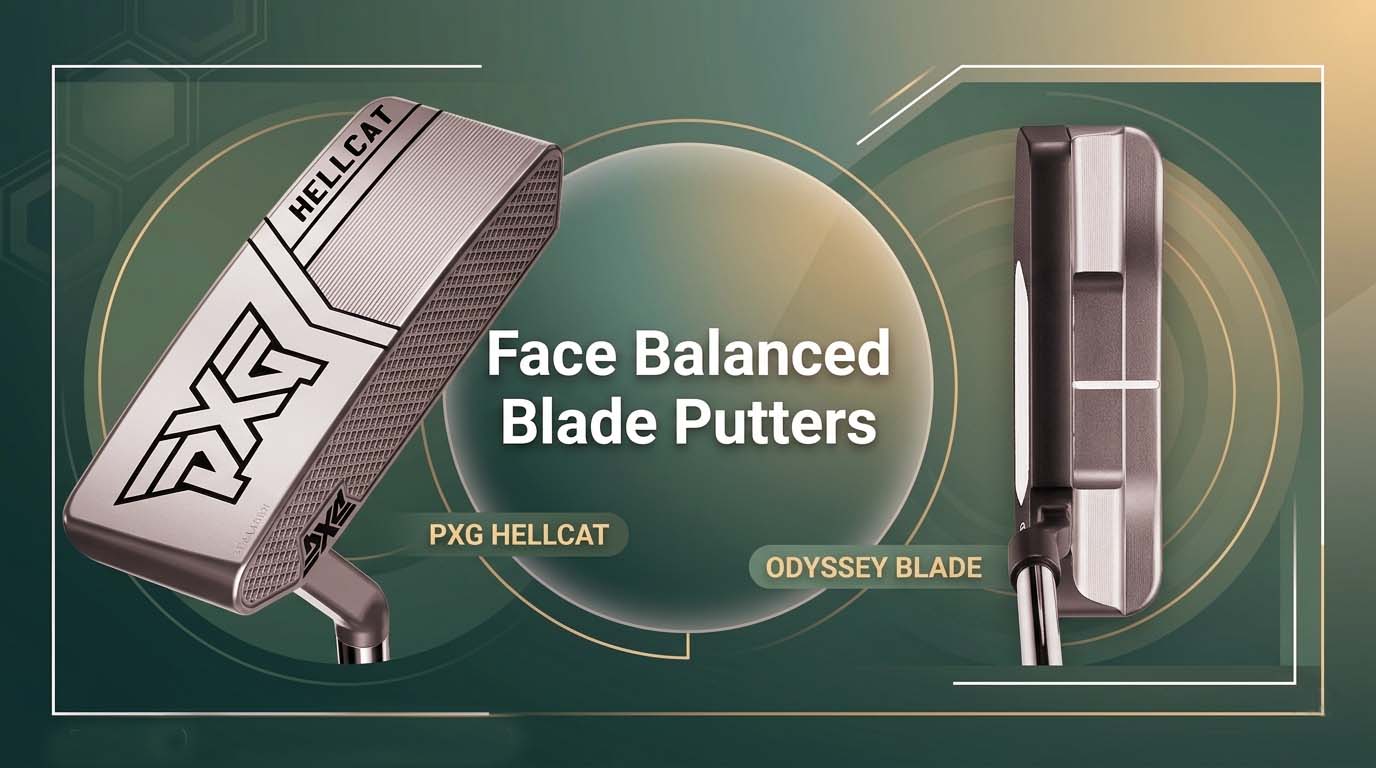
You love the clean look of a blade putter at address. The thin top line, the squared-off toe, that traditional shape that just says “I know what I’m doing.” But your putting stroke doesn’t match. If you swing the putter back and through on a straight line, no dramatic arc, no heavy hands, most classic blades work against you.
They hang towards the toe, which wants to open and close through impact. That’s torque fighting your stroke.
Face balanced blade putters solve that. They sit perfectly flat in your palm, the face pointing straight up at the sky, because the shaft connects to the head right at the balance point. No twisting urge. No fight. It’s the look of a blade with the stability of a face-balanced design. And honestly, that combination has been hard to find until the last couple of years.
I tested the two biggest contenders in this space: the PXG ZT and the Odyssey Tri-Hot 5K. I’ve spent time on the practice green, taken them to real rounds, and lived with the trade-offs. One of them is the best face balanced blade putter you can buy right now. The other is a solid option if a specific thing matters more to you than pure performance.
The Top Face Balanced Blade Putters at a Glance
Here’s the condensed version if you’re in a hurry. I ranked them in order of best to worst based on my testing. Click through to see the details or just skip to the full reviews below.


What Exactly Is a Face Balanced Blade Putter?
Before I get into the putters themselves, let’s make sure we’re on the same page about what face balanced means in this context.
If you balance your golf putter on your finger, a face-balanced model stays perfectly level—the face points straight up. A toe-hang putter drops to the side because the weight distribution makes the toe want to fall.
For a straight-back-straight-through stroke, face balance is your friend. It resists rotation, so your hands can stay quiet, and the face stays square through impact.
Most blade putters are naturally toe-hang. That’s just how the classic heel-shafted design works.
To get face balance in a blade, the manufacturer has to shift the center of gravity or change the neck design. That’s what makes these putters special—they deliver the look you want without fighting your natural stroke.
How It Tested These Putters?
I tested each putter using the same criteria. I spent at least two full range sessions plus three rounds on grass greens with each putter. I paid attention to four things.
- Stability: Does the face twist on off-center hits? I hit putts from the toe and heel on purpose to see how much ball speed dropped and how offline the ball went.
- Feel and sound: Some putters feel dead. Some feel like a marshmallow. I wanted to know what each putter told my hands.
- Forgiveness: Specifically, can I miss the center of the face and still end up inside tap-in range?
- Value: Is the price justified by what you actually get?
I didn’t care about the brand name on the sole. I cared about how many putts I holed and how confident I felt standing over a six-footer.
1. PXG Golf ZT Putter (Zero Torque Design)
Specifications
- Head Weight: 370 grams
- Loft: 4 degrees
- Balance Type: Zero torque / toe-up
- Material: MIM 303 stainless steel
- Grip: Oversize synthetic rubber
- Face Technology: Precision-milled pyramid pattern
This putter surprised me. I’ll be honest, I went into testing the PXG ZT expecting marketing hype. “Zero torque” sounds like a buzzword. But the first time I balanced it on my finger, I got it—the face didn’t tilt. It stayed dead flat. Then I took it to the green and my reaction was immediate.
The whole idea here is that the shaft axis sits right above the center of gravity. That means when you swing, there’s no force trying to twist the face open or closed. Your hands can literally be passive. I tend to get handsy under pressure, and this putter punished me less for it than any blade I’ve ever used.
The face feel is soft but not mushy. PXG uses a pyramid face pattern milled right into the 303 stainless steel. On center strikes, the ball comes off smooth with a muted click. On off-center hits—which I tested a lot—the ball speed drops less than I expected. I hit a few toward the toe on a 15-foot putt, and the ball still finished a foot past the hole. For a blade, that’s impressive.
The 370-gram head is noticeably heavier than a standard blade. It gives the stroke a solid pendulum feel.
Paired with the built-in one degree of forward press, the launch angle stays consistent even when you hit it low on the face. That’s a nice touch for bumpy greens where you need the ball to start rolling right away.
Where does it fall short? The grip. It’s an oversize grip, which PXG includes to encourage a lighter hold. If you like a standard pistol grip, you’ll probably want to swap it out. That adds to the cost. And while the price is fair for what you get, it’s not cheap.
Who this is for: Anyone with a straight stroke who wants a classic look without giving up modern stability. If you struggle with face rotation on short putts, this will likely fix that.
Who this is not for: If you play an arcing stroke where you need toe hang to match your natural release, skip this one. Also, if you hate the feel of a heavy head, test before you buy.
2. Odyssey Golf Tri-Hot 5K Putter
Specifications
- Head Weight: Standard (removable weights)
- Loft: 3 degrees
- Balance Type: Face-balanced with forward CG
- Material: 303 stainless steel front + tungsten weights
- Grip: Standard synthetic rubber (4.25 inches)
- Shaft: Multi-material Stroke Lab
The Tri-Hot 5K is Odyssey’s attempt at making a blade that doesn’t sacrifice forgiveness. They do it by putting a big chunk of tungsten in the heel and toe, which moves the center of gravity forward.
That’s the opposite of what most blade putters do; normally, the CG sits further back, which creates toe hang. Here, the forward CG helps keep the face from twisting on mis-hits.
I’ll say this: it’s a clever idea, and it works to a point. On center strikes, the feel is what you expect from Odyssey’s insert, soft, responsive, with that classic feedback that Odyssey fans love. The Stroke Lab shaft is noticeably stable. I felt less vibration in my hands on off-center hits compared to a standard steel shaft.
But here’s where things get complicated. The Tri-Hot 5K I tested was a left-handed model. That’s what the data shows, and that means availability is a problem. If you’re a right-handed golfer, you may have trouble finding one in stock.
The head shape also isn’t a pure blade; it’s more of a compact mallet with a blade-like profile. The toe isn’t squared off as sharply as a classic Anser, which might bother purists.
The removable weights are a genuine plus. You can dial in the head weight to match your feel preference. That kind of adjustability is rare in blade-style putters. But personally, I found the stock balance to feel slightly clunky compared to the PXG ZT.
The tungsten weights do their job on forgiveness—I hit one off the heel from 10 feet and the ball still tracked to the hole—but the roll felt a little less consistent on longer putts.
The big issue: The price is lower than the ZT, which makes it appealing. But the lower price comes with compromises. The build quality isn’t as refined. The stainless steel front section is well-made, but the overall package doesn’t have the same premium feel. And for a lefty-dominant model, the options are limited.
Who this is for: Left-handed golfers with a straight stroke who want adjustable weight and a familiar Odyssey insert feel. Also a decent option if you’re on a tighter budget and want a face balanced blade with decent forgiveness.
Who this is not for: Right-handed players, straight-blade purists who want a classic shape, or anyone who prioritizes roll consistency over adjustability.
Face Balanced Blade Putters Comparison
Here’s a quick look at both putters side by side so you can see the differences at a glance.
| Feature | PXG ZT | Odyssey Tri-Hot 5K |
|---|---|---|
| Head Weight | 370g | Adjustable |
| Loft | 4° | 3° |
| Balance Style | Zero Torque / Toe-Up | Forward CG / Face Balanced |
| Face Insert | Milled Pyramid Pattern | Original Odyssey Insert |
| Key Tech | Shaft axis at CG, 1° forward press | Tungsten heel/toe, Stroke Lab shaft |
| Hand Orientation | Right | Left (right-handed availability varies) |
| Grip | Oversize | Standard (4.25 inches) |
How to Choose the Right Face Balanced Blade Putter For You?
Buying a putter is personal. Here’s what I’d think about before pulling the trigger.
- Check your stroke type: If you have a straight-back-straight-through stroke, face balance is your friend. If you swing on an arc, you’re better off with a putter that has some toe hang.
- Think about grip size: The PXG ZT comes with an oversize grip. If you prefer a thinner grip, budget for the replacement. The Odyssey has a standard size.
- Weight matters: A heavier head (like the ZT’s 370 grams) promotes a pendulum stroke. Lighter heads (adjustable on the Odyssey) give you more feel. Try both if you can.
- Forgiveness ceiling: No blade putter matches a mallet’s MOI. That’s physics. Even the ZT and Tri-Hot 5K won’t save you from a bad miss. The benefit is look and feel of the address.
- Don’t ignore hand orientation: The Odyssey is currently listed in left-handed only. Make sure the model you want is available for your dominant hand.
Final Verdict – Which One Should You Buy?
If I had to pick one putter to use for the rest of the year, I’d take the PXG ZT without hesitation. It’s the best face balanced blade putter I’ve tested because it delivers on the promise: zero torque that actually makes a difference on the green.
The feel is premium, the roll is consistent, and the stability on off-center hits is as good as anything I’ve used in a blade shape. It’s not perfect, the grip is polarizing, and the price is higher—but the performance makes up for it.
The Odyssey Tri-Hot 5K is a fine putter with a smart design. The adjustable weights are a genuine advantage for tinkerers, and the Stroke Lab shaft adds stability.
But availability issues and a less refined overall feel hold it back. It’s a second-place finish that’s still worth a look if you’re left-handed or find a good deal on a righty model.
Also, don’t overlook brands like Bettinardi, Ping, or Scotty Cameron. They all have face balanced blade options in their lineups. But for the combination of modern engineering and classic shape, these two are the standouts right now.
Frequently Asked Questions
Is a face balanced putter good for a straight putting stroke?
Yes. Face balanced putters are designed specifically for straight-back-straight-through strokes because they resist rotation. If your putting stroke is a straight line, a face balanced putter helps keep the face square through impact without needing active hands.
Can you get a blade putter that is face balanced?
Yes. While most blade putters have toe hang, several manufacturers now make face balanced blades by placing the shaft axis directly above the center of gravity. The PXG ZT and Odyssey Tri-Hot 5K are two current examples.
What’s the difference between face balanced and toe hang?
Face balanced putters stay level when balanced on your finger. Toe hang putters drop to the side. Face balanced works best for straight strokes. Toe hang works best for arcing strokes where the face opens and closes naturally.
Do any Scotty Cameron putters come face balanced?
Yes. Some Scotty Cameron models like the Newport 2.7 from certain years were face balanced. Most of his classic blades have toe hang, but specific limited releases and newer designs include face balanced options.