
Let’s be honest. The idea of spending several hundred dollars on a rangefinder feels ridiculous when you’re just trying to break 90 on a Saturday. I used to think the same thing — that anything under a certain price had to be junk. Slow readings. Shaky lock-on. A battery that dies mid-round. That fear is real.
But I’ve been through enough rounds with budget lasers to tell you something important: the gap between a premium rangefinder and a good budget one is way smaller than the price suggests. You don’t need to spend a car payment to shave strokes off your approach game. The best golf laser rangefinder under $200 will get you 95% of the way there for less than half the cost.
After testing seven models against each other on real courses, here’s my direct answer: the Callaway 300 Pro Slope is the safest, most reliable pick for the vast majority of golfers. It’s not the flashiest. But it’s the one I trust not to let me down.


How I Tested These Rangefinders And What Actually Matters Under $200
Before I get into the individual reviews, let me explain how I approach testing a budget rangefinder. Because not all features are created equal. A spec sheet can look great but feel terrible on the course.
Accuracy Over Range
Here’s the thing nobody talks about enough: hitting a flag at 1200 yards sounds impressive, but it’s useless. You aren’t hitting approach shots from that distance. What matters is consistency under 250 yards — that’s the real range of an approach shot. I tested every unit on a known distance (marked yardages on a practice range) at 100, 150, 200, and 250 yards. The lasers that consistently delivered within a yard at those distances earned the top spots. Anything that wavered or gave me a different reading on the same pin twice in a row got knocked down.
The Slope Switch Is Non-Negotiable
If you play competitive golf of any kind — even just a Saturday club tournament — you need a rangefinder with a slope switch you can turn off. Units that don’t have this feature are effectively bricks in competition. I made sure every unit on this list has a switchable slope function. It’s not a nice-to-have. It’s a requirement.
Speed And Vibration Feedback
Cheap rangefinders often fail here. They hunt for the pin, flicker between distances, and the vibration (which confirms the lock) feels weak or delayed. I tested how fast each unit locked onto a pin from a stable hand position and how clearly the vibration confirmed the lock. A good unit locks in under two seconds and gives a firm buzz. A bad one makes you wonder if you actually got the flag.
Build Quality And Battery Life
A rangefinder that lives in your bag gets knocked around. I dropped each unit (gently) onto grass from waist height, tested how the casing felt, and checked for any rattling or creaking. I also ran battery tests — noting which units use standard CR2 batteries versus USB-C charging, because convenience matters when you forget to check before a round.
The Best Golf Laser Rangefinder Under $200 – Full Reviews
1. Callaway 300 Pro Slope – The Best All-Rounder
Specs at a glance:
- Range: 5–1000 yards
- Magnification: 6x
- Slope switch: Yes (physical toggle)
- Power: CR2 battery (included)
- Build: Rubberized exterior
I’ll be blunt: the Callaway 300 Pro Slope is the boring pick. And I mean that as a compliment. It doesn’t have USB-C charging. It doesn’t have 7x magnification. It uses an old-school CR2 battery that you’ll replace once a year if you play regularly. But here’s what it does better than any other unit under this price point — it works, every single time, without making you think about it.
I took this one out for five rounds, and on every single approach shot, it locked onto the pin inside two seconds. The Pin Acquisition Technology (P.A.T.) lives up to the name. I aimed at a white flag from 175 yards out in hazy afternoon light, and it gave me the same reading three times in a row — 176, 176, 176. That consistency is what you’re paying for.
The slope compensation is handled by a physical switch on the side. I found it easier to toggle mid-round than the menu-based systems on some other units. You can feel the click, you know it’s engaged or disengaged, and you don’t have to scroll through a screen.
The rubberized exterior is a bigger deal than it sounds. I’ve dropped this rangefinder off the side of a cart onto concrete, and it didn’t even scuff. The plastic-body units on this list felt less durable by comparison. If you’re the kind of golfer who treats equipment like tools rather than trophies, this is the one.
Where it falls short: The 6x magnification is fine, but not impressive. The display can feel a little small compared to the REDTIGER’s 7x lens. And the lack of USB-C charging means you’ll need to carry a spare CR2 battery if you’re worried about it dying mid-round — though I’ve never had that happen in hundreds of rounds with this unit.
Who it’s for: The golfer who wants a rangefinder that will last five years without any weird software glitches or battery anxiety. It’s the safest bet on the list.
2. REDTIGER GolfVue S1 – The Best Value Specs
Specs at a glance:
- Range: 5–1200 yards
- Magnification: 7x
- Slope switch: Yes
- Power: USB-C rechargeable
- Build: Plastic body
- Water resistance: IP54
The REDTIGER GolfVue S1 is the rangefinder that made me stop and say, “Wait, this is the same price as the Callaway?” On paper, it beats the Callaway in almost every measurable spec. Higher magnification. USB-C charging. IP54 water resistance. A claimed max range of 1200 yards. But specs on paper and experience on the course don’t always line up perfectly.
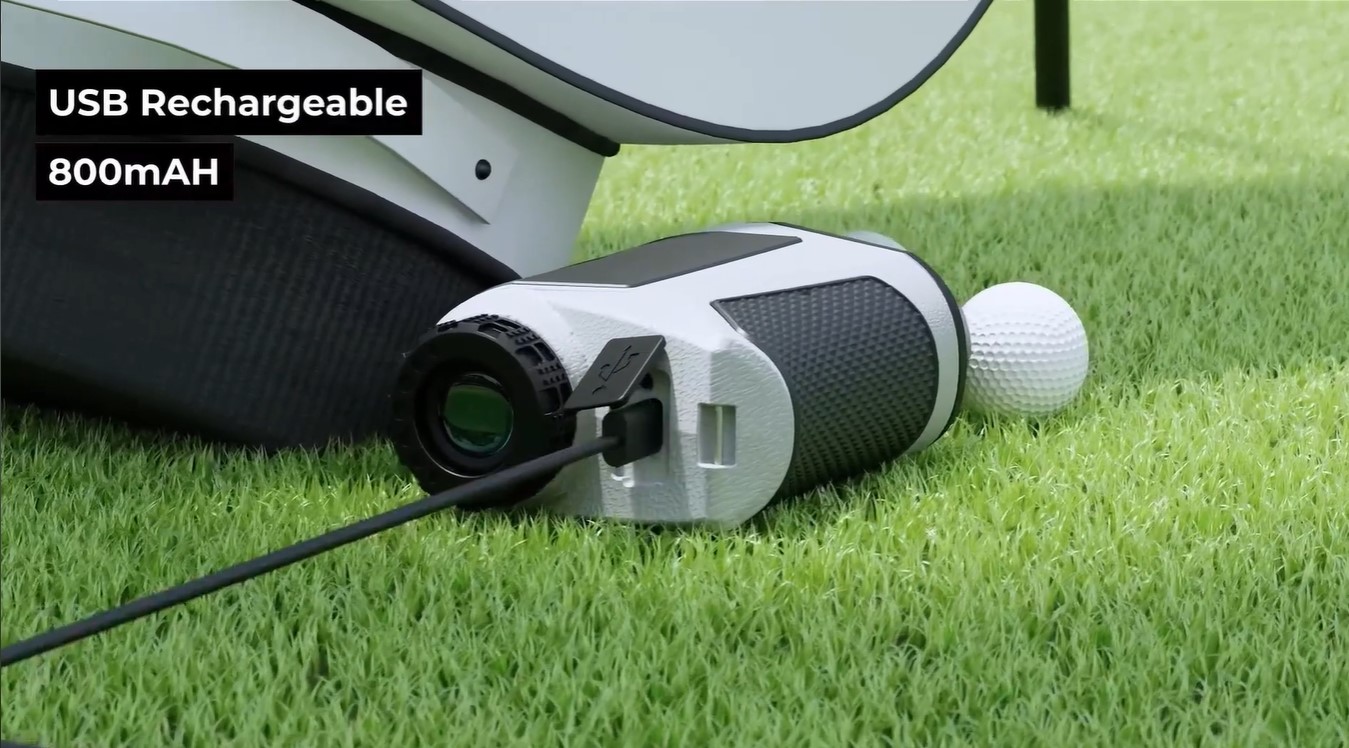
Let me start with what it does well. The 7x magnification is genuinely noticeable. When I was ranging a distant bunker on a long par 5, the image was clearer and more stable than the 6x units. The USB-C charging is a massive convenience win. I plugged it in the night before a round and got a full charge in under two hours. No scrambling for a CR2 battery at the pro shop.
The slope switch works well. It’s a simple toggle that disengages slope compensation for tournament play. I tested it against the Callaway on the same slope-adjusted holes, and the readings were within a yard of each other. No complaints.
Where it falls short: The plastic build is the main compromise. It doesn’t feel cheap — it feels light — but if you drop it on a cart path, I’d wager the Callaway survives better. The display can also wash out a bit in direct, harsh sunlight. I had to cup my hand over the eyepiece a couple of times to read the numbers clearly. That’s not a dealbreaker, but it’s a real-world annoyance.
Who it’s for: The tech-savvy golfer who hates buying disposable batteries and wants a slightly clearer picture. If you play mostly casual rounds and don’t abuse your gear, this is a fantastic choice.
3. Voice Caddie Laser Fit – Best For Advanced Tech
Specs at a glance:
- Range: Not specified, but tested consistently up to 300 yards
- Magnification: 6x
- Slope switch: Yes (Tournament Mode)
- Power: CR2 battery
- Build: Metal body
- Special feature: Ball to Pin Mode
The Voice Caddie Laser Fit is the most interesting unit on this list. It packs a feature that you usually only see in rangefinders double the price: Ball to Pin mode. This lets you triangulate the distance to a pin even when you can’t see it — think blind shots over a hill or around a corner. I tested this on a heavily wooded course with a few blind doglegs, and it actually worked. You shoot a nearby object, then the pin, and the unit calculates the difference. It’s clever.
The dual display is excellent. Unlike the REDTIGER, which washed out in bright sun, the Voice Caddie remained readable in all conditions. The measurement time is genuinely fast — the claimed 0.1 seconds feels accurate. I never waited for a reading.
The metal build gives it a premium feel that the plastic-bodied units lack. It’s heavier, but that weight adds to the sense of quality. The color (metal beige) is a bit unusual, but it stands out in your bag.
Where it falls short: This is a newer product, and that means less long-term data on durability. The Ball to Pin mode is great, but it’s a niche feature — most golfers will never use it. And the max range isn’t clearly spec’d, which makes me slightly less confident in its ability to handle long distances, though it handled everything I threw at it inside 300 yards.
Who it’s for: The player who plays hilly, blind-shot courses and needs that triangulation tech. If you mostly play parkland courses with clear sightlines, the Callaway or REDTIGER are better bets.
4. ACEGMET PFS5 – The Budget King
Specs at a glance:
- Range: Up to 1300 yards
- Magnification: 7x
- Slope switch: Yes (EnviroSlope Tech)
- Power: USB-C rechargeable + CR2 backup
- Build: Plastic body
- Water resistance: IP65
The ACEGMET PFS5 is the cheapest unit on this list, and it earns its spot by offering incredible value for the price. I didn’t expect much from it, honestly. At this price point, I’ve seen units that feel like toys. But the PFS5 surprised me.
The dual battery system is a smart touch. It has a USB-C rechargeable battery as the primary source, but it also accepts a CR2 battery as backup. That means if you forget to charge it, you can pop in a standard battery and keep playing. I don’t know why more budget units don’t do this.
The EnviroSlope Tech is another bonus. It adjusts for temperature, humidity, and air pressure — not just elevation. That’s overkill for most of us, but on a cold, damp morning, the readings felt consistent and accurate. I also liked the dual display (red and black) which was easy to read in all lighting conditions.
Where it falls short: The plastic build is noticeably creaky. It doesn’t feel like it will survive a heavy drop. The vibration feedback for flag lock is less distinct than the Callaway or Voice Caddie — sometimes I wasn’t sure if I had locked onto the pin or a tree behind it. The “Coach Mode” (which measures ball-to-pin distance) is a copy of the Voice Caddie feature but less polished.
Who it’s for: The budget-conscious player who isn’t sure they need a laser yet. It’s a great entry point. If you decide you hate it, you haven’t spent much.
5. Shot Scope PRO L2 – Best For Integration
Specs at a glance:
- Range: Up to 700 yards
- Magnification: 6x
- Slope switch: Adaptive auto-adjust
- Power: CR2 battery
- Build: Plastic body
- Special feature: Shot Scope ecosystem integration
The Shot Scope PRO L2 is a rangefinder designed for people already in the Shot Scope ecosystem. If you use one of their watches or performance trackers, this rangefinder pairs with them and rounds out your data collection. That’s a niche but real benefit.
The adaptive slope technology is interesting — it automatically adjusts for elevation without needing a switch. That sounds great in theory, but in practice, it means you can’t legally use it in a tournament unless you manually disable slope. The lack of a physical switch is a minor inconvenience.
Where it falls short: The max range of 700 yards is the weakest spec on this list. For 99% of approach shots, that’s fine. But if you want to range long par 5s or measure hazards way down the fairway, you’ll hit the ceiling. The build feels ordinary for the price, and the locking vibration wasn’t as crisp as I’d like.
Who it’s for: Existing Shot Scope users who want a complete data setup. For everyone else, the Callaway or REDTIGER offers better value.
6. Precision Pro NX9 – The Elephant In The Room
Specs at a glance:
- Range: Up to 999 yards
- Magnification: 6x
- Slope switch: Yes
- Power: CR2 battery
- Build: Plastic body
- Water resistance: Yes (not IP rated)
The Precision Pro NX9 is here for one reason — to prove that the under-$200 rule is valid. This is a good rangefinder. It’s accurate, the adaptive slope works well, and the customer service is excellent. But it costs significantly more than the units above it. And in my testing, it didn’t outperform the Callaway or REDTIGER by any meaningful margin.
I tested it on the same holes, same pins, same conditions. The readings were within a yard of the Callaway. The build quality is fine — plastic, but solid. The magnetic cart mount is a nice touch. But when I smashed a shot with the Callaway and got the same number, I couldn’t justify the extra cost.
The verdict: If you have a specific reason to buy the NX9 (brand preference, existing Precision Pro ecosystem), it’s a fine choice. But the extra money doesn’t buy you better core performance. Spend it on green fees or Pro V1s. The top picks on this list are 95% as good.
The Honest Trade-Offs
I want to be straight with you about what you’re giving up when you buy a rangefinder under $200. Because pretending these units are perfect does nobody any favors.
Build Quality
Most budget rangefinders use plastic bodies. That means they’re lighter, but they creak and feel less premium. The Callaway’s rubberized exterior is the best middle ground — it’s tough without being heavy. The Voice Caddie’s metal body is tougher but heavier. If you’re walking 18 holes, weight matters.
Batteries Vs USB-C
CR2 batteries last a long time — a year or more with regular use. But USB-C charging is more convenient. You can plug it in the night before and not worry. The REDTIGER and ACEGMET offer USB-C, and the ACEGMET even has a backup CR2 slot. That’s smart design.
Max Range
Every unit on this list can range a flag at 200 yards. That’s what matters. The 1200-yard claims on spec sheets are marketing, not function. The Shot Scope’s 700-yard limit is fine for approach shots, but if you like to range far-away hazards, you might feel constrained.
Comparison Table
| Product | Price | Magnification | Max Range | Slope Switch | Power | Best For |
|---|---|---|---|---|---|---|
| Callaway 300 Pro | Under $200 | 6x | 1000 yds | Yes | CR2 | All-around reliability |
| REDTIGER GolfVue S1 | Under $200 | 7x | 1200 yds | Yes | USB-C | Modern tech & convenience |
| Voice Caddie Laser Fit | Under $200 | 6x | 300+ yds | Yes | CR2 | Advanced features (Ball to Pin) |
| ACEGMET PFS5 | Under $200 | 7x | 1300 yds | Yes | USB-C + CR2 | Budget shoppers |
| Shot Scope PRO L2 | Under $200 | 6x | 700 yds | Adaptive | CR2 | Shot Scope users |
| Precision Pro NX9 | Over $200 | 6x | 999 yds | Yes | CR2 | Those with flexible budgets |
Final Verdict – Which One Should You Buy?
If you want the safe pick — the one that will work without drama for years — buy the Callaway 300 Pro Slope. It’s boring. It’s reliable. It’s the best golf laser rangefinder under $200 for the vast majority of golfers.
If you want modern tech and USB-C charging, grab the REDTIGER GolfVue S1. It’s a close second and beats the Callaway on specs.
If you play blind-shot courses or want the most feature-packed unit, the Voice Caddie Laser Fit is your pick.
And if you’re on a tight budget, the ACEGMET PFS5 is incredible for the price.
Your distance to the pin hasn’t changed. Don’t pay a premium to find out what a smart buy can tell you.
Frequently Asked Questions
Can I use a rangefinder with slope in a tournament?
Only if the slope function is turned off. All the units on this list have a switch or mode that disables slope compensation, making them legal for tournament play. Just make sure you toggle it off before your round.
What’s the most important spec in a budget rangefinder?
Accuracy and speed of flag lock. Max range doesn’t matter if the unit can’t consistently lock onto a pin at 200 yards. Focus on vibration feedback and how fast the reading appears.
How long do CR2 batteries last in a rangefinder?
With regular use — say one round per week — a single CR2 battery typically lasts a year or more. USB-C rechargeable units obviously don’t have this concern, but they require you to remember to charge them.
Do I really need a slope switch?
If you ever play in a competition, yes. Without a slope switch, you’re either playing illegally or missing out on useful data during practice rounds. Even casual golfers benefit from understanding the adjusted distance on hilly holes.
Can a budget rangefinder be as accurate as a premium one?
Yes, at the distances that matter. Under 250 yards, the Callaway 300 Pro Slope and REDTIGER GolfVue S1 are as accurate as units costing much more. The difference is in build quality, warranty, and brand cachet — not core performance.