
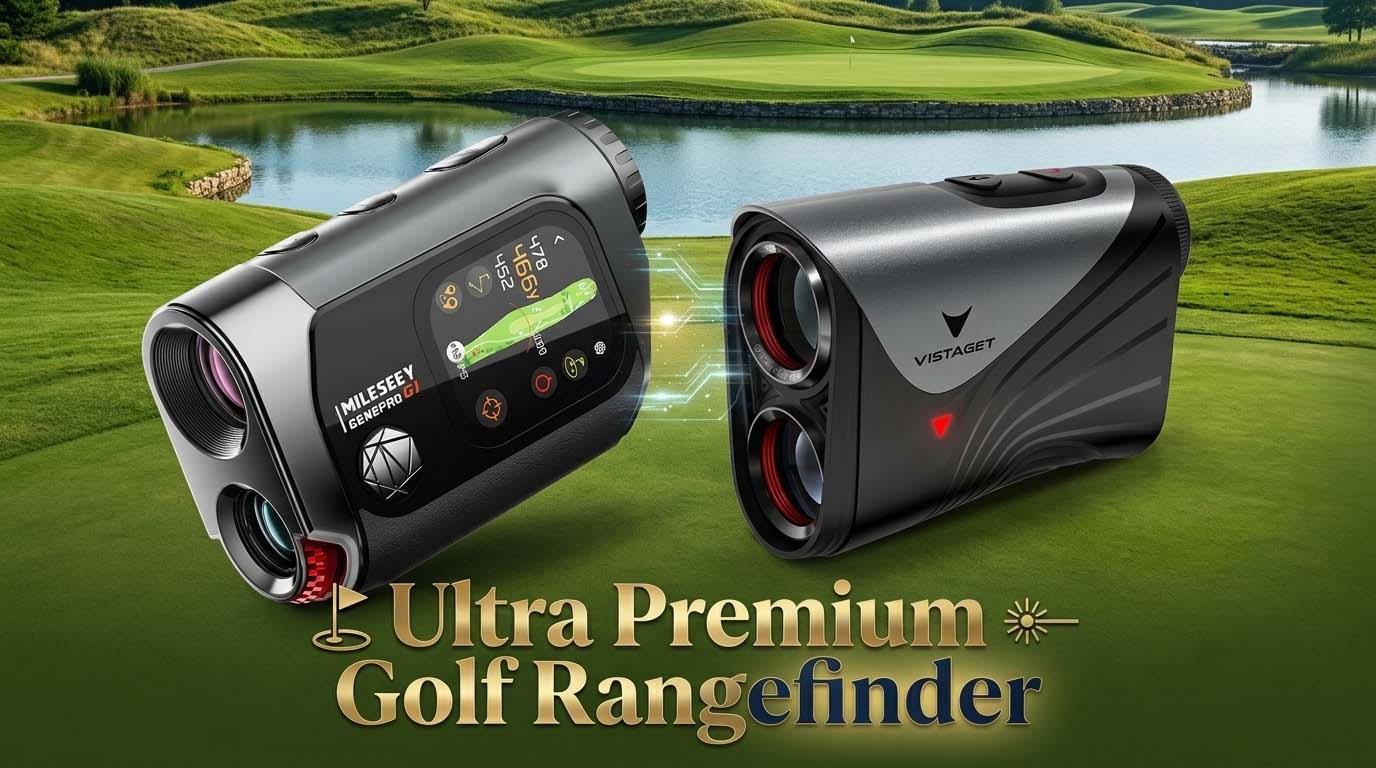
Let’s be honest: if you’re reading this, you already know a $150 rangefinder will give you distances. You’re past that. You want something that doesn’t just measure yards but takes the guesswork out of club selection, stays rock‑solid when your hands are shaking after a long carry, and feels like an extension of your game.
That’s the best ultra premium golf rangefinder 2025 or 2026, a device that justifies its price by actually changing how you play.
I spent the last month taking five top contenders out for multiple rounds, comparing them side by side on the same course, in the same light, with the same pins.
The market is splitting into two camps: pure laser specialists that focus on raw accuracy and build trust, and tech‑forward hybrids that layer GPS data and touchscreens on top of the laser.
There’s no single winner; the right choice depends on what kind of golfer you are. Let me walk you through what I found.


Why “Ultra Premium” Actually Means Something Different This Year
A few years ago, paying extra just got you a better lens and a magnet. That’s not true anymore.
The best ultra-premium golf rangefinders in 2026 separate themselves with three things: optics that compensate for you, intelligence that suggests clubs rather than just numbers, and build materials that survive a drop on a cart path.
A plastic body with a slope no longer qualifies when magnesium alloy and GPS overlays are available. I judged every unit on these three pillars, and only one nailed all three.
1. The Hybrid King: Mileseey GenePro G1 – The Tech Maximalist’s Dream
Key Specs:
– Display: 2.13” AMOLED touchscreen
– GPS: 43,000+ preloaded courses, free lifetime updates
– Laser range: 1,300 yards, flag lock from 600 yds in 0.1 sec
– Slope: SmartSlope with club recommendation
– Build: Magnesium-aluminum alloy
– Water/dust: IP65
– Battery: 24 hours (50+ rounds per charge)
– Magnet: Not included (requires a separate case)
I’ll be straight with you: the first time I held the GenePro G1, I thought, “This is too much.” A touchscreen on a rangefinder felt like a gimmick. But by the third round, I stopped reaching for my phone on the course.
The AMOLED screen is bright enough to read in full sun, and the GPS overlay shows you front, middle, and back distances without having to scan. The laser still handles flag locking in a tenth of a second, which is faster than anything else here.
The $500 Question: Is the AMOLED screen worth it?
Yes, but with a big caveat. The touchscreen is responsive, and the red/green display toggle helps in different lighting. Having 43,000 courses loaded means I know the exact yardage to the front of a green even when the pin is hidden.
The club recommendation feature gives you an adjusted distance and suggests a club based on slope, temperature, and altitude; it’s borderline cheating. But here’s the catch: there’s no built-in magnet.
For a unit at this price, that’s a glaring oversight. You’ll need to buy a separate magnetic case (or stick a magnetic plate on it), which feels like an afterthought.
The “Fog Mode” Reality Check
It works, but it’s not magical. In light mist, I got steady readings when other units struggled, but heavy fog still defeats it. I’d call it a nice bonus, not a dealbreaker.
Best for: The tech maximalist who wants one device that does it all and hates doing math on the course. If you want a rangefinder that feels like a smartphone, this is it.
2. The Stabilization Specialist: Golvia Ultra – No More Coffee Jitters
Key Specs:
– Magnification: 6x with Optical Image Stabilization (SteadyTrack)
– Accuracy: ±0.5 yard
– Lock confirmation: Acoustic Flag-Lock (sound) + visual
– Slope: Environmental calibration for temp/humidity/altitude, optional club recommendation
– Build: Plastic, IP65 water/dust resistant
– Battery: USB-C rechargeable (2-year warranty)
– Magnet: Built-in strong magnet
– Tournament legal: One-click slope switch
The Golvia Ultra doesn’t try to be everything. Instead, it solves the one problem almost all golfers have: holding the laser steady. The SteadyTrack optical stabilization is the real deal. I’m not a shaky guy, but when I’m tired on the back nine and the wind is gusting, the reticle dances. With the Golvia, the image stays nearly still.
That alone made my lock speed more consistent than with any other unit except the Mileseey’s quick-lock.
The acoustic flag‑lock is a beep that confirms you’re on the pin. I liked it more than the vibration on the Bushnell; my gloved hand sometimes misses the buzz. The sound cuts through the wind better.
The built‑in magnet is strong; I threw it on the cart strut at the turn, and it held. Battery life is solid; I got five rounds out of one USB-C charge.
Best for: Anyone who struggles with steady hands, older players, or golfers who want a reliable, stable laser without GPS complexity. The OIS is a genuine innovation that others should copy.
Satisfied Customer Opinion
3. The Tour-Proven Legend: Bushnell Golf A1-Slope – Boringly Reliable
Key Specs:
– Magnification: 6x
– Range: 1,300 yards, flag lock to 350 yds
– Slope: Yes, with on/off toggle
– Lock confirmation: PinSeeker JOLT (physical vibration)
– Build: Plastic, pocket-sized
– Battery: USB-C rechargeable, lasts 50+ rounds
– Magnet: Yes, built-in
– Tour trust: 98.6% of PGA Tour pros use Bushnell
The Bushnell A1 is the safest pick on this list. It does exactly what a rangefinder should do: give you accurate distances with slope adjustment and switch to tournament‑legal mode with a slide.
The JOLT vibration when you lock the flag is the industry standard for a reason; it’s unambiguous. I never wondered if I was on the pin.
But let’s be clear: it’s “just” a laser. There’s no club recommendation, no GPS, no touchscreen. For the purist who wants a tool, not a computer, that’s a feature. For anyone wanting the best ultra-premium golf rangefinder with integrated smarts, it feels old school.
The plastic build is fine but not special; it’s not magnesium like the Mileseey. That said, 50+ rounds on a charge and a 4.7-like performance rating (I give it a 4.6 because of the lack of innovation) make it a fantastic choice if you don’t need bells and whistles.
Best for: The traditionalist who trusts what works and wants a compact, reliable unit with proven tour credibility. If you only need distances, this is the one.
4. The Value Disruptor: Blue Tees Series 3 Max+ – Premium Features on a Budget
Key Specs:
– Magnification: 6x
– Range: 1,000 yards
– Slope: Adaptive slope switch, tournament legal
– Lock confirmation: Flag Lock with pulse vibration
– Display: Auto-Ambient adjusts text color
– Build: Plastic
– Battery: Rechargeable, 2-year warranty
– Magnet: Yes, built-in
– Extras: Waterproof case, cleaning cloth
The Blue Tees Series 3 Max+ is a great rangefinder at a lower price point. The auto-ambient display is a nice touch — the text color adjusts for lighting, which helps when I play with shifting clouds. Flag lock works well; the vibration pulse is similar to Bushnell’s, though not quite as strong.
But calling it “ultra premium” is a stretch. The plastic body feels less durable than Mileseey’s alloy, and at 1,000 yards max range it’s behind the others. It also doesn’t have GPS or club recommendations.
For the golfer who wants solid performance without paying top dollar, it’s excellent. For the ultra-premium category, it’s a step behind in build and features.
Best for: The budget-minded purist who wants a reliable laser with good lock speed and a built-in magnet, without the GPS extras.
5. The Underdog with Magnification: Pinned Prism – More Zoom, More Problems?
Key Specs:
– Magnification: 7x (highest here)
– Range: 1,000+ yards, accuracy ±1 yard
– Slope: Yes, with toggle (tournament legal)
– Lock confirmation: Short vibrating pulses
– Build: Plastic with magnetic strip
– Battery: USB-C rechargeable, 45 min charge for 60 rounds
– Bonus: American flag design (polarizing)
I wanted to like the Pinned Prism more. The 7x magnification sounds like an advantage; you can see the flagstick detail from farther away. But in practice, higher magnification magnifies your hand movement too.
Without any stabilization, I found it harder to keep the reticle on the pin than with the 6x units. It’s slow to aim, especially on a breezy day. The lock vibration is weak compared to Bushnell’s JOLT or Golvia’s sound.
The build is plastic, and the American flag color scheme is either love it or hate it. Battery life is impressive, 60 rounds from a 45-minute charge, but that doesn’t compensate for the usability issues. If you have steady hands and play wide-open courses with long views, the extra zoom can help. For most of us, it’s more trouble than it’s worth.
Best for: The long-iron player who needs to pick out a flag at 250+ yards and has rock-steady aim. Not for anyone with even a slight hand tremor.
Head-to-Head: The Tie-Breakers
Here’s a quick comparison of the top three that actually compete in the ultra premium space:
| Feature | Mileseey G1 (Hybrid) | Golvia Ultra (Stability) | Bushnell A1 (Purist) |
|---|---|---|---|
| Best Feature | GPS + Club Rec | OIS (hand steady) | Tour Trust / JOLT |
| Lock Speed | 0.1s (fastest) | Medium (but stable) | Medium |
| Biggest Flaw | No built-in magnet | No GPS | No club recommendation |
| Build Quality | Magnesium alloy | Plastic | Plastic |
| Battery Life | 24 hrs / 50+ rounds | USB-C, ~5 rounds per charge | 50+ rounds |
Final Verdict | Who Gets Your Money?
There’s no single #1 because the two best serve different golfers. Here’s how I’d decide:
If you want the most advanced tech on the course: Get the Mileseey GenePro G1. It’s the future of rangefinders — GPS, touchscreen, club suggestions, all in a magnesium body. Yes, you’ll need to buy a separate case for the magnet. Accept that trade‑off and you get a device that makes you play smarter.
If you value stability and want the most physically innovative product: Get the Golvia Ultra. The Optical Image Stabilization is a genuine game‑changer for anyone who struggles with steady hands. It’s also the best value in terms of innovation per dollar; no other unit does OIS at this price.
If you want something that will never let you down and you trust the tour standard: Get the Bushnell A1. It’s boring, reliable, and perfectly functional. It won’t surprise you, but it won’t fail you either.
Avoid the Pinned Prism if you have even a slight hand tremor — 7x magnification works against you. The Blue Tees is a great budget pick but doesn’t belong in the ultra premium conversation for build quality.
Frequently Asked Questions
a) What makes a golf rangefinder “ultra premium”?
Ultra premium means three things: optics that compensate for your movement (like OIS), intelligence that goes beyond slope to recommend clubs or display GPS data, and build materials like magnesium alloy that survive drops. A plastic body with basic slope no longer qualifies.
b) Is a hybrid GPS/laser rangefinder worth the extra cost?
For many golfers, yes. The Mileseey GenePro G1 gives you club suggestions and front/middle/back yardages without pulling out your phone. If you hate mental math, hybrids save time. But if you only care about pin distance, a pure laser like the Bushnell A1 is enough.
c) Do I need optical image stabilization in a rangefinder?
It helps more than you think. If you have slightly unsteady hands, are tired on the back nine, or play in windy conditions, OIS keeps the reticle still. The Golvia Ultra’s SteadyTrack made me more confident on every shot.
d) Can I use these rangefinders in tournament play?
All five models have a slope on/off switch that makes them tournament legal. Just flip the switch to disable slope and any club recommendations before the round.
e) Which rangefinder has the best battery life?
The Bushnell A1 and Mileseey G1 both claim 50+ rounds on a charge. The Pinned Prism offers up to 60 rounds. The Golvia Ultra lasts about 5 rounds between USB‑C charges. All are rechargeable except the Bushnell, which uses a USB‑C rechargeable battery.
f) What does “flag lock” mean and why does it matter?
Flag lock is the technology that locks the laser onto the flagstick instead of background objects.
All five units have it, with different confirmation methods: vibration (Bushnell, Blue Tees, Pinned), sound (Golvia), or both (Mileseey). A good lock algorithm prevents the “I aimed at the flag but got the tree behind it” frustration.