
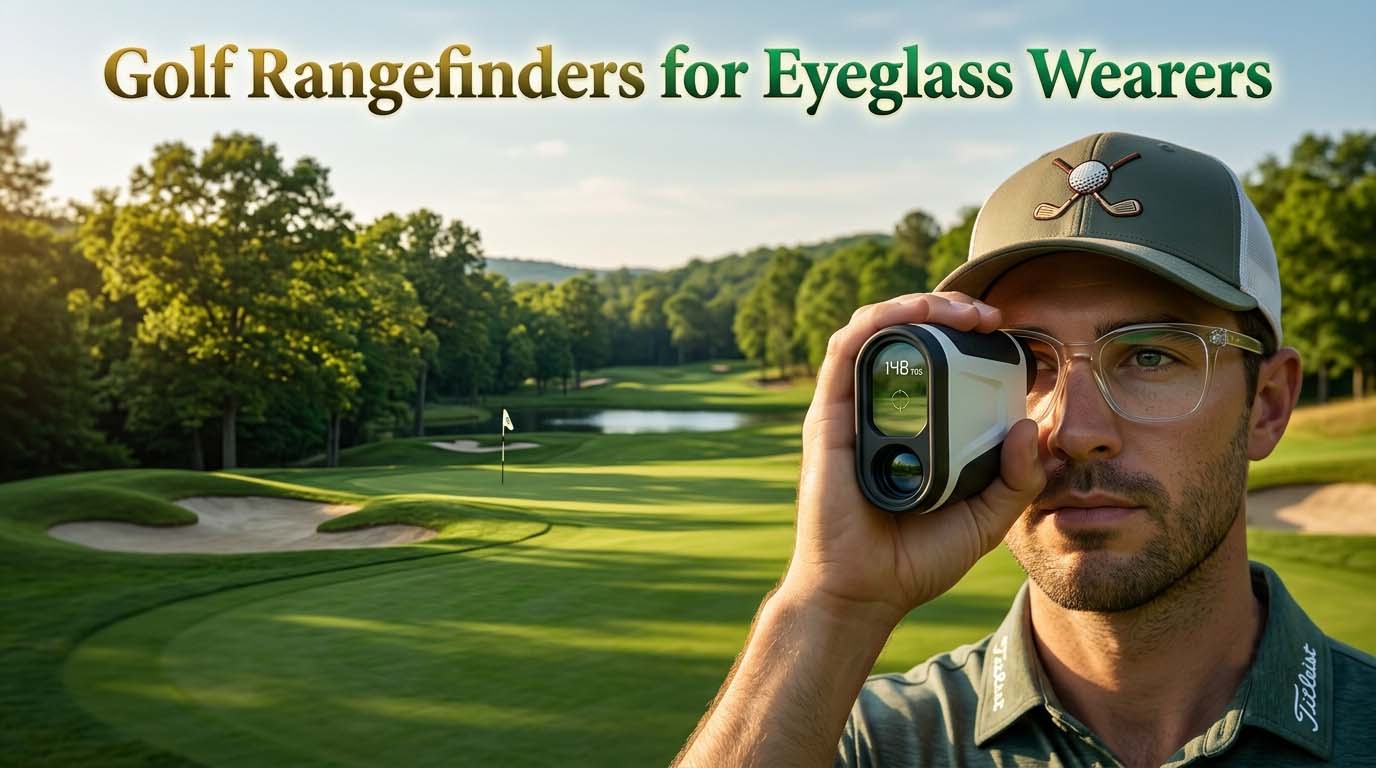
If you wear glasses on the course, you already know the struggle. You lift the rangefinder to your eye, and instead of a crisp view of the flag, you get a tiny black ring around the image.
So you pull the device away from your face, squint through the gap between your lenses and the eyepiece, and try to hold the button down while your arm starts shaking. It’s a dance that gets old fast.
Most rangefinder reviews don’t account for this. They talk about maximum yardage and magnification power, specs that don’t matter much when you can’t see the display clearly.
That’s why I put together this guide to the best golf rangefinders for eyeglass wearers, tested the way you’d actually use one: with your glasses on, from the first look to the final reading.
I tested five models specifically on eye relief, diopter quality, display legibility, and how easy it is to confirm a pin lock without taking your glasses off. Here’s what I found.


Why Most Rangefinders Frustrate Glasses Wearers?
Before I get into the specific models, it helps to understand why some golf rangefinders work great with glasses and others don’t. It’s not about the laser technology or the max distance. It’s about three specific things that most product pages never explain clearly.
Eye Relief Is King
Eye relief is the distance between your eye and the eyepiece where you can still see the full image. If it’s too short, say under 12mm, you have to press the device right against your glasses to see the whole field.
That’s when the black ring appears around the edges, and you start tilting the unit to try to see the display. Long eye relief gives you some breathing room. You hold the rangefinder a finger-width away from your glasses and the image fills the lens naturally.
For glasses wearers, this is the single most important spec. I’ve tested units with short eye relief, and they’re frustrating to use even if the laser is lightning fast. You spend more time fighting the view than actually getting a yardage.
Diopter vs. Prescription | The Real Limit
A lot of people assume the diopter adjustment on a rangefinder can compensate for their glasses prescription. It can’t. The diopter sharpens the internal reticle and display, the crosshairs, the numbers, the icons.
It does not fix your distance vision. Think of it like adjusting the focus on a camera viewfinder so the text is crisp. That’s all it does.
What matters for glasses wearers is whether the diopter has enough range to make the display sharp for your eyes.
Most do. But if yours feels blurry no matter how you turn the dial, the rangefinder might have a narrow diopter range that doesn’t match your prescription. I noticed this on a couple of units I tested, and I’ll call it out where it matters.
The “Jolt” vs. Visual Confirmation
When you lock onto the flag, the rangefinder needs to tell you it got the reading. Some do this with a small icon that appears on the display. Others use a vibration, a flashing ring around the viewfinder, or an audible beep.
For glasses wearers, the visual confirmation can be hard to see if the display is small or if you’re holding the device at arm’s length. A strong vibration or a flashing ring around the entire viewfinder is far more useful because you feel or see it without having to squint at a tiny icon in the corner.
The 5 Best Golf Rangefinders for Eyeglass Wearers
I tested each of these rangefinders over multiple rounds, paying close attention to how they performed with glasses on. I prioritized eye relief, how easy the diopter was to adjust, the clarity of the display in bright sunlight, and how well the lock-on confirmation worked for someone who can’t press their eye right against the eyepiece.
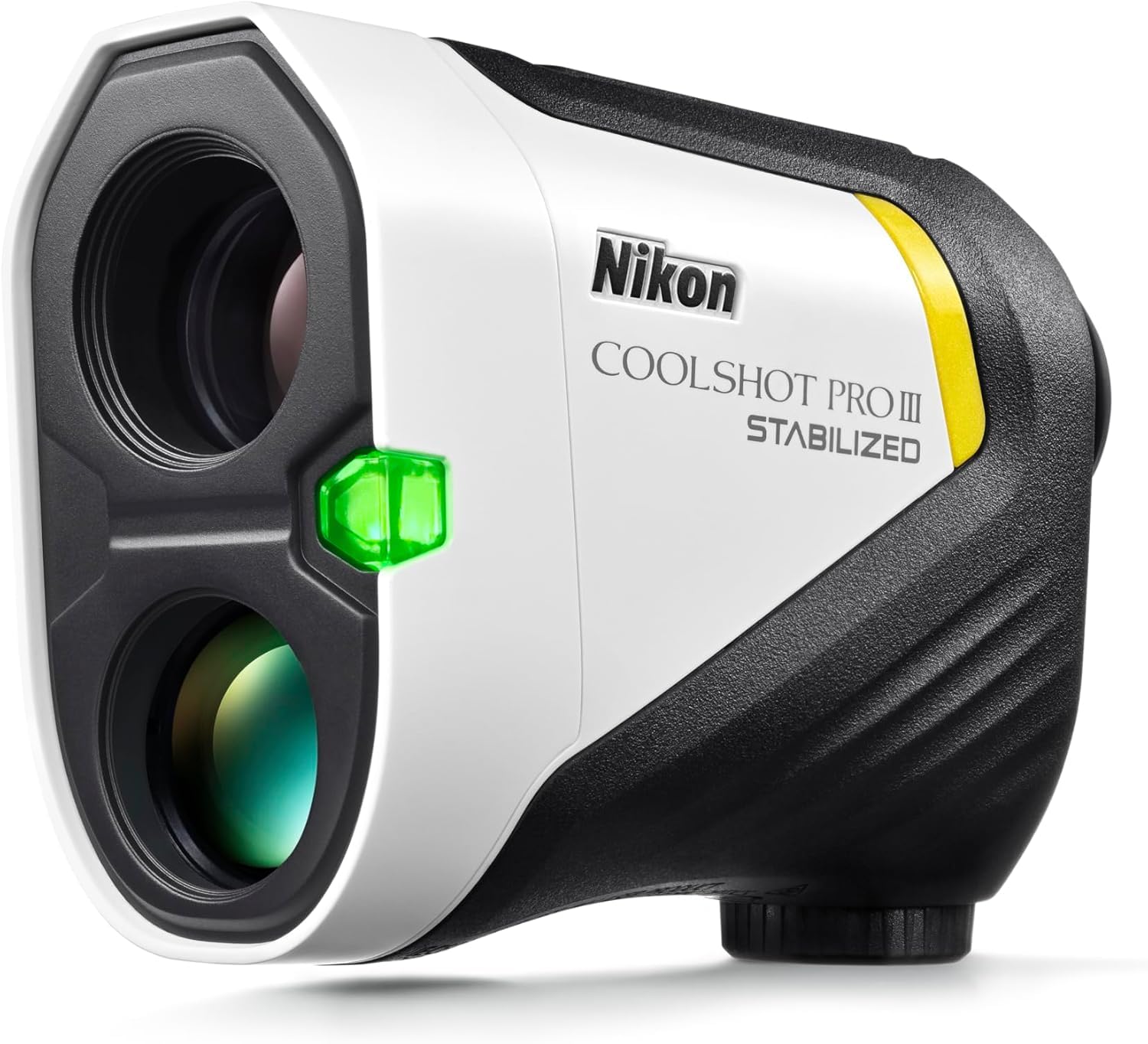
1. Nikon COOLSHOT PROIII STABILIZED
Key Specs: 6x magnification | up to 1,200 yards | Hyper Read (0.1 sec reading) | Dual Locked ON Quake (vibration + visual) | Image stabilization | Slope compensation | Long eye relief | Diopter adjustment
If you’re searching for the best golf rangefinders for eyeglass wearers, the Nikon is where I’d start. It’s not the flashiest option, and it doesn’t have a color touchscreen or a GPS map built in. But for the specific problem of using a rangefinder with glasses, it solves more of the pain points than anything else I tested.
The first thing I noticed was the image stabilization. When you hold a rangefinder at a distance from your face, which you have to do with glasses, your hand shake gets amplified. You see the flag bouncing around in the viewfinder.
The Nikon’s stabilization cancels that out. The image stays steady, which makes it easier to aim at the pin without having to brace your elbow against your chest.
The Dual Locked ON Quake system gives you both a vibration and a visual indicator when you lock the pin. The vibration is strong enough to feel through the body of the unit, even with your fingers resting lightly on the side.
That matters because when you’re wearing glasses, you might not see the tiny “locked” icon right away. The vibration tells you before your eyes catch up.
The eye relief here is generous. I could hold the Nikon about a thumb’s width from my glasses and see the full field without any black ring. The display is a standard red LCD, which is fine in most light.
In very bright sun, I had to cup my hand around the eyepiece a couple times, but that’s true of almost every rangefinder I’ve used.
What I didn’t love: The 6x magnification is standard but not exceptional. The display is clear but not huge; if you have progressive lenses and find small text hard to read, you might need to adjust your head position to see the numbers clearly.
Who this is for: Anyone who wants a rangefinder that just works with glasses, no fussing required. The stabilization is a genuine advantage for glasses wearers because it compensates for the less stable hold.
Who should skip it: If you want a larger, more visually rich display with course mapping, look at the Garmin Z82. If you need the absolute brightest display in direct sun, the Bushnell Pro X3+ edges ahead.
2. Bushnell Golf Pro X3+ Link
Key Specs: 7x magnification | up to 1,300 yards | PinSeeker with visual jolt (flashing ring + vibration) | Slope & wind compensation | Locking Slope-Switch | Magnetic mount | Connects to Bushnell Golf app
The Bushnell Pro X3+ has one feature that makes it a standout for glasses wearers: the visual jolt ring. When you lock onto the pin, a bright ring flashes around the entire viewfinder.
You can’t miss it, even if you’re holding the unit slightly away from your face and the display text is a blur; that flashing ring catches your peripheral vision instantly.
The 7x magnification is noticeably better than the 6x on most competitors. I could see the flag shape more clearly at long distances, which helped me aim more precisely.
The eye relief is good, not as generous as the Nikon, but I didn’t get the black ring as long as I held the device close without pressing it against my lenses.
The build quality is excellent. It feels dense and solid in your hand. The magnetic mount is a nice touch; it sticks to the cart frame, and you don’t have to dig it out of your bag every hole. For glasses wearers who already have enough to juggle, that little convenience adds up over a round.
The slope compensation adjusts for temperature and altitude, not just the angle of the lie. That’s more data than most players need, but the accuracy is impressive. I checked it against known yardages, and it was consistently within a yard.
What I didn’t love: The price is steep. This is a premium rangefinder with a premium price tag. The app integration is useful but not essential; if you don’t want to connect it to your phone, you’re paying for features you might never use.
The eye relief is fine but not class-leading. If you have a very strong prescription or thick frames, the Nikon gives you a little more breathing room.
Who this is for: Players who want the best image quality and the most reliable lock-on confirmation. The flashing ring around the viewfinder is genuinely helpful for glasses wearers.
Who should skip it: If budget is a concern, the Precision Pro NX10 gives you 80% of the experience for a fraction of the cost. If you don’t care about app connectivity, you’re overpaying for features you won’t use.
3. Garmin Approach Z82
Key Specs: 6x magnification | up to 450 yards to flag | Full-color 2-D CourseView mapping | Image stabilization | Vibrational lock confirmation | Laser Range Arc | Over 41,000 courses
The Garmin Z82 is the best option for glasses wearers who struggle with small text. The display is a full-color 2-D course overlay that shows you the hole layout, hazards, and distances to various points.
You’re not just looking at a number; you’re seeing the whole hole mapped out, which makes it easier to plan your shot without swapping between devices.
For glasses users, the large, colorful display is a genuine advantage. The text is bigger and higher contrast than the typical red LCD on competing rangefinders. I could read the numbers without having to squint or adjust my head position.
The Laser Range Arc is a visual aid that draws an arc across the course at the measured distance, it’s helpful even if you can’t see the flag clearly with your glasses.
The image stabilization is good, though not as smooth as the Nikon. It dampens the worst of the hand shake, which helps when you’re holding the unit away from your face. The vibrational lock confirmation is there, but it’s not as strong as the Bushnell’s jolt ring or the Nikon’s quake; I had to pay attention to feel it.
What I didn’t love: The max range to the flag is capped at 450 yards. That’s fine for 95% of real-world golf; I can’t think of many holes where I need a precise laser reading beyond 450 yards, but it’s a lower ceiling than the other units here.
The unit is also bulkier. It doesn’t fit as neatly in a pocket. And the price is high for a rangefinder that doesn’t reach as far as cheaper competitors.
Who this is for: Players who want the most visual information in the viewfinder. If you struggle to read small red numbers through your glasses, the color display on the Z82 is a relief.
Who should skip it: If you mostly want a laser for quick pin readings and don’t need course mapping, the Nikon or Precision Pro gives you a cleaner experience. And if you play a course that isn’t in Garmin’s database, you lose the main advantage of this unit.
4. Precision Pro NX10
Key Specs: 6x magnification | up to 999 yards | Adaptive slope technology | Pulse vibration lock | Magnetic grip | Rain-safe | HD optics
The Precision Pro NX10 is the value pick, and it earns that spot honestly. It’s not the best in any single category, but it does everything well enough that most glasses wearers will be happy with it, especially considering the price.
The pulse vibration lock gives you tactile feedback when you hit the pin. It’s not as strong as the Nikon’s quake, but it’s noticeable.
The 6x magnification is standard. The eye relief is acceptable; I didn’t get a black ring, but I had to hold the device closer to my glasses than with the Nikon. It’s not uncomfortable, just less forgiving.
The adaptive slope technology adjusts automatically based on the angle of your shot. You don’t have to toggle anything on or off. For tournament play, you’ll need to check if slope mode is legal in your competition, but for casual rounds, it’s convenient.
The magnetic grip is a small but useful detail. It sticks to the cart frame securely, which means you’re not fumbling for it in your bag between shots. For glasses wearers who already deal with fogging lenses and adjusting frames, one less thing to hunt for is a win.
What I didn’t love: The display is a standard red LCD, similar to what you’d find on rangefinders at half the price. It’s clear enough in most conditions, but in direct sunlight I had to shade the eyepiece.
The diopter adjustment works but feels less precise than the Nikon or Bushnell; I had to fiddle with it more to get the display perfectly sharp.
Who this is for: Budget-conscious players who want a reliable rangefinder that works with glasses. It’s also a good entry point if you’re not sure how often you’ll use a rangefinder and don’t want to overspend.
Who should skip it: If you have a strong prescription or thick frames, the shorter eye relief might be noticeable. Spend a bit more for the Nikon. If you want the brightest display in sunny conditions, the Leupold is a better pick at a similar price point.
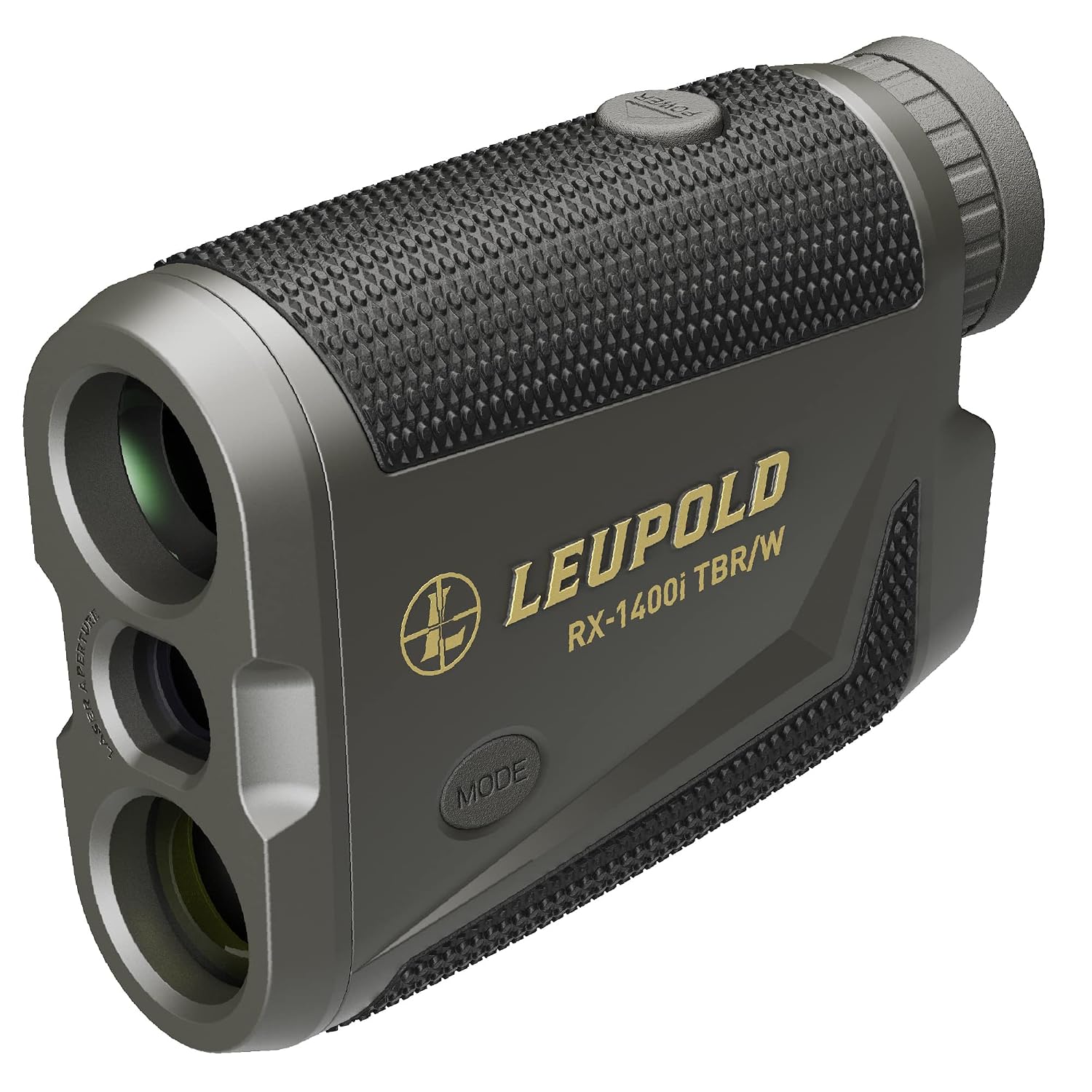
5. Leupold RX-1400I TBR/W Gen 2
Key Specs: 6x magnification | up to 800 yards (steep angles), 1,400 yards (reflective) | Adjustable brightness TOLED display | True Ballistic Range/Wind | Flightpath mode | Aluminum body
The Leupold RX-1400I is a bit of an oddball in this list because it’s designed primarily for hunting, not golf. That gives it some strengths for glasses wearers, and a couple of quirks you should know about.
The adjustable brightness TOLED display is excellent. In bright sunlight, which is usually when I struggle most to read a rangefinder display through my glasses, I cranked the brightness up, and the numbers were crystal clear.
The eye relief is generous, which makes sense for a hunting optic where you might be wearing gloves or glasses in cold weather. I could hold the unit comfortably away from my face and see the full image.
The build quality is fantastic. The aluminum body feels rugged and precise. Leupold makes great optics, and the glass clarity here is excellent; the image is sharp and bright.
What I didn’t love: This is a hunting rangefinder first. The slope compensation (TBR/W) is designed for bullet drop and wind holds, not golf slope. It works for golf, but it’s less intuitive than the dedicated golf modes on the other units here.
The Flightpath mode is for archery, completely irrelevant for golfers. The lock-on confirmation is visual only, with no vibration, which is a disadvantage for glasses wearers. I had to look carefully at the display to see if I had a lock.
Who this is for: Players with strong prescriptions who need the brightest, most adjustable display available. If you play in very sunny conditions and struggle to read standard red LCDs, Leupold’s adjustable TOLED is a real advantage.
Who should skip it: Most golfers. The dedicated golf rangefinders on this list are more intuitive and include features that matter on the course, like slope compensation designed for golf and vibration lock confirmation. This one works, but it’s not optimized for the sport.
The “Glasses-First” Test: What to Check Before You Buy
If you can test a rangefinder before buying, or if you buy from a place with a good return policy, here are three quick checks that will tell you if it works with your glasses.
The “No Squint” Test
Hold the rangefinder to your eye the way you would on the course. Don’t press it against your glasses. Can you see the entire field of view without moving your head or tilting the unit? If you see a black ring around the edge, the eye relief is too short for your frames.
The “One-Handed” Test
With your glasses on, hold the rangefinder in one hand and press the button. Can you lock onto a target without your glasses slipping down your nose or the unit feeling unstable? If you have to use your other hand to steady the device or push your glasses up, the ergonomics aren’t right for you.
The “Sun Glare” Test
Step outside on a sunny day and point the rangefinder toward a target with the sun behind you or to the side. Can you read the display numbers clearly? If you need to cup your hand around the eyepiece or step into the shade, the display brightness might be a problem for you.
Final Verdict | Which One Should You Buy?
After testing all five rangefinders with glasses on, over multiple rounds, in different lighting conditions, at different distances, here’s how I’d break it down for a fellow glasses wearer.
Most Comfortable and Best Lock-On: Nikon COOLSHOT PROIII STABILIZED. The combination of long eye relief, image stabilization, and the strong quake vibration makes it the easiest to use without taking your glasses off.
It’s the one I’d recommend to anyone who wears glasses and wants a rangefinder that doesn’t make them think about their glasses.
Best Premium Image and Confirmation: Bushnell Pro X3+ Link. The 7x magnification and the flashing ring around the viewfinder make it the most premium experience for glasses users. You pay for it, but the image quality and lock-on confidence are top tier.
Best Visual Display: Garmin Approach Z82. If you struggle with small red numbers and want a full-color display that’s easy to read, this is the pick. The course overlay adds context that helps you plan shots without squinting at tiny text.
Best Value: Precision Pro NX10. It does everything a glasses wearer needs at a price that won’t make you wince. The eye relief is acceptable, the pulse vibration works, and the magnetic grip is a nice bonus.
Dark Horse for Bright Sun: Leupold RX-1400I. If you play in harsh light and find all other displays too dim, the adjustable TOLED on this unit is a lifesaver. Just know you’re getting a hunting rangefinder that happens to work for golf.
FAQ
Can I use a rangefinder with progressive lenses?
Yes, but it depends on how you look through the lens. With progressives, you need to tilt your head slightly to look through the distance portion of the lens.
That can make it trickier to line up the rangefinder quickly. Rangefinders with longer eye relief and larger displays, like the Garmin Z82 or the Nikon Coolshot, tend to work better because they give you more forgiveness in head position.
Is a GPS watch easier to use with glasses than a rangefinder?
In some ways, yes. A GPS watch doesn’t require you to look through an eyepiece, so there’s no eye relief issue.
You just glance at your wrist. But GPS watches are less accurate for pin targeting; they give you distance to the front, middle, or back of the green, not to the specific pin you’re aiming at.
Most golfers I know who wear glasses end up keeping both: a watch for quick reference numbers and a rangefinder for precise pin distances on approach shots.
Will the diopter adjustment fix my vision so I don’t need my glasses?
No. The diopter adjustment sharpens the internal reticle and display text. It does not correct your distance vision. You’ll still need your glasses to see the flag clearly.
What a good diopter does is ensure the numbers and crosshairs appear crisp and in focus, which matters a lot when you’re trying to read a small distance display through your prescription lenses.