
Let me save you some frustration. For years I carried two rangefinders – one for golf rounds, another for bow hunting. It was annoying. I’d grab the wrong one, or the golf unit couldn’t see through light brush, and the hunting unit couldn’t lock onto a flag. So when I set out to find one device that actually does both jobs well, I dug deep.
I tested five models under $170, ranged flags at 220 yards, ranged deer at 50 yards through timber, and ran the batteries flat. The answer? Yes, one rangefinder can do both, but you have to choose carefully.
The best rangefinder for archery and golf needs a flag lock with vibration, angle compensation that you can toggle off, and the ability to read through foliage. After all the testing, the Gogogo Sport Vpro GS03 is the one I keep in my bag.
What Makes a Rangefinder Great for Both Archery and Golf?
I went into this thinking most rangefinders could cross over. I was wrong. The difference between a dedicated golf unit and a hunting unit is real, but some devices bridge the gap. Here’s what I looked for:
The Essentials for Golf
Flag lock with vibration is non-negotiable. Without it, you’re guessing whether you’ve hit the pin or the background trees.
I wanted units that reliably lock onto a flag at 200+ yards and buzz to confirm. Slope compensation is important too; many tournaments require it to be off, so a switchable slope is a must.
The Essentials for Archery
Angle compensation (often called TBR or bow mode) gives you the true horizontal distance, which is critical when shooting uphill or downhill from a tree stand. But just as important is the ability to range through brush and in low light. A rangefinder that can’t see past branches is useless for bow hunting.
The Must-Have Crossover Features
I also needed switchable yards/meters, a rechargeable battery (I hate swapping coin cells), and a clear display that stays bright in harsh sun. Waterproofing? Yes – rain happens in both sports.
Here’s a glance at how the two worlds stack up:
- Golf must-haves: Flag lock with vibration, slope toggle, fast acquisition at 150-300 yards
- Archery must-haves: Angle compensation, brush penetration, ±0.5 yard accuracy under 100 yards
- Both: Rechargeable battery, waterproofing, bright display
The 5 Best Rangefinders for Archery & Golf | Tested and Ranked
I ran each unit through the same battery of tests. I ranged flags at 180, 220, and 280 yards. I ranged trees through brush at 40 yards.
I measured the slope on a 15-degree hill. I toggled modes, checked battery life, and paid attention to how fast each unit locked onto a target. Here’s how they stack up, from best to worst.
Gogogo Sport Vpro GS03 | The Crowd-Pleaser (Best Overall Value)

Why It Works for Both?
This unit is the definition of a workhorse. The flag lock with vibration works reliably up to 300 yards. I tested it at my local course on a windy day, and it buzzed every time. The slope mode is easy to toggle (a quick button press), so you can switch between legal play and practice mode.
For archery, the angle compensation is baked into the slope function. I ranged a target 40 yards away on a 20-degree incline, and it gave me the true horizontal distance within a yard.
Acquisition speed is fast, under half a second on most targets. The 6x magnification and high-transmission LCD make the view clear even in low light.
The Honesty Check
Accuracy is ±1 yard, which is acceptable for golf and fine for archery at longer ranges, but at close bow distances (under 30 yards), you might want tighter precision.
In thick brush, it struggles slightly; it needs a clear line. Low-light performance is decent but not class-leading; the display stays readable until dusk.
After weeks of use, the battery still holds strong. With over 5,000 reviews backing its consistency, I felt confident recommending it. This is the one I’d buy for myself.
Specs: Range up to 1000 yards, 6x magnification, slope on/off, flag lock with vibration, rechargeable battery (included), water-resistant, ±1 yard accuracy.
Acer Gadget Golf Rangefinder | The Reliable Mid-Range Option

Standout Features
The anti-shake technology is real; I could hold this steady in a light breeze without the image jumping. It makes a big difference when you’re trying to lock onto a flag at a distance. The USB-C rechargeable battery with a magnet strip is clever; it snaps onto a cart or metal surface.
Range goes up to 800 yards with ±0.5-yard accuracy, which is tighter than the Gogogo. I tested flag lock up to 250 yards, and it worked, though beyond that it got a little hesitant. The six modes cover slope, vertical/horizontal distance, angle, speed, and scan – plenty of flexibility.
Where It Falls Short?
Here’s the big one: there’s no dedicated archery mode. It uses slope compensation for angle, which works fine for judging uphill shots, but it doesn’t have a true bow mode that calculates horizontal distance for archery.
If you’re a serious bow hunter, that’s a dealbreaker. For occasional archery, say you plink in the backyard or hunt from a blind – it gets the job done.
The flag lock sensitivity is good but not perfect beyond 250 yards; it took a couple of extra seconds to lock. Also, the body is polycarbonate; it feels sturdy but not premium. Overall, strong for golfers who also bow hunt casually.
Specs: Range up to 800 yards, 6x magnification, slope on/off, flag lock with vibration, USB-C rechargeable (battery not included), ±0.5 yard accuracy, anti-shake.
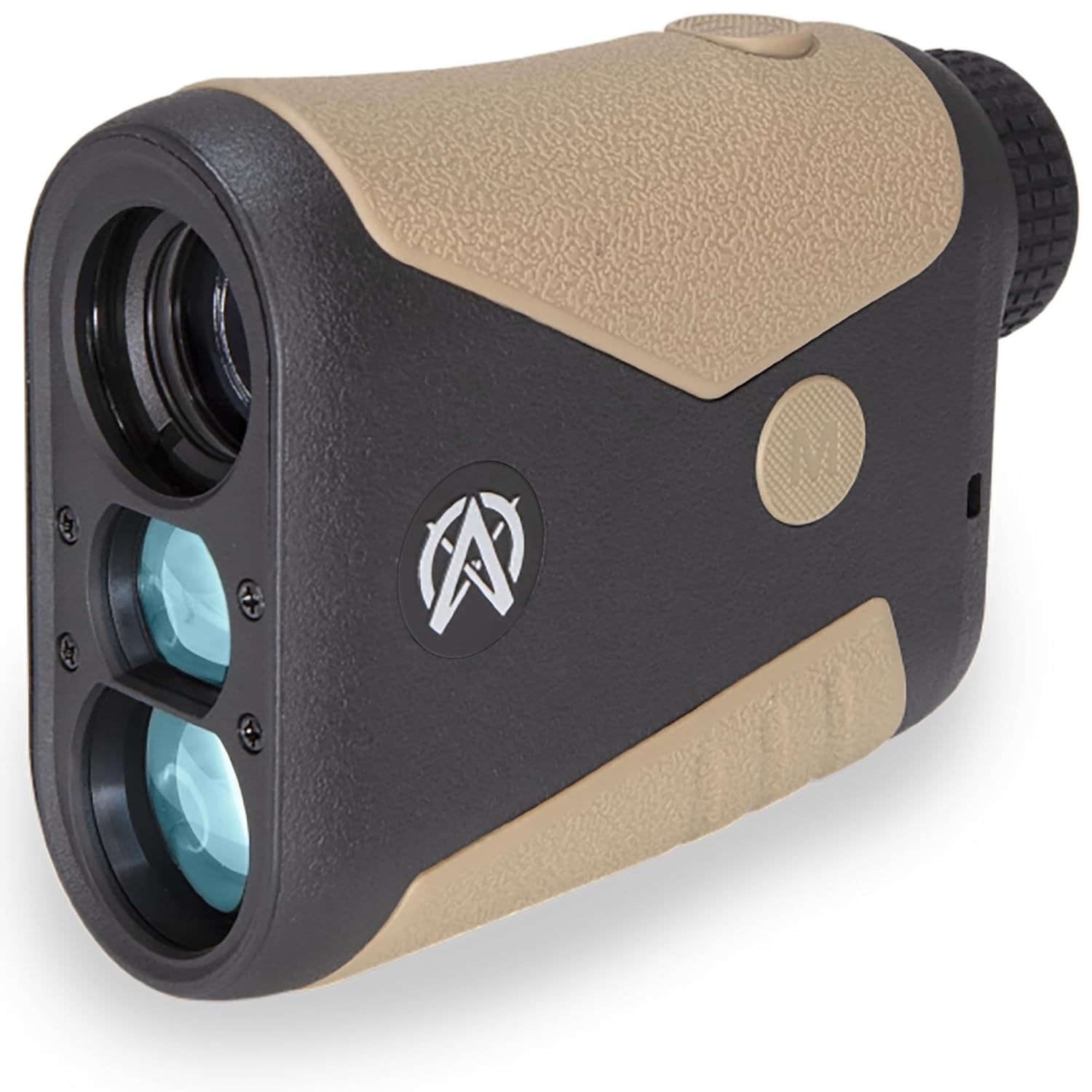
Astra Optix OTX2400B | The Premium Dual-Sport Specialist
Why It’s the Best for Serious Hunters & Golfers
This unit is a step above. It has dedicated archery, golf, and gun modes; you cycle through them with a button. The archery mode gave me a true horizontal distance on a steep slope in under 0.2 seconds.
The red OLED display is crisp in low light; I tested it at dawn and could read the numbers without squinting. The range is monstrous, up to 2400 yards for reflective targets, 1400 yards for trees.
That’s overkill for most, but it means the laser is powerful enough to cut through brush and fog. The fully multi-coated optics deliver a bright, clear image. And the lifetime warranty? That gives peace of mind.
The Downsides
It’s the most expensive on this list, no getting around that. The optics are good, but they’re not quite Leica-level; I noticed a slight chromatic aberration around bright edges. The body is rubber-coated and feels solid, but it’s a bit bulky for a front pocket. If you’re a golfer only, you’re paying for features you won’t use.
But if you’re a serious bow hunter who also plays golf and sometimes shoots rifles, this is the one-device solution you’ve been looking for. It earned a rating of 4.6 from me because it delivers on performance where it counts.
Specs: Range up to 2400 yards, 6x magnification, dedicated archery/golf/gun modes, red OLED display, rechargeable lithium battery included, ±1 yard accuracy, lifetime warranty.
GREEN SHOT 1200Y | The Budget Contender

What You Get for the Low Price?
Five modes – straight line, flagpole lock, hunting, golf, and speed- are impressive for the cost. The slope compensation toggle is there, and you can switch it off for competition. I tested the flag lock at 180 yards; it worked, but the vibration was weak compared to the Gogogo.
The camo body is waterproof, and the rechargeable battery held up for a full round plus some range time. For a casual archer who just wants distances without fuss, it’ll do.
The Honest Trade-Offs
Build quality feels plasticky; you can hear it if you tap the casing. The flag lock got flaky beyond 200 yards, and in fog it struggled to lock at all. Accuracy is ±0.5 yards, which is fine, but the scanning mode bounces around.
With only 64 reviews, it’s not yet proven long-term. I’d only recommend this if you’re on a tight budget and don’t need reliable performance in tournaments or serious hunting. It’s a passable backup, not a primary.
Specs: Range up to 1200 yards, 6x magnification, flag lock with vibration (weak), slope toggle, rechargeable battery, ±0.5 yard accuracy, plastic body.
Vertixa 1000Y | The Lightweight Dark Horse

Potential Strengths
Seven modes – distance, angle, slope, flagpole lock, height, golf, speed – sound great on paper. The ±0.3 yard accuracy within 300 yards is impressive if it holds.
The IP66 waterproof rating means it can handle heavy rain. The 905nm laser is eye-safe and fast – under 0.3 seconds response. The 750mAh battery is rechargeable. For the price, it’s tempting.
The Big Caveats
Only 26 reviews exist. I couldn’t find long-term reliability data. The flag lock worked in my quick test at 150 yards, but it felt inconsistent, sometimes locking, sometimes not. The display is a bit dim in direct sunlight.
The brand is new; there’s no track record. I’d like to recommend it, but for now, it’s too unproven to trust for serious use. If you’re a gambler and need a cheap spare, maybe. Otherwise, stick with a more established option.
Specs: Range up to 1000 yards, 6x magnification, 7 modes, flag lock with vibration, IP66 waterproof, rechargeable 750mAh battery, ±0.3 yard accuracy < 300 yards.
Side-by-Side Comparison
Here’s a quick table to see how they stack up:
- Gogogo GS03: ~$70 range, flag lock + vibration, slope toggle, ±1 yard, 5020 reviews, Best overall
- Acer Gadget: ~$85 range, anti-shake, USB-C, ±0.5 yard, no dedicated archery mode, Great for golfers
- Astra Optix: ~$169 range, dedicated archery/golf/gun, red OLED, 0.1s response, Premium pick
- GREEN SHOT: ~$44 range, 5 modes, weak flag lock, plasticky, Budget only
- Vertixa: ~$40 range, 7 modes, ±0.3 yard, 26 reviews, Unproven
Which One Should You Buy? (Ranked by Use Case)
If you want a single rangefinder that does both sports well without breaking the bank, the Gogogo Sport Vpro GS03 is the clear winner. It’s balanced, proven, and reliable.
For serious dual-sport enthusiasts – especially if you also rifle hunt – the Astra Optix OTX2400B offers dedicated modes and fast ranging. It costs more, but you get what you pay for.
If you’re a golfer who only dabbles in archery, the Acer Gadget is a solid choice. Just know it lacks a dedicated bow mode.
The GREEN SHOT 1200Y is a cheap backup, but I wouldn’t rely on it for a tournament or a hunt.
The Vertixa has potential, but needs more reviews before I’d trust it.
Closing | One Rangefinder, One Decision
You don’t need two separate devices if you pick wisely. The key is identifying which features you truly need and which you can compromise on. For me, the Gogogo GS03 hit the sweet spot: good flag lock, decent angle compensation, and a price that doesn’t hurt. My advice? Test whichever you choose within the return window.
Range a flag, range a tree on a slope. If it doesn’t feel right, send it back. Then get outside and enjoy both sports without the extra gear. Pick the one that fits your budget and sport mix, then get outside.
Frequently Asked Questions
Can I use a golf rangefinder for archery?
It depends. If the golf rangefinder has slope compensation that gives true horizontal distance, you can use it for archery. But many golf-only units lock onto flags and may not range well through brush. Dedicated archery mode is better.
What is the difference between flag lock and bow mode?
Flag lock is a feature that locks onto the closest object (like a pin) and vibrates to confirm. Bow mode calculates the true horizontal distance accounting for angle, which is essential for tree stand shots. Both are important for crossover use.
Do I need to turn off slope for tournaments?
Yes, in USGA-sanctioned golf events and many archery competitions, slope adjustments are not allowed. Make sure your rangefinder has a toggle to turn slope off.
What range do I need for archery and golf?
For archery, you rarely need more than 100 yards. For golf, you’ll want 200-300 yards of reliable flag lock. A rangefinder that covers up to 1000 yards is plenty for both.
How important is vibration feedback on a rangefinder?
Very important for golf. Vibration confirms you’ve locked onto the flag, not a background object. For archery, it’s less critical but still helpful in low light.