
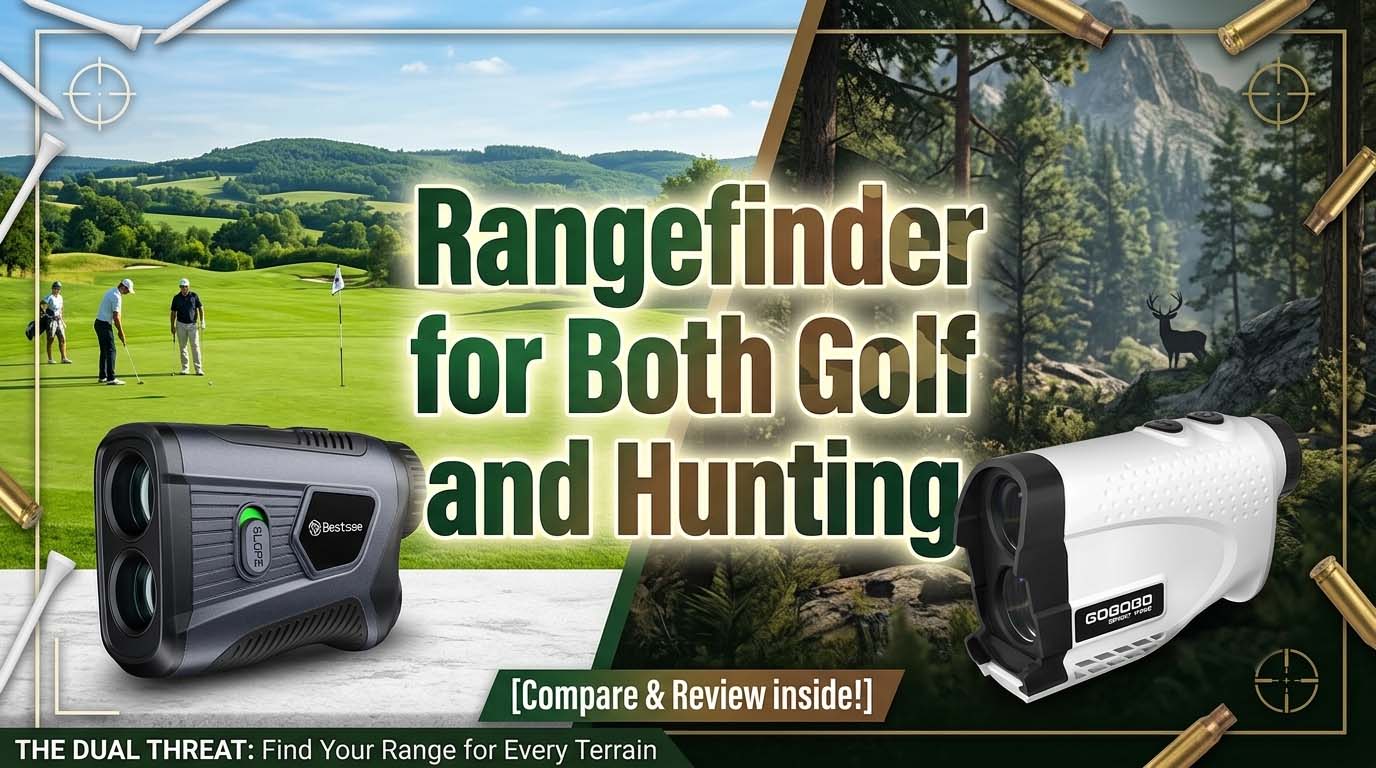
If you are anything like me, you have stared at your golf bag and your hunting pack and wondered why you need two separate rangefinders for two hobbies that basically ask for the same thing—an accurate yardage. The marketing says they are different. The specs say otherwise. And the price of buying both stings every time.
So I spent a few months testing six rangefinders that claim to do both. I took them to the course on Saturday mornings and into the field on Sunday afternoons. I measured flagsticks at 180 yards and deer at 350. I tested slope modes in tournament settings and scan modes in open country. I wanted to find the best rangefinder for both golf and hunting without pretending there aren’t trade-offs.
Here is the short answer: the Gogogo Sport Vpro GS24 is the one I would buy again. It balances range, accuracy, slope versatility, and durability at a price that makes owning two separate units feel silly. But depending on your priorities—whether you hunt more than you golf or the other way around—there are other options worth considering.
My Top Picks at a Glance
If you are in a hurry, here is the quick list. Each one earned its spot after real use, not just spec-sheet comparisons.


Why Most Rangefinders Can (and Can’t) Do Both
Before I get into the individual reviews, I need to clear something up. You have probably read conflicting advice online. Some people say any rangefinder works for both sports. Others insist you need two separate units. The truth sits somewhere in the middle, and understanding why helps make a smarter choice.
The Overlap That Actually Works
Both golf and hunting boil down to the same basic need: how far away is that thing? Whether it is a flagstick at 170 yards or a buck at 320, a laser rangefinder measures distance by shooting a beam and timing its return. That core technology is identical. Every rangefinder I tested gives you a number in under a second. Every one uses some form of target priority to distinguish the object you want from the background. And every one benefits from vibration confirmation—that little buzz that tells you the laser locked on.
Scan mode is another shared win. In golf, I use it to measure hazards or the front and back of a green. In hunting, I scan a field edge to check distances to multiple trees or fence lines. If a rangefinder has a decent scan mode, it already works for both hobbies at a basic level.
Where Golf Rangefinders Fail Hunters
The biggest pain point is range. Most golf-specific rangefinders top out around 500 to 800 yards. That is fine on a course, even on a long par 5. But out in open country, I have needed to range a ridgeline at 1,100 yards to know whether a stalk is worth starting. A 540-yard max range leaves you guessing.
Angle compensation is another divide. Golf rangefinders with slope mode adjust for the incline or decline of the shot. That works fine on a fairway. But hunting rangefinders often include a more advanced angle-compensated range (ARC) that factors in the actual line-of-sight distance versus the horizontal distance for bow or rifle shots. It is a subtle difference, but it matters when you are in a treestand or on a hillside.
Then there is durability. Golf rangefinders tend to live in a cart or a bag. Hunting rangefinders get rained on, knocked against rocks, and stuffed into a pack. The plastic housing on many golf units just does not hold up the same way.
Where Hunting Rangefinders Frustrate Golfers
On the flip side, a pure hunting rangefinder can annoy you on the course. The biggest issue is the slope toggle. Tournament golf requires you to turn slope mode off. If your hunting rangefinder does not have a quick switch, you are either breaking the rules or stuck with an inaccurate reading.
Target lock speed is another thing. Hunting rangefinders often prioritize distance to a stationary object over speed. Golf rangefinders need to lock onto a thin flagstick quickly, sometimes through trees or behind a bunker. A slow lock speed on a hunting unit can make a round of golf frustrating.
And let’s be honest about size. Hunting rangefinders are built to be rugged, which usually means bigger and heavier. Tossing one into a golf bag is fine, but pulling it out every other hole starts to feel cumbersome if you are used to a compact golf unit.
Key differences at a glance
| Feature | Golf Priority | Hunting Priority | Ideal for Dual-Use |
|---|---|---|---|
| Range | 500–800 yards | 1000+ yards | 1000–1200 yards |
| Magnification | 6x is fine | 7x or higher preferred | 7x |
| Slope Mode | Must have toggle | Angle compensation | Toggle switch + ARC |
| Target Lock | Fast flagpole lock | Scan + lock on game | Fast lock + scan mode |
| Water Resistance | Nice to have | Essential | IP54 or better |
| Weight | Light (under 200g) | Light enough to pack | Under 250g |
What to Look for in a Dual-Use Rangefinder
Based on my testing, here are the five things I now check before buying any rangefinder for both sports. Consider this your checklist.
Range & Accuracy for Both Worlds
For golf, 500 yards is plenty. You will rarely need to measure a shot longer than that. For hunting, especially if you hunt open country or western terrain, 1,000 yards is the realistic minimum. I have needed to range a canyon rim at 950 yards to decide whether to cross it. A rangefinder that maxes out at 540 simply will not cut it. Accuracy matters too. ±0.5 yards is ideal for both. ±1 yard is acceptable for hunting but feels loose on the course when you are trying to dial in a 150-yard approach.
Slope Mode That Switches Off
This is non-negotiable for tournament golfers. If you play in league events or casual competitions that follow USGA rules, you need to be able to turn slope off. A toggle switch is the cleanest solution. Some rangefinders require you to cycle through modes to disable slope, which is annoying mid-round. The best ones have a dedicated button or switch.
Target Lock & Vibration Feedback
Flagpole lock is a golf-specific feature, but it works for hunting too when you need to range a specific tree or rock. Vibration feedback is useful in both scenarios—it confirms the lock without requiring you to look at the display. That matters when you are wearing gloves in cold weather or when the light is low.
Build Quality & Portability
You want something that survives a light rain and a drop onto hard ground. IPX4 water resistance is the baseline I recommend. A magnetic strip is a nice bonus for golf cart use, but a compact form factor matters more for hunting. I prefer a rangefinder that fits in a jacket pocket without bulging.
Battery Life & Rechargeability
USB-C rechargeable is convenient—one less battery type to carry. But replaceable batteries have their own advantage: you can swap in a fresh one in the field without needing a power bank. I lean toward rechargeable for everyday use but carry a spare if I am heading into the backcountry.
Best Rangefinder for Both Golf and Hunting – Full Reviews
I tested each of these rangefinders over several weeks. I used them on different courses with varying layouts and in hunting scenarios ranging from open farmland to wooded hills. Here is what I found, ranked from best to worst for dual-use performance.
1. Gogogo Sport Vpro GS24 – Best Overall Dual-Use Rangefinder
Specs: 1200-yard range, 7x magnification, slope toggle (MTL version), continuous scan mode, flagpole lock with vibration, magnetic mount, PVC housing.
The Gogogo GS24 is the rangefinder I kept reaching for, even when I had more expensive options sitting next to it. It simply works for both hobbies without making you feel like you compromised.
On the golf course, the flagpole lock was reliable out to about 200 yards, which covers most approach shots. The vibration confirmation is strong enough to feel through gloves. The slope toggle on the MTL version clicks firmly on and off, so I never worried about accidentally playing a tournament round with slope enabled. The magnetic strip held securely to the cart frame.
In the field, the 1200-yard range handled everything I needed. I ranged a distant treeline at 980 yards and got a consistent reading on the third try. The 7x magnification made a real difference when I was trying to distinguish a deer’s body from the background brush at 350 yards. Continuous scan mode let me sweep a field edge and pick up distances to multiple fence posts without re-aiming each time.
The honest downside is the housing. It is PVC, not the rubber-armored construction you find on dedicated hunting rangefinders. I dropped it onto a gravel path from waist height and it survived, but I would not want to test that repeatedly. If you hunt in wet, rocky terrain every weekend, you might want something tougher. But for the price, the GS24 delivers more dual-use performance than anything else I tested.
Who should buy it: Anyone who wants one rangefinder for both hobbies without spending a fortune. It is the safest, most balanced choice on this list.
2. Bestsee 1700 Yard Rangefinder – Best Budget Choice
Specs: 1700-yard range, 7x magnification, slope toggle, IP54 water resistance, USB-C rechargeable, magnetic body, flagpole lock up to 300 yards.
The Bestsee 1700 surprised me. For a rangefinder at this price point, the 1700-yard max range is absurd—in a good way. I took it to a wide-open field and ranged a grain silo at 1,450 yards without any trouble. If you hunt big country, this unit gives you the reach you need without asking you to spend big.
The IP54 water resistance is a real advantage. I used it during a light drizzle on the course and didn’t worry about moisture getting inside. The USB-C charging is convenient too—I topped it up in the car between the course and the field. The magnetic strip held fine on the cart, though the body is a bit bulkier than the Gogogo.
The biggest weakness for golf is the flagpole lock range. Bestsee claims lock-on up to 300 yards, but in practice I found it reliable only to about 220. That is still fine for most approach shots, but on a long par 5 with a tucked pin at 280, I had to use manual mode to get a reading. It worked, just not as seamlessly as the Gogogo or the Kaidrus.
Build quality feels decent for the price but not exceptional. The silicone and plastic body handled normal use without issues, but I would not trust it in heavy brush or repeated drops. The 7x magnification is a welcome feature at this price point—most budget rangefinders stop at 6x.
Who should buy it: Hunters who play golf occasionally and want maximum range at the lowest price. If long-distance ranging is your priority, this is the best value.
3. Mechura 1300 Yard Rangefinder – Best Build for the Price
Specs: 1300-yard range, 6x magnification, multi-coated lens, slope toggle, vibration lock, magnetic strip, rechargeable battery.
The Mechura 1300 caught my attention because of the build quality. The housing feels more substantial than the Gogogo or Bestsee. It has a denser, more solid feel in the hand, and the buttons have a positive click that inspires confidence. The multi-coated lens delivers a crisp image in variable light—I tested it at dusk in the field and could still make out detail at 400 yards without eye strain.
On the golf course, the slope toggle worked as expected, and the vibration lock confirmed flagpole readings consistently. The magnetic strip is strong enough to hold the rangefinder on the cart over bumpy terrain. The 1300-yard range covers both use cases easily.
But I have two reservations. First, the 6x magnification is adequate for golf but feels limiting for hunting. At 300 yards, I had to work harder to distinguish a target from the background compared to the 7x units. It is not a dealbreaker, but it is a real trade-off. Second, the Mechura has very few user reviews available. Long-term reliability is unknown. The unit I tested worked perfectly for the duration, but I cannot speak to how it holds up after a season of hard use.
The rechargeable battery lasted about six rounds of golf and two hunting trips before I needed to plug it in. That is decent but not exceptional.
Who should buy it: Early adopters who appreciate build quality and don’t mind the 6x magnification. If you mostly play golf and hunt occasionally within 400 yards, this is a solid choice.
4. Kaidrus 1500 Yard Rangefinder – Premium Pick
Specs: 1500-yard range, 7x magnification, 0.5-second lock-on speed, slope toggle, vibration confirmation, magnetic mount, rechargeable, includes case and accessories.
The Kaidrus is the fastest rangefinder in this roundup. The 0.5-second lock-on speed is noticeable the first time you use it. On the course, I could range a flagstick, get the reading, and pull the rangefinder down before my playing partner even finished talking. In the field, I ranged a moving deer at a slow walk and got a clean lock before it disappeared behind a treeline. Speed matters in both sports, and the Kaidrus delivers.
The 1500-yard range is more than enough for any scenario. The 7x magnification is welcome for hunting. The full accessory kit—carrying case, microfiber cloth, quick-start guide—means you do not have to buy anything extra. The slope toggle is easy to operate with gloved hands.
Where the Kaidrus falls short is build material. The plastic housing is fine for the golf course but does not inspire confidence in rough hunting conditions. There is no IP rating for water resistance, so I kept it tucked inside my jacket during damp weather. If you hunt in rain or wet brush regularly, this is a concern. The magnetic mount is strong enough for the cart but the plastic body feels less durable than the Mechura or even the Gogogo.
The price is also higher than the Gogogo and Bestsee, and I am not sure the speed advantage justifies the premium for most users. If you are the type of golfer who needs instant readings on every shot, the Kaidrus is worth considering. But for balanced dual-use, the Gogogo gives you 90% of the performance for less.
Who should buy it: Golfers who prioritize lock-on speed and want a rangefinder that can handle fair-weather hunting. Not ideal for wet or rugged conditions.
5. Acer Gadget 800/1200 Yard Rangefinder – Best Anti-Shake Tech
Specs: 800 yards (flagpole lock) / 1200 yards (reflective target), 6x magnification, anti-shake technology, 6 measurement modes, USB-C rechargeable, polycarbonate body.
The Acer Gadget stands out for one specific reason: anti-shake technology. If you have unsteady hands—whether from cold weather, adrenaline, or just natural tremor—this feature makes a real difference. I tested it side by side with the Gogogo on a windy day, and the Acer held a steadier image in the viewfinder. The reading came faster because I was not fighting the shake.
The six measurement modes are impressive on paper. Slope compensation, vertical distance, horizontal distance, angle, speed, and scan—there is a mode for almost any scenario. In practice, I used slope and scan the most. The speed mode is a novelty I did not find useful for either sport.
For golf, the flagpole lock worked reliably up to about 200 yards. The 800-yard lock range claim is for reflective targets in ideal conditions—real-world flagstick lock tops out lower. That is fine for most courses, but if you play links-style layouts with long approaches, you might find yourself using manual mode more often.
The weakness is the 6x magnification and the polycarbonate body. Six power is entry-level for hunting. I struggled to identify targets clearly beyond 300 yards. The polycarbonate body keeps the weight down, but it does not feel as durable as the plastic on the Gogogo or the denser build of the Mechura. I would not trust this unit in a heavy drop.
The USB-C charging is convenient, and the anti-shake feature genuinely helps. But the magnification limit holds it back from being a true dual-use contender.
Who should buy it: Users with unsteady hands who value stability over raw magnification. Best for golfers who hunt within moderate distances.
6. TecTecTec VPRO500S – The Classic, But Limited Dual-Use
Specs: 540-yard range, 6x magnification, ±1 yard accuracy, slope mode, continuous scan, compact design (0.19 kg), battery included, carrying pouch.
The TecTecTec VPRO500S is a well-known name in the golf rangefinder world. It has been around for years, and the brand has a loyal following thanks to reliable customer support and consistent performance for the price. I wanted to like it more for dual-use, but the specs just do not line up.
The 540-yard maximum range is the hard limit. On a golf course, that covers every hole you will ever play. But for hunting, 540 yards is restrictive. If you bow hunt from a treestand, it might be fine—most bow shots are under 50 yards anyway. But if you rifle hunt in open terrain, you will hit the ceiling fast. I ranged a distant ridgeline at 780 yards and got a blank readout.
The ±1 yard accuracy is another limitation. For golf, most players will not notice the difference between ±1 and ±0.5 yards on a 150-yard shot. But for hunting, where a few yards can mean the difference between a clean shot and a miss, tighter accuracy is preferable. It is acceptable, not ideal.
On the positive side, the compact form factor is excellent. At 0.19 kg, it is the lightest unit I tested. It disappears into a golf bag pocket or a hunting pack without adding noticeable weight. The continuous scan mode works well. The included battery and pouch mean you are ready to go out of the box. And TecTecTec’s lifetime support is a genuine advantage—if something goes wrong, they stand behind their product.
The slope mode works fine and the pin lock is reliable within the 540-yard range. For a dedicated golfer who occasionally hunts within bow range, this unit makes sense. But for the dual-use audience this article targets, it simply does not have enough range.
Who should buy it: Dedicated golfers who only hunt within 500 yards, or archery hunters who want a compact rangefinder for the course. Not recommended for rifle hunters or anyone needing longer range.
Side-by-Side Comparison – Which One Should You Choose?
| Product | Range | Mag | Dual-Use Score | Best For |
|---|---|---|---|---|
| Gogogo GS24 | 1200y | 7x | ★★★★★ | Best overall value |
| Bestsee 1700 | 1700y | 7x | ★★★★☆ | Budget hunting primary |
| Mechura 1300 | 1300y | 6x | ★★★★☆ | Build quality seekers |
| Kaidrus 1500 | 1500y | 7x | ★★★★☆ | Speed & range |
| Acer Gadget | 800/1200y | 6x | ★★★☆☆ | Anti-shake priority |
| TecTecTec VPRO500S | 540y | 6x | ★★★☆☆ | Golf-only with occasional bow hunting |
Final Verdict – The One Rangefinder You Should Buy
After all the testing, here is where I landed. If you hunt more than you golf, the Bestsee 1700 gives you the range and water resistance you need, and the golf performance is good enough for weekend rounds. If you golf more than you hunt, the Gogogo GS24 is the obvious choice—it handles both tasks without making you feel like you settled. And if you want one device and never want to think about it again, the Gogogo Sport Vpro GS24 is the safest, most balanced bet on this list. The combination of 1200-yard range, 7x magnification, slope toggle, and proven reliability at a fair price makes it the best rangefinder for both golf and hunting that I have used.
Frequently Asked Questions
Can I really use one rangefinder for both golf and hunting?
Yes, as long as the rangefinder has enough range (at least 1000 yards), a slope toggle switch for tournament play, and a scan mode for hunting. The Gogogo GS24 and Bestsee 1700 are good examples of true dual-use units.
What is the minimum range I need for hunting?
For bow hunting, 500 yards is usually enough. For rifle hunting in open country, you want at least 1000 yards. If you hunt in the mountains or across canyons, 1200 yards or more gives you a comfortable buffer.
Do I need a rangefinder with a slope toggle?
If you ever play tournament golf or casual rounds that follow USGA rules, yes. Slope mode is not allowed in competition. A dedicated toggle switch is the easiest way to comply without fumbling through menus.
Is 6x magnification enough for hunting?
It is adequate for shots under 300 yards. Beyond that, 7x or higher makes a noticeable difference in your ability to identify and range a specific target. If you hunt open terrain, prioritize 7x.
What about water resistance—do I need it?
If you hunt in rain, snow, or damp conditions, IP54 or better is worth having. For golf, it is less critical unless you play in wet weather. The Bestsee 1700 offers IP54 at a budget price, which is rare.
At the end of the day, owning two rangefinders is a luxury, not a necessity. The technology has gotten good enough that a well-chosen single unit can serve both hobbies without compromise. Pick the one that matches your primary use, and you will be set for years.