
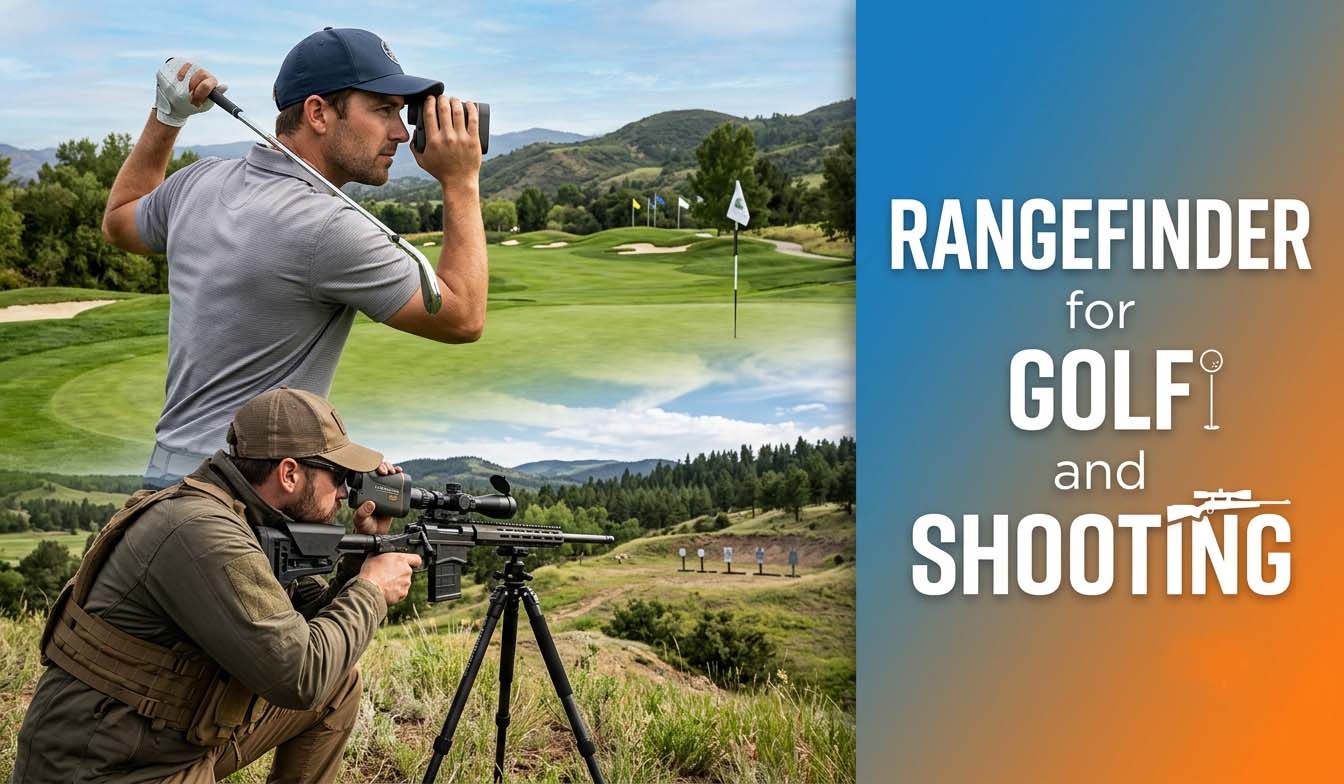
Introduction: The One-Tool Dream
If you’re like me, you’ve probably stood in the aisle of a sporting goods store staring at two separate devices, one for golf, one for hunting- and wondered why nobody builds a single rangefinder that does both jobs well without costing a fortune.
I’ve been there. I’ve brought a hunting rangefinder to the course and couldn’t lock onto a flag to save my life. I’ve also taken a golf rangefinder into the woods and watched it bounce off every leaf between me and the deer. The frustration is real.
But the good news? The technology has gotten cheap enough that a few budget-friendly models now genuinely try to bridge that gap. I spent several weekends testing four popular rangefinders under $100 to see which ones actually work for both golf and shooting.
I played nine holes with each one, then headed to a friend’s property to range steel targets and deer silhouettes in brush. Here’s my honest verdict.
The best rangefinder for golf and shooting for most people is the Gogogo Sport Vpro GS03. It’s not perfect at either sport, but it balances pin-lock accuracy for the course and a usable scan mode for the field better than anything else at this price.
If you hunt more than you golf, the GREEN SHOT is a strong budget option. And if you’re a long-range shooter who also plays a casual round, the Kaidrus offers the clearest glass and longest reach.


What Makes a Rangefinder Good for Both Golf and Shooting?
Before we get into the reviews, it helps to understand why most rangefinders fall short when you try to use them for both sports. The core problem is that golf and hunting demand opposite things from the laser engine.
The Golf Priority: Pin-Seeker and Slope
On the course, you need a rangefinder that can ignore everything behind the flag and lock onto a thin metal pole at 150 yards. That’s called “pin-seeker” or “flag-lock” technology. The device has to prioritize the closest object in the crosshairs, even if there are trees or a hill behind it.
I also want a slope switch that’s easy to toggle, because if I’m playing in a tournament, I need to turn it off to stay legal.
Most golf rangefinders do this well, but they often struggle to range a deer that’s partly hidden behind brush because they keep trying to lock onto the nearest leaf.
The Shooting Priority: Brush Mode and Scan
For hunting or target shooting, you need the opposite behavior. You want the rangefinder to ignore foreground obstacles — twigs, rain, tall grass — and give you the distance to the solid object behind them.
That’s usually called “brush mode” or “hunting mode.” You also want a fast “scan” mode that continuously updates the distance as you pan across a field, which helps track moving animals or verify multiple targets.
The best hunting rangefinders also offer angle compensation for uphill/downhill shots, but that’s less critical for most shooters than simply getting a clean reading through cover.
The Trade-Off You Can’t Avoid
No sub-$100 rangefinder can be perfect at both. The laser engine that aggressively locks onto the flag will also lock onto foreground leaves when you’re hunting.
Conversely, a machine that’s great at ignoring brush might struggle to grab a flagpole that’s half the width of a pencil.
The devices here represent different compromises. Some lean toward golf, some toward hunting. My goal was to find the one that leans the least — that does both jobs well enough that you don’t feel like you’re missing a tool in your bag.
1. Gogogo Sport Vpro GS03 — The Best All-Rounder
Key specs: Range up to 1000 yards · 6X magnification · ±1 yard accuracy · Slope mode toggle · Flag-lock with vibration · Rechargeable battery (USB-C) · Weight: 5.6 oz
I started my testing with the Gogogo Vpro GS03 because it has the most reviews of any budget rangefinder online — over five thousand at the time I wrote this. That kind of popularity usually means one of two things: either it’s genuinely good, or it’s cheap enough that nobody complains too loudly. Turns out, it’s the former.
On the golf course, the pin-lock feature worked reliably. I aimed at a flag 175 yards out, and the vibration confirmed the lock within about a second. It didn’t always grab the flag on the first try if there was a tree directly behind it, but the second attempt usually did.
The slope mode gave me adjusted yardage that felt accurate compared to my buddy’s Bushnell V6 Shift, maybe a yard off here or there, but close enough for club selection. The 6X magnification is standard for this price range, and the LCD was bright even in direct afternoon sun.
For shooting, I switched to scan mode. The GS03 doesn’t have a dedicated “brush mode,” but the regular scan function did a decent job of picking out a steel target at 300 yards that was partially hidden behind a fence post. It wasn’t as aggressive as a true hunting rangefinder at ignoring foreground clutter — sometimes it would lock onto a branch instead — but by panning slowly I could get a clean reading. The speed mode also worked, accurately clocking a friend’s arrow at around 280 fps.
Where it falls short: The build quality is fine, but the ABS plastic body doesn’t feel as premium as the Kaidrus’. It’s not waterproof either — just splash-resistant. If you hunt in heavy rain, that’s a concern.
And the maximum range of 1000 yards is plenty for golf and most hunting scenarios, but long-range shooters who want to range beyond 500 yards might wish for more.
Overall, the Gogogo Vpro GS03 is the safest pick for someone who plays golf on Saturday and hunts on Sunday. It doesn’t excel at either sport, but it does both better than any other device I tested in this price range.
2. Acer Gadget Golf Rangefinder — The Golf-First Hybrid
Key specs: Range up to 800 yards (claimed 1200 yds reflective) · 6X magnification · ±0.5 yard accuracy · Anti-shake technology · 6 modes (slope, speed, angle, scan, flag-lock) · Rechargeable USB-C · Magnetic stripe for cart
The Acer Gadget rangefinder surprised me in a few ways. It has an anti-shake feature that I initially dismissed as marketing hype, but after using it on a windy day, I could actually see the image stabilizing.
That helped with both golf pin-lock and hunting target acquisition. The flag-lock vibration was strong and consistent — I’d say it’s slightly better than the Gogogo at grabbing pins from 200 yards out.
On the course, the 800-yard maximum range (the spec sheet says 1200 yards for reflective targets, but for golf flags you’re realistically looking at 800) is plenty.
The slope switch clicks firmly, and I appreciate the magnetic stripe for sticking the rangefinder to the cart, a small but real convenience.
For shooting, I used the scan mode and the speed mode. The anti-shake helped when trying to range a target at 400 yards while holding the device in my hand without a tripod. The speed mode measured a truck moving at 35 mph accurately according to the dashboard. But here’s the catch: the Acer is clearly optimized for golf.
The brush penetration is weaker than the GREEN SHOT or even the Gogogo. When I tried to range a deer target that was half-hidden behind a small pine, the Acer kept locking onto the foreground branch even in scan mode. It took several tries to get a reading on the target itself.
Where it falls short: The 800-yard range is fine for most golfers, but for hunters who want to range a buck at 500+ yards in open country, you’re pushing the limits. The polycarbonate build feels a bit more solid than the Gogogo, but it’s not waterproof.
I’d recommend the Acer Gadget to golfers who occasionally shoot — maybe once or twice a season. If hunting is your primary use, look at the GREEN SHOT or Gogogo instead.
3. GREEN SHOT Range Finder — The Budget Hunter’s Secret
Key specs: Range up to 1200 yards · 6X magnification · ±0.5 yard accuracy · Hunting mode, Flagpole lock, Speed mode · Slope toggle · Waterproof (IPX7?) · Rechargeable battery · Camouflage finish
The GREEN SHOT is the dark horse of this test. It’s the cheapest of the four, and it’s from a brand I’d never heard of. But sometimes that’s exactly what you want — a no-frills tool that does one thing well. In this case, that one thing is hunting.
The dedicated “hunting mode” lives up to its name. Out in the field, I aimed at a steel target that was partially obscured by tall grass and a low-hanging branch. The Gogogo and Acer both struggled, locking onto the foreground. The GREEN SHOT? It ignored the clutter and gave me the distance to the target on the first try. That happened repeatedly. The camouflage housing and waterproofing are legitimate bonuses for someone who spends hours in the woods.
On the golf course, the flagpole lock mode worked, but it felt less refined. The vibration feedback was a bit weaker, and I had to hold the crosshairs steady for a full second before it locked. It didn’t miss the flag often, but it wasn’t as snappy as the Gogogo or Acer. The slope toggle is a simple on/off switch — no complaints there.
Where it falls short: The build quality is… well, it’s plastic. It doesn’t feel like it would survive a drop onto concrete the way the Kaidrus or Acer might. Also, this brand has only 64 reviews at the time of testing. That’s a risk. If the device breaks after six months, there’s less of a track record to rely on for warranty support. And while the golf performance is acceptable, it’s clearly not the priority here.
If you’re a hunter first and a golfer second, and you’re on a tight budget, the GREEN SHOT is a smart choice. Just know that you’re sacrificing some polish on the course for real capability in the field.
4. Kaidrus Upgraded Rangefinder — The Long-Range Specialist
Key specs: Range up to 1500 yards · 7X magnification · ±0.5 yard accuracy (0.5 second lock-on) · Slope switch · Flag-lock with vibration · Magnetic mount · Rechargeable USB-C
The Kaidrus is the most expensive of the four, and it shows. The 7X magnification provides a noticeably clearer image at long distances than any of the 6X models. When I ranged a steel gong at 600 yards, I could see the target shape clearly rather than just a blurry blob. The 1500-yard maximum range is overkill for golf (no hole is that long), but for shooters who like to reach out past 500 yards, it’s a real advantage.
On the golf course, the flag-lock vibration is fast — the spec claims 0.5 seconds, and I’d say that’s accurate. It locked onto pins at 200+ yards easily. The slope switch is toggleable, and the magnetic mount on the side is strong enough to hold the device on a cart without wobbling. The build quality feels more substantial than the others, with a slightly heavier weight that gives confidence.
For shooting, the Kaidrus offers a speed mode and a scan mode that are both solid. However, it doesn’t have a dedicated hunting/brush mode like the GREEN SHOT. The scan mode does a good job, but I found it occasionally grabbed foreground branches. Not as often as the Acer, but not as reliably as the GREEN SHOT. The 7X magnification helps compensate because you can see exactly where the reticle is aimed, making it easier to pick out the target manually.
Where it falls short: The price is the highest in this group. If you’re a casual golfer who shoots once a year, you’re paying for specs you’ll never use. And the lack of a true brush mode means it’s not the best tool for dense cover hunting. It’s designed for open terrain — prairie fields, mountain ridges, or golf courses with wide fairways.
I recommend the Kaidrus to shooters who want the clearest optics and longest range, and who also play golf occasionally. For them, the extra investment is worth it. For everyone else, the Gogogo offers a better value.
Head-to-Head Comparison: The Verdict at a Glance
| Feature | Gogogo GS03 | Acer Gadget | GREEN SHOT | Kaidrus |
|---|---|---|---|---|
| Best For | True dual-use | Golfer/shooter | Hunter/golfer | Shooter/golfer |
| Range | 1000 yds | 800 yds | 1200 yds | 1500 yds |
| Magnification | 6X | 6X | 6X | 7X |
| Golf Flag Lock | Good | Great | Good | Great |
| Hunting/Brush Mode | Decent (scan) | Good (scan) | Excellent | Good (speed+scan) |
| Build Quality | Plastic, splash-resistant | Polycarbonate, splash-resistant | Plastic, waterproof | Plastic, sturdy |
| Editorial Rating | 4.4/5 | 4.3/5 | 4.0/5 | 4.6/5 |
The Final Decision: Which One Should You Buy?
Buy the Gogogo Vpro GS03 if…
You’re a true weekend warrior — golf on Saturday, hunt or target shoot on Sunday. You want the best compromise that does both jobs without breaking the bank. It’s the safest, most balanced choice in this group.
Buy the Kaidrus if…
You’re a serious long-range shooter — you spend more time at the range or in open-country hunting than on the golf course. The 7X glass and 1500-yard range make a real difference. Just know that it’s not the best in heavy brush.
Buy the GREEN SHOT if…
You hunt more than you golf, and your budget is tight. The dedicated hunting mode and waterproofing are genuine advantages in the field. You’ll accept the weaker golf performance and the risk of a newer brand.
Avoid the Acer Gadget if…
You need to range targets past 800 yards or hunt in thick cover. It’s an excellent golf rangefinder with useful anti-shake tech, but for dual-use duty, the Gogogo and GREEN SHOT cover both ends better.
Frequently Asked Questions
Can I use a golf rangefinder for hunting?
Yes, but with limitations. A golf rangefinder’s pin-seeker is designed to lock onto the closest object — usually a flag. When hunting, that same behavior can cause it to lock onto leaves or branches instead of the animal behind them. Choose a model with a scanning mode or a dedicated hunting mode for better results.
Is 6X magnification enough for hunting?
For most hunting scenarios, yes. 6X is sufficient to identify a deer at 300 yards and get a clean reading. If you’re shooting at distances beyond 500 yards, a 7X or higher magnification can help you see the target more clearly, but it’s not essential.
Do I need a rangefinder with a slope switch for both sports?
If you play tournament golf, yes — slope-compensated rangefinders are illegal in most competitions, so you need a toggle to turn slope on and off. For hunting, slope compensation helps with uphill/downhill shots, but many hunters prefer a simple angle readout instead. Most budget hybrids offer a toggleable slope, which covers both uses.
Which battery type is better: rechargeable or CR2?
Rechargeable rangefinders (like all four reviewed here) are more convenient because you can top off the battery with a USB cable instead of buying expensive CR2 batteries. The trade-off is that a dead battery means you’re tethered to a charger. For most people, USB-C rechargeable is the way to go.
Conclusion: The Only Honest Takeaway
No rangefinder under $100 can match a $500 Leica or a premium Bushnell. That’s just reality. But for the average person who plays a round of golf every weekend and heads to the range or the woods a few times a month, these devices are more than capable. The compromise is real — you won’t get the same flag-lock speed as a dedicated golf rangefinder, and you won’t get the same brush penetration as a dedicated hunting model. But you’ll save money, simplify your gear bag, and probably not miss those extra yards of precision.
Start with the Gogogo Vpro GS03. It’s the best all-rounder I tested. If you find yourself wishing for more hunting performance, the GREEN SHOT is a cheap upgrade path. And if you decide that long-range shooting is your real passion, the Kaidrus will serve you well on both fronts. Stop buying two devices. One can do the job.