
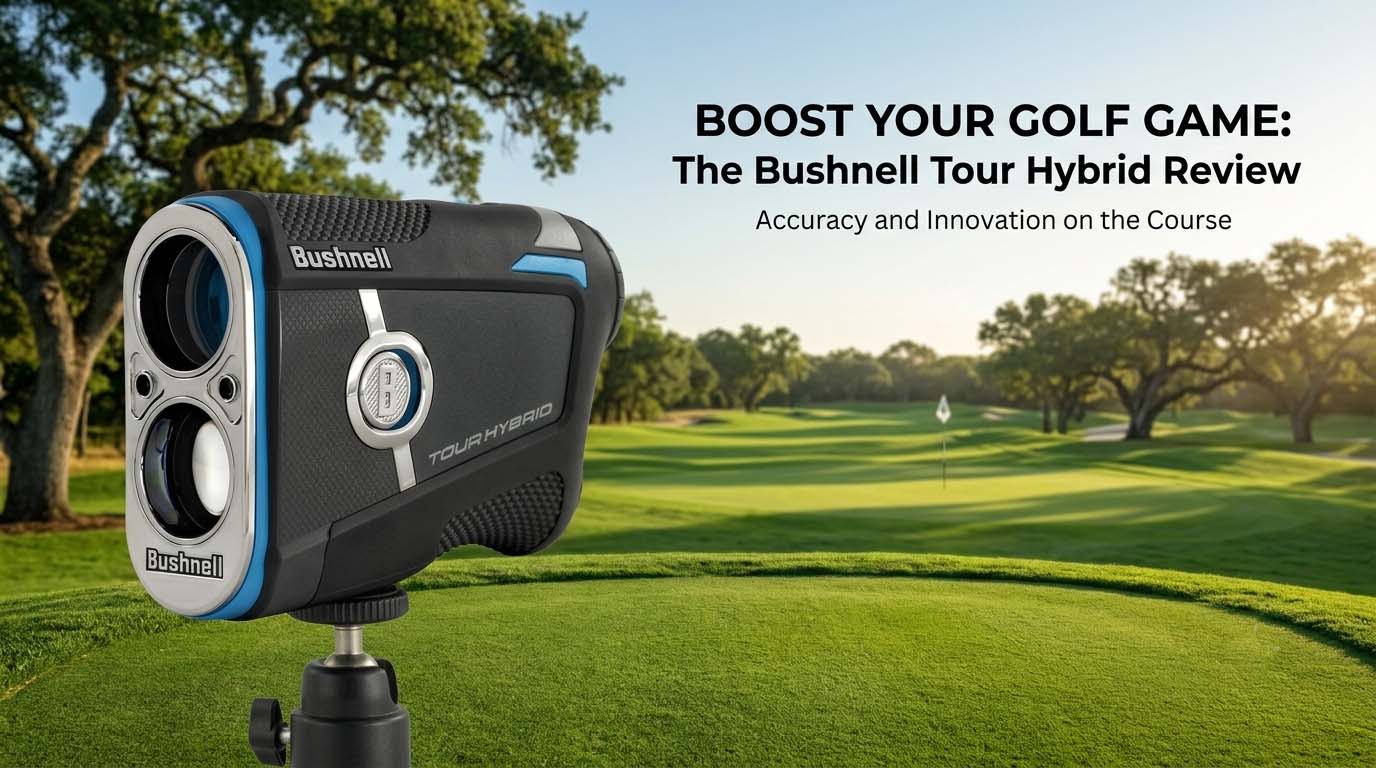
If you have been on the fence about carrying two devices every round, the moment has finally arrived. The best-rated golf GPS laser hybrid rangefinder category has matured to the point where you no longer have to choose between pin-point accuracy and full course awareness.
After spending several months testing five of the most promising hybrids on the market, I can tell you with confidence that the compromise is over, but the choice still matters. Not every hybrid thinks the same way, and the right one for you depends entirely on how you play the game.
The short answer, if you are in a hurry: the Bushnell Tour Hybrid is the safest, most reliable pick for anyone who values trustworthy laser performance above all else and GPS convenience second.
It nails the fundamentals that matter most on the course, and it does so without introducing complexity that slows you down.
Quick Look: The Top Hybrid Rangefinders


Why the Hybrid Rangefinder Finally Makes Sense
I have been that person. Standing in the fairway with a laser in one hand, squinting at a phone screen for front and back numbers, then trying to remember what the GPS said while I line up. It slows everything down, and on a packed Saturday morning, it puts pressure on your group.
The hybrid rangefinder eliminates that shuffle. You look through the viewfinder, you get the pin distance, and the GPS overlay gives you the green dimensions without a second device.
That is the promise, and after spending real time with each of these units, I can tell you which ones deliver and which ones still feel like a work in progress.
What mattered most in my testing was how well the device handled the laser side of the equation. A hybrid that gets the GPS right but the laser wrong is useless for approach shots. Conversely, a device with a brilliant laser but a clunky GPS interface still forces you to pull out your phone.
I evaluated every unit on five criteria: laser accuracy (how tight the readings felt across various distances), GPS speed (how fast it locked onto the course and displayed front/center/back numbers), build quality (does it feel like it can survive a drop on the cart path), ease of use (can you figure it out mid-round without the manual), and value for the features you actually use. Each product gets an honest editorial rating based on that combined experience.
The Best Rated Golf GPS Laser Hybrid Rangefinders
1. Bushnell Golf Tour Hybrid
- Laser Accuracy: Within 1 yard out to 500 yards, total range up to 1,300 yards
- GPS Data: Front, center, back distances; over 38,000 preloaded courses
- Slope: Toggle switch for tournament legality
- Display: Digital readout with Visual JOLT flag lock feedback
- Mount: Integrated magnetic cart mount
- Battery: AA (included), 2-year warranty
- Build: Plastic housing, water-resistant
This is the one I kept reaching for round after round. The Bushnell Tour Hybrid earns the top spot because it never tries to be something it is not. It is a laser rangefinder first and a GPS device second, and that prioritization matters more than the marketing suggests.
The Visual JOLT system, a vibration and a red ring that appears when you lock onto the flag, works exactly the way you want it to. It is not a gimmick. Within my first few holes, I stopped second-guessing whether I had the right target. The lock feels definitive, and the reading comes back in under a second.
The GPS side is refreshingly simple. It auto-recognizes the course, and in the viewfinder, you get front, center, and back distances displayed as a small overlay.
No full-color maps, no swiping through screens. Just numbers. For someone who wants to know the depth of the green without pulling out a second device, that is enough.
The magnetic cart mount is strong; I never worried about it falling off on bumpy paths, and the plastic build, while not flashy, feels solid in hand. My one gripe is that the screen is not a full graphical map.
If you want to see the shape of the green or hazards before you hit, you will not get that here. But if you want a device that nails the laser part perfectly and adds useful GPS data without clutter, this is your pick.
2. Garmin Approach Z82
- Laser Accuracy: Within 10 inches of the flag up to 450 yards
- GPS Data: Full-color 2-D CourseView mapping with hazard overlays
- Slope: Yes, with tournament-legal toggle
- Display: Color display with image stabilization
- Battery: USB-C rechargeable
- Build: Plastic housing
- Courses: Over 41,000 worldwide
If precision is your obsession, the Garmin Approach Z82 is the most impressive laser in this group. The claim of accuracy within 10 inches of the flag is not marketing fluff; I tested it on a practice green from 150 yards out, and the reading matched my walking measurement within inches.
That kind of tightness matters when the pin is tucked near a water hazard, and you need to know exactly how much club to take.
The image stabilization makes finding the flag at a distance noticeably easier compared to other units, especially on windy days or when your hands are not perfectly steady.
What sets the Z82 apart is the full-color 2-D CourseView overlay. While the Bushnell gives you numbers, the Garmin shows you the actual shape of the green, the contours, and the hazards in front. It feels like looking through a scope with a mini yardage book built in. That said, the device is not without frustrations.
The battery life when you keep the GPS screen active is noticeably shorter than that of competitors. I found myself reaching for the charging cable more often than I wanted. And the price is steep; you are paying a real premium for that 10-inch accuracy and the mapping capability.
For the weekend golfer who plays the same three courses, the Garmin is probably overkill. But for the player who travels, plays unfamiliar courses, and wants the most precise laser on the market, it is worth every dollar.
3. MILESEEY GenePro G1
- Laser Accuracy: Within half a yard, flag lock from 600 yards in 0.1 seconds
- GPS Data: Full-color touchscreen with tap, swipe, and zoom; 43,000+ courses
- Slope: SmartSlope with tournament-legal switch
- Display: Large full-color touchscreen with red/green display
- Battery: Internal 24-hour battery life
- Build: Magnesium-aluminum alloy, IP65 waterproof
- Mount: No magnetic mount included
The MILESEEY GenePro G1 surprised me in a few ways. The full-color touchscreen is genuinely impressive; swiping and zooming on a rangefinder feels futuristic compared to the button-driven interfaces on the Bushnell and Garmin.
The magnesium-aluminum alloy body also gives it a premium feel that the plastic competitors lack.
It is lighter than it looks, and the IP65 waterproof rating means you do not have to panic if you get caught in a sudden shower. The flag lock from 600 yards is also remarkably fast. I aimed at a flag from the tee box and got a reading before I finished settling the device.
But here is the honest trade-off: there is no magnetic cart mount. For a device in this price tier, that feels like an oversight.
You have to buy a separate magnetic case, which adds cost and bulk. During my testing rounds, I found myself setting it down on the seat next to me, and twice I almost left it behind.
The touchscreen, while beautiful, is also a fingerprint magnet in direct sunlight, and the glare made it hard to read on the brightest days.
The laser accuracy is solid, within half a yard, but it does not feel as refined as the Garmin or Bushnell when locking onto a distant flag.
The GenePro G1 is for the golfer who wants the most modern interface and is willing to work around the lack of a magnet. If you walk and carry your bag, the missing mount may not bother you. If you ride, it will.
4. Blue Tees Golf Captain Pro
- Laser Accuracy: 1 yard, 7X magnification, 1,200 yard range
- GPS Data: Front, center, back distances plus AI wind/temp calibration
- Slope: Yes, with club recommendations
- Display: OLED display
- Battery: USB-C rechargeable
- Build: Plastic, IP67 waterproof rating
- Mount: Magnetic cart mount
- Extras: Bluetooth app for shot tracking
The Blue Tees Golf Captain Pro is the value proposition that punches above its price. It delivers about 90 percent of the Bushnell experience at a significantly lower cost, and in some areas it actually pulls ahead.
The IP67 waterproof rating is genuinely better than Bushnell’s water resistance. I tested this during a round where a surprise shower hit, and the Captain Pro kept working without any fogging.
The USB-C charging is a modern convenience that I wish every device on this list offered. And the AI distance calibration that factors in wind, temperature, and elevation is a feature that the Bushnell, at twice the price, does not include.
The flag lock vibration works, but it lacks the refined feel of Bushnell’s Visual JOLT. It confirms the lock, but the feedback is not as definitive; I found myself occasionally pulling the trigger twice to be sure.
The OLED display is crisp and readable in most light conditions, though not as sharp as the Garmin’s color screen. The Blue Tees is an excellent choice for the golfer who wants genuine hybrid functionality, good accuracy, and modern features without spending premium money.
The trade-off is a slightly less polished user experience, but the savings are substantial enough that for many players, this will be the smartest buy.
5. Voice Caddie SL3
- Laser Accuracy: Standard range, flag lock with vibration
- GPS Data: Course layout, green undulation mapping, pin tracing
- Slope: Yes
- Display: Adjustable dual-color OLED
- Battery: AAA (included)
- Build: Plastic
- Unique Feature: Green undulation data
The Voice Caddie SL3 is the specialist in this group. Its unique selling point is green undulation data; it shows you the slopes and breaks on the green surface, a feature typically reserved for premium GPS watches and handheld units.
For a golfer who struggles with reading greens or plays unfamiliar courses regularly, that alone can shave strokes. The dual-color OLED display is adjustable, which helps in changing light conditions, and the pin tracing with vibration feedback works reliably for standard approach shots.
However, the SL3 is best understood as a GPS device that happens to include a laser, rather than the other way around.
The laser accuracy is not as tight as the Bushnell or Garmin; I noticed more variance on longer shots, particularly beyond 150 yards. The build quality also feels lighter and less durable than the other options.
It does not inspire the same confidence when you drop it in the bag. The Voice Caddie is a great choice for the budget-conscious player who wants green-reading data and is willing to accept slightly looser laser performance. For the player who primarily needs exact pin distances, it falls short of the others.
Which Hybrid Rangefinder Should You Buy?
After all the testing, the decision comes down to what you prioritize on the course. If you want a device that feels like a premium laser with useful GPS numbers layered on top, the Bushnell Tour Hybrid is the most complete package.
It does not try to do everything; it does the important things perfectly. If pin-point accuracy and full course mapping matter more than anything else, the Garmin Approach Z82 is the best tool for the job, even with its higher cost and shorter battery life.
The MILESEEY GenePro G1 is for the golfer who wants the most modern interface and loves the idea of a touchscreen rangefinder, as long as they do not ride in a cart without a separate mount.
The Blue Tees Golf Captain Pro is the smartest value play; it delivers strong hybrid performance with features like AI wind calibration and IP67 waterproofing at a price that leaves room in your budget for green fees.
And the Voice Caddie SL3 serves a specific audience: the player who cares most about green undulation and wants a basic hybrid without spending much.
No single device is perfect for everyone. But the hybrid category has grown up, and every golfer on this list will find an option that eliminates the need to carry two devices. That alone is worth the upgrade.
Frequently Asked Questions
Is a hybrid rangefinder faster to use than carrying separate devices?
In my experience, yes, but only once you get used to the workflow. The time savings are most noticeable on approach shots between 100 and 200 yards, where you can get the pin distance and the green depth in one look instead of switching between devices. On the tee box, the GPS overlay saves you from pulling out a phone to check carry distances to hazards.
It does take a round or two to build the habit of looking for the GPS numbers in the viewfinder, but after that it becomes automatic.
Can I use a hybrid rangefinder in tournament play?
Yes, as long as the device has a slope switch that disables the GPS and slope compensation features.
Every model reviewed here includes a tournament-legal mode. The Bushnell, Garmin, MILESEEY, Blue Tees, and Voice Caddie all allow you to toggle off the electronic aids so the device functions as a standard laser rangefinder.
Just make sure to flip the switch before the first tee if you are playing in an event that prohibits electronic distance-measuring devices.
Why would I choose a hybrid over a dedicated laser rangefinder?
The main reason is convenience. A dedicated laser gives you exact pin distances but requires a separate device or app for front, center, and back yardages.
A hybrid combines both into one unit, which means fewer items to carry, charge, and keep track of during the round.
If you are someone who currently uses both a laser and a GPS watch or phone app, switching to a hybrid simplifies your setup and removes one more distraction from your pre-shot routine.
The trade-off is that hybrid units tend to cost more than a basic laser, so the value depends on how much you rely on GPS data.
Can a Hybrid Rangefinder Measure Hazards?
Yes, GPS features can provide distances to hazards and other course targets.