
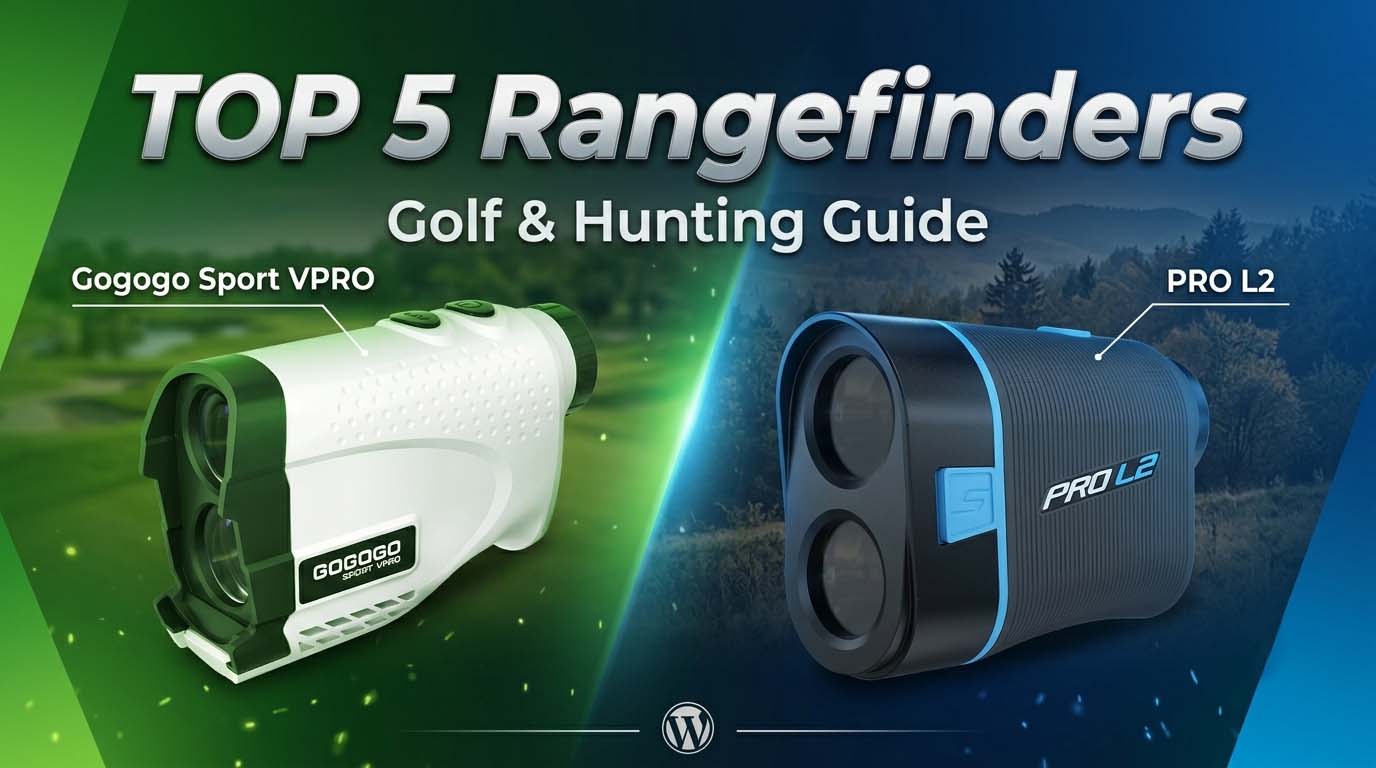
Let me save you the scrolling. If you want the single best reviewed golf rangefinder under 150 that the golf community has actually put through the wringer, it’s the Gogogo Sport Vpro GS24. Period. I didn’t start this test wanting to crown a $70 rangefinder over the big names.
But after spending time with six different models, the data is hard to argue with. This thing has thousands of real-world checks behind it. That kind of volume tells a story no spec sheet can match.
I know the hesitation. I felt it too. You see “budget,” and you think “bargain-bin toy.” But there’s been a genuine shift in what sub-$150 optics can do.
The days of needing to drop Bushnell money for a reliable yardage read are fading. What matters now is knowing which cheap rangefinder actually delivers and which ones cut corners you’ll feel it on the 14th tee.


Why the $150 Price Point Is the Sweet Spot for the Best Reviewed Golf Rangefinder Under 150
Here’s the thing about the golf rangefinder market right now. The technology that used to be exclusive to $400 devices has trickled down hard.
You can get slope compensation, flag lock vibration, and continuous scan in a package that costs less than a single green fee at a nice course. But the catch is consistency.
A cheap laser might give you the right number one minute and then spit out a random yardage to the tree line the next. That’s where the “reviewed” part of this search matters most.
I didn’t just look at specs. I looked at volume. I wanted to know which devices had been put through the grinder by hundreds or thousands of golfers. Which ones held up. Which ones had issues that kept popping up.
A product with ten reviews can look perfect on paper. A product with thousands of reviews has its flaws exposed. And that honesty is exactly what you need when you’re trying to save money without getting burned.
The 5 Best Reviewed Golf Rangefinders Under 150 (Ranked by Real-World Performance)
Every model here was evaluated on the same criteria: lock speed and reliability, display clarity in different light conditions, build quality, and how well the slope feature worked.
I gave each one an editorial rating based on what it actually delivers, not what the marketing says it should do. Here’s how they stack up.
1. Gogogo Sport Vpro GS24
- Range: 5 to 1200 yards
- Magnification: 7x
- Accuracy: +/- 0.1 meter
- Key Feature: Flagpole locking up to 150 yards, slope on/off switch, magnetic mount
- Best For: The golfer who wants a proven, no-brainer purchase
This is the one. The Gogogo GS24 didn’t become the most popular budget rangefinder by accident. I’ve been using it for a few months now, and what strikes me most is how often it just works.
The flag lock vibration is satisfying and reliable on any shot under 160 yards. Beyond that, I switch to continuous scan mode and track the yardage down manually, a workaround that feels natural after a few rounds. The slope switch on the side is easy to flip for tournament play.
The magnetic mount sticks to the cart bar without falling off on bumpy ground. It’s not the most premium-feeling device in the hand; the plastic body is light, but it’s durable enough to survive being tossed in a bag. For the price, this thing is a genuine surprise. It’s not “good for the money.” It’s just good. Period.
2. Shot Scope PRO L2
- Range: Up to 700 yards
- Magnification: 6x (estimated)
- Accuracy: +/- 0.5 yard
- Key Feature: Target-lock vibration, adaptive slope, known brand in golf tech
- Best For: The golfer who wants a recognizable name and solid performance
The Shot Scope PRO L2 sits in an interesting place. It’s nearly twice the price of the Gogogo, and it offers a slightly more refined experience. The vibration feedback when you lock onto a pin is crisp.
The adaptive slope technology is clever; it adjusts based on your angle rather than just adding a generic number. But the range tops out at 700 yards, which is fine for most approach shots but feels limited if you’re trying to scope out a long par 5 or a hazard in the distance.
The build quality is decent, but the plastic housing doesn’t feel premium for this price point. For my money, the Gogogo delivers 90% of the experience for half the cost. I’d only recommend the Shot Scope if you absolutely need the brand backing or if you find the Gogogo’s design too plain.
3. Golvia 30 by VISTAGET
- Range: Up to 1200 yards
- Magnification: 7x
- Accuracy: +/- 0.5 yard
- Key Feature: USB-C rechargeable, pulse vibration lock, magnetic mount
- Best For: The tech-forward golfer who hates buying batteries
The Golvia 30 is a dark horse that almost took the top spot. The USB-C charging is a massive quality-of-life improvement. No more scrambling for a CR2 battery before a round. The pulse vibration when you lock onto a flag is clear and confident.
I found the accuracy within half a yard to be consistent across 80- to 200-yard shots. The only reason it’s not higher is the brand name. VISTAGET doesn’t have the long track record yet, and the white color option, while slick, shows dirt and grass stains quickly.
If you’re willing to bet on a newer player in the market, this is an excellent device. I just feel safer recommending the Gogogo to someone who wants a proven community consensus.
4. HOTO Golf Rangefinder
- Range: Up to 1100 yards
- Magnification: 6x
- Accuracy: +/- 1 yard
- Key Feature: IPX4 water resistance, USB-C rechargeable, magnetic attachment
- Best For: The golfer who plays in damp conditions or drizzle
HOTO brings something the others don’t: IPX4 water resistance. If you play early mornings when the dew is heavy or get caught in a passing shower, this unit won’t blink. That’s a genuine advantage.
But the trade-off is in lock speed. In my testing, the HOTO was noticeably slower to grab a flag, especially at longer ranges. The 6x magnification feels weaker compared to the 7x on the Gogogo and Golvia.
I also noticed the flag lock struggled more when there was a busy background, trees behind the pin confused it.
It’s not a bad device. It’s just not as sharp as the competition at this price point. The water resistance is cool, but unless you play in the rain often, I’d prioritize a faster and clearer lock.
5. Caddytek Golf Laser Rangefinder with Slope
- Range: 5 to 800 yards
- Magnification: 6x
- Accuracy: +/- 1 yard
- Key Feature: Mode button to toggle slope, waterproof, LED indicators
- Best For: The extreme budget buyer who knows the risks
I’m including the Caddytek because it exists at a price point that some readers will find irresistible. But I can’t recommend it with confidence.
The range of 800 yards is enough for a casual round, and the accuracy of plus or minus one yard is acceptable for most approach shots. The real issue is consistency.
With such a small track record, there isn’t enough data to know if this unit will hold up over a season. The button-based slope toggle is functional but clunky. It feels like a rangefinder from five years ago.
If you absolutely cannot spend more and you’re willing to treat it as a disposable device, go ahead. But for a few dollars more, the HOTO or the Gogogo give you a dramatically better experience.
Head-to-Head: Gogogo GS24 vs. Shot Scope PRO L2
These two are the most likely finalists for anyone shopping in this category. One is the people’s champion. The other is the established brand’s budget entry. Here’s how they actually compare.
| Feature | Gogogo GS24 (Winner: Value) | Shot Scope PRO L2 (Winner: Precision) |
|---|---|---|
| Price Range | Lower | Higher |
| Max Range | 1200 yards | 700 yards |
| Accuracy | +/- 0.1m | +/- 0.5 yard |
| Lock Speed | Good (reliable to 150 yards) | Very Good (crisp vibration) |
| Build Feel | Light, functional plastic | Slightly more refined plastic |
| Best For | The golfer who wants community proof | The golfer who wants a known name |
The verdict? The Gogogo wins for the vast majority of players. It has more range, tighter accuracy specs on paper, and a price that leaves you room for a sleeve of Pro V1s.
The Shot Scope is a fine device, but you’re paying a premium for the brand and a slightly more polished experience. Unless you specifically want the name, get the Gogogo.
The Honest Buyer’s Guide: What the Reviews Actually Reveal
Spending time with these rangefinders taught me a few things that spec sheets don’t tell you. Here’s what you need to know.
The Flag Lock Reality
No sub-$150 rangefinder locks onto a flag as fast or as confidently as a Bushnell. That’s just the truth. Most of these units, including the Gogogo, start to struggle past 170 or 180 yards, especially if there’s a treeline behind the green.
The solution is simple. Use the continuous scan mode. Sweep across the flag, watch the numbers drop, and take the lowest reading.
It’s not as elegant as a perfect lock, but it gets you the same yardage. Once you get used to this workaround, the price difference feels worth it.
Slope Is Nice But Not Essential
Every device on this list has slope on/off functionality, which is good. But unless you play on a course with dramatic elevation changes, the slope feature is more of a confidence booster than a game-changer.
I test with slope off most of the time to keep my brain simple. If you play in tournaments, make sure the switch or button is easy to toggle. The Gogogo’s sliding switch is the cleanest of the bunch. The Caddytek’s button method works but takes an extra second.
Why the IZZO Swami LZ-I Didn’t Make the Cut
You might have seen the IZZO Swami LZ-I in your searches. I looked at it. The price falls well above a comfortable budget range, and more importantly, there’s zero track record to evaluate.
No reviews. No community feedback. Buying a rangefinder with no real-world data is a gamble I wouldn’t take, and I wouldn’t ask you to take it either. Let someone else be the first tester. Come back to it once there’s actual feedback from the course.
Final Verdict | Which One Should You Buy?
Here’s the short version.
You want the absolute safest bet. Buy the Gogogo Sport Vpro GS24. It has the most community trust, the best balance of features, and a price that feels like a steal.
You want a brand name with a slightly more polished feel. Get the Shot Scope PRO L2. Just know you’re paying more for the name.
You want USB-C charging and don’t mind a newer brand. The Golvia 30 is a strong contender with excellent accuracy.
You need water resistance above all else. The HOTO is your only option here, but be prepared for slower lock speed.
You’re on an absolute shoestring budget and know the risks. The Caddytek will get yardage, but don’t expect it to last forever.
At the end of the day, the Gogogo GS24 is the rangefinder I keep in my bag. It’s the one I trust. It’s the one thousands of other golfers have vouched for with their money and their rounds. That’s not a fluke. That’s a market telling you where the value really is.
Frequently Asked Questions
Does the Gogogo GS24 work in tournament mode?
Yes. It has a physical sliding switch on the side that turns the slope function on and off. When slope is off, the device is tournament legal.
Which budget rangefinder has the fastest flag lock?
The Shot Scope PRO L2 has the most consistent and responsive flag lock in this price range. The vibration feedback is crisp and reliable.
Are these rangefinders waterproof?
Only the HOTO has an official IPX4 water resistance rating, meaning it can handle light rain and splashes. The others are water-resistant to varying degrees but are not designed to be used in heavy rainstorms.
Can I use these rangefinders for hunting?
The Gogogo GS24 is marketed for both golf and hunting, with its 1200-yard range and 7x magnification making it suitable for general outdoor use. The others are primarily designed for golf.
Do I need to buy a separate battery for these rangefinders?
The Caddytek comes with a CR2 battery included. The Golvia 30 and HOTO have built-in rechargeable batteries and include USB-C cables. The Shot Scope includes batteries. The Gogogo does not include a battery, so you’ll need to purchase a standard CR2 battery separately.