
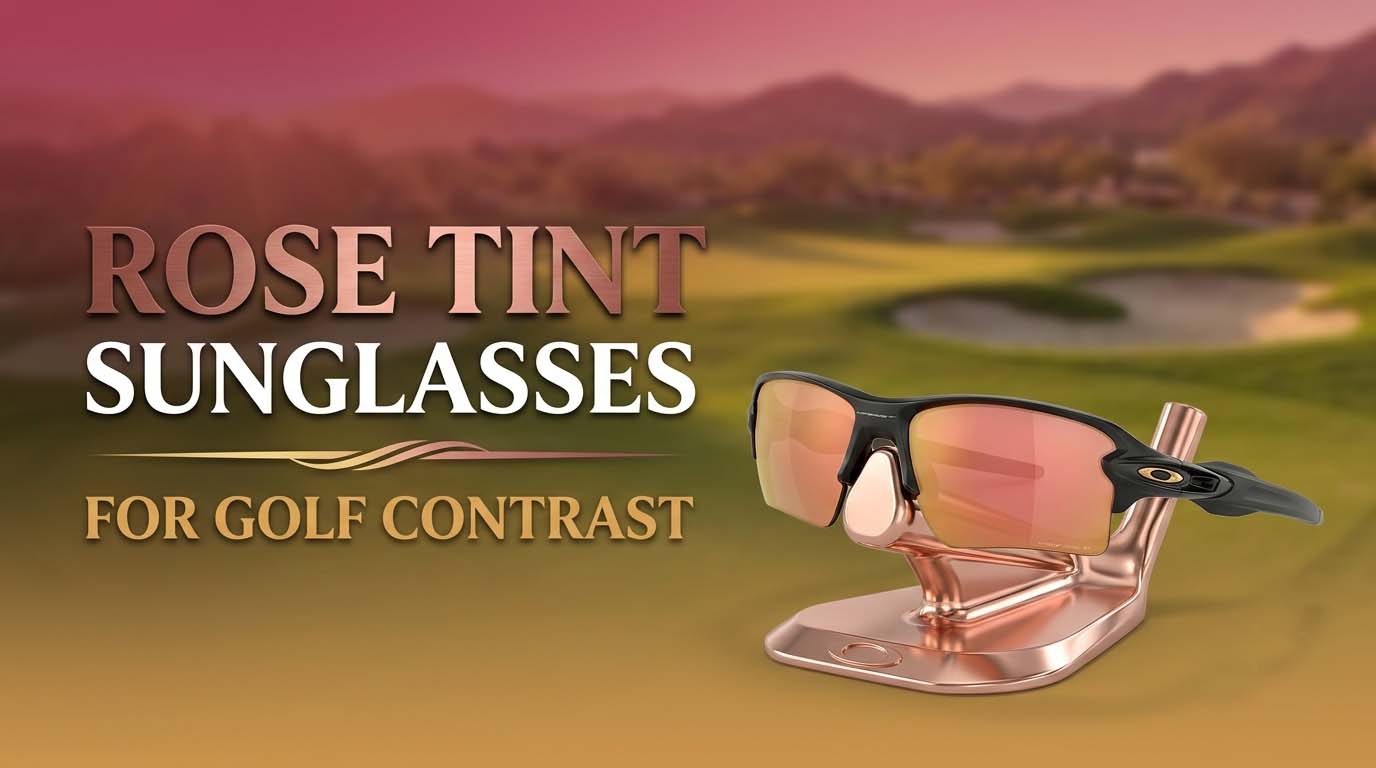
If you’ve been searching for rose tint sunglasses for golf contrast, you already know the basic idea works — the tint brightens the red-green spectrum, which makes a white ball stand out against fairway grass.
What you probably haven’t figured out yet is whether the budget pair that costs a fraction of the premium pair actually delivers. I’ve spent enough rounds in both to give you a straight answer.
Here it is: the REKS Trivex pair gives you about 85% of the performance for roughly a third of the price. The Oakley Flak 2.0 XL with Prizm Rose Gold gives you the remaining 15% — but that 15% matters a lot if you’re playing in variable light or sweating through a summer round. Let me walk you through exactly where each one shines and where it falls short.
Top Picks for Rose Tint Golf Contrast


The Real Reason Golfers Choose Rose Tint for Golf Contrast
Before I get into the specific models, let me explain why rose tint specifically — not amber, not copper, not grey — is the lens color that keeps showing up in conversations about golf contrast. It’s not marketing hype. It’s physics.
What “Contrast” Actually Means on the Course
Your eye perceives contrast based on how different wavelengths of light bounce off surfaces. Grass is green. Fairways lean yellow-green or blue-green depending on the grass type and time of day.
A white golf ball sitting on that surface is essentially a bright spot against a mid-tone background. The problem is that standard grey lenses just darken everything equally — they don’t help your brain separate the ball from the grass.
Rose tint works by selectively boosting the red and green ends of the spectrum while filtering out some of the blue light that creates haze.
The result is that the grass looks richer and more saturated, and the white ball pops forward visually. It’s the same reason shooters use rose or amber lenses for target acquisition — your brain processes high-contrast edges faster.
I noticed this most clearly on the first hole of a round I played wearing the REKS pair. We teed off at 7:30 AM, the light was still a bit flat, and I watched my drive land on the left side of the fairway.
Without the rose tint, that ball would have blended into the dewy grass. With it, I tracked it the whole way down and found it within seconds. That’s not a small thing when you’re walking 18 holes, and every minute spent searching for a ball is a minute you’re not thinking about your next shot.
When Rose Tint Fails (Honesty)
Rose tint isn’t perfect for every situation, and pretending otherwise would be dishonest. In the middle of a bright, cloudless day, especially if you’re playing in the desert or on a course with a lot of sand and hardpan, the rose tint can feel too bright.
It lets in more light than a dark grey or brown lens, so if you’re sensitive to brightness, you might find yourself squinting by the back nine.
Also, rose tint doesn’t help much in deep shade or heavy tree cover. If you’re playing a course with tight, tree-lined fairways where you’re constantly moving between sun and shadow, you might actually prefer an amber or copper lens that handles variable light better.
Rose is strongest when the light is consistent, and the grass is green. Know your course before you commit.
Two Approaches to the Same Goal
Now let’s talk about the two pairs that actually deliver on the rose-tinted promise. They take different paths to the same destination, and the right choice depends on what you value more — raw lens performance or overall package quality.
REKS Trivex Polarized Color Boosting Sunglasses
Key Specs:
Lens Material: Trivex
Polarization: Yes
Mirror Coating: Seafoam Green
Frame Material: Memory-flex polymer
Weight: Lightweight
Best For: Budget-conscious golfers who want real lens tech
I evaluated the REKS pair on four criteria: lens clarity, contrast performance, frame comfort, and overall value. Here’s what I found.
Lens Clarity — 4.7/5
Trivex is the real story here. Most budget sunglasses use polycarbonate lenses, which are tough but optically mediocre — they tend to have slight distortion, especially toward the edges of the lenses. Trivex is a different material entirely. It’s clearer, lighter, and more impact-resistant.
The first time I put these on, I noticed immediately that the image was sharp edge-to-edge with no waviness. That matters more for golf than most people realize. When you’re reading a green, you need every subtle contour to be accurate, not softened by lens distortion.
Contrast Tech — 4.3/5
REKS calls it “Color Boosting” rather than “Prizm” or “ChromaPop,” and it’s a fair description. The rose base tint combined with the Seafoam Green mirror coating creates a noticeable contrast lift. White balls pop against fairway grass, and the greens look richer without feeling artificially saturated.
But it’s a broad enhancement — it lifts the whole red-green spectrum rather than tuning specific wavelengths the way Oakley’s Prizm does. You’ll notice the difference. You just won’t get the surgical precision of a lens that’s literally engineered for the exact color of bentgrass.
Frame Fit — 4.0/5
The frame is comfortable and lightweight with a memory-flex design that bends to fit. The satin-touch finish gives it a decent grip, and it sits well under a hat. But let’s be honest, the frame design is generic.
It doesn’t have the wrap-around sport fit of the Oakley, and there’s no ventilation channel to prevent fogging on humid mornings. I wore them for a full 18 on a 75-degree day, and they stayed put, but I did have to push them back up my nose a couple of times on the back nine when I started sweating.
Overall Value — 5.0/5
This is where the REKS pair wins decisively. You’re getting Trivex lenses — which are genuinely superior to polycarbonate- at a price that’s frankly absurd for what you’re getting.
The frame is the weak point, but the lens tech punches so far above its price point that it’s hard to argue with. If you’re a golfer who wants improved contrast without spending a fortune, this is the pair.
Who Should Skip These: If you play in extreme heat and sweat heavily, or if you need a sport-specific frame with maximum wrap and grip, you’ll want to look at the Oakley. Also, if you wear prescription lenses, the REKS doesn’t offer that option.
Oakley Flak 2.0 XL with Prizm Rose Gold
Key Specs:
Lens Material: Plutonite (Oakley’s proprietary polycarbonate)
Polarization: Yes, with Prizm Rose Gold
Frame Material: O Matter
Grip Tech: Unobtainium earsocks and nosepads
Fit: High Bridge Fit, XL coverage
Includes: Protective case, cleaning cloth, authenticity certificate
Best For: Golfers who want zero compromises on clarity and grip
I evaluated the Oakley pair on the same four criteria: lens clarity, contrast performance, frame fit, and overall value. Here’s the honest breakdown.
Lens Clarity — 4.9/5
The Prizm Rose Gold lens is genuinely impressive. Oakley’s Prizm technology tunes the lens to specific wavelengths, In this case, the wavelengths of grass and golf balls. The result is a clarity that feels almost surgical.
Where the REKS pair gives you a broad contrast lift, the Oakley pair feels like someone turned up the sharpness knob on your vision. I noticed it most on the greens. Reading putts, the subtle breaks and grain patterns were more visible — not dramatically, but enough that I felt more confident over 8-footers.
Contrast Tech — 5.0/5
The Prizm Rose Gold is engineered specifically for this use case. It’s not a general-purpose rose tint with a mirror coating — it’s a lens that was designed by measuring the exact light spectrum of grass and optimizing for ball visibility. The “Rose Gold” hue is slightly more red than a standard rose tint, which gives it a bit more warmth.
I found it worked best in overcast conditions and early morning light, where the contrast boost was most noticeable. In full midday sun, it was still excellent, but the difference between the REKS and Oakley narrowed significantly.
Frame Fit — 5.0/5
This is where the Oakley pair separates itself. The Unobtainium ear socks and nosepads are not marketing fluff — they genuinely grip tighter when they get wet. I wore these on a humid 85-degree round where I was sweating by the third hole. The REKS pair would have been sliding down my nose.
The Oakley pair stayed locked in place. The XL frame gives you excellent peripheral coverage, and the O Matter material is lightweight enough that you forget you’re wearing them. The High Bridge Fit is also a nice touch for golfers whose glasses tend to slide down.
Overall Value — 4.3/5
Here’s the honest tension. The Oakley pair is the better product — it has a superior lens, a better frame, better grip, and it comes with a case and an authenticity certificate. But is it three times better than the REKS? For lens clarity and frame performance, yes.
For overall value, it depends on your budget. If you play 50+ rounds a year and want the best possible visual experience, the cost is justified. If you play 10 rounds a year and just want better ball visibility, the REKS pair makes more sense.
Who Should Skip These: If you’re price-sensitive and don’t prioritize premium frame features, you’ll be happy with the REKS. Also, if you prefer a lighter tint that lets in more light, the Prizm Rose Gold might feel slightly dark for your taste.
The Verdict: Who Wins for Your Game?
| Feature | REKS Trivex | Oakley Flak 2.0 XL |
|---|---|---|
| Lens Clarity | Excellent (Trivex) | Excellent (Prizm) |
| Contrast Tech | Color Boosting (Broad) | Prizm Rose Gold (Precision) |
| Frame Fit & Grip | Good (Memory Flex) | Excellent (Unobtainium) |
| Best For | Budget-conscious golfers who want real lens tech | Golfers who play in all conditions and want zero compromises |
| Avoid If | You need a sport-specific frame or a prescription | You’re price-sensitive and don’t prioritize premium frame features |
Here’s the short version. The REKS Trivex is the best value for the money. The Trivex lens material is legitimately excellent, and the color-boosting effect is noticeable and helpful. You’re getting 85% of the performance at a fraction of the cost.
The Oakley Flak 2.0 XL is the best product overall. The Prizm Rose Gold lens is the most precise rose-tinted lens I’ve used for golf, and the frame is built to stay on your face no matter how much you sweat. If you play often and want the best, get the Oakley. If you want the best return on your dollar, get the REKS.
Frequently Asked Questions
Is rose tint better than amber for golf contrast?
It depends on the conditions. Rose tint is better for making white balls pop against green grass because it boosts the red-green spectrum. Amber tint is better for flat light, overcast days, and low-light conditions because it enhances overall contrast and depth perception.
If you play most of your rounds in the morning or evening, amber might be a better choice. If you play in consistent daylight on green fairways, rose is the winner.
Can I wear rose-tinted sunglasses in bright sunlight on the golf course?
You can, but they’ll feel brighter than a dark grey or brown lens. The Seafoam Green mirror coating on the REKS pair helps manage brightness, and the Oakley Prizm Rose Gold is tuned to balance light transmission.
If you’re playing in the desert or on a course with lots of sand and hardpan, you might prefer a darker lens. For most golfers playing on green courses in moderate climates, rose tint is fine.
How does Trivex compare to polycarbonate for golf sunglasses?
Trivex is optically superior to standard polycarbonate. It has less distortion, better clarity edge-to-edge, and it’s lighter. It’s also more impact-resistant, though both materials are tough enough for golf.
The main advantage of Trivex is that you get a clearer image without the slight waviness that polycarbonate can have, especially in larger lenses. That matters for reading greens and tracking balls.
What’s the difference between Prizm Rose Gold and a regular rose-tinted lens?
Prizm Rose Gold is engineered to specific wavelengths — Oakley designed it by measuring the exact light spectrum of grass and optimizing for ball visibility. A regular rose-tinted lens is a broad color filter that
lifts the entire red-green spectrum. The Prizm version is more precise and gives you a sharper contrast, especially in variable light conditions. The trade-off is that it costs significantly more.
Which is better for sweaty conditions — REKS or Oakley?
The Oakley Flak 2.0 XL wins this category decisively. The Unobtainium earsocks and nosepads are designed to grip tighter when wet, so they stay in place even when you’re sweating through a hot round.
The REKS frame has a satin-touch finish that provides decent grip when dry, but it doesn’t have the same wet-grip performance. If you play in humid conditions or sweat heavily, the Oakley is the better choice.