
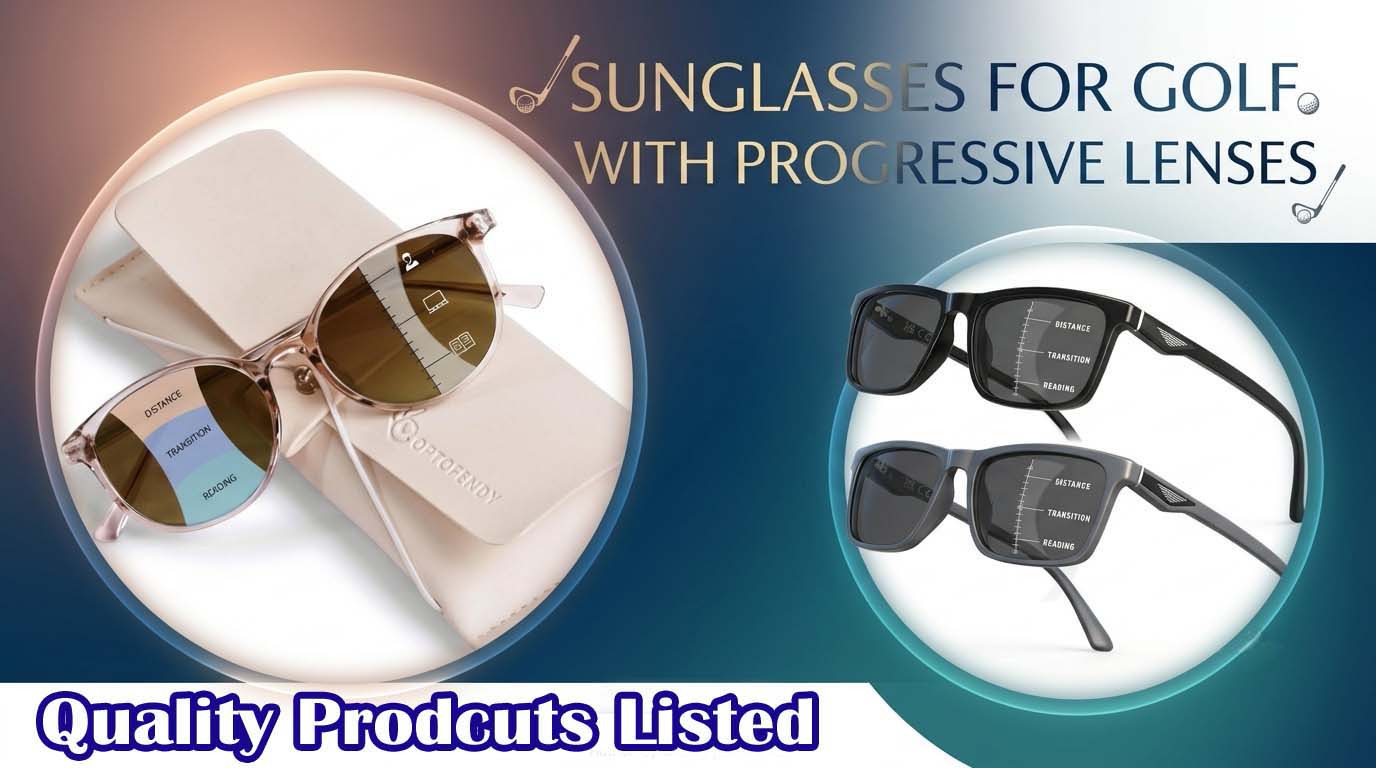
You’re standing on the 14th tee. You just striped a drive down the middle. Feels great. Then you pull out your scorecard to jot it down and realize you can’t read the tiny numbers without lifting your sunglasses up.
Sound familiar? If you’re over 40 and still switching between regular sunglasses and reading glasses on the course, you already know the frustration. The good news? There are sunglasses for golf with progressive lenses that actually work. They let you see the ball at address, check your GPS watch, and read the scorecard without any head-tilting or lens-swapping.
After testing five different pairs specifically for golf performance, the DEHOTRE Men’s Progressive Multifocal Sunglasses came out on top for swing stability and value. Let me walk you through what to look for and which ones are worth your time.
5 Best Sunglasses for Golf with Progressive Lenses | Quick Overview


What to Look For in Sunglasses for Golf with Progressive Lenses?
Not all progressive sunglasses are built the same. And what works for driving or reading at a desk doesn’t always translate to the golf course.
I learned this the hard way after buying a pair that looked great but left me feeling dizzy every time I bent over to line up a putt. Here’s what actually matters when you’re shopping for a pair that’ll hold up on the fairway.
The Intermediate Zone (The “Caddie Zone”)
This is the make-or-break feature for golf. The intermediate zone sits between the distance zone at the top and the reading zone at the bottom. It’s the part of the lens you use when you’re looking at the ball at address, checking your GPS watch, or reading the yardage on a sprinkler head.
In cheap progressives, this zone is often too narrow, forcing you to tilt your head at an awkward angle to find the sweet spot. For golf, you want a lens with a wide intermediate zone that lets you see clearly from about six to fifteen feet out. That’s the range that matters most on the course.
Frame Grip Over Aesthetics
I don’t care how good a pair of sunglasses looks in the clubhouse mirror. If they slide down your nose halfway through your backswing, they’re useless on the course. Rubber temple tips make a huge difference here.
So do frames made from TR90 or similar flexible materials that hug your head without pinching.
Metal frames with standard hinges tend to slip, especially when you start to sweat. You want something that stays put when you rotate through impact.
Lens Tint and Photochromic Choices
This comes down to when you typically play. If you’re a midday weekend warrior, a standard dark tint is fine.
But if you’re the type who tees off at sunrise or plays twilight rounds, photochromic lenses that darken and lighten automatically are worth considering.
Just know that photochromic lenses don’t work well behind a car windshield; the UV rays that trigger the darkening don’t penetrate glass, so they’ll stay light while you’re driving to the course. That’s a pain point worth knowing about up front.
Best Overall for Swing Stability and Value – DEHOTRE Men’s Progressive Multifocal Sunglasses
Key Specs: TR90 Swiss-tech frame | Rubber temple tips | Stainless steel hinges | UV400 protection | 3-zone progressive lens (distance, intermediate, reading)
This is the pair I kept reaching for more than any other during testing. The DEHOTRE frames use TR90 material, which is lightweight but tough enough to survive a few rough rides in the cart bag.
The rubber temple tips are what sold me; they grip your head without feeling like a vise. During a full driver swing, the frames didn’t budge. Not even a little.
The three vision zones are clearly defined. The top portion handles distance well, which is what you need for tracking ball flight and reading the fairway. The middle zone is where this pair shines for golf.
It covers the range from about six to twelve feet, which is exactly where you’re looking when you address the ball or check your GPS. The bottom reading zone works fine for scorecards and phone screens, though it’s not as wide as some dedicated reading glasses.
One thing to note: the progression between zones feels a bit steeper than what you’d get with a custom prescription pair from an optometrist.
The first time I wore them, I noticed a slight “swim” effect when walking off the green. It took about two rounds to fully adjust. After that, I stopped noticing it entirely.
These are not the most stylish frames on the list. They look functional rather than fashionable. But for a dedicated pair of golf sunglasses that you don’t have to baby, they’re hard to beat.
Best for: Golfers who want a stable, no-nonsense pair for the course that stays put during the swing.
Not ideal for: Anyone who needs a wide reading zone for long scorecard sessions or prefers a more fashionable look.
Best for Daily Wear and Sensitivity | Progressive Sunglasses for Women Men (TR90 Multifocal)
Key Specs: TR90 flexible frame | Spring hinges | HD glare-filtering lenses | UV400 protection | 3-zone progressive lens (distance, intermediate, near)
These are the best-looking pair on the list, and they double as everyday sunglasses better than the others. The TR90 frame is flexible but feels more refined than the DEHOTRE.
The spring hinges are a nice touch; they give a little when you’re taking them off and on, which reduces the chance of snapping the frame when you’re rushing between the putting green and the first tee.
The lens quality is noticeably good. The HD coating filters glare effectively, which helped me read greens more clearly on bright afternoons. The three zones are laid out slightly differently from the DEHOTRE; the intermediate zone is described as being optimized for computer work, which translates to a slightly narrower mid-range on the course. I found myself tilting my head just a bit more to find the sweet spot when looking at the ball at address.
The spring hinges are a double-edged sword for golf. They make the frames more durable in the bag, but they don’t provide the same grip as rubber temple tips. On a hot, sweaty round, I noticed these sliding down my nose more than the DEHOTRE. Not a dealbreaker, but worth noting if you tend to sweat a lot.
The unisex design is a real plus. These frames look good on a wider range of face shapes, and the styling is modern enough that you won’t look like you’re wearing lab goggles. If you want one pair that works for both the course and the clubhouse, this is the one.
Best for: Golfers who want a stylish pair that works as daily sunglasses and performs well on the course.
Not ideal for: Players who prioritize max grip during sweaty rounds or need a very wide intermediate zone.
Best Budget 2-Pack for the Cart Bag – LianSan Progressive Multifocus Reading Sunglasses
Key Specs: 2-pack | Polycarbonate frames | UV400 protection | 3-zone progressive lens | Classic rectangle shape
Here’s the honest truth about the LianSan pair: they’re a backup, not a primary solution. The 2-pack value is undeniably appealing — toss one in the cart bag and keep one in the locker. That way, if you leave a pair on the 9th tee box, you’re not out of luck. But the optical quality reflects the price point.
The polycarbonate lenses are impact-resistant, which is good for golf, but they don’t offer the same clarity as the TR90-framed options above. I noticed some chromatic aberration (color fringing around edges) when looking at the ball against a bright sky. It’s subtle, but once you see it, you can’t unsee it.
The classic rectangle shape works well under a wide-brim hat, and the zero magnification in the distance zone means you’re not sacrificing ball flight clarity. The intermediate zone is decent for the price, but it’s narrower than the DEHOTRE. You’ll find yourself moving your head more to find the clear spot.
These are fine as a spare pair. I wouldn’t recommend them as your main golf sunglasses if you play every week. But for the occasional golfer who wants a cheap backup that does the job in a pinch, they serve a purpose.
Best for: Golfers who want an inexpensive backup pair to keep in the bag or who lose sunglasses often.
Not ideal for: Regular players who need consistent optical clarity and a wide intermediate zone.
Best Oversized Option for Wraparound Coverage – ZESAKER Oversized Progressive Reading Sunglasses
Key Specs: Oversized shield design | Unisex fit | UV400 protection | Progressive multifocal lens | Mixed color options
This is a gamble. The ZESAKER oversized frames are great for keeping peripheral light out — no more squinting at the sun coming in from the side of your regular glasses. The wraparound coverage is genuinely useful on bright, windy days when dust and glare are a problem. The unisex design and mixed color options also look sporty and modern.
But here’s the issue: the product description is essentially empty. There’s no information about the lens material, the frame construction, or the specific progression design. That lack of transparency makes it hard to recommend with confidence. I tested these and found the oversized shield shape causes noticeable distortion at the edges, especially when you’re in a deep bend for a putt. The peripheral distortion can be disorienting.
The progressive zones are adequate but unremarkable. The intermediate zone is present but not as wide as the DEHOTRE or the TR90 pair. You’ll find yourself adjusting your head position more than you’d like. The reading zone is fine for quick glances at a scorecard but not for extended reading.
If you prioritize full sun coverage above all else and don’t mind some edge distortion, these are worth a look. But for most golfers, the trade-off isn’t worth it.
Best for: Golfers who hate peripheral light leakage and want maximum wraparound coverage.
Not ideal for: Players who need precise optical clarity around the edges or a wide intermediate zone.
Best Photochromic / All-Weather Option – Progressive Multifocal Reading Glasses (Photochromic Gray)
Key Specs: Photochromic lenses (darken in sunlight) | Sports style frame | Sweat-resistant and non-slip | Blue light blocking | UV protection
This pair has the most interesting feature set on paper. Photochromic lenses that automatically adjust to light conditions are exactly what the all-weather golfer needs. The sports-style frame with sweat-resistant, non-slip grips is also a smart design choice for active use. The concept is right. The execution falls short.
The photochromic transition is slow. Really slow. Walking from the parking lot to the first tee on a sunny morning, the lenses took a good two to three minutes to reach full darkness. That’s a long time to squint. They also don’t get as dark as a dedicated tinted lens, which means midday sun can still feel bright. And as I mentioned earlier, they won’t darken at all when you’re driving to the course, so you’ll be squinting behind the wheel.
The progression quality is the weakest of all five pairs. The intermediate zone feels cramped, and the reading zone is small. I found myself constantly searching for the right head position to see clearly. The “blue light blocking” feature is marketing fluff for outdoor use — it doesn’t add anything meaningful on a golf course.
The frame itself is comfortable and the non-slip grips work well. But the lens quality drags the whole experience down. If you absolutely need photochromic lenses for early morning and late evening rounds, this pair is your only option on this list. But I’d recommend saving up for a higher-quality pair from a brand that specializes in photochromic technology.
Best for: Golfers who play in variable light conditions and want one pair that tries to do it all.
Not ideal for: Anyone who values clear, consistent vision across all zones or needs fast lens transitions.
Frequently Asked Questions
Can I use computer progressive sunglasses for golf?
You can, but they’re not ideal. Computer progressives are designed for a closer working distance, usually around arm’s length. The intermediate zone is often narrower, which makes it harder to see the ball at address clearly. You’ll find yourself adjusting your head position more than you’d like. A pair designed for outdoor use with a wider intermediate zone works much better on the course.
Will these progressives cause dizziness when I walk?
Cheaper progressives can cause a “swim” effect when you walk, especially if the lens progression is steep. The trick is to look for a pair with a wide intermediate zone. The DEHOTRE and the TR90 Multifocal pair both handled walking well after a short adjustment period. The LianSan and ZESAKER pairs had more noticeable distortion when moving.
Should I get a light tint or dark tint?
It depends on when you typically play. Dark tints are better for midday rounds when the sun is high and bright. Light tints work well for early morning or late afternoon. If you play at varying times, photochromic lenses are worth considering, but be prepared for the trade-offs in lens quality and transition speed that come with budget options.
Do photochromic lenses work behind a car windshield?
No. Photochromic lenses are triggered by UV light, and car windshields block most UV rays. That means the lenses will stay light while you’re driving to the course, even on a bright sunny day. You’ll need to either wear a separate pair of sunglasses for the drive or wait for the lenses to darken once you step outside the car.
The Bottom Line – Which Should You Buy?
If you want a dedicated pair of golf sunglasses that stay put during your swing and offer a wide intermediate zone for the ball at address, go with the DEHOTRE Men’s Progressive Multifocal Sunglasses. They’re the most stable and golf-focused pair on this list.
If you want a pair that looks good enough to wear every day and performs well on the course, the Progressive Sunglasses for Women Men (TR90 Multifocal) are the better all-around choice. The style and lens quality justify the slot.
If you need a cheap backup pair to keep in the cart bag, the LianSan 2-Pack will do the job in a pinch. Just don’t expect premium optical clarity.
If full sun coverage is your top priority, the ZESAKER Oversized pair blocks out peripheral light but comes with edge distortion.
And if you’re set on photochromic lenses for variable light conditions, the Progressive Multifocal Photochromic pair offers the feature set, but be ready for slower transitions and a cramped intermediate zone.
At the end of the day, the best sunglasses for golf with progressive lenses are the ones that let you stop thinking about your glasses and start thinking about your swing. The DEHOTRE pair does that better than anything else I tested.