
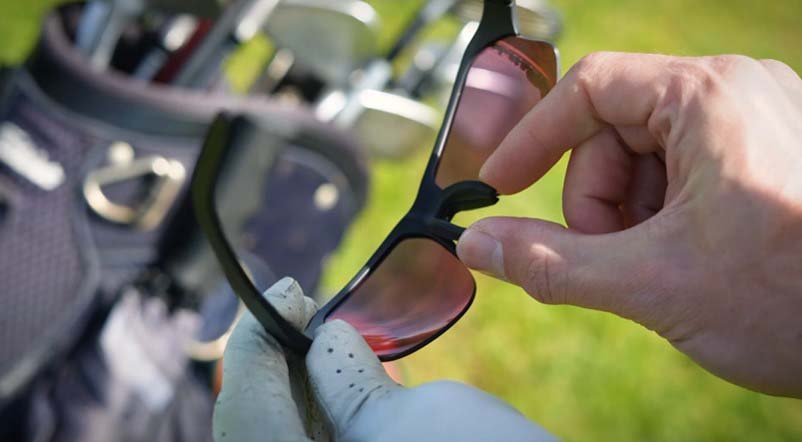
Yes, prescription golf sunglasses help performance by fixing vision issues and improving contrast, ball tracking, and green reading. Learn how they lower scores.
If you wear glasses or contact lenses and love golf, you have probably asked yourself this question. The short answer is yes, but the real value depends on your vision needs and the specific lens technology you choose. This article breaks down exactly how prescription golf sunglasses affect your game, when they matter most, and why even some pros skip them.
Understanding How Prescription Sunglasses Influence Golf Performance
To answer the main question clearly, we need to separate two distinct benefits that often get mixed together. The first is vision correction — the prescription part that fixes blurriness, astigmatism, or other refractive errors. The second is enhanced vision — the lens tints and coatings that improve contrast, reduce glare, and help you see the ball and green better. If you have 20/20 vision, you do not need prescription sunglasses for golf; you only need non-prescription golf tints. But if you need corrective lenses, getting a prescription built into a golf-specific sunglass gives you both benefits in one pair.
For a golfer with uncorrected nearsightedness or astigmatism, the gain is immediate. Reading a putt from 20 feet requires sharp depth perception. Losing the ball in flight because you cannot focus on it costs penalty strokes. A prescription lens solves those problems at the source. The question then becomes whether the lens tint and coating add measurable performance on top of clear vision.
Which Visual Challenges on the Course Directly Impact Your Score
Most golfers underestimate how often vision problems create bad outcomes. Here are the most common situations where better eyesight through prescription sunglasses can save strokes:
- Losing the ball in flight. A ball that you hit straight but cannot track against a bright sky or a treeline often ends up lost. That costs you a stroke-and-distance penalty — typically two extra shots per lost ball.
- Misreading green grain and slope. Subtle differences in grass color and texture tell you which way the putt will break. If you cannot see them, you are guessing. Three-putts from inside 20 feet are often caused by poor green reading.
- Depth perception errors in shadows. When your ball sits in a shadow on a sunny day, your brain struggles to judge distance. That leads to leaving approach shots short or blasting them over the green.
- Eye fatigue during the final holes. Squinting against glare for three hours drains your concentration. By the 15th hole, your swing mechanics and decision-making suffer, and you start leaking strokes.
Prescription golf sunglasses that also filter glare and boost contrast address all four challenges. The key is choosing the right lens type for your course conditions.
The “Pro” Contradiction: Why Tour Players Rarely Wear Them
You might have noticed that most PGA Tour professionals do not wear sunglasses on the course. Tiger Woods, Rory McIlroy, and Scottie Scheffler usually play without them. That can make you wonder: if sunglasses truly helped, wouldnt the best players use them?
The answer lies in their priorities and resources. Tour players often wear custom-tinted contact lenses that correct vision without frames. They also have caddies and spotters to help track the ball, so losing it in flight is not a concern. Peripheral vision is critical for pros — they need to see the full horizon without a frame edge blocking their view. Sunglasses also fog up in humid conditions and collect sweat on the lenses, which is a distraction during a swing.
For the average amateur golfer, the trade-offs shift. You are not competing for millions of dollars, so a small loss of peripheral vision is acceptable if it means you can see the ball better. You spend more time searching for misplaced shots. You play in varying light conditions without a team to help. In short, the benefit of prescription golf sunglasses is inversely related to skill level. The higher your handicap, the more you gain from improved vision because visual errors make up a larger share of your bad shots.
Three Measurable Ways Good Lenses Can Lower Your Handicap
It is easy to claim that sunglasses “help,” but can we quantify the effect? Based on reports from golfers who switch to prescription golf sunglasses and from optometrists who work with athletes, here are three specific ways they impact scoring:
1. Reduce Lost Ball Penalties
A typical amateur loses at least one ball per round to poor tracking — losing sight of it against a white cloud, a row of trees, or a bright sky. A lens that increases contrast between the ball and its background can cut that to zero. Saving one penalty stroke per round shaves a full point off your handicap over time.
2. Improve Green-Reading Accuracy
Contrast-enhancing tints, especially those with a brown or copper base, make the subtle grain patterns on greens stand out. Golfers who switch report reducing three-putts by 10 to 15 percent on putts between 10 and 25 feet. That is roughly one less three-putt per round, which again saves a stroke.
3. Eliminate Fatigue During the Final Holes
Polarized and glare-reducing coatings keep your eyes from tiring out in direct sun. When you are mentally fresh on the back nine, you choose the right club, commit to your line, and avoid sloppy bogeys. Many weekend golfers lose two to three strokes on the last four holes due to mental drift. Good sunglasses help prevent that.
How to Choose a Lens That Actually Matches Your Local Course
Not all golf lenses are created equal. The best lens for a desert course with intense sun is different from the best lens for a tree-lined parkland course or a coastal links. You need to match the lens tint to your home course conditions.
Here is a simple decision framework:
- If you mostly play on tree-lined courses with lots of green vegetation and shady patches, choose a brown-based lens (often called “Evergreen” or “GN” by manufacturers). It boosts contrast for green reading and works well in variable light.
- If you play on open, sunny courses with water hazards or coastal winds, a gray-brown lens with a blue mirror coating (like “Blue Water” or “BL”) offers superior glare control around water and keeps colors natural.
- If you play in overcast or low-light conditions (common in the UK or Pacific Northwest), choose a copper or rose-based lens with higher light transmission. It amplifies contrast even when the sun is weak.
- If you face mixed conditions — morning fog turning into bright afternoon sun — a versatile copper lens (often called “Drive” or “GO”) provides depth perception and shot tracking across changing light.
Understanding Polarization vs. Contrast-Enhancing Tints
A common mistake is buying heavily polarized lenses that darken everything equally. Polarization is great for cutting glare off water and sand, but too much polarization can wash out the subtle color differences on greens. The best golf lenses use a balanced approach: they include partial polarization to kill harsh reflections, plus a contrast-enhancing tint (like Prizm Golf or Revo Evergreen) to sharpen greens and ball flight. Look for a lens that offers both, not just one.
Frequently Asked Questions
Can I wear my prescription sunglasses for driving to the course and golfing?
You can, but it may not be ideal. Driving lenses often have a neutral gray tint that reduces overall brightness evenly, while golf lenses use a brown or copper tint to boost specific colors. If you use one pair for both, you give up some golf performance. A better approach is to keep a dedicated pair of golf prescription sunglasses in your bag.
Will prescription golf sunglasses work with a rangefinder or GPS watch?
Yes, most modern prescription golf sunglasses are compatible with rangefinders and watches. The lenses are made of optical-grade materials that do not interfere with laser readings. If you use an LCD watch, ensure the sunglasses do not have a strong polarization angle that darkens the screen — this is rare with golf-specific lenses but worth testing.
How do I measure my PD (Pupillary Distance) if I order online?
Your pupillary distance (PD) is needed to center the lenses correctly in the frame. You can measure it yourself using a ruler and a mirror: look straight ahead, place the ruler on your brow, and measure from the center of one pupil to the center of the other. Alternatively, an optician can provide it from your prescription. Many online sellers also accept a photo measurement tool that calculates PD automatically.
Prescription golf sunglasses are not a magic cure, but they address real visual problems that cost strokes. If you need corrective lenses and play at least a few times per month, the investment is worth it. Start by getting your current prescription, then choose a lens tint that fits your most common course conditions.