
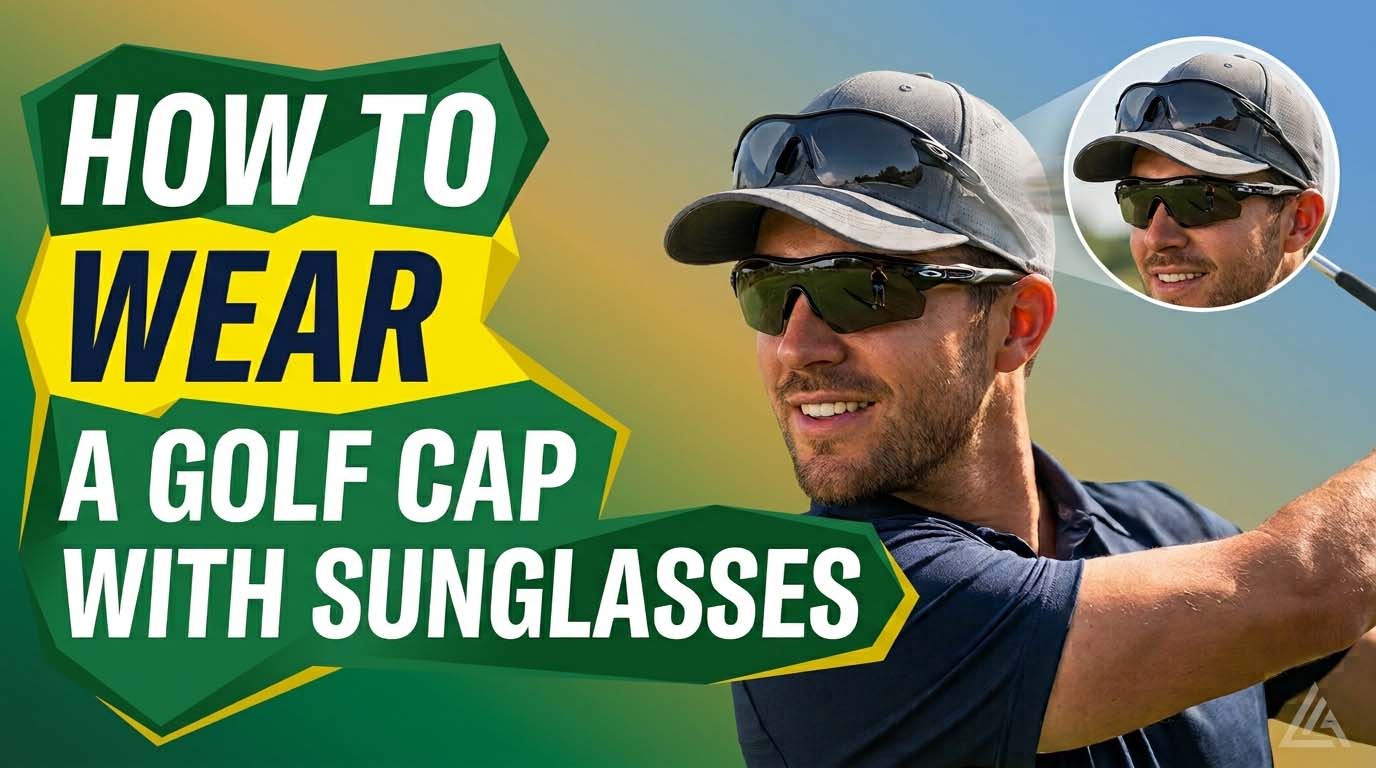
If you have a 7½-size head like mine, you know the struggle. You put on your golf cap, slide your sunglasses on, and suddenly your temples ache, the glasses push down your nose, or the hat rides up when you turn your head. It feels like crap—and it kills your focus on the course.
The problem isn’t that you’re doing it wrong. It’s that nearly every guide treats cap and glasses as separate choices, then tells you to “just adjust them.” That approach fails because the real issue is how the cap’s construction and the glasses’ frame geometry interact at three specific points: the temples, the crown-top of the glasses, and the bridge of your nose.
Here’s how to diagnose your setup, fix the fit, and play 18 holes without touching either.
Phase A: Diagnose Your Current Setup
Before you change anything, figure out whether your cap or your sunglasses is the main culprit.
Check Your Cap’s Construction
Cap comes in two fundamental types:
- Structured cap – has a stiff front panel that holds its shape. Often has a higher crown. Looks crisp but offers less flexibility around the temples.
- Unstructured cap – soft front panel that conforms to your head. Lower crown, more forgiving. Commonly called a “dad cap.”
If you wear a structured cap with a high crown, the sweatband sits high on your temples. That leaves less room for sunglasses arms to rest comfortably. With my 7½ fitted cap, the structured version pinches immediately.
Next, measure the crown height. Remove the cap and place it upside down on a table. Measure from the brim’s bottom edge to the top center of the crown. Anything over 4 inches is a high crown. Low crowns (under 3.5 inches) usually work better with thicker frames.
Check the brim curvature too. Flat brims (common on snapbacks) push the front of your hat downward, which can tilt sunglasses forward on your face. Curved brims allow the hat to sit more naturally.
Check Your Sunglasses’ Frame Geometry
Focus on three frame features:
- Temple thickness – thick plastic arms (like on Wayfarers) need more vertical space. Thin wire arms (like aviators) fit under almost any hat.
- Temple arm angle – straight-back arms vs. curved-wrap arms. Curved arms hug your head but can dig into the sweatband. Straight arms slide easier but slip more.
- Nose pad type – fixed nose pads put pressure on your bridge when the hat pushes the glasses down. Adjustable pads let you tweak the grip height.
If your sunglasses have thick, straight arms and your cap is structured with a high crown, you have a classic incompatibility. The arms want to sit above the sweatband, but the stiff fabric pushes them down onto your temple.
Phase B: The Three Contact Points
Every hat-and-glasses combination interacts at three places. Fixing one often messes up another if you don’t understand the trade-offs.
Point 1: Temples
Where the sunglass arms sit on your ears and press against the cap’s sweatband. Too much pressure = headache. Too little = glasses slide.
Point 2: The Crown-Top
Where the top of the sunglass frame meets the inside of the cap’s crown. If the crown is too low, the frame pushes the cap upward. If the crown is too high, the glasses sit too far down your nose.
Point 3: The Bridge
Where your nose carries the weight. When the hat sits low on your forehead, it can tilt the glasses forward, shifting weight to the nose pads. That’s why your glasses slide after a few swings.
The Cap-Sunglasses Compatibility Matrix
| Cap Type | Sunglass Frame Type | Compatibility | Main Issue |
|---|---|---|---|
| Structured high-crown | Thick temples (Wayfarer, Clubmaster) | Poor | Temple pinch, glasses push down |
| Structured high-crown | Thin wire temples (Aviator, rimless) | Good | May slide if cap worn high |
| Unstructured low-profile | Thick temples | Fair | Cap may ride up, temples sit outside sweatband |
| Unstructured low-profile | Wraparound sport (Oakley Radar, etc.) | Excellent | Best combo for active play |
| Fitted cap (any size) | Wraparound with rubber temple grips | Excellent | Sweat buildup under cap |
| Trucker mesh (structured front, mesh back) | Any | Variable | Mesh back may catch sunglasses arms |
This matrix saved me hours of trial and error. Once I switched from a structured high-crown fitted cap to a low-profile unstructured cap, my thick-frame sunglasses stopped pinching.
Phase C: Adjustments That Actually Work
If your cap and glasses are borderline compatible, these tweaks can fix them without buying new gear.
Modify Your Cap
- Break in the sweatband – new caps have stiff sweatbands. Soak the inside of the band with water, wear it for an hour, then let it dry. This softens the material and creates a small groove for the sunglass temples.
- Adjust the snap closure – on snapbacks, loosen one notch. That gives the temple arms more vertical clearance. On fitted caps, you can’t adjust the size, but you can stretch the crown by wearing it over a basketball for a few nights. This raises the crown slightly.
- Choose a lower crown next time – when buying a new cap, pick a low-profile or mid-profile model. They sit lower on the head and leave more room above the ears for glasses arms.
Adjust Your Sunglasses
- Bend the temple arms – carefully heat the arms with a hair dryer for 10 seconds (or dip in warm water) and gently bend them outward at the hinge. This widens the grip, reducing side pressure against the cap.
- Swap the nose pads – replace fixed nose pads with adjustable silicone ones. You can raise the glasses higher on your nose, which reduces the downward pressure from the hat.
- Add temple grippers – thin rubber sleeves that slide over the arms. They keep glasses from sliding forward, especially when combined with a lower crown cap.
When Replacement Is the Only Option
If your cap is a structured high-crown and your sunglasses are thick-framed with no temple adjustability, no tweak will fully solve it. Look for:
- A low-profile unstructured cap (like a Titleist Performance Dad Cap or similar)
- Wraparound sport glasses with thin, curved temple arms (Oakley Flak 2.0, Smith Attack)
- A hat with a slightly wider brim (to keep the front from tilting the glasses)
Phase D: Golf-Specific Performance
The real test happens during the swing. Here’s what changes when you combine cap and glasses on the course.
During the Swing
Your head rotates about 90 degrees from address to the top of the backswing. If your hat is too tight, it rotates with your head—then stays twisted as you start the downswing. That misalignment shifts the sunglasses, and your peripheral vision cuts off at the worst moment.
The fix: your cap should be snug enough to stay put, but loose enough that the fabric can slide slightly against your hair. If the sweatband leaves a mark on your forehead after 10 minutes, it’s too tight.
Sweat Management
When you wear both a cap and sunglasses, heat gets trapped against your face. The cap’s sweatband absorbs moisture, but the sunglass arms create a barrier that prevents airflow. This leads to fogging on humid days.
Solutions:
- Choose a cap with a moisture-wicking sweatband (most performance golf caps have this)
- Apply anti-fog spray to your lenses before the round
- Wear a thin headband under the cap if you sweat heavily
The Swing Test Protocol
Before your next round, run through this checklist:
- Put on the hat at your normal playing height.
- Add sunglasses. Check for temple pressure. Hold for 30 seconds—any pain means you need to adjust or switch gear.
- Simulate address position. Look down at the ball. Do glasses slide down your nose? If yes, tighten temple arms or raise nose pads.
- Simulate backswing head turn (look left or right 90 degrees). Does the hat rotate on your head? It should move just slightly, not spin.
- Full swing simulation (take a practice swing). Do you lose peripheral vision at the top of the swing? That means the hat crown is pressing the lenses too close to your eyes.
- Sweat check. Walk around with the hat on for 2 minutes, then remove it. If the sweatband is soaked through, consider a moisture-wicking liner or a sweatband.
Frequently Asked Questions
Can I wear polarized lenses with a golf cap, or will I see rainbows through the hat’s mesh?
Polarized lenses can create warped patterns (called “optical interference”) when looking through mesh or synthetic fabrics, especially trucker caps with mesh backs. It doesn’t affect vision during play because you rarely look through the mesh, but you might notice it pulling the hat on or off. For golf, polarized lenses help reduce glare from sand and water. Just avoid caps with large vent holes directly above your line of sight.
Why do my sunglasses fog up more when I wear a cap?
The cap traps warm air rising from your face, while the sunglass lenses create a cold surface. The combination causes condensation. The fix is airflow: choose a cap with small ventilation eyelets in the crown, or lift the front of the cap slightly between shots to let heat escape. Anti-fog wipes are a temporary fix, but addressing the airflow is permanent.
Is there a difference in approach for women’s golf caps due to bill design or smaller crown sizes?
Yes. Many women’s golf caps have lower crowns and shorter bills. That means the temple arms of sunglasses sit closer to the hinge point, which can cause the glasses to tilt forward if the cap sits low.
Women with smaller heads often find that unstructured caps work better, and glasses with adjustable nose pads are almost essential to prevent sliding. Look for caps labeled “low crown” or “women’s fit” and frames with thin, flexible temples.
Do magnetic clip-on sunglasses work with golf caps?
Clip-ons block UV but create a double-thick frame that presses into the cap’s sweatband. They work best with flat-brim caps because curved brims push the clips off-center. If you already own clip-ons, try wearing the cap slightly higher on your forehead to give the clip more clearance. But for active play, dedicated sunglasses with a single frame are more stable.
How do professional golfers manage this for 18 holes without adjusting constantly?
Most tour pros use custom-fitted hats from their sponsors (often structured caps tailored to their head shape) combined with wraparound sport frames that have rubber temple grips and adjustable nose pads.
They also wear a headband or use moisture-wicking caps to reduce sweat slippage. You can approximate this with any unstructured cap and a pair of sport sunglasses from Oakley, Smith, or Nike. The key is the combination of a soft, flexible crown and thin, curved temples.
After years of fighting with my own 7½ head, I finally switched to a low-profile unstructured cap and a lightweight pair of wraparounds. I haven’t touched my hat or glasses during a round since. You don’t have to settle for the constant adjusting either—now you know exactly what to look for.