
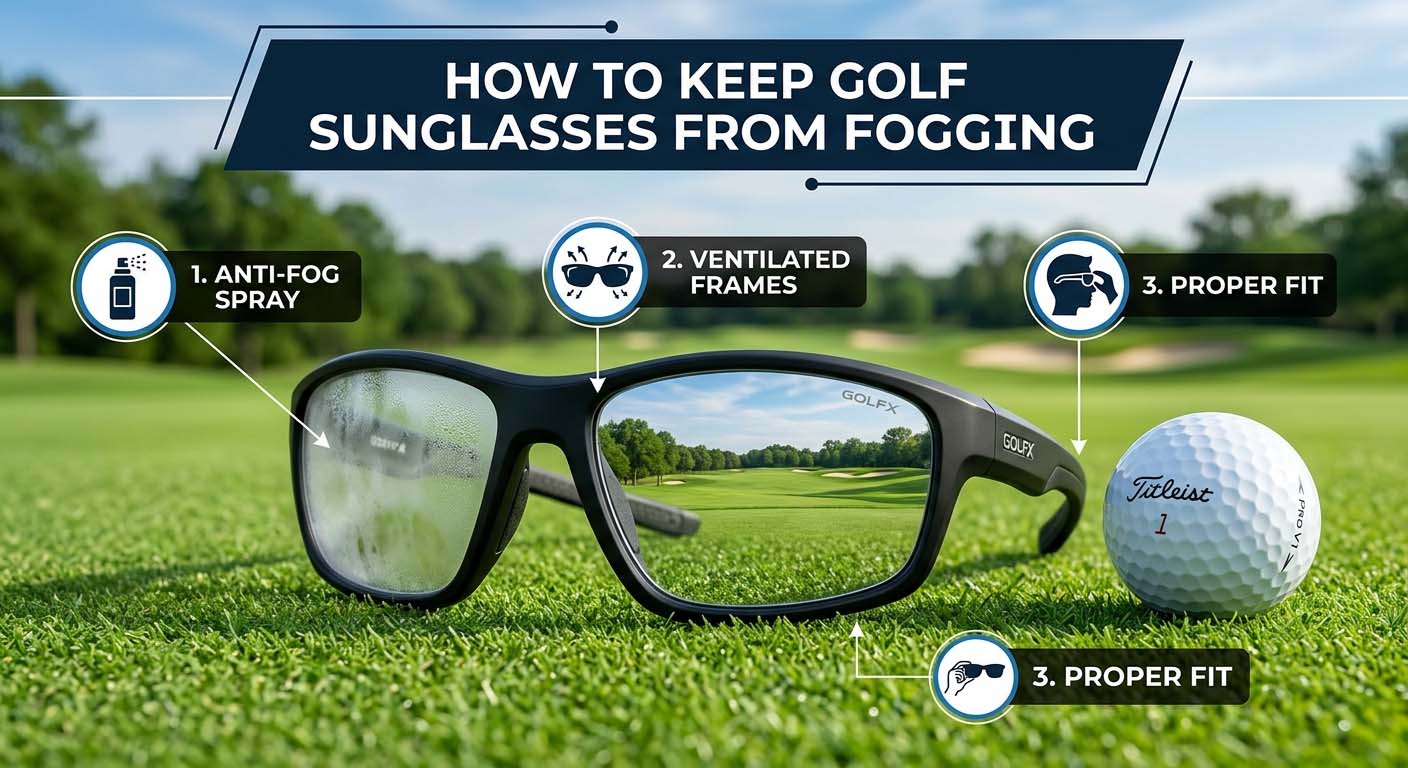
I have lost count of the times I have stood over a putt, only to have my lenses cloud up just as I started my stroke. Fogging on the course is not just an annoyance; it kills your depth perception, messes with your reads, and forces you to break focus at the worst possible moments.
After years of trying everything from dish soap to military-grade sprays, I can tell you one thing: there is no single trick that works for every round. But there is a reliable system that combines the right lens choice, proper anti-fog treatment, and a few on-course habits tuned to how you actually play.
This article breaks down why golf sunglasses fog differently from everyday glasses, then walks you through the five most effective prevention strategies ranked by how well they work in real playing conditions.
You will also get a reality check on common home remedies and a step-by-step guide to cleaning and restoring fogged lenses without damaging your gear.
Why Golf Sunglasses Fog More Than Everyday Glasses?
Most people think fogging is just about temperature differences. That is part of it, but golf adds three specific challenges that generic advice misses.
Temperature cycling. You go from an air-conditioned cart into direct sun, or from a shaded fairway to an open tee box. Your lens temperature lags behind the surrounding air, so moisture condenses instantly. Morning rounds are the worst because the lenses are cold from overnight air and then hit warm, humid breath and sweat.
Perspiration and humidity microclimate. Walking 4 to 6 miles with a bag generates steady facial heat and moisture. Unlike running, where airflow clears the lens, golf has a stop-and-start rhythm. When you stop to line up a shot, your body heat and sweat create a pocket of humid air trapped between your face and the lens. Frames with poor ventilation make this much worse.
Stop-start airflow. Every time you walk to your ball and stop, the air around your face stagnates. That still air lets moisture build up fast. When you are on a moving cart, the wind dries things out — but stepping off the cart into humid morning air is a perfect fog trigger.
The result is that your sunglasses fog exactly when you need them most: reading greens, looking down the fairway, or judging distance to a hazard. Understanding these triggers is the first step to preventing them.
The Five Prevention Strategies Ranked by Reliability
These strategies go from zero-cost habits to advanced treatments. For serious golfers, combining two or three approaches gives the best results across different conditions.
Strategy 1: Optimize Your On-Course Habits
Best for: golfers who want an immediate, free improvement.
- Wipe lenses before you step onto the green or tee box, not after fogging starts. A quick wipe with a clean microfiber cloth removes moisture buildup before it turns into visible fog.
- Alternate between sunglasses and a hat visor when moving between shaded and sunny areas. The smaller temperature swing between your face and the lens reduces condensation.
- When riding in a cart, keep your sunglasses in your bag during travel. Put them on only when you step out to walk to your ball. This prevents the shock of a cold lens hitting warm, humid air.
- Store lenses in a breathable microfiber pouch, not a sealed plastic case. A sealed case keeps the lens cold if the bag sits in a cool spot, then fogging hits hard when you open it outside.
Strategy 2: Choose the Right Frame Design
Best for: golfers buying new sunglasses or upgrading an existing pair.
Frame style makes a huge difference in how quickly fog forms. Wrap-around frames trap heat and humidity because they enclose your eye area, but they block wind and debris. Wire frames let air circulate freely but let in side glare and wind. The ideal compromise is a sport frame with built-in vent channels along the top edge. Many golf-specific frames include these — look for small slits or mesh panels at the brow line that let hot air escape.
Adjustable nose pads also help. By lifting the frame slightly off your face, you create a small gap for airflow. This alone can cut fogging time in half in humid conditions.
Strategy 3: Apply a Properly Formulated Anti-Fog Spray
Best for: serious golfers who want reliable protection every round.
This is the most effective active solution, and it is what I use myself. A quality anti-fog spray creates a surfactant layer on the lens that stops water molecules from clumping into visible droplets. The key metric is wetting angle — how evenly the liquid spreads. Military-grade or optical-industry formulations are designed for extreme humidity shifts and are safe on coated lenses like polarized or anti-reflective.
How to apply correctly: Spray once per lens, spread with a clean microfiber cloth, and let it dry completely before wearing. Do not wipe while wet. Reapply every 2 to 3 rounds or after heavy rain or extreme humidity.
I have used the 2-in-1 Anti-Fog / Lens Cleaning Spray from RIA Eyewear for a full season, and it lasts the entire round in moderate conditions. In high humidity, I reapply at the turn.
Strategy 4: Use Anti-Fog Wipes for Mid-Round Maintenance
Best for: golfers who need a quick touch-up without carrying a spray bottle.
Wipes are less durable than sprays, but they are perfect for a mid-round refresh. I keep a single wipe in my bag and use it after the 9th hole while I grab a snack. In high humidity or if I sweat heavily, I might use one after 6 holes.
The trick is to dry your face before applying the wipe; if your skin is wet, the wipe will just spread moisture around. Wipes work well as a backup to spray, not a replacement.
Strategy 5: The Pre-Emptive Dual Treatment
Best for: golfers who play consistently in high humidity — Gulf Coast, Southeast Asia, or Pacific Northwest.
This is an advanced approach. Apply a layer of anti-fog spray at home and let it cure for 12 hours. Then, just before your round, add a thin second layer. This stacking effect builds a thicker surfactant film that handles extreme moisture. It works particularly well for prescription golf sunglasses, where you cannot swap lenses mid-round. But test on a small area first to make sure your lens coating is compatible — some anti-fog products can react with older coatings.
The Home Remedies Reality Check
You will find dozens of DIY solutions online. Some work for a hole or two, but most can damage your lenses over time. Here is the truth about the most common ones.
| Remedy | Does it work? | Risk to lenses | Best use case |
|---|---|---|---|
| Dish soap (Dawn) | Yes, short-term | Leaves film that degrades anti-reflective and oleophobic coatings over time | Only on non-coated polycarbonate lenses in an emergency |
| Shaving cream | Yes, first few holes | Waxy buildup traps dirt and oils; lenses get smudged by hole 5 | Not recommended for any coated lens |
| Baby shampoo | Slightly better than dish soap | Still can degrade coatings after repeated use | Emergency use on cheap backup glasses |
| WD-40 | Will stop fogging for a while | Permanently damages coatings; oily residue attracts dust and distorts vision | Never use on any optical lens |
If you golf more than once a month, skip the home remedies and invest in a proper anti-fog solution designed for coated optical lenses. Your sunglasses cost too much to risk ruining with dish soap.
How to Clean and Restore Fogged Lenses Without Damage
Even the best anti-fog treatment will eventually wear off or get contaminated by sweat, sunscreen, or dirt. When that happens, do not just wipe harder. Follow this protocol to reset your lenses.
- Stop wiping with your shirt. Shirt fabric grinds in debris and accelerates coating failure. Use only a clean microfiber cloth.
- Use dedicated optical cleaner or distilled water. Tap water leaves mineral deposits that interfere with anti-fog performance. Spray the lens, wipe gently, and dry with a fresh microfiber cloth.
- To reset the anti-fog layer, clean thoroughly to remove all old product buildup, then reapply a fresh treatment. Old, uneven product creates patches where moisture collects.
- When to replace the lens: If you see permanent hazing — a cloudy area that does not disappear when you clean — the lens coating has failed. This happens faster with cheap anti-fog sprays. Quality optical sprays, like the RIA 2-in-1, are formulated to avoid this problem.
Frequently Asked Questions
Can I use the same anti-fog spray on my shooting glasses and golf sunglasses?
Yes, but only if the formula is rated for coated optical lenses. Ballistic or safety glasses often have different coatings that react poorly to consumer sprays. Military-grade formulations usually work across both.
How often should I reapply anti-fog for a full 18-hole round?
In moderate conditions (around 70°F, no rain), a quality spray should last the whole round. In high humidity or rain, plan to reapply at the turn. Wipes may need refreshing after 6 to 9 holes depending on sweat.
Will anti-fog spray affect my polarized lenses?
High-quality optical anti-fog sprays are designed specifically for polarized, anti-reflective, and mirror coatings. Always check that the product states “safe for all coatings.” Avoid anything with alcohol or ammonia, which can strip polarization layers over time.
Does temperature fogging happen more with glass lenses or polycarbonate?
Glass lenses warm up slower but also cool down slower — they fog initially but then stay clear once warm. Polycarbonate warms up fast but cools instantly, making it worse for cart-to-walk transitions. Neither is a clear winner; choose based on your typical weather and activity.
Can I use anti-fog wipes on prescription golf sunglasses with transitions?
Yes, with caution. Photochromic lenses already have a sensitive coating. Use only wipes labeled safe for photochromics. Instead of spraying directly on the lens, spray the wipe first, then apply.