
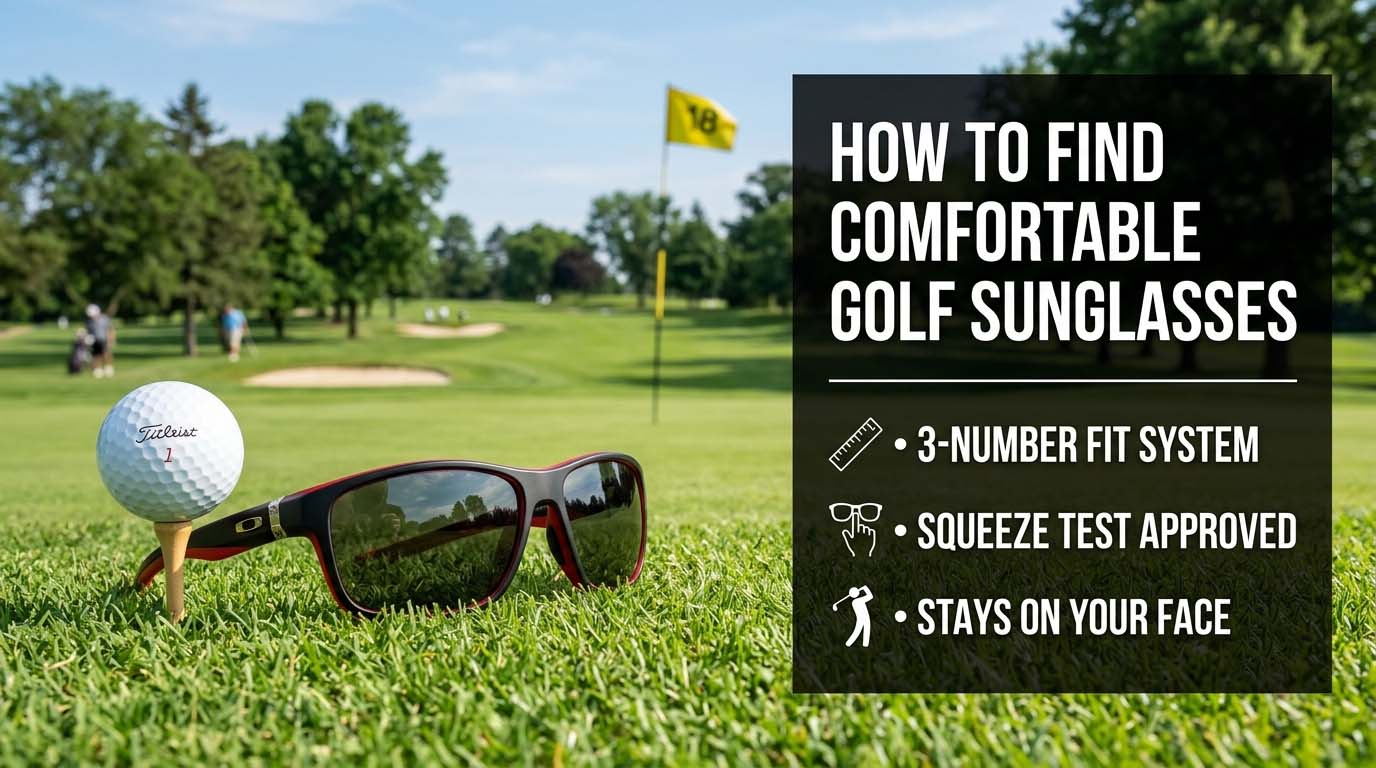
I have spent more rounds than I can count with sunglasses that either slid down my nose on every swing or pinched behind my ears by the back nine. It is a distraction that ruins your focus. The truth is that lens tint and UV protection mean nothing if the frame is not comfortable enough to wear for four hours.
Comfort is not a vague feeling. It comes down to four measurable things: how the frame fits your head, how it stays in place during a swing, how the weight is distributed, and how the materials feel against your skin. Here is how to get all of them right.
Start with Your Own Measurements: The 3-Number Fit System
Most people walk into a store, try on a few frames, and pick the one that looks okay. That approach fails because every face is different. To find comfortable golf sunglasses, you first need to know three numbers about your own head.
- Temple-to-temple width. Measure the distance across your face at the widest point, just above your ears. This tells you the total width the frame needs to span without squeezing your temples.
- Nose bridge width. Measure the distance between the inner corners of your eyes. Most frames have a bridge size between 14 and 24 millimeters. If the bridge is too narrow, the glasses sit too high. If too wide, they slide down.
- Ear height. Measure from the top of your ear where it meets your head to the bottom of the ear’s attachment point. This determines how long the temple arms need to be to reach comfortably behind your ear.
Once you have these three numbers, check the frame specifications online or on the display. Many brands list temple-to-temple width as “frame width,” bridge width as “bridge size,” and temple length in millimeters.
If a frame’s numbers are more than 3 mm off from your measurements, it is unlikely to be comfortable, no matter how soft the nose pads are.
The Squeeze and Shake Test for Dynamic Stability
A pair of sunglasses can feel perfect standing still in a shop, but they fail the minute you take a swing. Golf involves a fast, rotational head movement. The frame needs to grip your face without shifting. I call this the squeeze and shake test.
- Squeeze test: Hold the frame by the temples in front of you. Gently squeeze the temples inward as if they were hugging the head. If they flex too much with almost no resistance, the frame is too soft to hold position during a swing. If they barely move, the frame will likely create pressure points.
- Shake test: Once on your face, turn your head sharply to the left and right, as if following a tee shot. The glasses should not move at all. If they shift, the issue is either the temple grip, the nose pads, or the overall fit.
During my own search, I learned that frames with rubberized temple tips and adjustable silicone nose pads almost always pass the shake test. The rubber creates friction against your skin, and the adjustable pads let you fine-tune the grip so the weight of the lens does not pull the frame forward.
Why Lightweight Frames Are Not Always More Comfortable
Almost every article tells you to look for lightweight materials. They are partly right, but only partly. A frame that is too light often sacrifices structural rigidity. I once owned a pair of ultralight polycarbonate frames that
weighed almost nothing. They were comfortable for the first hour. Then they started to bend out of shape from being handled and put in my bag. After a few rounds, the temples were misaligned, and one side pressed into my temple constantly.
Comfort requires a balance between low weight and enough stiffness to hold its shape under repeated use. The best materials are:
- Nylon (Grillamid TR-90): Lightweight, flexible in a controlled way, and holds its shape well. This is the gold standard for sports frames.
- Acetate: Heavier and less flexible. It can be comfortable if the frame is well designed, but it often slides during a swing because it lacks grip.
- Titanium or steel: Very thin, very strong, and light. The temples can be adjusted precisely. Downsides: they can feel cold against the skin and may pinch if the frame does not have enough padding.
I prefer nylon frames with wire-core temples. The wire core lets you bend the temple arms to match the curve of your head, which solves most fit issues. The nylon body keeps the weight low enough that you forget they are there.
Nose Pads and Temple Tips: Where Comfort Lives or Dies
Two small parts of the frame determine whether you will feel pain after three hours: the nose pads and the temple tips.
Nose pads. Fixed nose pads are molded into the frame. They can be very comfortable if they happen to match the exact shape of your nose bridge. But they are not adjustable. If they do not fit, you are stuck with a pressure point or a slipping frame. Adjustable silicone nose pads, on the other hand, let you change the angle and distance.
They are almost always the better choice for golf because you can tweak them to distribute the weight evenly. The downside is that silicone can get slick when wet with sweat. Look for nose pads with a textured surface or a matte finish to maintain grip.
Temple tips. The tips of the temples rest behind your ears. If they are too short, they dig into the cartilage. If too long, they poke out and catch on your hat or hair. Most temple tips are made of soft rubber or silicone.
The key is to find a tip that wraps around your ear without pinching. Some brands offer “skull” tips that curve inward to hug the back of your head. Others have bayonet tips that are straight and only touch the top of the ear. For golf, skull tips are better because they lock the frame in place horizontally.
If the temple tips are causing pain, try bending the wire core (if available) outward slightly to reduce pressure.
Test Before You Buy: A Practical Checklist
You cannot trust online reviews alone when it comes to fit. Every face is different. If possible, visit a store that carries golf-specific or sports sunglasses. Take this checklist with you:
- Do the frames stay put after 10 head turns in each direction? Simulate a swing as closely as you can.
- Are any pressure points noticeable after 30 seconds? If you feel a pinch at the temples or bridge of the nose immediately, it will only get worse.
- Can you adjust the temple length or angle? Look for adjustable wire-core temples or a choice of temple lengths.
- Does the frame feel solid? Squeeze the temples gently. They should not bend out of shape with light force.
- Is there a return policy? If you order online, make sure you can return the glasses after wearing them indoors for a few minutes. Some companies accept returns only if the lenses are unworn, which is useless for testing fit.
If you are ordering online, order two or three different sizes or models at once. Compare them side by side on your face, then return the ones that do not work. This is the fastest way to find comfortable golf sunglasses without guesswork.
Frequently Asked Questions
How do I keep the temple arms from hurting behind my ears during a 4-hour round?
This often happens when the temple arms are too short or have sharp, non-ergonomic ends. Look for adjustable wire-core temples or frames with skull tips that wrap gently around the ear. Also avoid frames where the temple arm sits high on the ear cartilage instead of the softer area behind it.
Is it better to have a frame that is slightly too tight or slightly too loose for golf?
Slightly too tight is better. A loose frame will slide down your nose on every swing, which is a constant distraction.
A slightly snug frame can be adjusted to relieve pressure points, whereas a loose frame often cannot be tightened without compromising its integrity. Just do not go so tight that you feel pain at the temples or nose.
Do different nose pad shapes affect comfort on the course?
Yes, significantly. Fixed nose pads are less adjustable but can be very comfortable if they match your bridge perfectly. Adjustable silicone nose pads offer the greatest customization for comfort but can be prone to trapping sweat.
If the silicone gets wet, the frame may slide. Look for textured or matte silicone to maintain grip even when you sweat.
Can I wear polarized lenses for golf and still be comfortable?
Polarized lenses reduce glare but can interfere with depth perception and make it harder to read greens. Many golfers prefer non-polarized contrast-enhancing tints for that reason.
But comfort comes from the frame, not the lens type. If you already have a comfortable frame, you can often swap the lenses. Just make sure the frame is designed for sports use and holds prescription or aftermarket lenses securely.
How do I stop my sunglasses from fogging up when I walk between sun and shade?
Fogging is a lens issue, not a frame issue. However, a frame that sits too close to your face can trap warm air and make fogging worse. Look for frames with a slight gap between the lenses and your eyebrows, and choose lenses with an anti-fog coating. Some golfers also use anti-fog wipes or sprays on the inside of the lenses.
Comfortable golf sunglasses are not a luxury. They are a tool that lets you focus on the game instead of fiddling with your face. Measure your head, test the grip, check the materials, and don’t settle for a pair that only feels okay in the store. Your next round will be a lot better for it.