
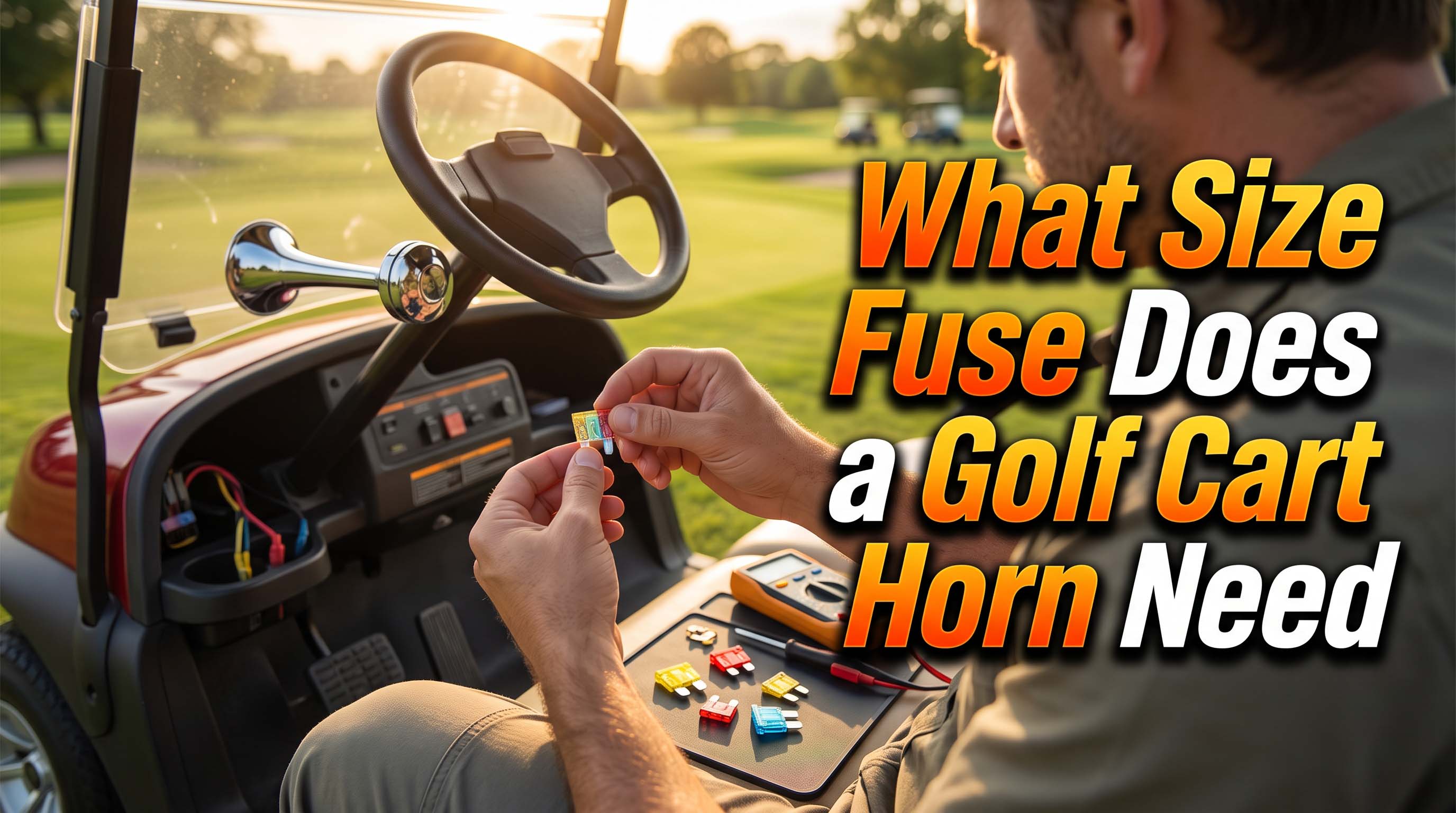
If you are wiring a horn into your golf cart or replacing a blown fuse, I will give you the direct answer first. A 5-amp blade fuse is the standard size for most golf cart horns. That covers stock horns and common aftermarket disc horns. Some louder trumpet horns draw less current and can even use a 2-amp fuse, but 5 amps is safe for almost every 12-volt horn you will find. Your absolute maximum should be 10 amps, and I will explain why going bigger is risky.
The key rule is simple: the fuse protects the wire, not the horn. Choose a fuse rated 125 to 150 percent of your horn’s amp draw. Most golf cart horns draw between 1.5 and 4 amps. That is why 5 amps works for nearly all installations. Before you buy a fuse, you need to check one number: the amperage rating printed on your horn.
How to Find the Right Fuse Size for Your Horn
You cannot guess fuse size by looking at the horn. Every horn has a label or a stamped specification that tells you how many amps it pulls. Look on the metal body of the horn, near the mounting bracket, or on the back side where the wire connects. It will say something like “12V – 2A” or “Max Draw 3.5A”. If the label is worn off, check the product listing if you bought it online, or use a multimeter to measure the current draw.
Using the 125% Rule
Once you have the horn’s amp draw, multiply it by 1.25. That gives you the minimum fuse rating. Then round up to the nearest common fuse size. Common sizes are 2, 3, 5, 7.5, and 10 amps. Do not round down. For example:
- A stock horn that draws 4 amps → 4 × 1.25 = 5 amps → use a 5-amp fuse.
- An aftermarket disc horn drawing 2 amps → 2 × 1.25 = 2.5 amps → round up to a 3-amp fuse (or 5-amp if that is easier to find).
- A Hella trumpet horn drawing 1.5 amps → 1.5 × 1.25 = 1.875 amps → use a 2-amp fuse (or 5-amp if you prefer to stock one size).
I have installed the Hella trumpet horn kit from OZ-USA many times. That horn uses only 1.5 amps, and the kit comes with a 2-amp fuse. A 5-amp fuse also works, but stays further from the ideal protection window. If you use a 10-amp fuse on a 1.5-amp horn, you lose most of the protection.
What Fuse Shape Do You Need?
Golf cart horns almost always use standard ATO or ATC blade fuses. These are the flat, plastic fuses with two metal prongs that you find in any auto parts store. The fuse goes into an inline fuse holder on the positive wire near the battery or the horn. Check your existing holder – some aftermarket kits use mini blade fuses (ATM style). Mini blades are smaller but work the same way. The amp rating is printed on the top of the fuse. Match the shape to your holder.
Where to Install the Fuse in the Horn Circuit
The fuse must sit on the positive wire between the battery and the horn. It should be as close to the battery as possible. That way, if a short happens anywhere along the wire, the fuse blows before the wire can overheat. Most pre-made horn kits, like the one OZ-USA sells, include an inline fuse holder right in the harness. If you are building your own circuit, buy a waterproof inline fuse holder and install it within 6 inches of the battery positive terminal.
Wiring Gauge Matters Too
The fuse protects the wire. If you use 18-gauge wire for the horn circuit, a 5-amp fuse is correct. If you use thinner 22-gauge wire, you should drop to a 3-amp fuse. I recommend using at least 18-gauge automotive wire for any horn installation. That wire is thick enough to handle 5 amps safely and gives you room to upgrade the horn later.
What Can Go Wrong With the Wrong Fuse Size
I have seen people grab whatever fuse they have lying around. That is a mistake. Here is what happens with each wrong choice.
Fuse Too Small
A 2-amp fuse on a horn that draws 4 amps will blow as soon as you honk. The horn might work for half a second, then go silent. You will keep replacing fuses and never fix the real problem. You also risk melting the fuse holder if you keep putting in higher-rated fuses without changing the wire.
Fuse Too Large
A 15-amp fuse on a circuit with 18-gauge wire is dangerous. The wire can only handle about 6 amps before it gets hot. If the horn draws 3 amps and a short appears in the wiring, the short might draw 12 amps. The 15-amp fuse will not blow. The wire will heat up, the insulation will melt, and a fire could start inside your golf cart. I have seen melted harnesses from oversized fuses on customer carts. It is not worth the risk.
No Fuse at All
Wiring a horn without a fuse is asking for trouble. A bare wire rubbing against the frame can create a short circuit that draws unlimited current from the battery. The wire will get red hot and burn through before the battery dies. Every golf cart accessory circuit needs a fuse. Do not skip it.
Troubleshooting a Horn That Does Not Work
If your horn stops working, the fuse is the first thing to check. But a blown fuse could be a symptom of a bigger problem. Here are the most common issues I run into.
Horn Works Sometimes, Then Goes Silent
Check the fuse. If it looks blown (the metal strip inside is broken), replace it with the correct amp rating. If the new fuse blows again right away, you have a short circuit. Inspect the wire where it passes under the seat or near the frame. Wires rub through insulation and touch metal, causing a short. Move the wire away from sharp edges and wrap it in electrical tape or split loom.
Horn Fuse Blows Only When It Is Hot Outside
Heat increases current draw slightly. If your horn is on the edge of the fuse rating, a hot day can push it over. Also, an old or worn horn mechanism draws more current because the internal contacts corrode. Replace the horn if it consistently blows a 5-amp fuse. Sometimes stepping up to a 7.5-amp fuse works temporarily, but I recommend replacing the horn instead.
Horn Does Nothing – Fuse Looks Fine
If the fuse is good, test for power at the horn wire with a multimeter. Set it to DC volts. Touch the probe to the positive wire and the other to ground. You should see battery voltage when you press the horn switch. If you have power, the horn itself is bad. If you have no power, the switch or wiring is broken.
Frequently Asked Questions
Can I use a car horn fuse in my golf cart?
Yes. Golf cart accessory circuits run on 12 volts, same as cars. As long as the fuse rating matches your horn’s amp draw and the physical shape fits your fuse holder (ATO/ATC blade style), it is perfectly safe. You can buy standard blade fuses at any auto parts store.
Where is the horn fuse located on a golf cart?
On factory-installed horns, the fuse is usually in the main fuse panel under the dashboard. On Club Car models, check near the dash fuse block. On EZGO and Yamaha, the fuse is often inline in the accessory harness under the seat. Aftermarket kits always have an inline fuse holder on the positive wire near the battery or horn.
What happens if I replace a 5-amp fuse with a 10-amp fuse because that is all I have?
It will probably work for a while. But you lose protection. A 10-amp fuse only blows when current exceeds 10 amps. A wiring fault drawing 8 amps will not blow it, and the wire can overheat. Use a 10-amp fuse only as a temporary solution. Replace it with the correct size as soon as you can.
Why does my horn fuse blow only when it is hot outside?
High ambient temperature makes the fuse element more sensitive to reaching its rating. Also, a horn motor or solenoid draws slightly more current when hot due to increased resistance. Your fuse may be marginal for the circuit. Check the horn’s amp draw with a multimeter when the cart is hot. If it is above the fuse rating, upgrade the horn or use a slightly higher fuse (within wire gauge limits).
After reading this, you should know exactly which fuse to buy, how to confirm the size for your specific horn, where to install it, and how to fix common problems. No need to guess or search for another article. Pick the right fuse, install it safely, and enjoy a horn that works every time you need it.