
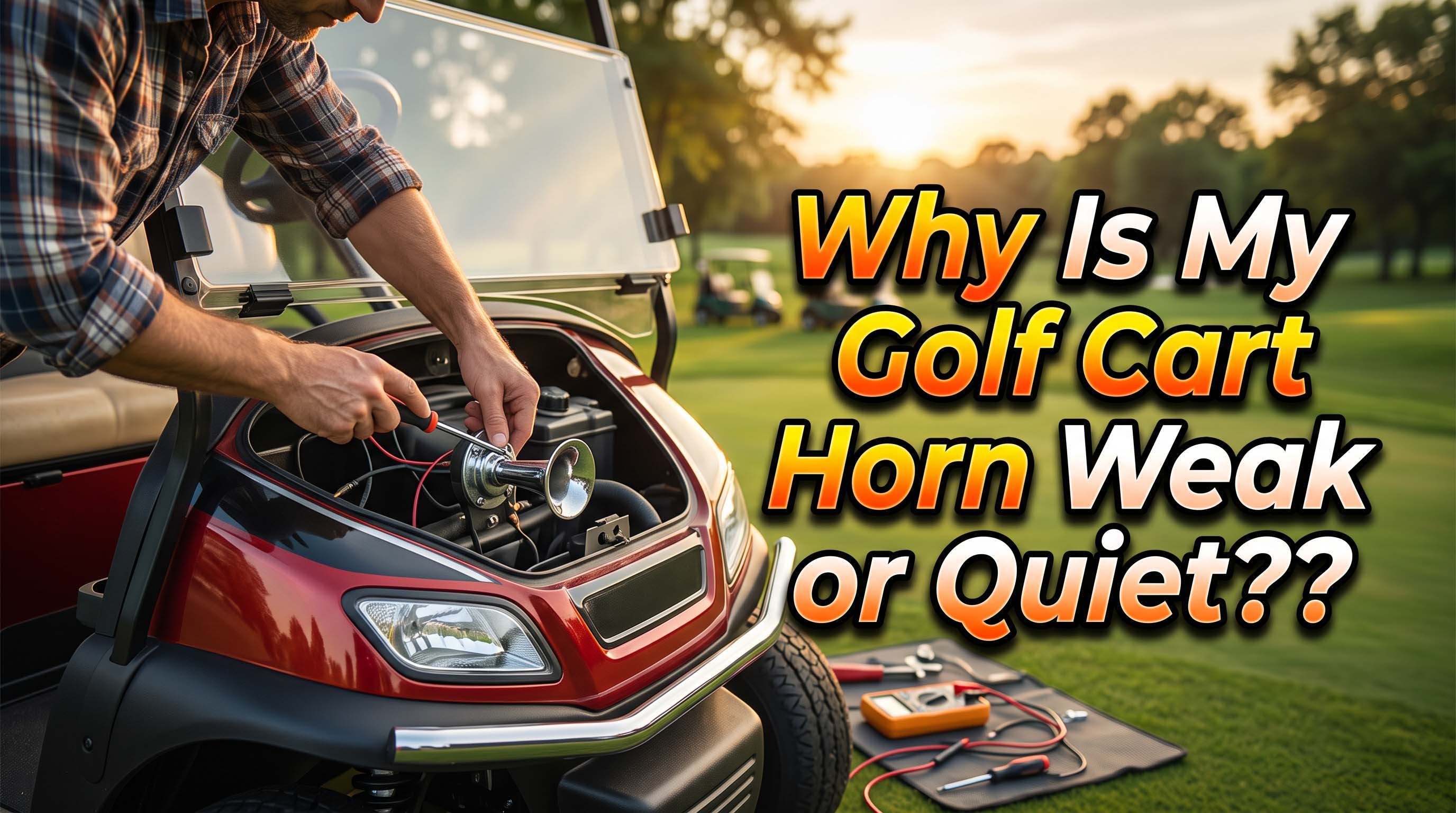
I’ve lost count of how many golf cart owners have told me their horn just doesn’t punch the way it used to. Usually, they’ve already swapped the fuse, maybe even bought a new horn, and nothing changed.
They’re frustrated, and I get it. A weak or quiet golf cart horn isn’t just annoying; it’s a safety concern when you’re on a street or near pedestrians.
Here’s the truth I’ve learned from troubleshooting these systems: in about nine out of ten cases, the horn itself is perfectly fine.
The real problem is somewhere in the circuit that powers it. This article will walk you through exactly what to check, in the order that matters, so you can fix your horn without wasting money on parts you don’t need.
Why a Golf Cart Horn Loses Its Punch
Before you start poking around with a multimeter, it helps to understand why a horn that worked fine last season now sounds like a bicycle bell. The short answer: electricity has to complete a full loop.
Break any part of that loop- poor ground, corroded wire, weak battery- and the horn gets starved for power. A starved horn sounds weak. Sometimes it doesn’t sound at all.
The most overlooked reason is the ground. Most golf carts today have fiberglass or plastic bodies. There’s no metal chassis to act as a ground like in a car.
If the horn’s negative wire is bolted to a piece of plastic or a painted metal bracket, it’s not actually grounding. That alone can make a horn go quiet. I’ll cover that in detail in a moment.
How the Horn Circuit Works on a Golf Cart
Let me simplify the path electricity takes. Your horn circuit has five main parts:
- Power source – usually a 12V auxiliary battery or a voltage reducer on 48V systems.
- Fuse – protects the wiring from excess current.
- Horn button – a momentary switch on your steering column or dash.
- The horn itself – an electromagnet that vibrates a diaphragm.
- Ground path – the return wire that completes the circuit back to the battery’s negative terminal.
If any of those five links is weak, the horn gets less voltage and current than it needs. The result is a quiet, wimpy sound.
The ground path is where golf carts differ from cars
On a car, the metal chassis acts as the ground. You can bolt the horn’s negative wire almost anywhere on the frame. On a golf cart, especially newer ones with composite bodies, that bolt might be going into fiberglass.
No connection. Or the bolt is grounding through a rusty bracket that has high resistance. That high resistance acts like a clogged pipe—it restricts the flow of electricity.
The Golf Cart Ground Problem Everyone Misses
This is the fix I end up doing most often. The horn’s ground wire should run directly back to the battery’s negative terminal. Not to the frame, not to a random bolt on the body. Direct to the battery.
I’ve seen carts where the factory ran the horn ground to the same bolt that holds the controller bracket. That bracket is painted. The wire was grounding through a few specks of bare metal. Over time, corrosion turned those specks into an insulator. The horn got weaker and weaker.
The check: Follow the horn’s negative wire. Where does it end? If it’s not going to the battery negative terminal, that’s your first suspect. Touch it directly to the battery negative with a jumper wire and press the horn. If it blasts loudly, you’ve found the issue.
Testing for Voltage Loss While the Horn Is Pressed
A battery can read 12.6 volts when nothing is running. But the moment you draw current, like when the horn kicks on, that voltage can drop hard. A weak battery that can still run the cart at slow speeds might not deliver enough amperage for the horn’s sudden demand.
You need a digital multimeter for this test. Here’s the method I use:
- Set your multimeter to DC voltage (20V scale).
- Put the red probe on the positive terminal of the horn (or the positive wire that feeds it).
- Put the black probe on the negative terminal of the horn (or its ground wire).
- Have a helper press and hold the horn button.
- Read the voltage while the horn is sounding.
If the reading is above 11.5 volts, the electrical supply to the horn is fine. If it’s below 10 volts, you’ve got a supply problem upstream—could be the battery, the fuse holder, a corroded connector, or the horn button contacts.
If the reading is zero, you have an open circuit somewhere. Check fuses and the button next.
Static voltage vs. voltage under load
I’ve had batteries read 12.8V at rest but drop to 5V when the horn draws current. That battery looks good on a voltmeter but fails under load. If your voltage drop test shows a big sag, try jumping the horn directly from a known good 12V battery (like a car battery, but be careful with polarity). If the horn is loud, your cart’s battery is the problem.
Mechanical Reasons a Horn Sounds Muffled
Sometimes the electrical circuit is perfect, but the horn still sounds quiet. That’s when you need to look at the horn itself as a physical device.
Debris and moisture: Horns have a compression chamber and a trumpet or disc opening. Bugs love to build nests there. Mud from trail riding can pack inside. Moisture can rust the diaphragm. I once pulled a horn off a cart that had a dried-up wasp nest blocking the sound port. Cleaned it out, and the horn was loud again.
Dielectric grease buildup: I see people slather dielectric grease on electrical connectors. That grease is for preventing corrosion on the metal contacts, not for packing into the horn’s sound exit. Too much can mute the horn.
Cracked trumpet or housing: A crack in the plastic or metal housing changes the resonance. The horn will sound weak even if the electrical side is fine.
The test: Remove the horn from the cart. Clean the opening with compressed air or a small brush. Then connect it directly to a 12V battery using jumper wires. If it’s loud, the problem was mechanical. If it’s still quiet, the horn’s internal components are worn out and it needs replacement.
How to Fix the Weak Horn
Now that you’ve diagnosed the cause, here’s how to fix each scenario.
If the ground is poor: Run a dedicated ground wire from the horn’s negative terminal directly to the battery’s negative post. Use at least 16-gauge wire. Secure it with a ring terminal and clean the connection point. That’s a permanent fix that also improves future performance.
If voltage drops under load: Charge or replace the battery. If your cart runs on a 48V system with a voltage reducer, test the reducer’s output. Sometimes the reducer can’t handle the horn’s current draw. You might need a separate 12V auxiliary battery for accessories.
If the horn is clogged or cracked: Clean the horn’s sound port. If cracked, replace it. Don’t bother trying to patch a plastic horn—it never seals right.
If the horn button is the problem: High resistance in the contacts can reduce voltage. Test by bypassing the button with a jumper wire. If the horn is loud, replace the button.
False fixes to avoid
Don’t wire a second horn in parallel on the same thin wire. The stock wiring is usually 18-gauge, not enough for two horns. You’ll just get two quiet horns.
Don’t install a 12V horn on a 48V cart without a proper voltage reducer. I’ve seen people fry horns or get intermittent operation.
Don’t mount a new horn under the cart in a splash zone. Horns are not waterproof. A wet horn will be quiet and will fail fast.
When to Upgrade to a Louder Horn
Sometimes the original horn was never that loud to begin with. Golf cart manufacturers often install the cheapest horn that meets minimum requirements. If your horn checks out fine on all tests but you still want more volume, upgrading is straightforward.
Look for a 12V horn rated at 110 decibels or higher. Many aftermarket horns include their own relay and wiring. On a golf cart, if you go with a higher-power horn, install a relay. The thin original horn wire can’t safely carry more than about 5 amps. A relay lets that thin wire just trigger the coil, while the heavy current flows through a direct battery connection.
One thing I recommend: after you install a new loud horn, test it from the driver’s seat. If you’ve added a lift kit, larger tires, or a roof enclosure, road noise and wind noise will mask the horn. What sounds loud outside might be barely audible to you.
In that case, position the horn facing forward, not downward, and keep it out from behind solid panels.
Frequently Asked Questions
How many volts should a golf cart horn receive?
A 12V horn needs between 11.5V and 14.5V to work properly. If you’re on a 48V cart with a voltage reducer, check the reducer’s output. Anything below 11V under load will make the horn sound weak.
Can a low golf cart battery make the horn sound weak even if the cart still drives?
Yes, absolutely. Driving the cart draws continuous current, but a horn demands a sudden surge. A battery that’s borderline can deliver enough for slow movement but can’t handle the spike. The voltage sags, and the horn suffers.
Is it safe to test a car horn by connecting it directly to a golf cart battery?
Yes, with common sense. Use jumper wires, connect positive to positive and negative to negative. Do not hold the connection for more than a few seconds—horns get hot. And never touch the wires together if the other end is connected to the battery.
Why did my horn get quieter after I installed a lift kit or larger tires?
That’s the perception problem I mentioned earlier. Larger tires and a lifted chassis increase road noise and wind noise. The horn’s actual output hasn’t changed, but the background noise has gone up.
If you measure the horn with a sound meter (or your phone app), it’s likely still as loud as before. Your ears are just competing with more noise.
Do I need a relay to install a louder aftermarket horn on a golf cart?
For any horn drawing more than 5 amps, yes. Check the horn’s specifications. The factory horn wire is thin and will drop voltage if you push too much current through it. A relay costs a few dollars and ensures your new horn gets full power.