

If your lead knee starts aching after a round, or if you feel a sharp twist during the downswing, you are not alone. The lead knee takes the hardest hit in the golf swing. The downswing forces it to rotate and straighten at the same time, which can grind away at ligaments and cartilage over months and years.
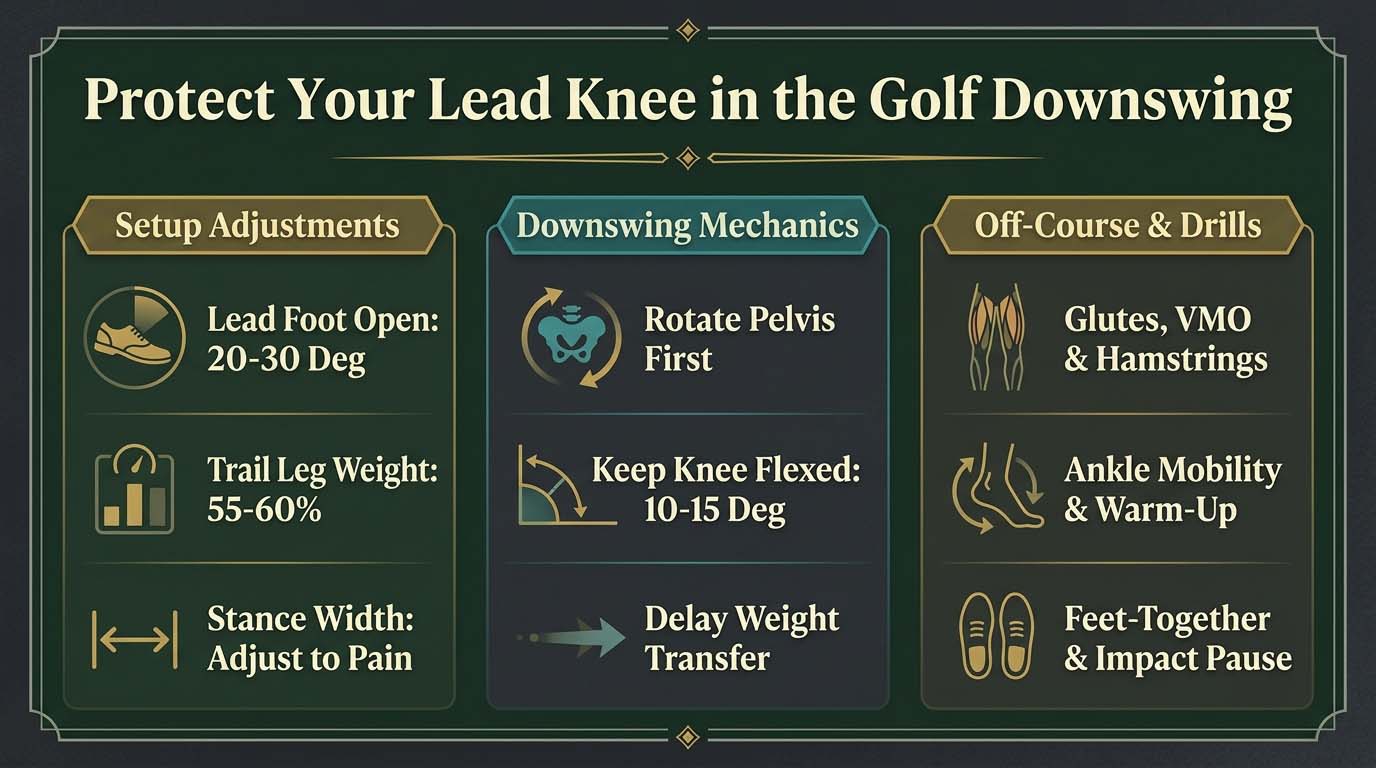
The most effective way to protect your lead knee is to maintain 10 to 15 degrees of knee flexion throughout the downswing, keep your pelvis stacked over your ankle, and avoid locking the knee at impact.
Looking for Discounts on How To Protect Your Lead Knee During the Golf Downswing??
Check out the latest price drops, clearance offers, and top-rated deals currently live on Amazon.
Check Live Discounted Prices on Amazon →But that alone is not enough. You also need the right setup, the right swing sequence, and the right off-course preparation.
This article covers the three pillars of knee protection: understanding the danger, fixing your setup and swing mechanics, and building the strength and mobility to keep your knee safe for the long run.
How the Downswing Creates Stress on the Lead Knee
During the downswing, your lead knee goes through two high-risk movements at once. It rotates from an externally rotated position to an internally rotated position, and it straightens rapidly. This combination creates an abduction moment, meaning the knee is being pulled outward.
The stress is not high enough to tear the ACL in one swing, but the repetition is the problem. Over hundreds of swings per round and thousands per season, the joint wears down.
Research shows that lead knee stress during the downswing can reach around 1 Newton-meter per kilogram of body weight. That is enough to cause micro-damage over time, especially if you already have arthritis or a previous knee injury.
This is why protecting the lead knee is not just about feeling good after one round. It is about keeping the joint healthy for years of golf.
Setup Adjustments That Offload the Lead Knee
Before you even start the backswing, the way you stand at address determines how much load your lead knee will handle. Small changes here make a big difference.
Rotate Your Lead Foot Open
Turn your lead foot toward the target by 20 to 30 degrees at setup. This reduces the amount of internal rotation the knee has to go through during the downswing.
It also shifts some of the stress from the medial side, where osteoarthritis often develops, to a stronger part of the joint.
Adjust Your Stance Width
Standing closer to the ball lowers the peak abduction moment on the lead knee. Standing farther away increases that moment. If your pain is on the inside of your knee, move slightly closer to the ball.
If your pain is on the outside, move slightly farther away. This is not a preference decision. It is a mechanical one based on where your knee hurts.
Set Your Weight Distribution
At address, keep 55 to 60 percent of your weight on your trail leg. This prevents you from lunging onto the lead leg too early in the downswing, which forces the knee into extension and internal rotation under full load.
Three Downswing Movements That Unload the Lead Knee
Once your setup is right, you need to control what your body does during the downswing. These three movements are the core of protecting your lead knee in real time.
Rotate the Pelvis, Not Just the Shoulders
Many amateurs rotate their shoulders and upper body while keeping the pelvis locked. This forces the lead knee to twist further than it should.
Instead, initiate the downswing by rotating your pelvis toward the target. This allows your femur to externally rotate, which reduces the internal rotation stress on the knee.
Keep the Lead Knee Flexed Through Impact
Do not let your lead knee lock out before impact. Locking it puts all the rotational load directly on the joint surfaces and ligaments.
Maintain a slight bend, around 10 to 15 degrees, all the way through the ball. The knee will extend naturally after impact as your body rotates forward.
Delay Your Weight Transfer
Do not shift all your weight to the lead leg early in the downswing. A common mistake is sliding the hips toward the target, which drives the knee past the ankle and creates a valgus collapse.
Instead, let your body rotate over a stable lead leg. The weight will shift naturally as your hips rotate, not as you slide forward.
The Off-Course Routine That Protects the Lead Knee
No swing change will last if your body cannot handle it. Strengthening and mobility work off the course are just as important as what you do on the tee box.
Strength Exercises for the Lead Knee
Three muscle groups matter most for knee protection:
- Gluteus medius (hip abduction). This muscle controls how much your hip drops inward during the downswing. Weak glutes force the knee to absorb rotation. Do side-lying leg raises or banded sidesteps.
- Vastus medialis oblique (VMO). This part of your quadriceps stabilizes the kneecap. Wall sits and short-arc quad extensions help.
- Hamstrings. Tight hamstrings pull the pelvis into posterior tilt, which limits hip rotation and loads the knee. Hamstring curls and deadlifts with light weight build strength.
Mobility Work for the Ankle
Limited ankle dorsiflexion forces the knee to bend forward past the toes. This increases the flexion moment on the joint. Work on ankle mobility with calf stretches and banded ankle distractions before every round.
A Warm-Up Sequence for the Lead Knee
Before you hit your first ball, do this warm-up:
- Glute bridges, 10 reps.
- Leg swings forward and side to side, 10 each direction.
- Bodyweight squats with a focus on keeping knees behind toes, 8 reps.
- Rotational lunges, 5 per side.
This takes three minutes. It activates the muscles that protect your knee during the swing.
Why Staying Down Can Wreck Your Lead Knee
You have probably heard an instructor say stay down through the ball. This is good advice for spine angle, but bad advice for your knee.
If you try to keep your head low and your shoulder down through impact, you force the lead knee into excessive flexion and internal rotation. The knee cannot sustain that angle under the force of the swing.
The reality is that your hip has to rise naturally as you rotate through the ball. The knee should extend gradually, not lock. Allow your body to stand up as you complete the swing. That movement protects the joint.
Three Drills That Teach Your Body to Protect the Lead Knee
Drills turn conscious changes into muscle memory. These three are simple and effective.
Feet-Together Drill
Stand with your feet touching, then swing at 50 percent speed. This forces your pelvis to rotate without sliding your knee forward. If you slide, you will lose balance. Use this drill to feel hip rotation without knee stress.
Pause at Impact Drill
Make a full swing but stop at impact and hold the position for two seconds. Check your lead knee. Is it bent 10 to 15 degrees? Is it in line with your ankle? If it is locked or past your toes, reset and try again.
Towel Under Lead Foot
Place a folded towel under your lead heel. Swing normally but do not let the towel slide. This keeps your weight on your trail side longer, which prevents early weight transfer and protects the knee.
Modifying the Downswing for Pre-Existing Knee Conditions
If you already have an ACL deficiency, arthritis, or a knee replacement, you need to adapt the advice above even further.
For Arthritis
Open your lead foot 30 to 40 degrees instead of 20 to 30. Use a wider stance to create a stable base. Shorten your backswing to reduce the rotational momentum entering the downswing. Smooth out your transition. No sudden acceleration.
For ACL Deficiency
A hinged knee brace that limits hyperextension can help. Focus on keeping the knee flexed through impact. Avoid any twisting motion at the knee by rotating the pelvis and hips first.
For Total Knee Replacement
Follow the same setup and swing mechanics, but add a longer warm-up and more rest between shots. Do not swing on uneven lies if possible. Use a compression sleeve for comfort, but know it does not provide structural support.
Frequently Asked Questions
Can I protect my lead knee without changing my swing?
Partially. Strengthening your glutes, VMO, and hamstrings, plus a proper warm-up, can reduce knee stress by up to 25 percent. But mechanical changes in your setup and swing mechanics are more effective for long-term protection.
Does wearing a hinged knee brace help during golf?
Only if the brace limits hyperextension or provides varus and valgus support. A compression sleeve offers comfort and proprioception but does not reduce the rotational stress on the knee.
Should I keep my lead heel on the ground throughout the swing?
Not necessarily. Lifting the lead heel reduces the torque on the knee by allowing the femur to rotate faster with less resistance. Try it both ways. Some players find it easier to rotate with the heel up, while others lose balance.
How does wet grass affect lead knee stress?
Wet grass decreases friction between your shoe and the ground. This can cause your foot to slip during the downswing, forcing the knee to absorb the rotational force instead of the ground. Use spiked shoes or soft spikes to maintain traction.
What exercises worsen lead knee pain?
Deep squats, lunges with the knee past the toes, and jumping exercises increase stress on the knee. Avoid these until your swing mechanics are clean and your knee is pain-free during a round.
Protecting your lead knee during the downswing comes down to three things: setting up in a way that unloads the joint, swinging in a sequence that respects the knee’s limits, and preparing your body to handle the load.
Start with the foot rotation and stance adjustments. Then work on keeping the knee flexed through impact. Build your strength and mobility off the course. Your knee will thank you for years of pain-free rounds.
1 thought on “How To Protect Your Lead Knee During the Golf Downswing?”