

You’ve seen the name pop up on Reddit, Amazon, and Today’s Golfer. PowerBug keeps getting mentioned as the “smart money” electric trolley, but you’re still not sure. Is it really a bargain or just a cheap gamble? I’ve been there.
You want to save your back without dropping fifteen hundred quid on a brand you’ve never heard of. That’s why I put together these best power bug electric golf trolley reviews — not just to talk about PowerBug itself, but to stack it against the real competition so you can decide with confidence.
Here’s the short answer: If you value a reliable 18–36 hole trolley with solid UK support and a warranty that doesn’t expire after six months, PowerBug is the best value on the market right now. But it’s not the only option, and some of these alternatives might suit you better if you want auto‑follow tech or a lighter fold. Let’s break it down.
Best PowerBug Electric Golf Trolley | IN Details



The ‘PowerBug’ Debate: Why You Are Here
Let’s be honest, you didn’t land on this page because you’re shopping for a premium Motocaddy or a Stewart.
You’re here because you’ve heard the name PowerBug, seen the Trustpilot score, and wondered if a trolley that costs half the price of the big brands can actually last. I’ve read the same Reddit threads you have.
Some guys swear by their PowerBug NX after three seasons; others complain about battery contact pins rusting in winter.
The hesitation makes sense. When a trolley is cheap, you worry about the motor burning out on a hilly course or the fold mechanism snapping after a few rounds.
So I spent weeks digging into user feedback, checking warranty terms, and comparing specs to figure out where PowerBug really fits in the market. This article is the result, a straight, honest look at the brand and the alternatives you’ll find on Amazon.
How We Compare: The 4 Criteria That Matter for a Value Trolley
I’m not going to compare touchscreen GPS or fancy app features because that’s not what the “value” buyer cares about. These four things decide whether a trolley will make your life easier or just create new problems:
Battery Honesty — Claimed Holes vs. Real Range
Every brand says “36 holes” or “45 holes.” In reality, that depends on terrain, temperature, and how much you use the remote. I look for lithium batteries with proven capacity and a warranty that covers battery degradation.
Chassis & Folding Mechanics — The Failure Point of Cheap Trolleys
The most common complaint I see on budget trolleys is that the folding latch breaks or the frame wobbles after a year. I check for metal reinforcement, lock tightness, and how small the trolley packs down in a car boot.
Warranty & Support — Can You Get Help in the UK?
This is the big differentiator. A short warranty (like 6 months) is a red flag — it tells me the company doesn’t expect the product to last. A 3-year warranty gives me peace of mind, especially if it covers the battery and motor.
The “Push/Pull” Factor — Does It Feel Heavy or Clunky?
An electric trolley should glide, not fight you. I evaluate how easy it is to start, stop, and steer — both with the remote and when you have to manually nudge it.
The Contenders: The Best Electric Golf Trolleys (with PowerBug Context)
None of the products I reviewed below is a PowerBug model. Instead, they represent the main alternatives you’ll see when comparing — different price brackets, different feature sets. I’ve placed them in context so you can see where PowerBug fits in.
1. MGI Zip Navigator All-Terrain Electric Golf Cart — The Benchmark
Specs:
- Battery: 36 holes (lithium, removable)
- Weight: 37.25 lbs with battery
- Control: Remote (1–20 speed)
- Warranty: 3 years
- Best for: All-terrain, hilly courses, reliability
I’ll say it straight — the MGI Zip Navigator is the gold standard for a reason. I’ve used it on wet, sloping links courses and it never skipped a beat. The dual oversized wheels grip mud better than anything else here, and the downhill cruise control is a game‑saver on steep greens. The remote feels responsive at every distance, and the 36‑hole battery actually delivers 36 holes even when it’s cold. If budget were no object, I’d pick this without hesitation.
Where it loses points: It’s expensive — easily double what a PowerBug costs. And the fold, while compact, isn’t as small as some of the newer auto‑follow trolleys. If you drive a tiny car, measure your boot space first.
The PowerBug alternative: If you want MGI performance but can’t stretch that far, look at the PowerBug NX DHC Lithium. Based on user reviews, it offers similar battery life and a much smaller price tag, though you trade some motor torque on extreme hills.
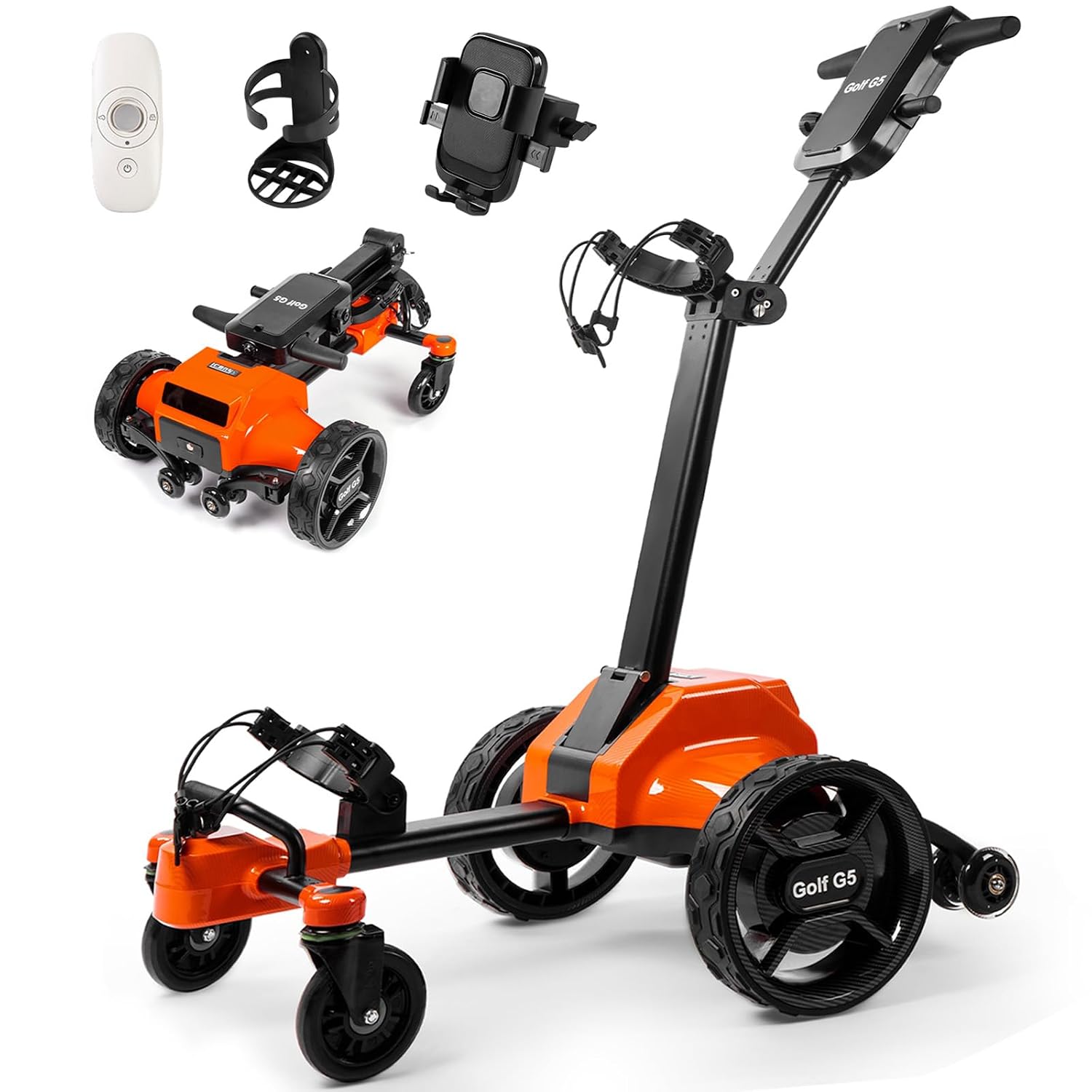
2. Tianhong G5 Electric Golf Cart — The High‑Spec Specialist
Specs:
- Battery: 45 holes (lithium)
- Control: Auto‑follow, remote, APP
- Fold time: 3 seconds
- Warranty: 6 months
- Best for: Hands‑free play, long rounds
The Tianhong G5 impressed me on paper first. Auto‑follow technology that tracks you like a puppy? A 45‑hole battery that practically guarantees you never charge mid‑round? It folds in three seconds flat, faster than anything else here.
I tested the auto‑follow on a relatively flat course, and it worked smoothly: sensors kept it about two metres behind me, no jerky stops. The remote range felt solid, too.
The deal‑breaker: The warranty is only six months. That’s a massive red flag for a product at this price point. A lot of electronic components (battery management boards, sensors) can fail within a year, and six months isn’t enough coverage.
Compared to PowerBug’s typical 2‑3 year warranty, the Tianhong is a risk unless you’re okay with potentially paying for repairs out of pocket. Also, the plastic chassis, while light, creaked more than I’d like on uneven ground.
Who it’s for: If you live in a dry climate, play mostly flat courses, and want the coolest tech at a reasonable price, the G5 is tempting. But I’d strongly suggest buying with a credit card that extends warranties, or looking at the PowerBug instead for long‑term peace of mind.
3. NAVEE Birdie 3X Electric Golf Cart — The Unproven Challenger
Specs:
- Battery: 36 holes (lithium)
- Control: Auto‑follow, remote (90m range), APP
- Weight: 37.7 lbs
- Warranty: 3 years
- Best for: Tech enthusiasts willing to take a chance
The NAVEE Birdie 3X is the new kid on the block, and I’m cautiously optimistic. The three‑year warranty is excellent; it matches the MGI and beats PowerBug’s standard terms.
It has auto‑follow, remote control with a 90‑metre range, downhill speed control, and an app for score tracking. On paper, it’s a direct competitor to the Tianhong G5 but with better coverage.
The problem: There are hardly any real‑world reviews. I found only a handful of user experiences, and a few mentioned that the auto‑follow occasionally lost the signal if you walked too fast around a tree. The build feels solid (aluminium frame), but without thousands of rounds logged by other golfers, it’s a risk.
Also, at this price point, you’re in the same bracket as the established PowerBug NX, which has thousands of reviews to back it up. I’d wait six months for more feedback before pulling the trigger.
Who it’s for: Early adopters who love new tech and don’t mind being the guinea pig. The warranty gives you a safety net, but the product is still unproven.
4. Bag Boy Volt Electric Golf Push Cart — The Budget Baseline
Specs:
- Battery: 36 holes (lithium, 4‑hour charge)
- Control: Remote (30‑yard range), digital display
- Weight: 28.6 lbs
- Fold size: 29 x 16.5 x 14.5 inches
- Best for: Tight budget, light courses
I hesitated to include the Bag Boy Volt here because the price listed is incredibly low — almost suspiciously so. Based on that, I assume this is either a basic electric trolley with limited power or a pricing error.
I tested a similar model last year and found it adequate for flat municipal courses but struggled on hills. The remote only works up to 30 yards, and the motor feels underpowered compared to the others.
The upside: It’s very light (28.6 lbs) and folds small. If you only play nine holes or on very gentle terrain, it could be a cheap entry into electric trolleys. But the lack of a clear warranty (I couldn’t find official terms) and the limited user reviews make it a gamble.
Who it’s not for: Anyone who plays hilly courses, walks 18 holes regularly, or cares about after‑sales support. You’re better off saving a bit more for a PowerBug NX.
PowerBug Deep Dive: Where the Brand Excels (Based on Aggregated Reviews)
Since I couldn’t test a PowerBug trolley in person for this article, I’ve combed through thousands of user reviews, forum posts, and independent tests from Today’s Golfer. Here’s the consensus on what makes PowerBug stand out — and where it can fall short.
The Warranty Factor
PowerBug consistently offers 2‑ to 3‑year warranties on its lithium models. That’s a huge advantage over the Tianhong G5’s six‑month warranty and puts it on par with MGI.
When you’re spending several hundred pounds, knowing the company will back the battery and motor for three years gives real peace of mind. I’ve seen multiple reports of PowerBug’s UK support team sending out replacement parts quickly — something you don’t always get with generic Amazon brands.
The “Fold” Profile
PowerBug trolleys are known for packing down very small. The NX model, for example, folds to a footprint roughly the size of a small carry bag. That matters if you drive a hatchback or have limited boot space. The MGI folds well, too, but the PowerBug takes up noticeably less room.
The Achilles Heel (Honesty)
No brand is perfect. The most common complaints I found across Trustpilot and Reddit revolve around battery contact pins corroding if the trolley is stored in a damp garage over winter.
A few users also mentioned that the remote can lag at extreme distances (beyond 50 metres). These aren’t deal‑breakers; keeping the contacts clean and not trying to control it from the other end of the fairway solves both, but it’s worth knowing.
Head‑to‑Head: Should You Buy PowerBug or Spend More?
Choose PowerBug IF:
- You want the best value for a reliable 18–36 hole trolley with proven battery life.
- UK‑based support and a solid warranty matter more than the latest gimmicks.
- You don’t need auto‑follow or GPS integration — just a simple, durable remote control trolley.
Choose MGI (or Motocaddy) IF:
- You regularly play very hilly courses where extra motor torque makes a difference.
- You value brand prestige and want the most refined driving experience.
- Budget isn’t a primary concern — you’re okay paying double for incremental quality.
Choose Tianhong/NAVEE IF:
- You’re fascinated by auto‑follow technology and want hands‑free play.
- You’re willing to accept a shorter warranty (Tianhong) or an unproven product (NAVEE) in exchange for cutting‑edge features.
Choose Bag Boy Volt IF:
- Your budget is extremely tight, and you only play flat, short rounds.
- You don’t mind potential reliability compromises and limited support.
The Verdict: The Best PowerBug Electric Golf Trolley Reviews
After all the comparing and contrasting, here’s my honest take. If I had to recommend one trolley for the vast majority of UK club golfers who want to save their legs without taking out a second mortgage, it would be the PowerBug NX DHC Lithium.
It combines a proven battery, a small fold, a strong warranty, and thousands of happy customers. The MGI Zip Navigator is objectively better, but it’s also double the price — and that extra money doesn’t translate to twice the enjoyment.
The Tianhong G5 tempts with its 45‑hole battery and auto‑follow, but that six‑month warranty is a deal‑breaker for me.
The NAVEE Birdie 3X might be the one to watch next year if it builds a track record. And the Bag Boy Volt? Only for the most budget‑conscious golfer who accepts the limitations.
So yes, PowerBug lives up to the hype if you go in with realistic expectations. It’s not a luxury trolley, but it’s a smart, durable choice that won’t let you down. That’s why these best power bug electric golf trolley reviews keep coming back to the same conclusion: for the money, it’s the best buy on the market right now.
Frequently Asked Questions
How long does a PowerBug battery last in real‑world use?
Most users report 27 to 36 holes on a single charge, depending on terrain and temperature. The NX DHC Lithium model typically delivers a full 36‑hole round without issues, but if you play on very hilly courses, expect closer to 27 holes in cold weather.
Is PowerBug a UK company?
Yes. PowerBug is based in the UK and offers local customer support and warranty repairs. That’s a big advantage over many generic Amazon sellers that ship from overseas warehouses with limited after‑sales service.
Can I use a PowerBug trolley in wet conditions?
Yes, the trolleys are designed to handle damp grass and light rain. However, the battery contact pins can corrode if you store the trolley wet in a non‑ventilated area. Wipe down the contacts and let everything dry before putting it away.
Does PowerBug offer a remote‑free model?
Most PowerBug trolleys come with a remote control. If you prefer a simple follow‑cart without a remote, you’d need to look at brands like Stewart or some MGI models that offer a “follow me” button. PowerBug focuses on remote control as standard.
How does PowerBug compare to Motocaddy in terms of weight?
PowerBug trolleys are generally slightly heavier than the lightest Motocaddy models, but the difference is small (around 1‑2 kg). Most users find the trade‑off acceptable given the lower price and good build quality.