
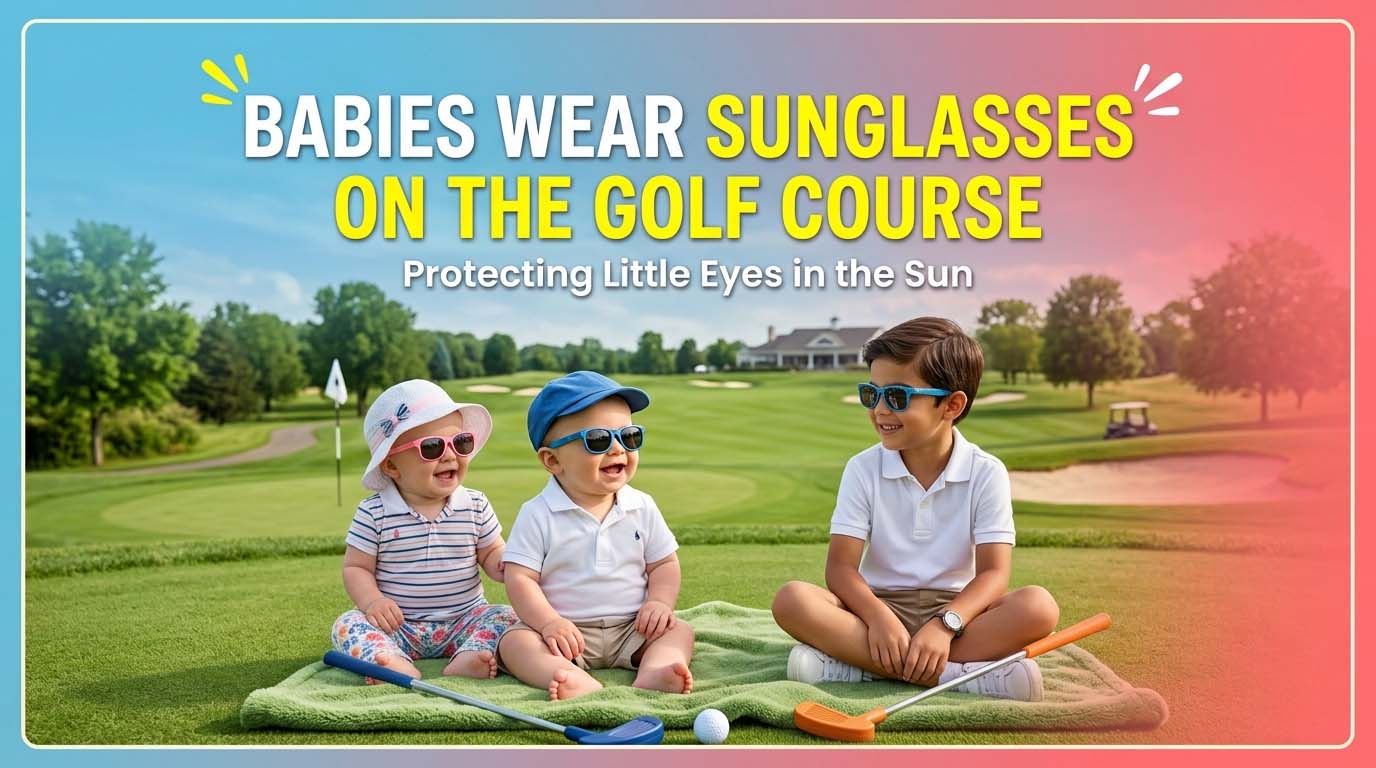
Yes, babies can wear sunglasses on the golf course, and they should. The bright sun, high‑albedo grass, and reflective sand and water make a golf course one of the most UV‑intense environments you can take a baby into.
But the real challenge is getting the right pair and making the baby keep them on. Below, I walk through what you actually need to know, from lens type to fit to the logistics of a round with an infant.
Why Does a Baby Need Eye Protection on a Golf Course?
A baby’s eyes are not like an adult’s. The lenses inside an infant’s eyes are much clearer, letting more UV light reach the retina. Their pupils are larger, and their protective pigments are still developing.
That means the amount of UV exposure that feels fine to you can do real harm to a baby’s eyes over time- think cumulative damage that shows up as cataracts or macular degeneration decades later.
Now add the golf course. Grass reflects UV. Hard to believe, but fresh fairway grass can reflect up to 10–15% of UV rays. Bunkers and water hazards reflect even more. A typical round lasts three to four hours.
Even if you keep the baby in the shade of a tree or umbrella, indirect UV from the sky and reflected glare still reaches the eyes. Shade cuts direct UV by about 50%, but the reflected portion remains. That is why you need sunglasses, not just a hat.
Polarized or Non‑Polarized for a Baby
This is where the golf world gets confusing. Adult golf brands like PeakVision sell non‑polarized lenses because polarized lenses can wash out the subtle breaks in a green and mess with depth perception. But that argument does not apply to babies.
The Standard Pediatric Recommendation
Pediatric eye doctors almost always recommend polarized lenses for babies under one year old. Polarized lenses block horizontal light waves that cause glare. On a golf course, glare comes from the grass, the sand, and the water.
Reducing glare makes the visual world calmer for a baby. Less squinting, less irritation, and a much lower chance that the baby cries from light sensitivity.
When Non‑Polarized Might Be Acceptable?
If you already own a good pair of baby sunglasses that are non‑polarized but have UV400 protection, do not rush to replace them.
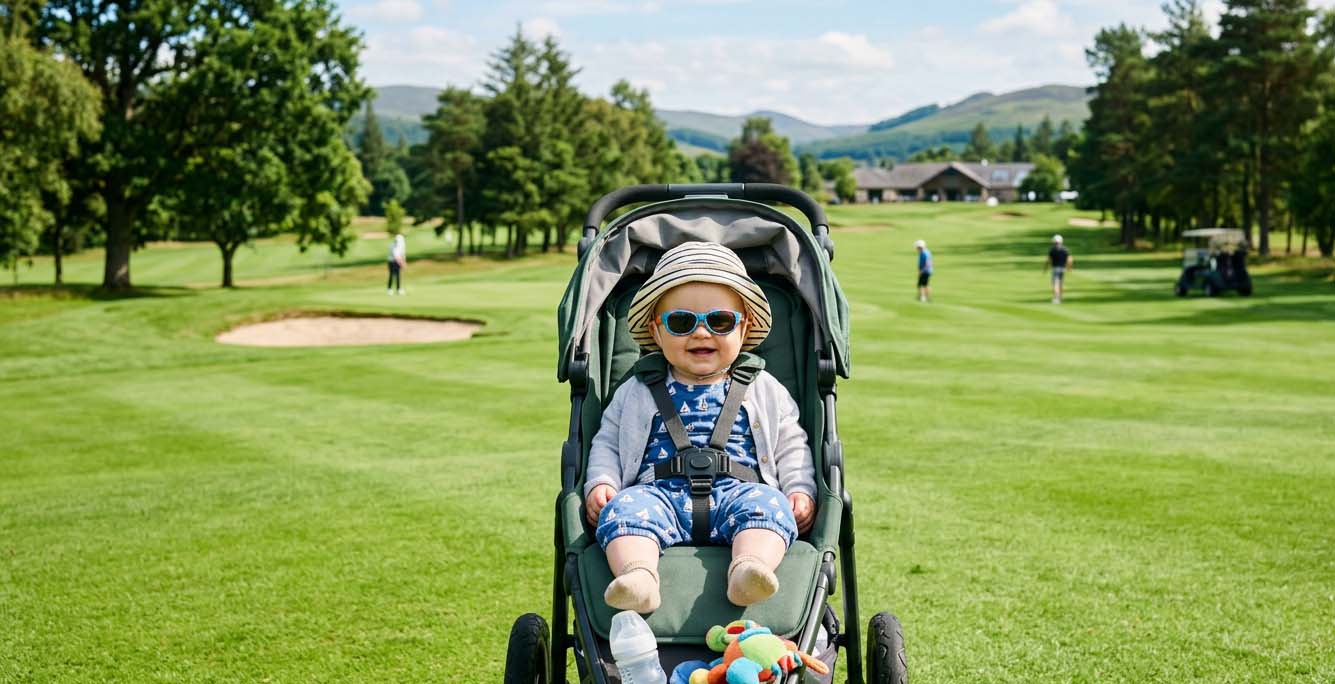
For a baby who spends most of the day in a stroller with a canopy, or under a wide‑brim hat, the extra glare reduction matters less. But if the baby is in a front carrier, in an open stroller, or sitting on your lap in a golf cart, polarized makes a noticeable difference.
What to Look for Regardless of Polarization?
- UV400 rating — blocks 99–100% of UVA and UVB rays.
- Impact‑resistant polycarbonate lenses — glass can shatter if dropped or stepped on.
- Flexible frame — silicone or rubberized material that bends without breaking.
- Strap attachment — not temple arms that fall off a tiny face.
- Small bridge and frame size — baby faces are not mini versions of adult faces.
Safety Features and Fit for Infant Sunglasses
a) Frame Materials and Design
Avoid hard plastic frames with hinges. Those pinch soft skin and leave red marks. The best infant frames are made from soft, non‑toxic silicone. They should wrap around the baby’s head, not rest on the nose.
A single piece of silicone with no hinges is the safest design, with no small parts that can break off and become a choking hazard.
b) Strap vs. Temple Arms
For babies zero to nine months, a full elastic strap is mandatory. Temple arms rely on friction against the ear and the side of the head. A baby’s head is round and smooth; temple arms slide right off.
A strap that goes around the back of the head holds the glasses in place even when the baby turns, shakes, or bounces in a stroller.
For babies nine to twelve months who can sit up and tolerate more, some accept temple arms if the fit is snug. But still use a strap. On a golf cart ride or a bumpy path, the glasses will fall off without one.
c) Sizing and Adjustment
| Age Range | Typical Frame Width | Bridge Width | Temple Length |
|---|---|---|---|
| 0–6 months | 10–11 cm | 12–14 mm | Uses strap |
| 6–12 months | 11–12.5 cm | 14–16 mm | 12–13 cm (with strap) |
To measure, place a soft tape from the outer edge of one eye to the outer edge of the other. Then add about 1 cm on each side for the frame. If the glasses sit too far apart, they will slide down. If they are too tight, they will pinch.
How to Get Your Baby to Keep Them On | Golf Course Edition
a) Acclimation Before Round Day
Start five to seven days before your tee time. Put the sunglasses on your baby for thirty seconds during a diaper change. The next day, try one minute while they are watching a favorite toy.
Work up to five minutes by day three. By the time you get to the course, the glasses feel familiar, not scary.
b) Distraction and Timing
Put the sunglasses on right before the baby gets engaged. The exact moment matters. If you put them on while the baby is bored or tired, they will pull them off.
If you put them on just as you walk onto the first tee and the baby looks at the wide green, the grass moving in the wind, or birds flying overhead, they often forget about the glasses.
c) Back‑up Strategies
- Stroller clip‑on sunshade — creates a dark environment that reduces the need for glasses.
- Wide‑brim hat — blocks most overhead sun, so the glasses only need to handle reflected glare.
- Baby carrier that blocks side sun — some soft carriers have a built‑in shade hood.
- Backup pair in the golf bag — you will lose one under a bush or cart. Guaranteed.
What to Do If the Baby Cries?
Stop, remove the sunglasses, and try again later. Never force them for long periods. The goal is not to win a battle; it is to protect the eyes. If the baby is clearly uncomfortable, move them into a shaded area or use the stroller canopy. A few minutes of UV exposure is not a problem. An hour of crying is.
Additional Golf‑Course Logistics with an Infant and Sunglasses
Sun Exposure Management
Plan your tee time for early morning or late afternoon. The sun is highest between 10 a.m. and 2 p.m.; that is when UV is strongest.
A round that starts at 7 a.m. has far lower UV exposure than one at 10 a.m. Even on overcast days, 80% of UV passes through clouds.
Glare from Water Hazards and Sand Traps
Water reflects up to 25% of UV. Light‑colored sand in bunkers reflects similar amounts. Polarized lenses cut this glare dramatically. If your baby’s sunglasses are polarized, you will see their eyes relax when you walk past a pond.
Wind and Dust Protection
Golf courses are dusty. A wind picks up, and suddenly sand or grass bits fly into the baby’s eyes. Wraparound style frames with a slight curve around the temples keep dust out. Also check that the lenses do not fog up. A foggy lens makes a baby frustrated and more likely to rip the glasses off.
Etiquette and Safety
Keep the baby away from swings, yours and others’. A baby in a stroller should be parked at least ten feet from the tee box and never behind a player who is swinging. Use a quiet stroller that does not click or rattle.
And make sure the sunglasses do not block the baby’s peripheral vision so badly that you do not see a golf cart coming or a hazard you are walking toward.
Visiting Brands and Real‑World Recommendations
- Babiators — flexible, shatterproof, come with a strap. Good for 0–24 months. Polarized and non‑polarized versions exist. Polarized recommended for golf.
- Roshambo — silicone frames, interchangeable straps. Very good fit for small faces. Polarized lenses standard.
- Julbo Looping — full wraparound, adjustable strap, extremely durable. These are the best for a golf course because they curve around the baby’s face and block side glare.
Clean them with a microfiber cloth. Do not use alcohol wipes or harsh cleaners — they can strip the UV coating.
Frequently Asked Questions
Can I take my 3‑month‑old baby out in the sun?
Yes, but avoid peak UV hours and always use sunglasses plus a hat and stroller canopy. A three‑month‑old’s eyes are still very sensitive. Keep direct sun exposure under thirty minutes.
Is it safe to bring a baby on a golf course?
Yes, if you follow safety rules. Keep the baby away from active swings. Use a quiet stroller. Stay hydrated. Heat and noise are the main concerns, not the activity itself.
Can babies wear sunglasses in the shade?
Shade cuts direct UV by roughly half, but reflected UV from nearby grass, sand, or water can still reach the baby. It is not necessary in deep shade, but it does not hurt. If the baby is comfortable, leave them on.
Do baby sunglasses need to be polarized?
Polarized is strongly recommended for golf courses because of the intense glare. For general backyard use, non‑polarized UV400 lenses work fine. For a golf course, polarized reduces eye strain and squinting.
How do I prevent my baby’s sunglasses from fogging up?
Buy lenses with an anti‑fog coating. Some silicone frames have ventilation holes. If fogging happens, wipe the lenses dry and reapply an anti‑fog spray made for glasses.
Are clip‑on baby sunglasses safe?
Clip‑ons that attach to a hat or stroller canopy are safe, but they do not stay on the baby’s face. They protect from direct overhead sun but not from reflected glare. A proper pair of infant sunglasses is a better solution.
What if my baby has a strong light sensitivity?
Some babies naturally squint or turn away from light. Start by using a wide‑brim hat and a dark stroller canopy. Try the sunglasses indoors for short periods first. If the sensitivity persists, talk to a pediatric eye doctor.