
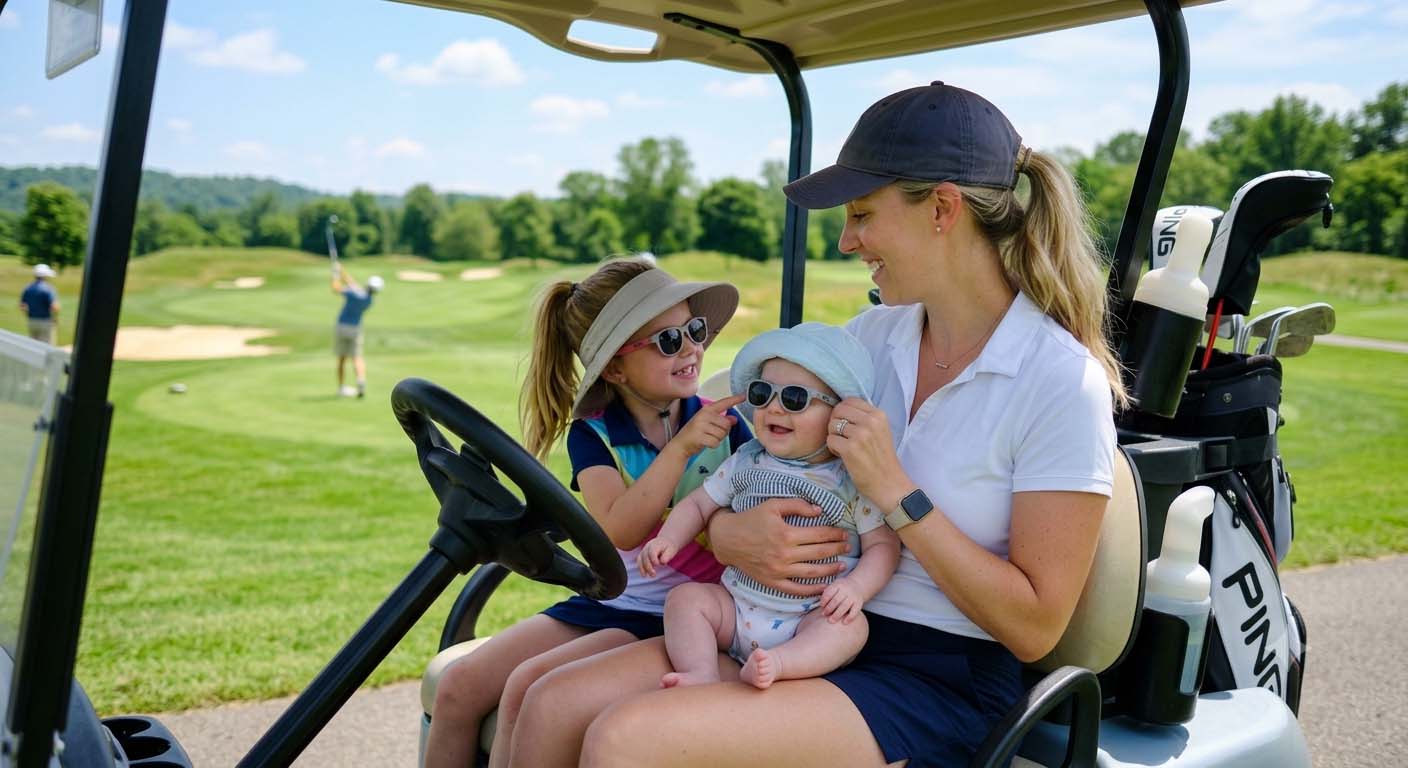
I have been that parent standing on the first tee with a baby in a stroller, trying to squeeze in a round while the little one naps. For years, I thought a simple hat and a stroller canopy were enough.
Then I noticed how my baby squinted every time we passed a water hazard or a sand trap. That is when I started digging into how the golf course is different from a park or a backyard.
The short version: you need a layered approach that accounts for reflected UV bouncing off grass, sand, and water. A wide-brimmed hat, wraparound UV400 sunglasses (if your baby is old enough), a stroller with a real sun canopy, and smart scheduling will keep those tiny eyes safe for all four hours of your round.
Why Baby Eyes Are More Vulnerable to UV Damage?
Babies are not just small adults. Their eyes are more vulnerable because:
- Thinner eyelids and less pigment – The skin around a baby’s eyes is thinner and produces less melanin, so UV penetrates deeper.
- Clearer lens – Until about age 10, the lens of a child’s eye is much clearer than an adult’s. That means more UV reaches the retina.
- Longer lifetime exposure – Experts say as much as 80% of our lifetime UV eye damage happens before age 18. Every unprotected minute on the golf course adds up.
Studies show that a single bad sunburn in childhood doubles the risk of melanoma later in life. The same principle applies to eyes: UV exposure early on increases the risk of cataracts and macular degeneration decades later.
The Unique UV Hazards on a Golf Course
A golf course is not a normal outdoor space. You are out in the open for hours, with reflective surfaces all around. Here is what makes it worse:
- Grass – Well‑kept fairway grass can reflect up to 10–15% of UV rays upward. So even if your baby is in the shade, UV can bounce up from below.
- Sand traps – Light‑colored sand reflects 25–30% of UV. If you are near a bunker, your baby’s eyes get a second dose from below.
- Water hazards – Calm water can reflect as much UV as sand. A pond on hole 7 can double the UV load on your baby’s eyes.
- Open sky – Golf courses have very few trees or buildings to block direct UV. The sun hits from above and from every reflective surface around.
The take‑away: shade alone is not enough. A baby sitting under a tree near a sand trap still gets significant UV reflected into the eyes. That is why you need a layered defense.
A Step‑by‑Step Protection Plan for the Golf Course
1. Schedule Early or Late Rounds
UV index peaks between 10 a.m. and 4 p.m. Tee off before 9 a.m. or after 5 p.m. if you can. During those hours, the UV is lower, and the sun is lower in the sky, which also reduces harsh glare from the ground.
2. Use a Stroller with a Full UV‑Blocking Canopy
A cheap umbrella stroller will not cut it. Look for a stroller with a canopy rated UPF 50+ that extends low enough to cover your baby’s face when the sun is overhead. If your stroller canopy is short, add a separate UV‑blocking stroller shade that clips on. Some parents use a clamp‑on golf umbrella attached to the stroller frame – that works too.
3. The Right Hat for Every Age
A wide‑brimmed hat is non‑negotiable. Choose one with a brim at least 3 inches (7–8 cm) all around. A bucket hat or a legionnaire hat with a flap over the neck is ideal. For infants under 6 months who cannot wear sunglasses yet, the hat is your main eye protection. Make sure it fits snugly but comfortably.
What if baby pulls it off? I have been there. Use a hat with a chin strap or clip the hat to the stroller canopy with a soft tether. Another trick: put the hat on when baby is already in the car or stroller, so they do not associate it with a fight.
4. Sunglasses for Babies 6 Months and Older
Once your baby is 6 months old, sunglasses become a serious tool. Look for:
- 100% UVA/UVB protection (UV400) – The label must say it blocks 99–100% of both.
- Wraparound style – These block light coming from the sides and from below.
- Impact‑resistant lenses – Polycarbonate is best. Avoid glass.
- Elastic strap instead of arms – A strap keeps them on even when your baby turns their head or falls asleep.
Polarized lenses are a plus on the golf course. They cut glare from water and sand, so your baby will squint less.
5. Protective Clothing: Long Sleeves and High Collars
Dress your baby in a UPF 50+ onesie or a sun suit with long sleeves and a high collar. A high collar protects the back of the neck, which is hard to cover with a hat. If the suit has built‑in mitts or fold‑over sleeves, use them to cover the hands. That also stops your baby from pulling off the sunglasses.
6. Sunscreen Around the Eyes (6 Months and Older)
Apply a mineral sunscreen (zinc oxide or titanium dioxide) around the eye area. Avoid chemical sunscreens here because they can sting if they get into the eyes. Use a small brush or your fingertip to put a thin layer on the eyelids, under the eyes, and on the temples. Reapply every two hours or after sweating.
The Reflective UV Factor on Grass and Sand
This is the part most parents miss. Even if your baby is in the shade of a stroller canopy, UV can bounce off the ground and reach their eyes from below. A simple test: on a sunny day, hold a piece of white paper near the ground next to a sand trap. You will see a bright glare on the paper. That same glare hits your baby’s eyes.
To counter this:
- Position the stroller so the baby faces away from reflective surfaces (e.g., away from water or sand).
- Tilt the stroller canopy downward on the side facing the hazard.
- If you are walking near a bunker or pond, angle the stroller so the canopy blocks as much upward‑angled light as possible.
Golf Course Logistics for Parents
Protecting your baby’s eyes on a golf course requires some planning in real time. Here are practical moves I have learned the hard way:
Where to Park the Stroller
On the tee box, park the stroller under the nearest tree or behind the golf cart (if the cart has a roof). On the green, keep the stroller on the cart path, ideally in the shadow of the cart itself.
Do not leave the stroller out in the open while you putt – that is when the sun moves and catches your baby right in the eyes.
Using the Golf Cart for Extra Shade
Most golf carts have a roof that blocks UV. If yours does not, consider a clamp‑on UV umbrella that attaches to the cart frame. You can also buy a UV window film kit for the cart’s windshields – it blocks 99% of UV without reducing visibility.
Reapplication During a Round
Sunscreen on the face needs reapplication every two hours or after sweating (even if you are not swimming, the baby may perspire). Keep a small bottle of mineral sunscreen in your golf bag.
Reapply during a slow hole or while waiting on the tee. Use a gentle dab motion around the eyes to avoid getting it in the eyes.
Sudden Cloud Cover – Don’t Relax
Clouds do not block UV. Up to 80% of UV passes through light cloud cover. If it gets overcast, keep the hat, sunglasses, and shade in place.
Myth vs. Reality: Sunglasses for Babies
| Myth | Reality |
|---|---|
| Babies under 6 months don’t need sunglasses; they are in the stroller. | False. Reflected UV can reach their eyes even in a stroller. Sunglasses are not yet safe for under 6 months (fit and development), so rely on hat and shade. |
| Sunglasses will harm a baby’s eye development. | False. Wearing UV‑blocking sunglasses does not affect vision development. It only reduces harmful UV. |
| All baby sunglasses are the same. | False. Many cheap “baby sunglasses” do not block 100% UV. Always check for UV400 or “99–100% UVA/UVB” on the label. |
| Polarized lenses are only for adults. | False. Polarization cuts glare from water, sand, and concrete – perfect for a golf course. It makes the world less harsh for your baby too. |
Frequently Asked Questions
Can I use a UV‑filtering stroller cover instead of sunglasses?
Yes, but only if the cover completely encloses the stroller and is rated UPF 50+. Mesh covers that let in air but block UV are good for babies under 6 months. For babies 6 months and older, a combination of hat, sunglasses, and cover is best.
What if my baby is under 6 months old and we have a morning tee time?
Stick to early (before 9 a.m.) or late (after 5 p.m.) times. Use a UV‑rated stroller cover, a wide‑brim hat, and park in full shade whenever possible. Do not rely on sunscreen for the face – keep the baby inside the covered stroller except for feeding or diaper changes.
How do I clean baby sunglasses without scratching the lenses?
Use a microfiber cloth and a gentle lens cleaner (or just water). Do not use paper towels or rough fabrics. Store the sunglasses in a soft case when not in use.
Are polarized lenses better for babies on a golf course?
Yes. Polarized lenses reduce glare from water, sand, and bright grass. That means your baby will squint less and may even keep the glasses on longer. They also improve contrast, which helps them see the world more comfortably.
What’s the best way to keep a hat on a baby who pulls it off?
Choose a hat with a chin strap or a fitted style that cannot be easily yanked off. You can also clip the hat to the stroller canopy using a safety tether (the kind used for pacifiers). Some parents sew a small velcro tab onto the back of the hat and a matching tab onto the stroller seat – that keeps it anchored.
Taking your baby to the golf course does not have to mean sacrificing their eye health. With a little planning and the right gear, you can enjoy your round and know those little eyes are safe from direct and reflected UV. I still remember the first time I used a stroller tilt to block sand glare – my baby stopped squinting and fell asleep. That is the kind of small win that makes it all worth it.