
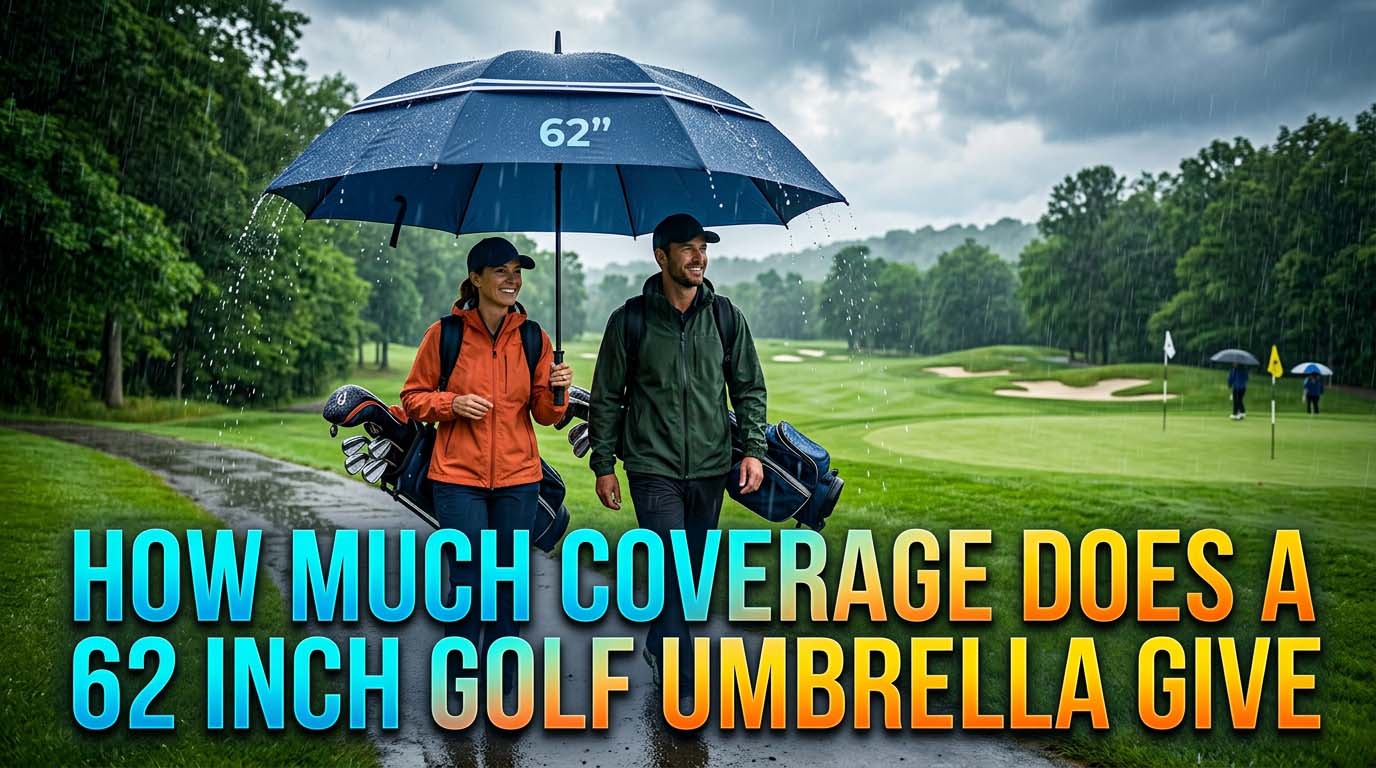
I have used a 62-inch golf umbrella for years on rainy courses and city streets. The number alone tells you little. You need to know exactly where that canopy stops relative to your body, your bag, and your walking partner.
Here is what I have learned from testing it in everything from a light drizzle to sideways gusts.
A 62-inch canopy covers an average adult (about 5’9”) from the crown of the head to the mid-thigh when held at a normal standing height. It spreads wider than your shoulders, so your whole upper body stays dry.
If you carry a standard stand bag beside you, the bag’s top two-thirds and the club handles will also stay dry in straight-down rain. That is the quick answer. The rest of this guide breaks down how that coverage changes based on your height, your posture, the wind, and the size of the umbrella next to it.
What a 62-Inch Canopy Actually Covers on a Human Body
Stand under a 62-inch umbrella with your arm relaxed by your side. The edge of the canopy will fall somewhere between your upper thigh and your knee. The exact spot depends on your height and how high you hold the handle.
At a typical handle grip height (around waist level for most people), the canopy creates a dry zone shaped like a shallow dome. If you stand still:
- Head and neck: Fully covered. No drips on your collar.
- Shoulders and upper arms: Fully covered. The canopy width (62 inches) is wider than any adult’s shoulder span, usually by at least 10 inches.
- Torso: Fully covered from collarbone to mid-thigh.
- Hands and wrists: Covered as long as you keep them near your body.
- Lower legs and feet: Exposed. The drip line falls above the knee, so shins and shoes will get wet in moderate rain.
That boundary is the key. A 62-inch umbrella gives you a dry upper body and dry hands, but your lower legs will still feel the rain unless you tilt the umbrella or stand in a specific way.
How Your Height Changes the Coverage Zone
The 62-inch umbrella works differently for short and tall people. Here is what I have seen from handing it to friends of different heights.
Short user (under 5’4”)
The canopy sits lower relative to your body. The coverage extends past the knee, sometimes to the middle of the shin. Your lower legs stay drier. The trade-off is that the umbrella feels top-heavy.
You have to hold the handle higher to keep the canopy from hitting your head, which pushes the drip line down even further.
Average user (5’7” to 5’11”)
The coverage ends right around the mid-thigh. This is the sweet spot. Your torso and gear stay dry, but you still need rain pants or gaiters for your calves in heavy rain.
Tall user (6’2” and above)
The canopy sits higher. Coverage drops from mid-thigh to upper thigh. Your lower legs and knees are completely exposed. You will notice that you have to angle the umbrella more aggressively to keep the rain off your chest.
The handle grip also matters more. A longer handle lets you hold the umbrella lower, which brings the canopy down and improves coverage for your legs.
How Wind and Walking Angle Change Effective Coverage
Static coverage is one thing. Real rain rarely falls straight down. The moment you walk into the wind or tilt the umbrella, the dry zone shrinks and shifts.
The tilt deficit
When you angle a 62-inch umbrella 45 degrees into a headwind, the horizontal footprint under the canopy narrows. The front edge drops, and the back edge rises.
Your back and the back of your bag will catch more rain. I have tested this by walking into a 15 mph gust. The club handles on the far side of my bag got a light misting even though the canopy was over me.
Walking posture
If you walk hunched forward (like most of us do in rain), the canopy tips forward. That shifts the dry zone backwards.
Your head and upper back stay drier, but your thighs and bag get less protection. To compensate, you need to hold the umbrella slightly behind you. This takes practice.
Sideways rain
A 62-inch umbrella does well against direct overhead rain. In driving sideways rain, the coverage is worse. The wind blows rain under the canopy from the side. You can angle the umbrella into the wind, but that leaves your opposite shoulder and bag exposed.
For truly horizontal rain, you need a 64-inch or 68-inch umbrella that gives you more shielding margin.
62 Inches vs 60 and 64 Inches: Where the Real Trade-Offs Live
Most articles say 62 is a middle ground. That is true, but it is vague. Here is the practical difference you will feel.
60 inches
Covers your torso and the top of your bag. Your knees and the bottom of your bag will get wet in anything but drizzle. The weight is noticeably lighter, and the umbrella is easier to control in gusts.
If you never carry a bag and you are short, 60 inches may be enough. For a golfer with gear, 60 inches is too small.
62 inches
Covers your torso and the top two-thirds of a standard stand bag. The bag’s lower section and your knees sit right at the drip line. In still rain, you are dry. In side rain, you may need to tilt to keep the bag dry.
This is the smallest size I would recommend for anyone who wants to protect both themselves and a bag without inheriting the weight penalty of a 64-inch model.
64 inches
Covers your full torso and the entire length of a stand bag. Your knees stay dry even in moderate rain. The extra 2 inches of diameter adds roughly 3 inches of horizontal width at bag level.
That small margin is the difference between club heads staying dry and getting a misting. The catch is weight and wind.
A 64-inch umbrella is noticeably heavier in the hand and harder to hold steady in a strong gust. It also takes up more space when closed.
Real-World Scenarios: Is 62 Inches Enough for What You Do?
Golfing with a stand bag
Yes, 62 inches is enough for a single golfer carrying a stand bag in straight-down or light side rain. You will stay dry from the waist up, and your clubs will be dry unless the rain is heavy and the wind is strong.
In heavy sideways rain, expect the bag bottom to get wet. You can carry a towel to dry grips before each shot.
Walking with a push cart
No. A push cart’s handles sit higher than a bag, but the basket and lower bag sections fall outside the drip line. Your grips will stay dry, but the cart frame and your lower bag will be exposed. A 64-inch or 68-inch umbrella is better for cart use.
Covering two people walking shoulder to shoulder
Barely. Two average adults can stand under a 62-inch canopy if they stay close and the rain is direct. One shoulder will almost certainly get wet unless the umbrella is perfectly centered. For two people walking, I would go up to 64 inches or use two umbrellas.
Standing at a sports event or bus stop
Good. You can cover yourself and the space in front of you. Your shoes will still get wet if you stand in a puddle, but your upper body will stay dry. The umbrella is large enough that people standing nearby can share some shelter, but not full coverage.
Daily carry and commuting
Manageable if you drive or keep it in a car. Too big for a backpack or handbag. It works well for walking the dog or waiting at a school pickup because you have room to swing it without hitting others.
Frequently Asked Questions
Does a 62-inch umbrella cover an entire golf push cart?
No. It covers the handles and the top of the bag. The wheels and lower bag sections sit outside the drip line in most conditions.
Can a 62-inch golf umbrella cover two people walking shoulder to shoulder?
Barely. It offers tight coverage for two average adults in direct overhead rain, but one shoulder will get wet if the umbrella is not centered.
Is a 62-inch canopy large enough for sun protection?
Yes, for one person sitting or standing. The shade covers your head, shoulders, and a chair. It will not cover your full lower body on a lounge chair.
Does the handle length of a 62-inch umbrella affect coverage?
Yes. A longer handle lowers the canopy, pushing the coverage boundary down. More legs get covered, but the bag on the side may lose coverage. A short handle raises the canopy, giving more gear protection but less leg coverage.
Is a 62-inch umbrella too big for daily non-golf use?
More portable than a 68-inch, but still not compact. It is better for car storage, dog walking, and standing at events than for crowded sidewalks or handbag carry.