
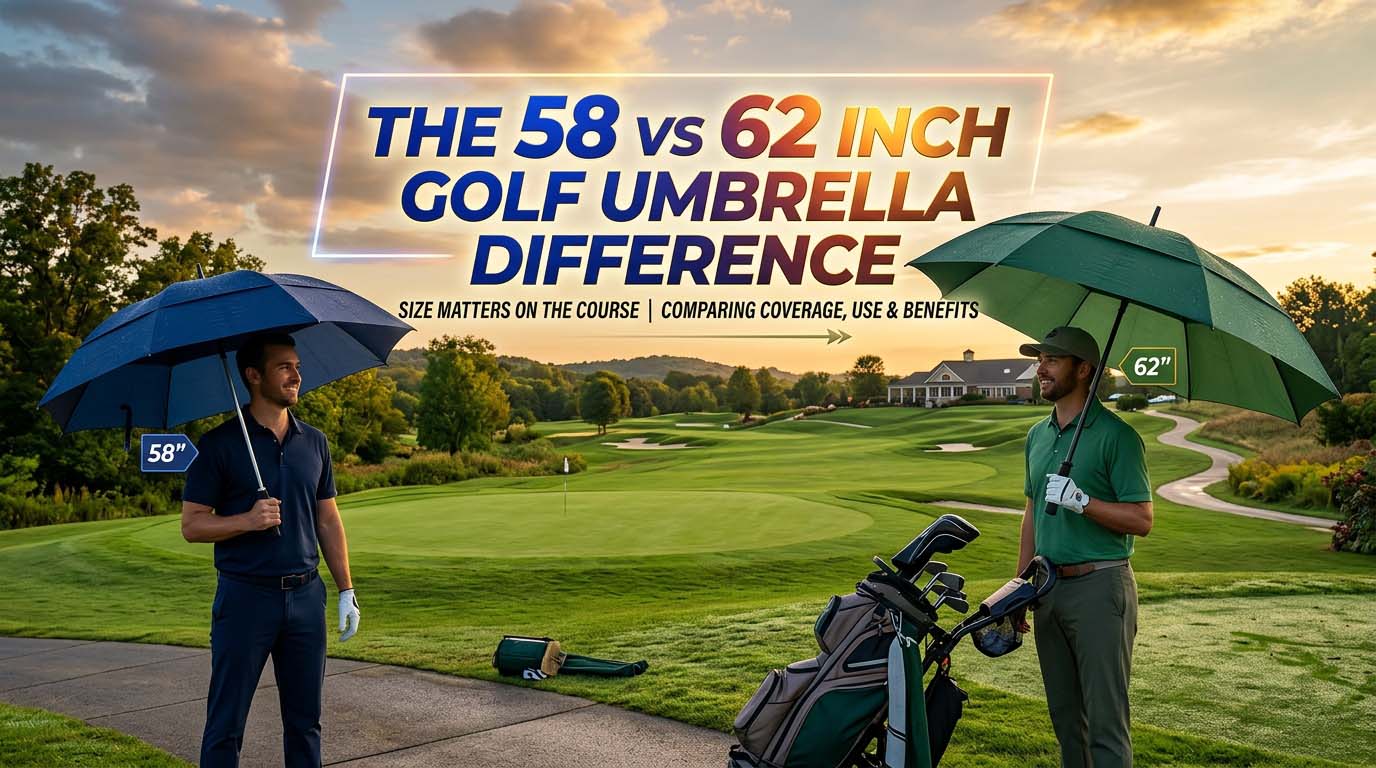
You are staring at two umbrellas on a website. One says 58 inches. The other says 62 inches. Your first instinct is to compare the size. That is a mistake. The 58 vs 62-inch golf umbrella difference is rarely about the four inches of fabric you see on the spec sheet. It is about what kind of umbrella usually carries each number.
Here is the truth in one sentence: a 58-inch umbrella is almost always a folding travel umbrella, and a 62-inch umbrella is almost always a one-piece stick.
Those two designs behave completely differently in wind, in your golf bag, and on an airplane. Size is the last thing you should compare.
What the 58 vs 62 Inch Golf Umbrella Difference Really Comes Down To
Walk through any pro shop, and you will see the pattern. The 58-inch model folds into itself. It has sections, hinges, and a collar that locks when you open it. The whole thing shrinks down to about the length of a loaf of bread.
The 62-inch model is one straight line from the handle to the tip. It does not fold. It does not shrink. It is a solid, old-school stick umbrella.
This is not a rule written in stone. You can find a rare folding 62-inch umbrella and a stiff 58-inch stick. But the standard shapes hold, and they change everything about how you use the umbrella.
| What You Compare | 58-Inch Folding | 62-Inch Stick |
|---|---|---|
| Closed length | About 18 to 21 inches | About 40 to 43 inches |
| Frame type | Six or seven sections with hinges | One solid piece from handle to tip |
| Where it fits | Suitcase, tote bag, golf bag side pocket | Golf cart holder, car trunk, umbrella stand |
| Typical weight | 1.2 to 1.6 pounds | 1.8 to 2.5 pounds |
| Wind behavior | More joints that can snap in gusts | Bigger sail that needs a strong frame |
Choose the 58-inch if you need an umbrella that disappears into your daily carry. Choose the 62-inch if you want the most coverage and the fewest moving parts. That is the entire argument in one paragraph.
How the Four Inches Actually Appear on Your Golf Bag and Back
Let us talk about what the number on the tag really means. Umbrella sizes use arc length, which is the measurement over the curved top of the canopy. The coverage you actually feel is the diameter underneath.
Reliable brands like UV-Blocker publish both numbers, and they are worth memorizing:
- A 58-inch arc gives a coverage diameter of about 48 to 50 inches.
- A 62-inch arc gives a coverage diameter of about 52 to 54 inches.
That is the whole truth about the four inches. Half of the difference lands on each side of the umbrella. So the 62-inch does not give you four extra inches of shade. It gives you roughly two extra inches on the left and two extra inches on the right.
For an average adult around 5 feet 9 inches tall, the 58-inch canopy covers your shoulders and the top of your back. You stay dry from the neck up. The 62-inch pushes that protection out past your shoulders and over your upper arms, which matters if you are carrying a golf bag on one side.
The bag itself is about 12 to 15 inches wide at the top. The 62-inch canopy hangs over the clubs completely. The 58-inch canopy just barely covers the bag, and a heavy sideways rain still reaches the grips.
So the four inches are not about your head. They are about your bag, your arms, and the angle of the rain. That is where the extra fabric earns its keep.
How Travel Limits and Cart Holders Change Your Choice
Here is the part almost every article skips. The 62-inch stick umbrella is 40 or more inches long when closed. That is too long for a carry-on suitcase. It will not fit in an overhead bin.
You have to check it at the gate, and it takes up most of a checked bag. The 58-inch folding umbrella collapses to roughly 21 inches. It slides right into a carry-on next to your shoes.
If you fly to a golf trip, this single fact decides for you. The 58-inch folding model is the only one of the two that travels well.
But now flip the situation. You are on the course, and the sky opens up. A standard golf cart has a sleeve on the back for umbrellas. That sleeve is narrow and deep. A 62-inch stick slides in and stays put.
The folded 58-inch is a thicker bundle because all those sections stack together. It often does not fit the sleeve, and when it does, it wobbles. You end up holding it the whole round.
The same logic applies to golf bags. A stand bag has a small umbrella holder loop near the handle. The 62-inch stick fits through it cleanly. The folded 58-inch is too thick at the base and too short to balance in the loop. It tips over and lands in the grass.
So the travel story goes in two directions. The 58-inch wins on airplanes and city streets. The 62-inch wins every time the umbrella has to live in a golf cart or a bag sleeve.
The Heavyweight Battle of Wind and Frame
Wind is where big umbrellas earn their reputation, and it is also where they break. The physics are simple and unforgiving.
When you make a canopy wider, the wind force on it goes up much faster than the size does. A 68-inch umbrella catches about two and a half times more wind than a small 42-inch compact. The 62-inch is right behind it. You are not holding a shade. You are holding a sail.
The 62-inch catches more wind than the 58-inch, but it also has fewer parts that can fail. A folding umbrella has six or seven sections, and every section has a hinge. Every hinge is a breaking point.
When a gust flips a cheap folding umbrella, the weakest hinge snaps. A one-piece stick has none of those joints. It can bend, and fiberglass ribs can flex, but it does not have little mechanical links waiting to give out.
There is also the shaft question. A large canopy needs a thick shaft to stay balanced. Cheap 58-inch folders sometimes use a thin aluminum shaft to keep the weight down, which turns the umbrella into a wobbly lever in a breeze.
A quality 62-inch stick uses a thicker fiberglass or wood shaft, and that thickness is what keeps the canopy under control. The 62-inch feels heavy in your hand for a reason. That weight is structural.
If you live in a windy place, the honest answer is that neither size is perfect. But the 62-inch stick with fiberglass ribs will survive the gust. The 58-inch folding umbrella will survive the gust once, maybe twice, and then the hinges will start to loosen.
Which Size Suits a Golfer vs. a Steady Walker
Think about how the umbrella will spend its day. Take two people as examples.
The first person walks eighteen holes. Their umbrella spends the morning strapped to a cart bag, then gets pulled out for a rain delay, then sits in the cart sleeve again while they eat lunch.
They need coverage for their clubs, protection from a sideways drizzle, and a frame that can take being shoved into a sleeve dozens of times.
For them, the 62-inch stick is the only serious option. The 58-inch folding model is too short to stay in the bag loop and too delicate for constant course duty.
The second person walks the dog every evening. They live near a park, and on cloudy days they want one hand free and a dry jacket. The umbrella rides in a backpack during the week and in a tote on weekends. It has to open quickly, close quickly, and never spend a night in the rain.
For them, the 58-inch folding model is the obvious winner. It disappears when the sun comes back out, and the slightly smaller canopy is less annoying to hold at a relaxed walking pace.
Ask yourself which person sounds like you. If neither fits, lean on your worst weather. If you stand still in open areas on windy days, the 62-inch is more stable. If you mainly walk while carrying the umbrella, the lighter 58-inch will not wear out your wrist.
The Truth About Durability and Material
Durability is not just about the frame. The canopy fabric matters just as much, and the two sizes usually get different fabric treatments.
The 58-inch folding umbrella is designed for convenience, so the fabric is often thinner and the ribs are narrower. Every time you fold and unfold it, the canopy creases in the same spots.
Over a few months, those creases wear through the waterproof coating. The silver UV coating on a quality folding umbrella like the UV-Blocker models takes longer to wear out than a cheap spray-on finish, but the constant flexing still works against it.
The 62-inch stick umbrella opens and closes once per rain shower. The canopy is not being crushed into a bundle between uses. The fabric stays smooth, the coating stays intact, and the umbrella lasts years longer.
That is not marketing talk. It is simple mechanics. Fewer open-close cycles and less folding stress mean a longer life.
Material selection also differs. Large stick umbrellas commonly use fiberglass ribs because fiberglass bends under pressure and then returns to shape. Steel snaps. If you see a cheap 58-inch folding umbrella with steel ribs and a thin aluminum shaft, it will not survive its first real storm. A 62-inch stick with fiberglass ribs can take a beating and keep working.
Why a Vented Canopy Matters on a Large Umbrella
There is one feature that can save you from the most embarrassing moment in any umbrella’s life: flipping inside out. On any canopy larger than 50 inches, a vented double canopy is close to a necessity.
A vented umbrella has a mesh panel between two layers of fabric near the top. When a gust of wind slams into the underside of the canopy, the air pushes through the mesh instead of building up pressure. The umbrella does not invert. It just lets the gust pass through. The same design lets trapped hot air escape on a sunny day, which is a bonus if you are using the umbrella for shade.
This matters more for the 62-inch stick than for the 58-inch folding model. Why? Because the 62-inch has a bigger surface area and catches more wind. If you buy a 62-inch without a vent, you are betting that the frame is strong enough to hold against every gust. That is a risky bet. The vent is the safety valve.
Some 58-inch folding umbrellas skip the vent to save weight and folded bulk. That is acceptable for a travel umbrella that mostly sees light rain. But if you are choosing the 62-inch for golf, make sure it has a vented canopy. It turns a white-knuckle grip in the wind into an easy one-handed hold.
Frequently Asked Questions
Does a 58-inch or 62-inch umbrella fit in a standard golf bag?
A 62-inch stick fits the umbrella loop on a standard stand bag and the sleeve on a cart bag. The loop is sized for stick umbrellas. A 58-inch folding umbrella is shorter and thicker when collapsed, so it tends to tip out of the loop or jam in the cart sleeve. If the umbrella needs to live on the bag, choose the 62-inch.
What happens to the UV coating on a folding 58-inch vs. a 62-inch in heavy rain?
Heavy rain alone does not wash off a quality UV coating. The real enemy is creasing. Every fold and unfold of a 58-inch umbrella presses the fabric into the same lines, and over time those creases crack the coating.
A 62-inch stick opens and closes without being crushed, so the coating lasts much longer. Rain matters less than how often you fold the umbrella up wet.
Is a 62-inch umbrella dangerous for small children walking beside you?
The 62-inch canopy is wide enough that its ribs extend well past your shoulders. When you swing it or rest it on your shoulder, the tip of a rib can brush a child’s face or eyes. The risk is real, especially with cheaper umbrellas that have sharp tips.
If you regularly walk with small children, look for a model with rounded rib tips and hold the umbrella tilted forward so the canopy stays in front of you.
At the end of the day, the choice is not about four inches of fabric. It is about how the umbrella fits into your life.
If it needs to fold into a bag and fly with you, get the 58-inch. If it needs to stand firm on a golf course and stay put in a cart, get the 62-inch. Match the umbrella to the day you actually have, and either size will treat you well.