
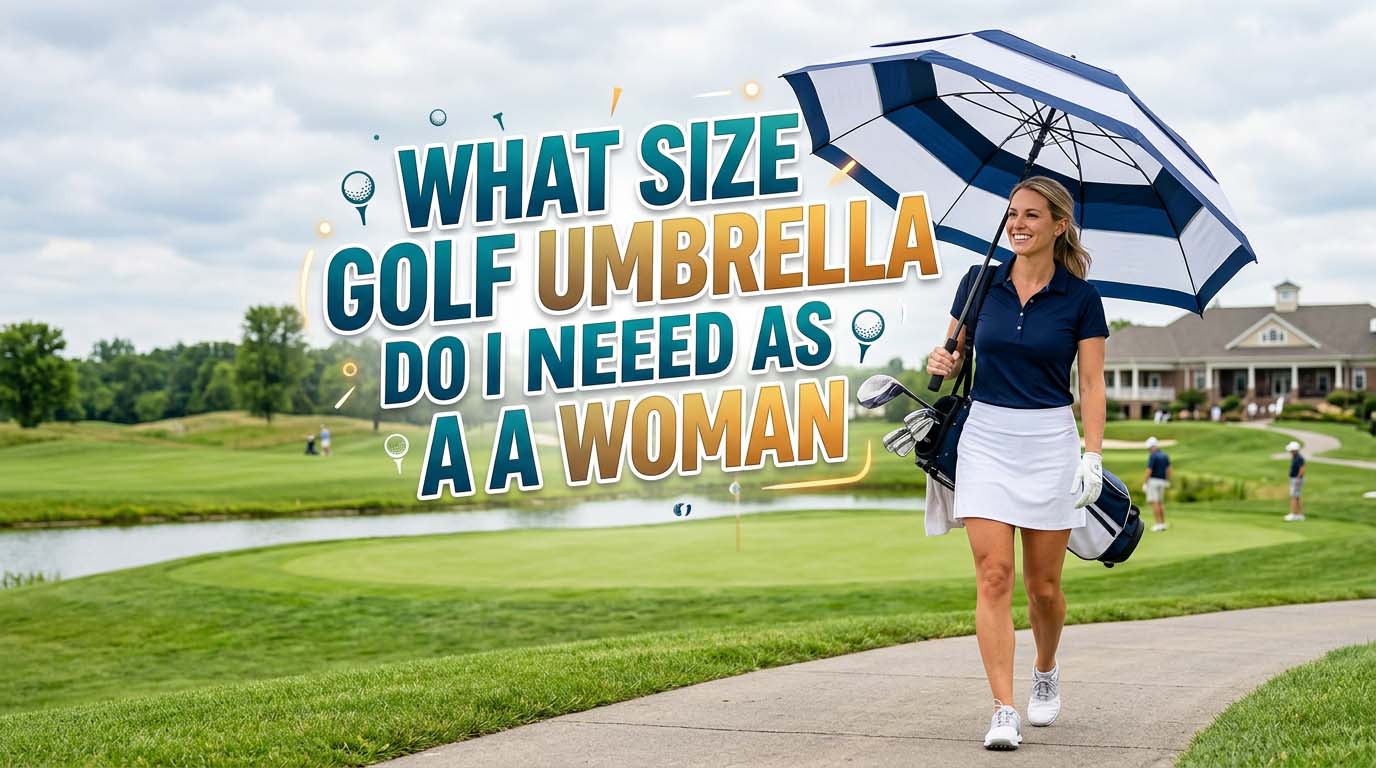
The internet will tell you to buy a massive 68-inch golf umbrella because bigger is always better. That is the single most unreliable piece of advice for a female golfer. A 68-inch canopy turns into a sail in the wind, adds unnecessary weight to your bag, and often hits your legs as you walk.
The true power move for most women is a 62-inch vented canopy. It covers your shoulders, your bag, and your legs without dragging you sideways on the course. But the right size depends on your height, your build, and whether you walk or ride. Here is exactly how to find your size.
Check Your Height First
Height is the single biggest factor because it determines how the umbrella covers your body. A canopy that works for a 6-foot man will leave gaps or hit the ground for a woman under 5’4″. Here is a simple guide based on real proportions:
| Your Height | Best Canopy Diameter | Why |
|---|---|---|
| 5’0″ to 5’4″ | 60 inches | Your shadow is shorter. Rain falls at a direct angle, so a 60-inch canopy covers your head and shoulders without the outer edge hanging down and dripping onto your pants. A 68-inch canopy will collect water on your hips, and your bag will get wetter. |
| 5’5″ to 5’8″ | 62 to 64 inches | This is the sweet spot for single-golfer coverage. The canopy extends far enough to keep your bag and back dry while you swing, but it is not so wide that it becomes a lever in the wind. |
| 5’9″ and up | 66 to 68 inches | At this height, a 62-inch canopy may leave your lower back exposed when you bend over to tee the ball. A wider canopy gives you the extra arc you need. But be prepared for the extra weight. |
Why Vented Double Canopies Matter More Than Size
Many women buy a 68-inch umbrella to stay dry, only to watch it flip inside out on the first warm-up swing. The problem isn’t size, it is wind resistance. A vented double canopy (two layers of fabric with an open gap at the top) allows wind to pass through instead of catching against the fabric.
This makes a 62-inch vented umbrella more stable in a 20-mph gust than a 68-inch solid canopy. For a woman, this matters because you do not have the upper-body strength to fight a heavy umbrella that suddenly fills with air.
Look for the phrase “double canopy” or “wind vent” in the product description. It is the single best feature for real course conditions.
The Water Dump Problem
When you close a 68-inch curved canopy, all the collected water dumps straight onto your legs. A 62-inch canopy is flatter and sheds water more evenly, so you stay drier when you collapse it. If you walk between holes in a downpour, this makes a noticeable difference.
Do Not Buy a Shrunk and Pink Version
Some brands sell “women’s golf umbrellas” that are 54 inches with pink handles. A 54-inch canopy has a tiny arc. When you lean over to tee up the ball, the gap between your back and the umbrella edge is huge. Rain hits your spine and your bag.
Worse, a small canopy forces you to hunch over the bag to stay dry, which ruins your posture and your swing. A 54-inch umbrella belongs in a beach bag, not on a golf course. Stick to 60 inches minimum. The weight savings from a smaller canopy are not worth the exposure.
The Shaft Length and Grip Are Silent Dealbreakers
Most articles talk only about the canopy diameter. They never mention the shaft length. For a woman of average height, a standard umbrella with a 40-inch shaft will hit the back of your knee when you carry it over your shoulder.
The umbrella then bumps into your heel with every step. Before buying, check the closed length of the umbrella. A closed length under 22 inches usually means the shaft is short enough to rest comfortably on your shoulder without banging your legs. Also, the grip must fit your hand.
A standard umbrella handle is made for a man’s grip circumference. For a woman with smaller hands, a thick rubber handle causes hand fatigue after a few hours.
Look for a low-profile foam or TPE handle; it is thinner, softer, and stays grippy even when wet. If the umbrella has an ergonomic curve, test it. The curve should match the natural crook of your fingers, not a male grip.
The Auto-Open Button
Many umbrellas have a one-touch auto-open button that requires a firm push with your thumb. If the button is stiff and positioned for a larger hand, you will struggle to open it one-handed while holding a bag.
Read this explanation specifically for hand strength. A woman who has tried the umbrella will often mention if the button is hard to press.
The Wind Factor | Choose Fiberglass, Not Steel
Wind resistance is about the frame material, not the size. Steel ribs are heavy and rigid. When wind catches a steel-framed umbrella, the umbrella does not bend; it either breaks or yanks your arm.
Fiberglass ribs are lighter and flexible. They allow the canopy to bend 10 to 15 degrees without snapping. For a woman, fiberglass is the better choice because you are not fighting leverage.
A 62-inch fiberglass umbrella is much easier to hold steady than a 62-inch steel one. The weight difference is usually half a pound or more. Over 18 holes, that matters.
Also look for a curved shaft or a flexible fiberglass top, these are designed to shed wind rather than catch it. A stiff straight shaft will act like a sail in a gust.
The Gold Standard for Women
After testing several umbrellas on the course, the combination that works best for most amateur women golfers is straightforward:
- Canopy: 62 inches, vented double canopy
- Frame: Fiberglass shaft and ribs
- Weight: Under 1.5 pounds (1.2 is ideal)
- Grip: TPE or foam, low profile, non-slip
- Closed length: 22 inches or less
- Ribs: 8 minimum (10 is better for wind)
This setup gives you the coverage you need without turning your umbrella into a liability. It fits in a standard golf bag pocket, does not drag on your heel, and stays put in the wind. You can finish the round dry without a sore shoulder.
Myth: A Bigger Umbrella Covers More of Your Bag
The truth is that a 68-inch canopy mounted on a push cart sits higher and wider, often blocking your line of sight. You end up moving it out of the way more than staying dry. A 62-inch canopy sits lower and closer to your body, which keeps your bag and back protected without the visual obstruction.
The real metric is the angle of the rain relative to your body. You need the umbrella in line with your bag and your body, not around you. A 62-inch canopy does this without the bulk.
Frequently Asked Questions
Does a lighter canopy mean less water resistance?
No. Lighter fabric like ripstop nylon is still waterproof if it has a PU coating or TPU layer. The tradeoff is that a very light fabric flaps more in high wind, so it needs extra ribs (8 or 10) to stay taut. Heavy fabrics like Pongee weave are quieter but heavier.
For a woman, the best balance is a 190T to 210T polyester with a waterproof coating. That is light enough to carry but sturdy enough to shed water without flapping.
What exactly is a T fabric rating, and does it matter for rain?
“T” stands for thread count, the number of threads per inch. A 210T fabric has 210 threads per inch, which is the standard for a good golf umbrella. It is dense enough to resist rain without being heavy.
Anything below 190T may leak over time, especially in heavy rain. Look for 210T or higher with a waterproof coating (not just water-resistant).
Should I buy a black umbrella or a colorful one for sun protection?
Dark solids block UV better than light colors, but the inside coating matters more. An umbrella with a silver-coated interior reflects heat and provides UPF 50+ regardless of the outside color.
For sun protection, choose a canopy with a UV coating regardless of the shade. A colorful top with a silver underside gives you both style and protection.
My bag has a bolster strap. Does that make a difference?
Yes. A bolster strap sits around the bag’s midsection and cuts into the umbrella sleeve. If your bag has a tight sleeve, you need an umbrella with a closed length short enough to slide in without bending the ribs.
Measure your sleeve depth before buying. Many women mistake a “fits most bags” claim as universal, only to find their 68-inch umbrella sticks out and gets caught on cart handles.
The Bottom Line
When you are standing on the 18th tee looking at grey clouds rolling in, you will not care about the brand logo. You will care that the handle does not slip in your sweaty hand, that the canopy actually shields your legs, and that the umbrella does not pull your arm out of its socket.
Check the tags for “fiberglass” and “vented double canopy.” Put the closed length next to your bag. Pick a 62-inch size if you are under 5’8″. And never let a budget “rain umbrella” dictate whether you finish the round. Get the right tool, and you will walk off the course dry, focused, and ready for the next tee time.