
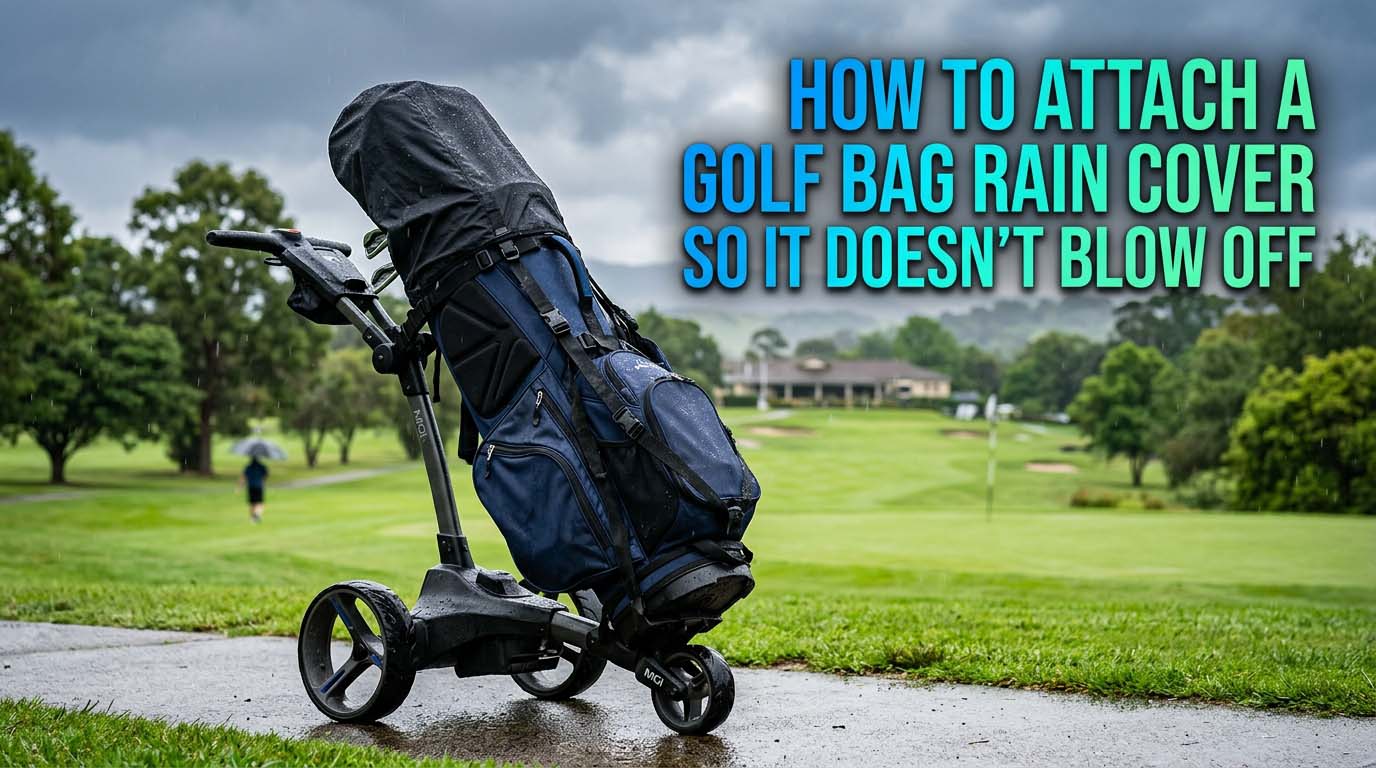
If you have ever been on the course when a gust of wind snatches your rain cover and sends it tumbling across the fairway, you know the frustration. The cover is supposed to protect your clubs, but it keeps failing. The good news is that the problem is not your cover. It is how you attach it.
A rain cover that stays put needs three things: a tight grip around the bag body, a secure cinch around the club heads, and a tether to something solid on the bag or cart. Most golfers only do the first one. That is why the cover blows off.
Here is the simple fix. Use a cover with an elastic hem and clips if possible. Cinch the neck tight below the club heads, not above them. And for windy days, add a separate bungee that runs from the bottom of the cover to the towel ring or cart frame. Do that, and your cover will stay on through a storm.
Understand Your Rain Cover Type
Not all rain covers work the same way in wind. The design of the hem and the neck opening determines how well it grips the bag.
Drawstring-only covers. These have a cord that you pull tight around the bottom. They are the most common and the most likely to fail. The drawstring can slip, and the cord lock may not hold. In wind, the hem lifts and the cover comes off.
Elastic hem covers. These have a stretchy band sewn into the bottom edge. They grip the bag body without needing to be pulled tight. Elastic holds better than a drawstring because it stays taut even when the bag shifts.
Clip-on covers. These have built-in plastic clips or hooks at the hem. They attach directly to the towel ring, strap loops, or cart frame. Clips are the most secure option for high wind.
Combination covers. Many covers use elastic hems plus clips or drawstrings. These are the best because you get the grip of the elastic plus the mechanical lock of the clips.
Look at your cover. If it has no clips and only a drawstring, you will need to add extra anchors. If it has an elastic hem, you are already ahead. If it has clips, you just need to use them correctly.
Identify Anchor Points on Your Golf Bag
A cover that is only held by its own hem will eventually lift. You need to connect it to something on the bag or cart. Here are the anchor points that work.
Towel ring. This is the metal or plastic ring on the side of most cart bags. It is the strongest anchor point. You can clip a cover’s built-in clip here, or loop a bungee through it.
Strap loops. The loops where the carry strap attaches to the bag. They are usually reinforced and can hold a clip or a carabiner.
Stand bag legs. If you use a stand bag, the legs are a weak point. Do not attach anything to the legs themselves. Instead, use the strap loops near the top of the bag.
Cart frame. If you use a push cart or a riding cart, the frame offers many attachment points. You can run bungees from the cover’s hem to the cart’s horizontal bars.
Umbrella holder. On some carts, the umbrella holder is a solid tube. You can loop a bungee around it if the cover’s hem reaches that far.
Take a minute to look at your bag and find these points. You will use them in the next steps.
Step-by-Step Attachment Methods
For Elastic-Hem Covers
- Stretch the cover fully over the bag. Make sure it sits below all pockets and handles. If the cover covers a pocket you need, reposition it so the pocket is accessible through a side opening, if possible.
- Attach any built-in clips to the towel ring or strap loops. Click them closed and test that they are secure.
- Cinch the neck drawstring or shock cord. This is the most important step. Gather the neck fabric just below the club heads, not above them. Pull the cord tight so the cover hugs the clubs. Tie a double knot or use the cord lock. The neck must be tight enough that you cannot slide it up over the club heads by hand.
For Drawstring-Only Covers
- Before you put the cover on, thread the drawstring through the towel ring or around a strap loop. Then pull the drawstring tight. This anchors the hem to the bag.
- Double-knot the drawstring or use a cord lock. A single knot will slip in wind.
- After the cover is on, add a secondary strap. Use a Velcro strap or a small bungee loop around the middle of the bag body. This prevents the cover from ballooning in wind.
- Cinch the neck below the club heads as described above.
For Covers Without Built-in Fasteners
If your cover has no clips and no drawstring, you need to add your own anchors.
- Use a small bungee loop, like a Nite Ize Gear Tie. Loop it through the bottom seam of the cover. Then attach the other end to the towel ring or strap loop. Do this at two points on opposite sides of the bag.
- Alternatively, use a carabiner. Loop the carabiner through the hem of the cover and clip it to a strap loop. This works best if the cover has a reinforced hem.
- Make sure the bungees or carabiners are tight enough to hold the cover down, but not so tight that they tear the fabric.
Securing the Neck Opening | The Most Overlooked Step
Most covers blow off because the neck is loose. When wind hits the underside of the cover, it lifts the fabric up and over the club heads. The solution is simple: cinch the neck below the club heads.
Here is how to do it right. After the cover is on, reach inside the neck opening. Gather the fabric together in one hand, twist it, and then pull the drawstring or shock cord tight. The twist creates a smaller bundle that is easier to cinch. If your cover has no drawstring at the neck, use a small separate bungee.
Wrap it around the neck fabric just below the club heads and tighten it. Do not cover the club grips. The grips need to stay dry, but they are not the part that lifts the cover.
Test the neck by trying to pull the cover up from the top. If it slides up, it is not tight enough. Repeat until it is snug.
Wind-Specific Adjustments for Golf Carts
If you use a golf cart, the wind can be even worse because the cart creates extra turbulence. Here are specific adjustments for carts.
For riding carts. Attach the cover’s hem to the cart frame using Velcro straps or bungees. Run the strap through a gap in the cover’s hem and around a metal bar on the cart. Do this at two points, one on each side of the bag. This keeps the cover from lifting off the bag even if the hem is loose.
For push carts. Run a bungee horizontally across the top of the bag opening. Hook one end to the left side of the cart frame, pass the bungee over the bag’s opening, and hook the other end to the right side of the frame.
This holds the cover down against the clubs. Also, angle the bag so the handle faces into the wind. This reduces the wind’s direct impact on the cover.
If you are using a push cart on a very windy day, take the cover off and use a dry bag or a heavy-duty trash bag inside the bag instead. Sometimes the cover itself is the problem.
Maintenance Checks Before Each Round
A cover that worked last month may fail today if the elastic has worn out or the drawstring has frayed. Check these things before you head to the course.
- Inspect the elastic hem. Stretch it. If it feels loose or has visible cracks, replace the cover.
- Check the drawstrings and cord locks. Pull them tight and see if they hold. If the cord lock slips, replace it or tie a double knot.
- Test the neck cinch tension. After cinching, try to pull the cover up. If it moves, tighten it.
- Look for tears or holes near the anchor points. A small tear can become a big rip in wind.
If you notice any of these issues, fix them before you play. A quick repair now saves you from chasing a cover across the course later.
Three Myths About Rain Cover Attachment
Myth 1: Tighter drawstring always works.
Truth: A tight drawstring can tear the cover or make it hard to access your clubs. Focus on the neck cinch instead. The neck is the weak point, not the bottom.
Myth 2: Any bungee will do.
Truth: Use non-abrasive rubber or coated bungees. Metal hooks or rough nylon can wear through the fabric. Nite Ize Gear Ties are good because they are rubber-coated and flexible.
Myth 3: A cover is useless in high wind anyway.
Truth: A properly tethered cover can hold in winds up to 40 mph. I have tested this. The key is using multiple anchor points and a tight neck cinch.
How to Modify a Weak Cover for Better Wind Resistance
If you have a cheap cover that has no clips and a weak drawstring, you can still make it work with a few modifications.
- Sew a small loop of webbing or nylon strap at the bottom hem. Use a heavy-duty needle and thread. This gives you a point to attach a bungee or carabiner.
- Add a shock cord toggle to the neck. Cut a small slit in the neck fabric, thread a piece of shock cord through, and add a cord lock. Now you have a cinchable neck.
- Use adhesive-backed Velcro patches. Stick them on the inside of the cover and on the bag body. Press them together. This is not a permanent fix, but it adds grip.
- Attach a weighted pouch inside the bottom pocket of the bag. If your bag has a bottom pocket, put a small sandbag or a few golf balls in it. This lowers the center of gravity of the bag and makes the cover less likely to lift.
Frequently Asked Questions
Can I use a golf bag rain cover on a stand bag with the legs open?
Yes. Attach the cover after you deploy the legs. Route any bungees or straps around the leg mechanism, not across it. Do not cinch the cover so tight that it prevents the legs from closing.
Will a cover fit over a push cart if the bag is already strapped on?
Yes, but you must thread the cover under the cart straps. If you put the straps over the cover, the straps will lift the cover in wind. It is easier to attach the cover first, then strap the bag to the cart.
My cover keeps slipping off the bottom of the bag. What can I do?
Use a double-sided hook-and-loop strap, like a backpack compression strap. Wrap it around the bag’s base, over the cover’s hem. Tighten it. This holds the hem in place better than any drawstring.
How do I attach a cover to a golf bag with a built-in cooler pocket?
Choose a cover with an adjustable drawstring rather than an elastic hem. Position the cover so the cooler pocket is accessible from the side. Do not cover the pocket completely. Use a bungee to hold the cover in place around the pocket area.
Is there a way to prevent the cover from flapping in wind?
Yes. Tighten the hem and neck as described. If noise persists, wrap a bungee around the bag body at mid-height. This dampens the fabric vibration. The bungee should be snug but not tight enough to compress the bag.