
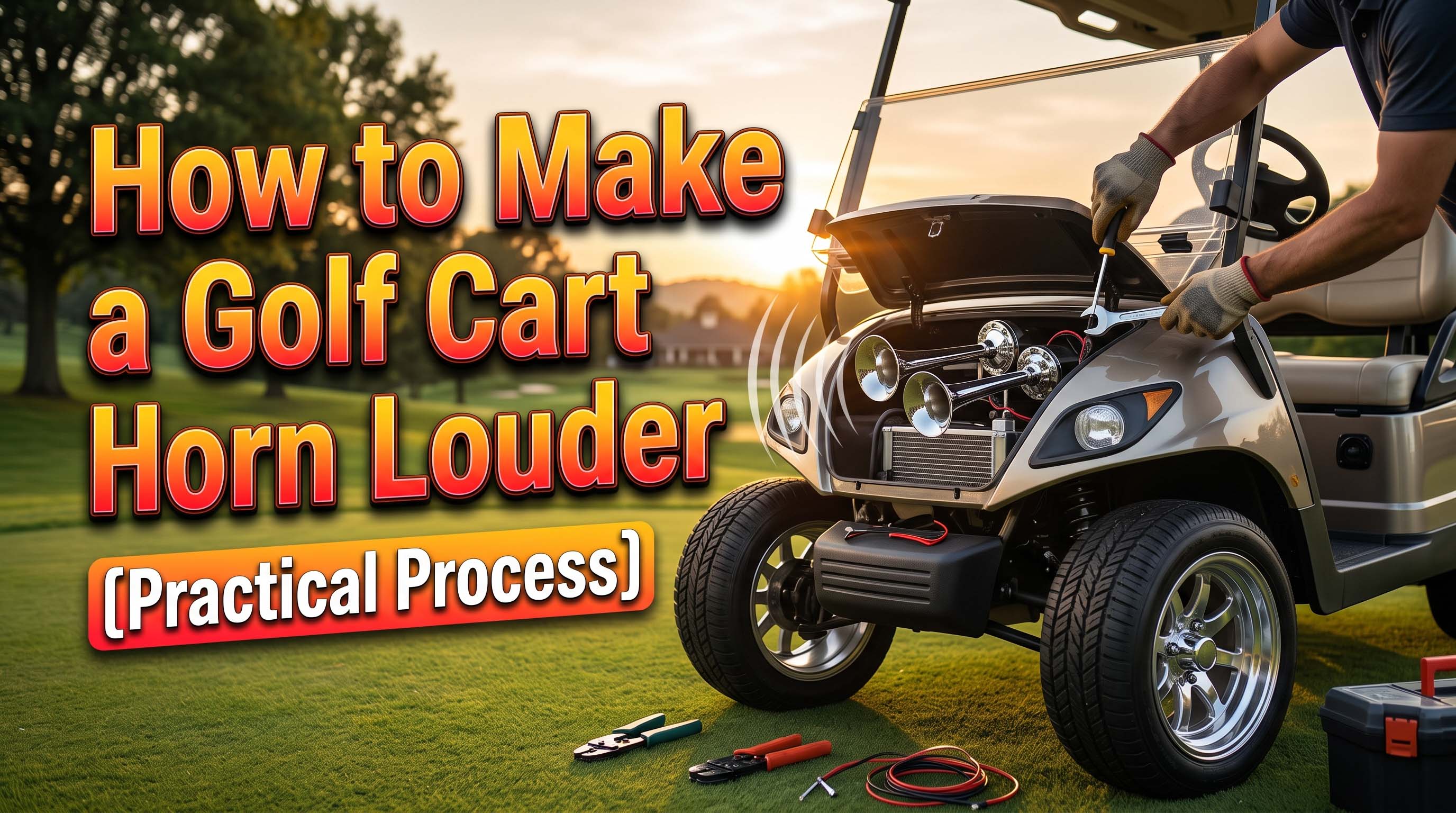
I’ve been down this road myself. Your golf cart horn sounds more like a tired mosquito than something that warns people you’re coming. The good news is you don’t need to spend a lot of money or time to fix it. There are three main paths: clean up your electrical system, swap the horn for a louder one, or add a separate air horn setup.
Which one works for you depends on why your horn is quiet in the first place. Let’s start there.
Why Your Golf Cart Horn Is Quiet
Before you buy anything, figure out the real problem. A weak horn usually comes from one of these:
- Low voltage at the horn. Golf carts often run on 6-volt or 8-volt batteries wired in series. The 12-volt system (if you have one) might come from a voltage reducer. If that reducer is weak or the wiring is thin, the horn gets starved.
- Corroded or loose connections. The horn ground wire rusts at the frame, or the positive terminal has green crust. Even a good horn sounds weak when the connection is bad.
- The factory horn is just weak. Stock golf cart horns often put out 80–90 decibels. That’s barely louder than a conversation. They’re built to meet minimum safety rules, not to be heard on a busy road.
- No relay. Many carts run the full horn current through a small switch or button. That causes a voltage drop. Adding a dedicated relay fixes it.
Grab a multimeter and check the voltage at the horn terminals while you press the button. If it’s less than 12.0 volts (for a 12-volt system), you have a wiring or power issue. If it’s 12.6 or higher and the horn still sounds weak, the horn itself is the problem.
How to Make Your Horn Louder: Methods Ranked by Effort and Cost
I’ll walk you through three levels. Start with the cheapest and easiest. Only move up if you need more volume.
Method 1: Clean Connections and Add a Relay
- Disconnect the battery. Safety first.
- Find the horn. It’s usually under the front body, near the bumper or behind the dash.
- Remove the wires. Clean the spade terminals with a wire brush or sandpaper. Do the same for the frame ground point.
- Reconnect and test. If it got louder, great. If not, move to adding a relay.
- Install a 12-volt relay (30-amp rated). Run a fused wire from the battery positive to the relay coil (pin 86). Ground pin 85. Connect the original horn wire to pin 85 or use a fused trigger wire if needed. Then run a thick wire (14 gauge) from battery positive to relay common (pin 30), and from relay normally open (pin 87) to the horn positive. Use a dedicated ground wire for the horn, not the frame.
This alone can boost volume by 10–20% if the original wiring was dropping voltage. Cost: under $10 for a relay and some wire.
Method 2: Replace with a Louder 12-Volt Electric Horn
If cleaning and a relay didn’t cut it, swap the horn. Look for a compact electric horn that fits your mounting space.
Examples include the Big Bubba programmable horn (119 dB, but needs a dry location) or a standard car horn from any auto parts store. Pick one rated for 12 volts and at least 110 dB.
- Remove the old horn. Note how it’s mounted. Horns need to vibrate freely, so don’t bolt them directly to a solid bracket without rubber isolation.
- Mount the new horn in a dry spot facing forward, slightly downward so water drains. Use the included bracket or a homemade one with rubber washers.
- Wire it using the relay setup from Method 1. Most aftermarket horns draw 5–10 amps, so a relay is still smart.
- Test. If you got a programmable horn, upload your sound via USB (Windows only for some models).
Cost: $25–$60 depending on the horn. Volume gain: 20–30 dB over stock.
Method 3: Add a Compact Air Horn System
For serious volume, get a small air horn with a compressor. These produce 120–130 dB. But they take more space and power.
- Find a location for the compressor and air tank. Under the seat or in the rear bodywork. The trumpets must face forward and be mounted away from heat sources.
- Wire the compressor through a relay (usually included) and a fused line. Use 12-gauge wire if the compressor draws 15+ amps.
- Mount the trumpets using rubber grommets so the vibration doesn’t rattle the cart.
- Plumb the air line from compressor to tank to trumpets. Follow the kit instructions.
- Test for air leaks with soapy water.
Cost: $50–$150. Not legal everywhere, so check local noise ordinances first.
Which Method Is Best for You?
Here’s a quick comparison table to help you decide.
| Method | Loudness Gain | Cost | Difficulty | Best For |
|---|---|---|---|---|
| Clean connections + relay | 5–10 dB | Under $10 | Easy | Weak horn that still works |
| Replace electric horn | 15–30 dB | $25–$60 | Medium | Stock horn too quiet |
| Air horn system | 30–40 dB | $50–$150 | Hard | Need maximum volume |
If you want to be heard on a golf course or neighborhood street, Method 1, Method 2 is plenty. If you drive on public roads with traffic, Method 3 will get attention but might earn you a ticket.
Golf Cart Voltage and Ground Issues Explained
This is the part most guides skip. Your golf cart’s electrical system isn’t like a car. Here’s what to watch for.
Series batteries and 12-volt taps. If your cart uses six 6-volt batteries, you might tap two of them for 12 volts. That works but can unbalance the battery pack. Better to use a 12-volt voltage reducer (converter) rated for the horn’s current. Cheap reducers drop voltage under load; test yours with a multimeter while honking.
Ground loops. Golf cart frames are painted or powder-coated. The horn’s ground connection to the frame often fails. Always run a dedicated ground wire from the horn negative back to the battery negative terminal or the voltage reducer’s ground.
Wire gauge. Factory horn wiring is often thin 18-gauge. For a new horn that draws 10 amps, use 14-gauge. For an air compressor, use 12-gauge. Thicker wire means less voltage drop and more volume.
Legal decibel limits. Many states require horns to be audible from 200 feet but not exceed 100–110 dB. Check your local laws. A 119 dB train horn on a golf cart can get you a noise violation, especially on public streets.
What Not to Do When Making Your Horn Louder
I’ve seen these mistakes more than once. Avoid them.
- Don’t add a second horn in parallel. Two horns together only increase volume by 3 dB – barely noticeable. Use a single louder horn instead.
- Don’t remove the horn cover. The cover protects the diaphragm and directs sound. Removing it lets moisture in and actually reduces projection.
- Don’t mount a horn directly to metal without rubber. The vibration dampens the sound and can rattle the whole cart. Use rubber grommets or isolation mounts.
- Don’t assume an air horn fits under the dash. Most compressors and tanks are too big. Measure your space first.
- Don’t ignore the horn button. If the switch is dirty or undersized, it can’t carry the current for a high-power horn. Replace it with a momentary switch rated for 20 amps if needed.
Frequently Asked Questions
Can I use a car horn on a golf cart?
Yes, if your cart has a clean 12-volt source (either from a reducer or from two batteries in series). Most car horns are 12 volts and draw 5–8 amps. Wire it through a relay and use a dedicated ground.
Do I need a relay to make my horn louder?
If your factory horn wiring is thin or the button is small, a relay ensures full voltage reaches the horn. For any aftermarket horn that draws more than 5 amps, I recommend a relay. It also protects your switch from burning out.
How do I measure my current horn’s decibel level?
Use a free smartphone app like Decibel X or a cheap SPL meter. Stand three feet in front of the horn and honk. Stock golf cart horns usually read 80–90 dB. A loud aftermarket horn should hit 110 dB or more.
Will a louder horn drain my golf cart battery?
Not in normal use. A horn draws 5–10 amps. Even ten seconds of honking uses less than 0.03 amp-hours. That’s nothing compared to your cart’s 100+ amp-hour battery pack.
Is it legal to modify my golf cart horn?
Most states require a horn that can be heard from 200 feet. They don’t demand a specific decibel level, but many local ordinances limit noise to around 100 dB.
On private golf courses, the rules are usually looser, but check with your course management before installing a train horn.
Can I wire a programmable car horn like the Big Bubba to my golf cart?
Yes, as long as you have 12 volts and a momentary button (included with many models). Mount the horn in a dry location; it’s not waterproof. Upload your sound using a Windows computer via USB. Some models also offer a wireless remote kit for extra convenience.
Final Thoughts
Making your golf cart horn louder doesn’t have to be complicated or expensive. Start by cleaning your connections and adding a relay.
If that’s not enough, swap the horn for a compact 110 dB model. Only go with an air horn if you truly need ear-splitting volume – and be ready for legal and mounting challenges.
The key is knowing your cart’s electrical setup. Measure the voltage at the horn, fix any grounding issues, and use a relay for anything beyond a stock horn. Do that, and you’ll have a horn that people actually hear.