
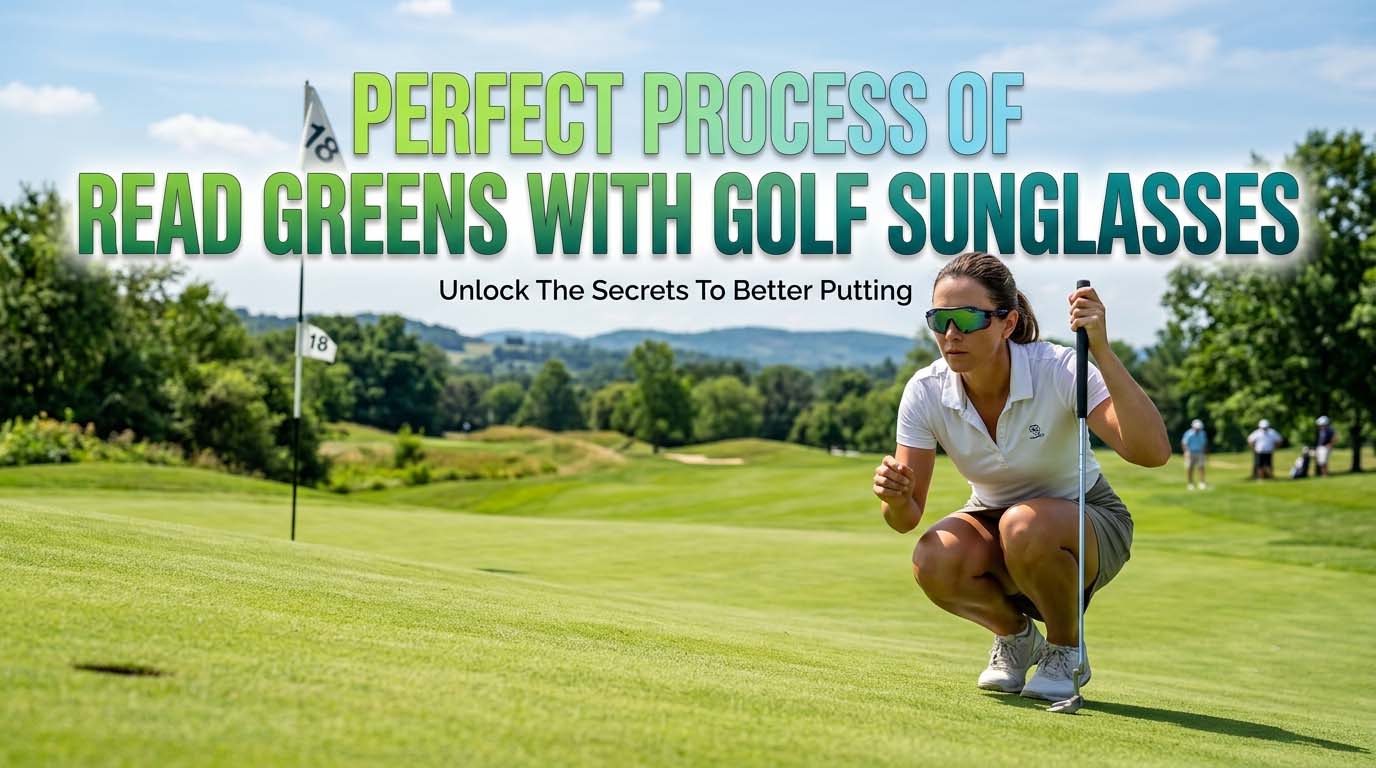
I remember the first time I put on a pair of golf-specific sunglasses. Everything on the green looked different, more saturated, almost like a map I had never seen before. But I still missed the putt. That’s when I realized the sunglasses don’t do the work for you. They give you better data. You still have to know what to look for and how to use it.
If you’ve already bought a pair of golf sunglasses, or you’re thinking about it, this guide is for you. We’re skipping the sales pitch. I’m going to show you exactly how to read greens with golf sunglasses, step by step, so you can turn those fancy colors into lower scores.
What Changes When You Put on Golf Sunglasses?
Before you can read a green with sunglasses, you need to understand how your vision changes. Standard polarized lenses actually flatten the green; they remove the horizontal light that creates shadows and highlights. That’s why you can’t see the subtle breaks.
Golf sunglasses, on the other hand, use a different kind of lens technology. Brands like JONDO use KRISP technology, which enhances the red, green, and blue spectrums. This does two things:
- It turns invisible information into visible color gradients. You’re not just seeing grass; you’re seeing elevation, moisture, and grain mapped out in shades of purple, yellow, and blue.
- It preserves depth perception. Unlike polarized lenses, golf sunglasses let you see the actual contour of the land.
The key mental shift is this: don’t look for shadows or cup edges anymore. Look for color patterns. That’s your new green-reading language.
How to Translate the Color Signals
Once you’re wearing the sunglasses, the green will look like a topographical map. But you have to know what each color means. Here’s the cheat sheet I use:
Red and Purple Hues | Slope and Fall Line
Look for the deepest red or purple patches. Those are the lowest points on the green. Think of them as valleys where water would collect. The ball will naturally roll toward those areas.
Your job is to find the darkest spot between your ball and the hole; that’s your gravitational target. The break will curve away from the lighter areas (high points) and toward the darker ones.
Blue and Sparkle – Grain Direction
Grain is the direction the grass grows. It’s one of the most overlooked elements in green reading. With golf sunglasses, grain becomes obvious. The side of the grass that reflects light (the “sparkly” side) shows grain growing away from you. That means the ball will roll faster and break less. The dull, dark side shows grain growing toward you. The ball will be slower, and the break will be bigger. When you’re over the putt, tilt your head slightly, the blue spectrum will light up the grain direction clearly.
Green and Yellow Tones – Moisture and Speed
Dry, fast grass looks yellow-green. Wet, slow grass looks deep emerald. If you’re on a morning round with dew, you’ll see a lot of dark green. That means you need to hit the ball harder. On a sunny afternoon, the yellow-green patches tell you the surface is firm and fast. Adjust your speed accordingly.
Step-by-Step Green Reading Protocol with Sunglasses
Here’s the exact routine I use now. It replaces the old way of walking around and guessing.
- Behind the ball – the tunnel scan. Stand behind your ball and look at the entire surface between you and the hole. Don’t fixate on the cup. Scan for the darkest purple area. That’s the lowest point. That’s where the ball wants to go. Mark it mentally.
- Walk the lateral side – the crouch check. Move to the side of the putt (90 degrees from your ball-to-hole line). Crouch down. The enhanced depth perception from the sunglasses will show you any ridge, false front, or subtle slope that looked flat from behind. Look for a color shift that indicates an elevation change.
- Over the ball – grain final check. Address the ball and tilt your head just a little. The blue spectrum will show you the sparkle pattern. If the grain is running against you, add a little more speed and play a bit more break. If it’s with you, play less break.
- Commit – the one-eye test. Close one eye. This flattens the 3D image back to 2D. Does the line you see match the color map you built? If it does, trust it. If it doesn’t, walk the putt again.
Getting Used to the New Look
Nobody talks about the first 10 minutes of wearing golf sunglasses. It’s overwhelming. Everything looks hyper-saturated, almost artificial. That’s your brain trying to process new signals. It’s normal. Here’s how to speed up the adaptation:
- Do a practice green drill. Find a 10-foot putt. Read it with the sunglasses on. Then take them off and read it again. Hit the putt. Notice how the color map matched the real break. Repeat this for 10 minutes. Your brain will start to map the new colors to your old feel.
- Trust your feet first. The sunglasses can make a subtle slope look steep. Your feet still feel the actual slope through your stance. If the visual says “big break” but your feet say “flat,” go with your feet for the first few rounds. Eventually they’ll agree.
- Don’t change your routine entirely. The sunglasses enhance what you already do. If you usually walk the green, keep walking. If you use AimPoint, keep using it. Just add the color data on top.
Common Mistakes to Avoid
I’ve made all of these mistakes so you don’t have to.
- Reading every color change as grain. Not every dark patch is grain. Fertilizer lines, disease, or even shadows can look like a grain shift. Cross-check with the direction of the sun and the time of day.
- Standing still. The color gradients change as you move around the putt. If you only read the putt from behind the ball, you’ll miss half the information. Walk the read.
- Forgetting the stroke. The sunglasses improve your input, not your execution. A bad stroke will still miss the line. Focus on good mechanics.
Does It Work on Every Grass Type?
Yes, but the effect varies. On Bermuda grass, the blue spectrum (grain) is a huge advantage because Bermuda has strong grain. On bent grass, the red spectrum (slope) matters more because bent grass is smoother and grain is less pronounced. Your sunglasses will work on both, but you’ll rely on different signals depending on the course.
Frequently Asked Questions
How long does it take to adjust to golf sunglasses for reading greens?
Most golfers need about one practice session and the front nine of a round to fully trust the new visual data. Doing the practice green drill I described above can cut that time in half.
Can regular polarized sunglasses replace golf sunglasses for reading greens?
No. Polarized lenses remove the horizontal light that creates the “sparkle” of grain and the depth of shadows. That actually flattens the green. Golf sunglasses are designed to keep that light and enhance the colors you need.
Will golf sunglasses help me with speed control?
Indirectly, yes. The green spectrum tells you instantly whether the grass is wet or dry. That’s half the speed equation. You still need to practice distance control, but you’ll have better information to make the decision.
What if I still miss putts after using the sunglasses?
Then the problem is likely your stroke or your read of the color map. Keep practicing with the drill. Sometimes the sunglasses show you a break that isn’t really there—that’s why I recommend trusting your feet for the first few rounds. Over time, your brain will calibrate.
Reading greens with golf sunglasses is a skill, not a magic trick. The lenses give you a clearer picture of what’s already there. Once you learn to interpret that picture, you’ll make more putts and feel more confident over every attempt. Now go practice.