
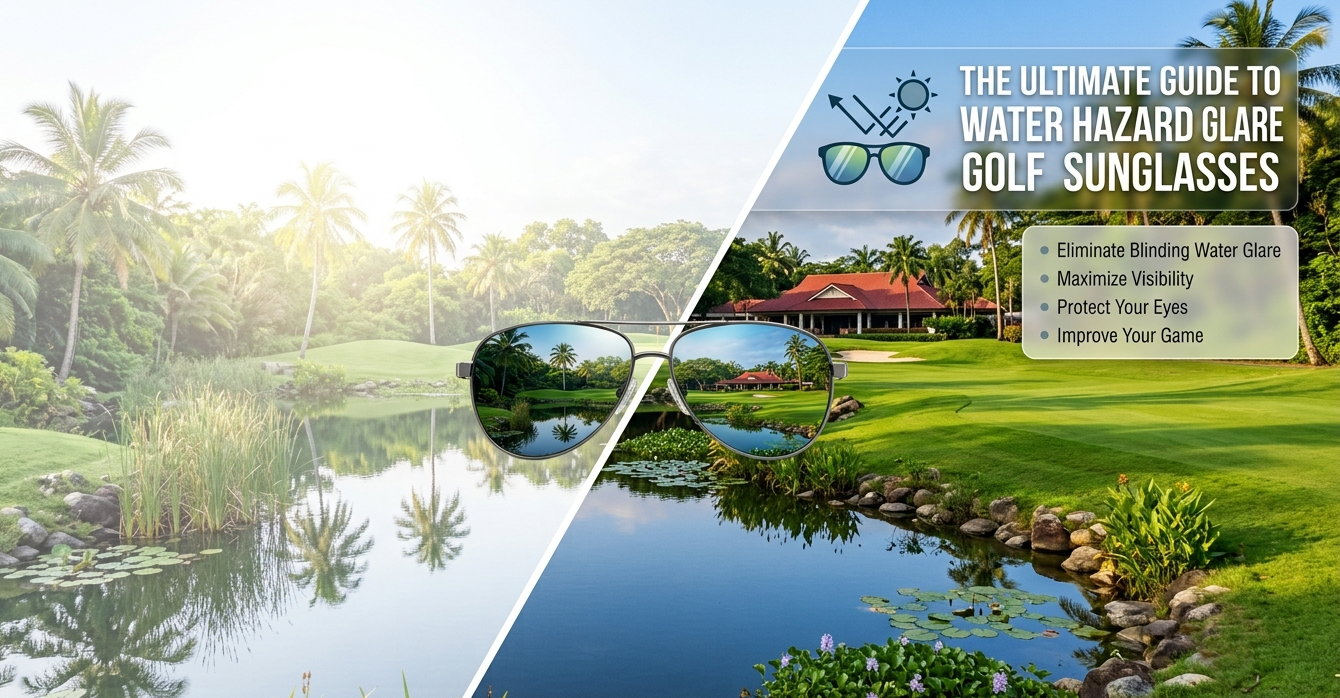
If you have ever stood over a shot near a pond, lake, or creek and watched your ball disappear into a wall of white light, you know the problem. That blinding flash is not just annoying. It makes it nearly impossible to track the ball in the air, judge the wind, or read the distance.
Most golf sunglasses are designed for general use on fairways and greens. They fall short when the sun hits the water just right.
This guide focuses on that specific moment. You will learn why water hazard glare is different from any other glare on the course, which lens features actually solve it, and how to pick a pair that works for the rest of your round too.
Why Water Hazard Glare Is Different from Fairway Glare?
Glare from grass and sand is diffuse. The light scatters in many directions, so your eyes can adapt without too much strain. Water surfaces act like a mirror. When the sun is at a low to moderate angle in the sky, the light hitting the water reflects off at a specific angle. This is called the Brewster angle. The result is intense, horizontal glare that can completely wash out your view of the ball and the landing area.
Your eyes struggle for two reasons. First, they have to constantly adjust between the bright reflected light from the water and the shaded areas of the fairway or green. This rapid switching causes fatigue and slows down your reaction time. Second, the glare reduces contrast, making it very hard to see the ball against the sky or the water surface.
A standard tinted lens that just darkens everything does not fix this. It reduces overall brightness, but the horizontal glare remains because the light is still hitting your eye from that specific angle.
Lens Technology That Solves the Problem
Not all sunglasses are built the same. For water hazard glare, you need a specific combination of features.
Polarization
This is the most critical feature. Polarized lenses contain a filter that blocks light waves oriented in a specific direction. The glare reflecting off water is mostly horizontal light. A vertically oriented polarizing filter stops that horizontal light from reaching your eye.
The key detail is quality. Cheap polarized lenses have a weak filter. You can test this. Look at a reflective surface like a car windshield or a puddle. Rotate the lens 90 degrees. If the glare disappears and then reappears sharply as you rotate, the polarization is strong. If the change is subtle, the filter is weak and will not cut water hazard glare effectively.
Lens Tint for Water and Green Contrast
A gray lens is neutral. It reduces brightness but does not enhance contrast. That is fine for general driving but not ideal for golf near water. You need a tint that makes the green of the fairway and the surface of the water stand out from each other.
Copper and rose tints are the best choice. They enhance the contrast between green grass and blue or gray water. They also help you see the texture of the green more clearly, which is important when you are putting near a hazard. A base tint with a visible light transmission (VLT) of 30 to 50 percent is ideal. It is dark enough to kill the glare but light enough to preserve shadow detail and depth perception.
Coatings That Help
Two coatings matter specifically for water hazard glare.
Hydrophobic coating makes water bead up and roll off the lens instead of spreading into a blurry film. After a shot near the water, a quick blink or a wipe with a microfiber cloth restores clear vision instantly.
Anti-reflective coating on the back of the lens prevents light from the sun behind you from bouncing off the back surface and into your eye. This is not about cutting the water glare itself. It prevents a secondary glare source that can distract you during the swing.
How to Choose Your Sunglasses for Water Hazards
Use this four-step process when you are shopping.
- Identify your playing time. If you mostly play in the morning, the sun is lower and water glare is most intense. You need strong polarization and a medium tint. Afternoon golfers face higher sun angles, so a lens with a slightly darker tint (lower VLT) can help.
- Decide on lens type. A dedicated golf lens is tuned for the course. Photochromic lenses darken and lighten automatically. They are convenient, but they are slower to adjust and may not get dark enough for a bright day near bright water.
- Check the frame fit. Wrap-around frames block side glare that can sneak in around the edges of standard frames. This matters when you are looking sideways at a water hazard. Make sure the frames have vents or an anti-fog coating, because moving from a hot fairway into a shaded area near water can fog the lens.
- Test for prescription compatibility. If you wear prescription lenses, look for a brand that offers a dedicated golf lens with polarization in your prescription. Clip-on polarized lenses work but leave gaps on the sides where glare can enter.
Why a Darker Lens Can Hurt Your Putting Near Water
A common mistake is buying the darkest lens available to kill all light. This backfires on the green. When you putt near a water hazard, you need to see the subtle breaks and slopes. A very dark lens reduces contrast on the green surface and compresses shadows, making the break look flatter than it actually is. A medium tint with a copper base preserves those details while still handling the glare.
Interchangeable Lenses vs. Dedicated Golf Sunglasses
Interchangeable systems let you swap lenses for different conditions. This is useful if you play in varied weather. The downside is cost and the risk of scratching the lens during swaps. Dedicated golf sunglasses with a fixed lens are usually more optically precise because the lens is bonded to the frame without a removable mechanism. If you play most of your rounds in similar light conditions, a dedicated pair is the better long-term choice.
On-Course Strategies for Water Hazard Glare
Even the best sunglasses need some help from you.
- If you still see residual glare after putting on polarized lenses, tilt your head slightly to the side. The polarizing filter works best when the lenses are level, but tilting can rotate the filter enough to further reduce any stray reflected light.
- Wear a hat with a brim. It cuts the high-angle sun that creates back-glare on the water surface when you look down at the ball.
- Carry a microfiber cloth in your pocket. Water spots from sweat or spray can scatter light and cause glare. A quick wipe restores clarity.
- If your frame blocks your peripheral view of the ball during the putting stroke, take the sunglasses off for that putt. The trade-off of losing a small amount of glare reduction is worth gaining full vision of the target line.
Frequently Asked Questions
Can I use fishing sunglasses for golf?
Fishing sunglasses are heavily polarized and often have a blue or gray tint. They work well on open water. On a golf course, the tint is usually too dark for reading greens and spotting the ball against the fairway. The copper or rose tint designed for golf provides better contrast on grass.
How do I know if my sunglasses are truly polarized for water?
Look at a reflective surface at a 45-degree angle. Slowly rotate the sunglasses. A strong polarizing filter will make the reflection appear to turn black at a certain angle. If the change is weak or the reflection stays bright, the polarization is low quality.
Do anti-reflective coatings help with water hazard glare?
Not directly. Anti-reflective coatings stop light from bouncing off the back of the lens and into your eye. They help when the sun is behind you, but they do not cut the horizontal glare coming from the water itself. Polarization handles that job.
Should I buy a specific brand like Oakley, Maui Jim, or Costa for golf?
Focus on the features first. Costa makes glass lenses with their 580G technology that is excellent for water clarity. Oakley has a Prism Golf lens tuned specifically for course contrast. Maui Jim offers a rose-colored lens that is great for variable light. Test the polarization quality and the fit before committing to any brand.
What about clip-on polarized lenses for my prescription glasses?
Clip-ons work as a temporary solution. They add polarization to your existing glasses. The problem is they do not wrap around the sides, so glare from the periphery can still reach your eyes. If you play frequently near water, investing in a full wraparound prescription pair is worth it.