
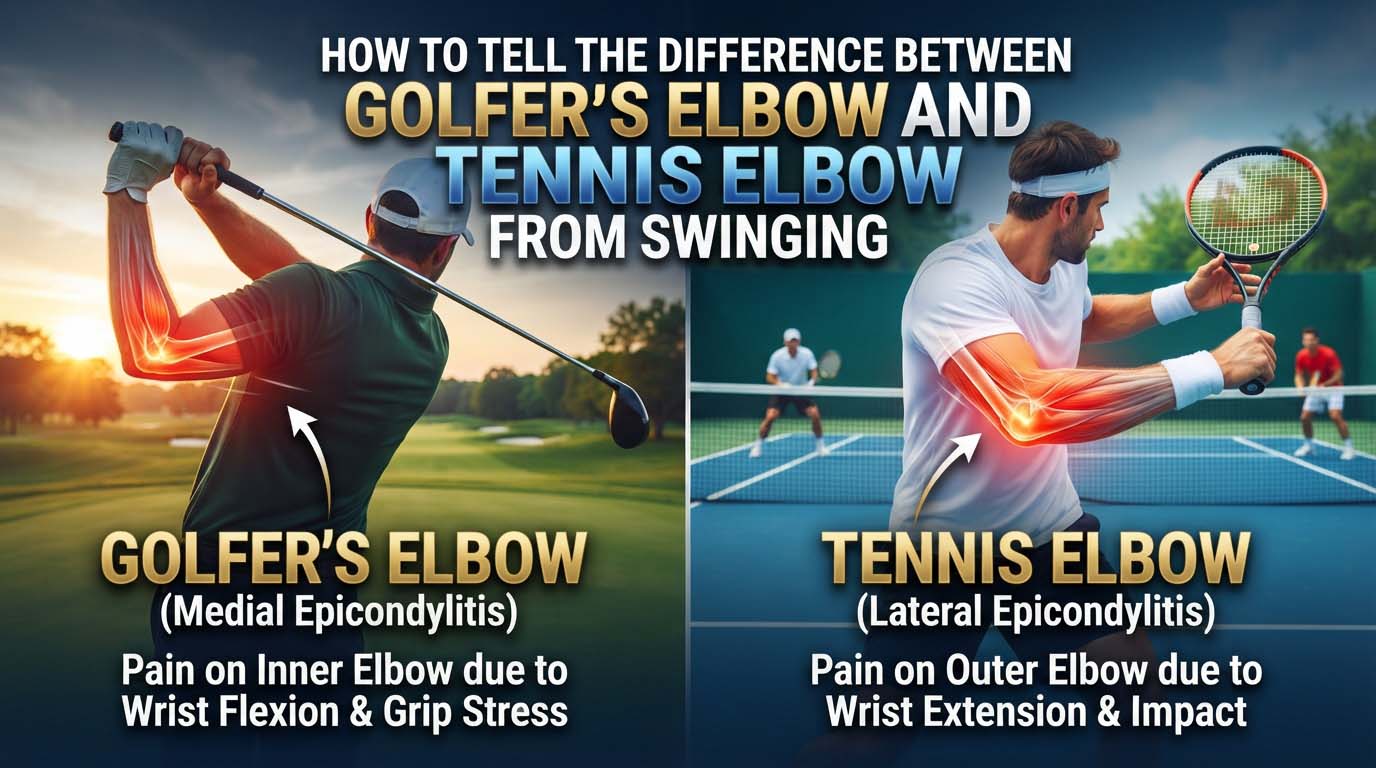
If you play golf, tennis, baseball, or pickleball, you already know that one bad swing can ruin your whole day. But the real frustration starts when your elbow hurts and you are not sure why. You look up the symptoms online and every article tells you the same thing: outer elbow pain means tennis elbow, inner elbow pain means golfer’s elbow. That is true in a general sense, but it does not help you figure out what is actually happening inside your elbow when you swing.
Here is what most articles miss. The sport you play does not always determine which condition you have. A golfer can develop tennis elbow. A tennis player can develop golfer’s elbow. The real difference comes down to one thing: what your wrist does during the swing.
The Two Stress Points in Every Swing
Every swinging motion puts force on the tendons that connect your forearm muscles to your elbow bone. There are two main attachment points. The lateral epicondyle is the bony bump on the outside of your elbow. The medial epicondyle is the bump on the inside.
When you swing a club, racquet, or bat, your wrist either bends upward (extension) or curls downward (flexion) under load. That bending direction decides which tendon takes the beating.
If your wrist bends upward against resistance, the outer tendon gets strained. That is tennis elbow. If your wrist curls downward against resistance, the inner tendon gets strained. That is golfer’s elbow.
But here is where it gets tricky. A single swing does both motions at different points. The pain might show up in one phase and disappear in another. That is the clue most people ignore.
Pain During the Backswing vs. the Follow-Through
The timing of your pain tells you more than the location alone.
Pain That Peaks During the Backswing or Takeaway
When you start your swing, your wrist is loading up. In golf, that is the takeaway. In tennis, it is the racket drop on a serve. In baseball, it is the load phase before you stride forward.
During this phase, your wrist flexors (the muscles on the inside of your forearm) contract to control the weight of the implement. If you feel a sharp ache or burning on the inner elbow during this part of the swing, you are dealing with medial epicondylitis — golfer’s elbow. The tendon is fighting to keep the wrist stable as it lengthens under tension.
Pain That Peaks During the Acceleration or Follow-Through
When you release through the ball, your wrist extensors (the muscles on the outside of your forearm) take over. They have to hold your wrist steady as you snap through impact. If the pain spikes when you strike the ball or immediately after, you are looking at lateral epicondylitis — tennis elbow.
This happens a lot in golf when players try to generate extra power by flipping their wrists at impact. The extensor tendons get overloaded during the release, even though the person is swinging a golf club, not a tennis racquet.
The Wrist Position Trap
The position of your wrist during the swing directly changes which tendon gets irritated. This is the part that most guides skip entirely.
The Bent Elbow Problem
If you swing with a bent elbow throughout the motion, like in golf or a tennis volley, the angle of your elbow changes how the force travels through your forearm. A bent elbow shifts more load to the medial (inner) side. That is why golfers typically get inner elbow pain. But if you have a flat wrist at the top of your backswing and then bow it through impact, you might develop lateral pain instead.
Grip Pressure and Wrist Deviation
Your grip matters more than you think. A strong grip (turned to the right for a right-handed player) forces your wrist into ulnar deviation — bending toward your pinky. This loads the inner tendon. A weak grip (turned to the left) forces radial deviation — bending toward your thumb. This loads the outer tendon.
If you change your grip to fix one issue, you might accidentally trigger the other. This is why you need to pay attention to which direction your wrist moves during the swing, not just where it hurts afterward.
The Swing Anomaly: When the Sport Confuses the Diagnosis
Here is a real scenario I have seen multiple times. A golfer shows up with pain on the outside of the elbow. Every website says that is tennis elbow. But this person has never played tennis. They swing a golf club. How does that happen?
The answer is the chicken wing swing. When a golfer lets the lead elbow bend and flare away from the body during the downswing, the wrist extensors get yanked hard. The outer tendon absorbs the force that should go through the arm. The pain shows up on the outside even though the person is swinging a club.
The same thing happens in tennis. A player who uses a heavy Western grip hits with a flexed wrist. That puts repeated stress on the inner tendon. They get inner elbow pain even though they are swinging a racquet.
The sport name on the condition is misleading. You have to look at the mechanics, not the activity.
Two Self-Tests That Actually Work
You can figure out which condition you have without an MRI. Both tests take less than a minute.
The Chair Lift Test for Tennis Elbow
Stand in front of a chair. Place your hand flat under the seat with your palm facing down. Keep your arm straight. Try to lift the chair by pushing up with your palm.
If you feel a sharp, specific pain on the outer elbow, that is a positive test for lateral epicondylitis. The extensor tendons are fighting against the weight, and they let you know immediately.
The Wrist Flex Test for Golfer’s Elbow
Sit down and rest your forearm on a table with your hand hanging off the edge. Hold a light dumbbell or a can of soup with your palm facing up. Slowly curl your wrist upward toward your body.
If pain hits the inner elbow during that motion, you have medial epicondylitis. The flexor tendons are loaded and they protest.
Do both tests. Sometimes people test positive for both. That is possible, but rare. If only one test hurts, you have your answer.
Equipment Mistakes That Make It Worse
Your gear can cause or worsen elbow pain without you realizing it.
Grip Size
A grip that is too small forces you to squeeze harder. That tightens the flexor muscles and loads the inner tendon. A grip that is too large limits your wrist extension and forces your extensors to work harder.
For golf, standard grip size works for most men. For tennis, a 4 3/8 inch grip is average for men. If your hands are on the larger side, go up one size. If you have smaller hands, go down.
String Tension and Shaft Flex
For tennis players, tighter string tension transmits more vibration through the arm. That vibration irritates the tendons. Dropping tension by a few pounds can reduce pain. For golfers, a shaft that is too stiff transfers shock up the arm. A more flexible shaft absorbs some of that force.
Recovery Depends on Correct Identification
Treating the wrong condition wastes time. The rehab exercises for tennis elbow focus on wrist extension. The exercises for golfer’s elbow focus on wrist flexion. If you do the wrong exercises, you might make the pain worse.
Your goal in the first week is to calm the inflammation. Rest from swinging. Ice the sore spot for 15 minutes a few times a day. Use a counterforce brace placed two finger widths below the elbow. That brace changes the angle of the tendon pull and reduces strain at the attachment point.
After the acute pain drops, start gentle strengthening. For tennis elbow, do wrist extension with a light weight. For golfer’s elbow, do wrist curls with palm up. Start with no weight if necessary. Pain during the exercise means you are pushing too hard.
Frequently Asked Questions
Can I get tennis elbow from swinging a baseball bat?
Yes. A baseball swing involves rapid wrist extension through the zone. If your wrists roll under the ball or you cast the barrel early, the extensor tendons on the outer elbow take the hit. The sport name has nothing to do with it.
Does the type of grip change where pain develops?
Yes. A strong grip (hand turned to the right for right-handed players) loads the inner elbow. A weak grip loads the outer elbow. Changing your grip can shift the stress point, but it takes time for the tendons to adapt.
If my pain is on the outside but disappears when I play, is it still tennis elbow?
This is common. The tendons warm up during activity and stop hurting. The pain returns after you stop. This does not mean the injury is gone. It means the tendon is inflamed but not yet in the acute stage. Continuing to play under these conditions makes the tear worse.
Should I use a brace that pushes out or pulls in for a swinging motion?
Use a counterforce brace that wraps around the forearm, not over the bone. It should sit about two finger widths below the elbow. It compresses the muscle belly and changes the tendon pull angle. For lateral pain, place the pressure pad on the outside. For medial pain, place it on the inside.