
Let’s cut through the marketing. If you play golf in sunglasses, you already know most pairs fail. They slip when you sweat. The tint flattens out the subtle breaks on greens. Or they just don’t stay put when you rotate through a swing.
Oakley and Maui Jim are the two names that keep coming up in golf bags. But they approach the problem from entirely different angles. Oakley builds for impact resistance, wrap coverage, and contrast that helps you track a ball against a bright sky. Maui Jim builds for true color, scratch resistance, and cutting glare so cleanly that you see details you didn’t know you were missing.
I’ve worn both on course for over a hundred rounds combined. Here’s what actually matters when you’re standing over a putt or trying to find your ball in the rough.
Why generic sunglasses fail at golf
Most sunglasses are designed for driving or walking around a city. They cut brightness and maybe reduce glare. That is not enough for golf.
Golf demands three things that normal sunglasses ignore:
– Depth perception at close range – reading a 4-foot putt requires seeing millimeter differences in slope. Cheap tints crush that detail.
– Contrast against a single color background – a white ball against a blue sky or green fairway needs separation, not just dimming.
– Stability during movement – your head rotates, tilts, and accelerates. Sunglasses that shift even slightly break your focus.
Both Oakley and Maui Jim address these, but they prioritize different parts of the visual experience. That is where the decision gets interesting.
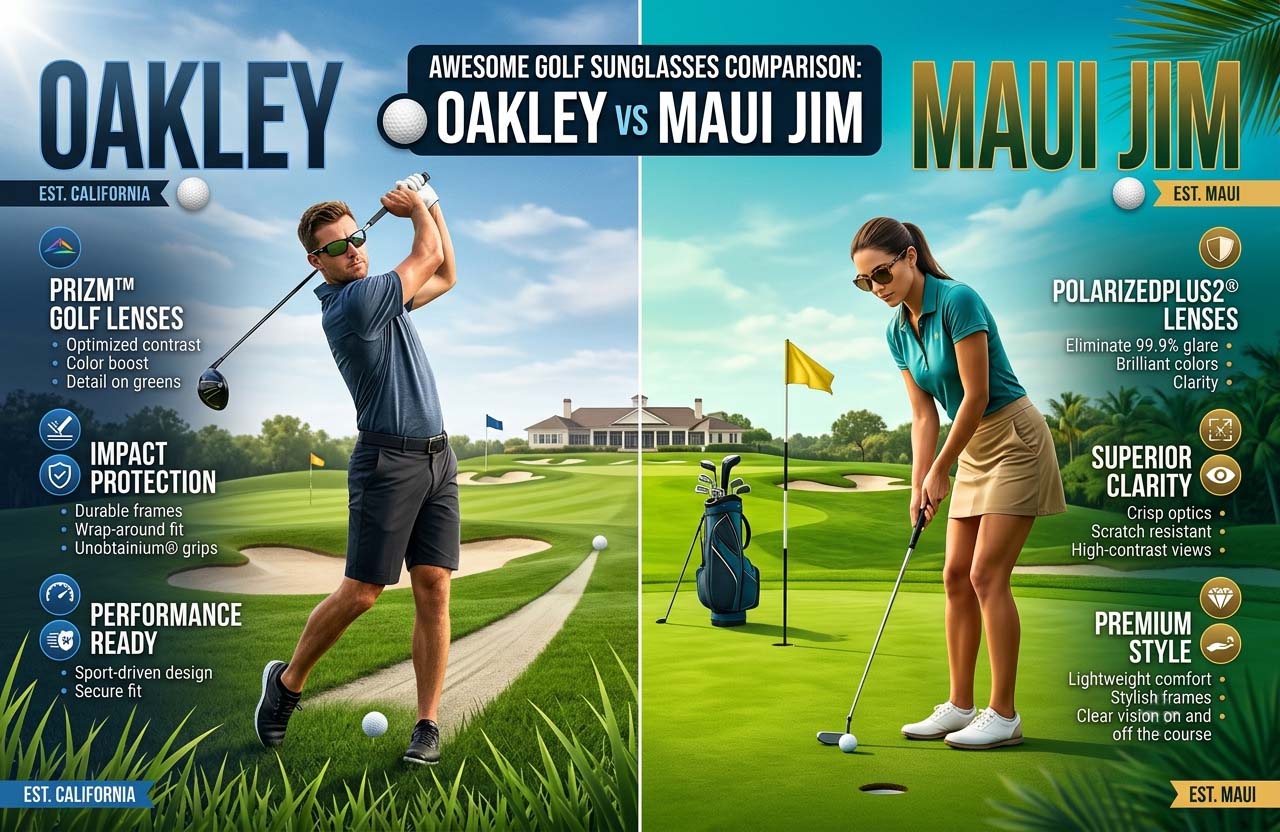
Oakley’s Prizm Golf lens technology on the course
Oakley’s Prizm Golf lens is not a general tint. It is a specific filter designed to enhance the contrast between grass, sky, and ball. The company uses what they call “chromatic contrast enhancement” – meaning they tweak which wavelengths of light get through so your eye picks up subtle differences in color.
I first tried Prizm Golf on a bright afternoon at a course with bentgrass greens. The fairways looked almost neon green, and the ball popped off the turf. Reading the roll on putts felt easier because the grain direction was more obvious.
Oakley offers two versions: Prizm Golf for variable light and Prizm Dark Golf for full sun. If you play mostly morning or evening rounds, standard Prizm Golf works better. Dark Golf is for midday when the sun is high and shadows are harsh.
The trade-off is noticeable indoors or under heavy cloud cover. Prizm Golf lenses darken greens so much that they feel unnatural in low light. I had to switch to clear lenses during an overcast round in the Pacific Northwest because I kept losing the ball in the wet grass.
Frame fit and peripheral vision for Oakley
Oakley frames typical use wrap-around designs. That keeps wind and debris out, which matters when you play in breezy conditions. But wrap lenses can distort your view if you have a flatter swing plane. At address, the edge of the lens can make the ball look like it’s sitting slightly left or right of where it actually is.
I’ve found that the Oakley Flak 2.0 and Oakley Holbrook frames are the most golf-friendly. Flak 2.0 gives good coverage without too much wrap. Holbrook has a flatter lens that works well with a hat brim – the frame doesn’t hit the brim on the backswing.
Sweat management is decent. The rubberized nose pads grip well when dry, but after walking nine holes in humidity, I do need to push them back up. Not a deal breaker, but something to note if you sweat heavily.
Maui Jim’s glass lenses and true color performance
Maui Jim uses polarized glass lenses as their standard. That is the first big difference. Glass is heavier than polycarbonate, but it is much harder. You can drop your sunglasses on cart path or scratch them on a towel and they come out fine.
The rose-colored lenses are the ones golfers talk about most. Maui Jim’s rose tint warms the color spectrum. Greens look richer, and the contrast on greens is outstanding for reading grain and subtle breaks.
I played a round at a course with Poa annua greens – notoriously tricky because the grain changes direction throughout the day. With Maui Jim rose glass, I could see the sheen difference between with-grain and against-grain putts clearly. I made more putts from 10 feet that day than I normally do.
The anti-reflective coating on the back of the lens is another detail that matters. When the sun is behind you, most sunglasses let light bounce off the back of the lens and into your eye. Maui Jim’s coating stops that. It sounds like a small thing, but on a bright morning round, it keeps your eyes fresh longer.
Weight, fit, and fogging with Maui Jim
Glass is heavier. There is no way around it. A pair of Maui Jims with glass lenses weighs about 30 grams more than comparable Oakleys. For the first few holes, you notice it. After that, most people adapt. But if you are sensitive to weight on your face, Oakley wins this category.
Fogging is the bigger issue. Maui Jims do not have the ventilation slots that some Oakley frames offer. On a humid morning, especially if you are walking and sweating, the lenses fog up between shots. I have had to wipe them after almost every hole in Florida summer conditions.
The frames themselves are well-made. The Maui Jim Peahi and Maui Jim Ho’okipa designs sit comfortably and do not slide easily. The temple tips curve around your ear securely, so they stay put during a full swing.
Lens physics: what actually matters for green reading and ball tracking
This is where most comparisons go wrong. People talk about polarization and tint without explaining the physics.
Polarization cuts glare from horizontal surfaces – water, wet grass, car hoods. On a golf course, that means less glare off dew-covered fairways. But polarization can also hide subtle green breaks. Some grain patterns show up as a difference in reflected light. Polarized lenses can eliminate that difference, making it harder to read putts.
Maui Jim uses polarization in all their lenses. Oakley offers it as an option on some models but not their core Prizm Golf lines.
Depth perception comes from how your eyes process slight differences in color and brightness. Maui Jim’s rose tint enhances the red end of the spectrum, which helps you see texture on greens. Oakley’s Prizm Golf enhances green and blue contrast, which helps you track a ball against the sky.
There is no right answer. It depends on which part of your game needs more help.
How frame curvature affects your swing
Wrap-around frames create a curved visual field. Your brain corrects for this automatically, but during a fast movement like a golf swing, the distortion can cause misalignment. Players with a flatter swing plane or steep shoulder turn are more sensitive to this.
Oakley’s wrap frames are more susceptible to this than Maui Jim’s flatter designs. If you have ever felt like the ball was moving slightly when you set up, try a flatter lens like the Maui Jim Peahi.
Side by side: Oakley vs Maui Jim for golf
This table covers the practical differences that matter on the course:
| Feature | Oakley Prizm Golf | Maui Jim Rose Glass |
|---|---|---|
| Lens material | Polycarbonate (light, impact-resistant) | Glass (heavy, scratch-resistant) |
| Weight | Light – 25-30g per pair | Heavy – 55-60g per pair |
| Best for | Ball tracking, sunny skies | Green reading, variable light |
| Polarization | Optional on some models | Standard on all |
| Scratch resistance | Low (scratches easily) | High (hard to scratch) |
| Fog resistance | Better (ventilation options) | Worse (no ventilation) |
| Hat brim fit | Can hit brim (wrap designs) | Rarely hits brim |
| Replacement lens cost | ~$80-120 | ~$150-250 |
| UV protection | 100% UV blocking | 100% UV blocking |
Lens replacement and maintenance gap
This is a detail that drives me crazy when people compare these brands. They talk about initial price but ignore what happens after you drop them on the ground.
Oakley uses polycarbonate lenses. They are lightweight and impact-resistant, but they scratch easily. After one season of regular use, my Prizm Golf lenses had micro-scratches from wiping them on my shirt and putting them in the cart cubby. The scratches did not affect vision much, but they annoyed me.
Replacing Oakley Prizm lenses costs somewhere between $80 and $120 depending on the frame. You can do it yourself at home.
Maui Jim uses glass. I dropped mine on concrete cart path and saw no damage. After two years, the lenses look new. But if you do crack them – and glass can break if you hit it just right – replacement runs $150 to $250. Maui Jim’s warranty is better for manufacturing defects, but it does not cover drops or scratches.
For a golfer who plays 50+ rounds a year, Maui Jim’s glass saves money over time because you rarely need replacements. For a casual player, Oakley’s lower replacement cost feels safer.
Which brand works with prescription lenses
Both brands offer prescription options. Oakley’s are more common and easier to order through most opticians. They can put Prizm Golf tint into prescription lenses, but you lose some of the contrast enhancement because the base lens is different.
Maui Jim’s prescription program is more limited. Not every frame is available, and the rose tint is harder to find in a prescription version. If you need strong correction, Oakley is the better choice.
Decision guide: pick based on your golf game
Choose Oakley Prizm Golf if:
- You play in sunny climates and track balls against the sky
- You prefer lightweight frames that do not slide
- You need prescription lenses
- You play in windy conditions where wrap coverage helps
- You want to stay under $200
Choose Maui Jim rose glass if:
- You struggle reading greens and grain direction
- You play in variable light or overcast conditions
- You are hard on your gear and want scratch-proof lenses
- You play in humid climates (though fogging is a risk)
- You are willing to carry a microfiber cloth for foggy mornings
Try before you buy. Most golf shops with a fitting area will let you look at a putting green through different lenses. Take a ball and a club. See how the ball looks at address. See how the green looks from 10 feet. That one test will tell you more than any online review.
Frequently Asked Questions
Can I wear prescription lenses in Oakley or Maui Jim golf frames?
Yes. Oakley offers a wider selection of prescription-compatible frames. Maui Jim also has prescription options but fewer frames and less tint variety. If you have a strong prescription, Oakley is usually easier to fit.
How do Oakley Prizm Golf lenses compare to Maui Jim rose in overcast conditions?
Maui Jim rose performs better in overcast conditions. The rose tint warms up the greens, which helps you see detail even when the light is flat. Oakley Prizm Golf darkens greens, which can make low light feel even dimmer. If you play a lot of morning or evening rounds, Maui Jim is the stronger choice.
Which brand offers better wind protection for golfers who play in breezy conditions?
Oakley wins here. Their wrap-around frames block wind from entering the sides, which keeps your eyes from tearing up. Maui Jim’s flatter frames let wind in from the sides, especially at higher speeds.
Do professional golfers on tour wear Oakley or Maui Jim?
Both appear on tour, but Oakley is more common. Many players wear Oakley Flak 2.0 or Radar EV frames with Prizm Golf lenses. Maui Jim is less visible but has a loyal following among players who prioritize green reading. It comes down to personal preference.
How does humidity affect lens fogging in each brand?
Maui Jim fogs more easily because the glass lenses lack ventilation. Oakley frames with ventilation channels stay clearer. If you play in high humidity, Oakley is less frustrating.
Are there cheaper alternatives that use similar lens technology?
Not with the same level of performance. Brands like Tifosi and Sunwise offer polarized golf lenses for under $100, but the contrast enhancement and scratch resistance are not comparable. You get what you pay for in optics.
How often should I replace golf-specific sunglasses lenses?
Check them every season. If you see scratches that interfere with your view of the ball, replace them. Polycarbonate lenses (Oakley) need replacement every one to two years with heavy use. Glass lenses (Maui Jim) can last five years or more.
Can I use the same pair of sunglasses for golf and everyday driving?
You can, but it is not ideal. Golf tints are optimized for green and blue light. Driving tints are optimized for road glare and depth perception. Both Oakley Prizm Golf and Maui Jim rose work for driving, but the colors will look strange on pavement. If you only want one pair, Prizm Dark Golf is more neutral for daily use.